31 DAYS OF HALLOWEEN (DAY 5)
“Headless Horseman” by Edgar Stillman Kelley
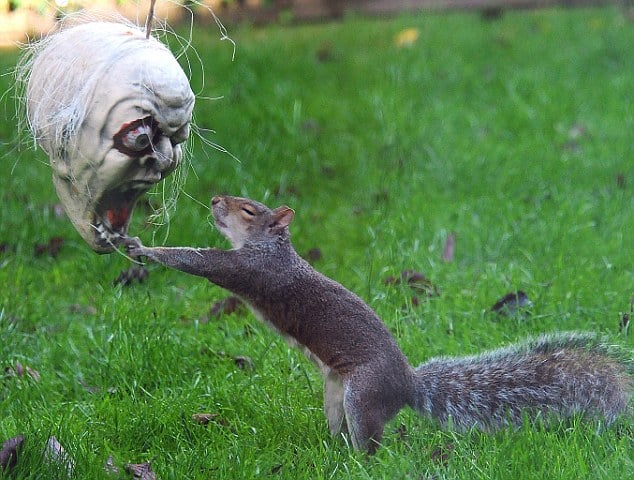
31 DAYS OF HALLOWEEN (DAY 5)
“Headless Horseman” by Edgar Stillman Kelley
Porcupine!
Larry Fine was born on this date in 1902. It’s been scientifically proven that all men know who Larry Fine is. For the benefit of the rest of you, Larry Fine was the bushy-haired, reactive Stooge. You know, the guy who stood there and mostly underplayed as Moe slapped the hell out of Curly. Until he himself became collateral damage.
Fine was born Louis Feinberg at 3rd and South Streets in Philadelphia. The son of a watch repairman and jewelry shop owner, he was encouraged to take up the violin to counteract the effects of an acid burn, which damaged the muscles in his forearm when he was boy. The acid had been used by his father to test jewelry for gold content. Young Larry was about to drink the stuff, when his father slapped it away.
Larry showed such dedication to the violin that his parents wanted to send him to study the instrument at a conservatory in Europe, but with the outbreak of World War I, he remained in Philadelphia. He took up boxing to further strengthen his arm and won his only professional fight, before his father put a stop to it.
Larry brought his violin to the vaudeville circuit. It was there that he met Shemp Howard and the problematic Ted Healy. Healy, who was a raging alcoholic and notoriously abusive, would eventually come to a bad end under mysterious circumstances, possibly at the hands of Wallace Beery (the original onscreen “Champ”). These days, Healy is remembered, if at all, as the man who introduced The Three Stooges.
Shemp was looking to take a break from Healy’s act for a few months, so he asked Larry if he might be interested in being a substitute “stooge.” The pay was good (Healy offered him an extra ten dollars a week if he would “throw that fiddle away”), so Larry was amendable.
At first, he was tossed in with Bob Pinkus and Sam “Moody” Braun. Once Shemp returned, however, Larry, Shemp, and Shemp’s brother Moe – who had worked with Healy from the beginning – were brought together for the first time.
Shemp would depart to pursue a solo career in film, working with W.C. Fields, Fatty Arbuckle, and Abbott and Costello. He was replaced by his and Moe’s younger brother, Jerome – better known as Curly.
The reconfigured Stooges followed Healy to the big screen. Soon Healy was being groomed by MGM for a career as a solo comedian. The Stooges signed their own contract with Columbia and left their abrasive former boss in the dust. From the mid-1930s through the late-‘40s, The Three Stooges were the movies’ most popular short subject attractions. Shemp would return to the team after Curly suffered a stroke in 1946.
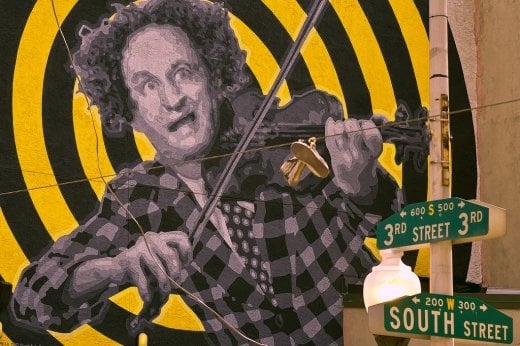
Larry, Philadelphia’s native Stooge, is commemorated in a mural near his birthplace at 3rd & South. We’re coming up on the 20th anniversary of the original mural’s dedication on October 26, 1999. The mural was overpainted with another Larry mural in 2006.
While we’re on the subject of boxers and violinists, Curly is unstoppable in his ascent to the championship, thanks to Larry’s stirring rendition of “Pop Goes the Weasel,” in “Punch Drunks” (1934):
Happy birthday, Larry Fine!
PHOTO: Larry, as immuralized in 2006
31 DAYS OF HALLOWEEN (DAY 4)
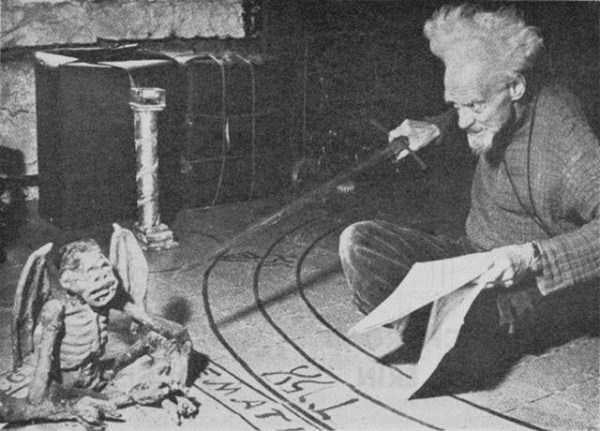
Frederic Curzon’s “Dance of an Ostracised Imp”

How can you not love this guy?
Today is the Feast Day of Saint Francis of Assisi. This is a saint who was never too busy to chat with the birds or to befriend a wolf. He introduced the crèche to Christmas, complete with livestock. He even lobbied for a special law so that people would provide for the birds and the beasts.
Regardless of one’s creed, no one, I should think, would take umbrage at the idea of love and respect for the natural world. Take a moment today to be kind to the animals. Hug your pet. Water the birds. Let a cricket out of the house. Then join me at 4:00 on The Classical Network for music inspired by Saint Francis and friends.
We’ll hear Franz Liszt’s “Saint Francis of Assisi’s Sermon to the Birds,” Kenneth Fuchs’ horn concerto “Canticle to the Sun,” and Paul Hindemith’s Saint Francis ballet “Nobilissima Visione.”
Cats will waltz. Grasshoppers will dance. Dogs will eat pancakes. And sheep may safely graze.
At 6:00, you’ll have a chance to expand your affection to the cryptozoological realm, with music from movies about dragons, on “Picture Perfect.”
What’s not to love? The music will have legs – four of them! – from 4 to 7 p.m. EDT, on WWFM – The Classical Network and wwfm.org.
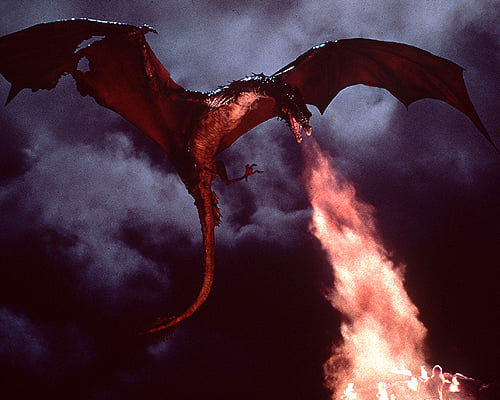
I don’t want to set the world on fire, goes the old Ink Spots classic; I just want to start a flame in your heart.
This week on “Picture Perfect,” there be dragons!
Who doesn’t enjoy a good dragon movie? Unfortunately, there are so few of them. Inevitably, the stories fail to live up to the production design, the special effects, and, yes, often the music.
One score that Universal Pictures definitely took to, like a dragon to its hoard, was that for “Dragonheart,” from 1996. The film starred Dennis Quaid, with Sean Connery supplying the voice of the film’s dragon, Draco. The studio loved the music so much that it was used in its movie trailers for years, so don’t be surprised if you recognize it, even if you never saw the film. The composer was Randy Edelman.
Alex North wrote one of the finest dragon scores for “Dragonslayer,” from 1981. “Dragonslayer” caused a bit of stir on its release, since it was an early foray by Disney into more mature territory. The film featured shocking (for the time) onscreen immolations and dismemberment.
The story is a fairly generic sorcerer’s apprentice tale. However, the dragon, Vermithrax Pejorative, easily carries the movie, which also features a late performance by Sir Ralph Richardson as the master wizard. The composer reused portions of his rejected score for Stanley Kubrick’s “2001: A Space Odyssey.” A number of critics, including Pauline Kael, praised the result.
The film was nominated for an Academy Award for its outstanding visual effects, but lost out to “Raiders of the Lost Ark.” George Lucas’ Industrial Light and Magic provided the effects for both films. In my humble assessment, Phil Tippett’s “go motion” dragon has yet to be surpassed.
In 2010, Disney competitor Dreamworks released “How to Train Your Dragon,” a wholly computer-animated film. The story is one of forbidden friendship between a young Viking and a scaly representative of his tribe’s hereditary foes. Despite the Viking characters and setting, the score has an overt Celtic flavor and the actors speak with a Scottish bur(!). The music was by John Powell.
Purely animated films are often more successful in creating an organic, believable world than those supposedly “live action” films that place actors in front of green screens and surround them with video game pyrotechnics. Only director Peter Jackson could have devised a way to pad J.R.R. Tolkien’s classic bedtime story, “The Hobbit,” into three bloated installments, darkening the tone, tying it in with lore from Tolkien’s “The Silmarillion,” and self-consciously anticipating the events in the equally self-indulgent film versions of “The Lord of the Rings.”
Howard Shore supplied the music for all of the Middle Earth movies. He was recognized with three Academy Awards – one for “The Fellowship of the Ring,” in 2001, and two for “The Return of the King” in 2003, for which he also provided the Best Original Song. We’ll hear a selection of his music for the second of the films inspired by “The Hobbit,” subtitled “The Desolation of Smaug,” from 2013. The part of the dragon, by the way, was voiced by Benedict Cumberbatch.
Feel the burn! Rekindle your affection for dragon movies, this Friday evening at 6:00 EDT, on WWFM – The Classical Network and wwfm.org.
Aaron Copland (93) Beethoven (95) Composer (114) Film Music (137) Film Score (143) Film Scores (255) Halloween (94) John Williams (195) KWAX (229) Leonard Bernstein (103) Marlboro Music Festival (125) Movie Music (152) Mozart (88) Opera (208) Philadelphia Orchestra (89) Picture Perfect (174) Princeton Symphony Orchestra (108) Radio (88) Ross Amico (244) Roy's Tie-Dye Sci-Fi Corner (290) The Classical Network (101) The Lost Chord (268) Vaughan Williams (103) WPRB (396) WWFM (881)