Category: Daily Dispatch

  • De Palma’s Thrillers Music from Hitchcock’s Heir

    De Palma’s Thrillers Music from Hitchcock’s Heir

    Brian De Palma is an extraordinarily adept filmmaker, who has been criticized for his adherence to “genre trash.” He has always been attracted to suspense and crime thrillers, usually of an especially violent nature, many of them tinged with horror.

    This week on “Picture Perfect,” with Hallowe’en right around the corner, we’ll hear music from four of De Palma’s films.

    It’s hardly surprising that such an admirer of Alfred Hitchcock would also hire Hitch’s signature composer. Bernard Herrmann scored two films for De Palma – “Sisters,” in 1973, and “Obsession,” in 1976.

    “Obsession” is a spin on Hitchcock’s “Vertigo.” A botched rescue attempt results in the death of a businessman’s kidnapped wife. Years later, he encounters someone who could be her doppelganger. The film stars Genevieve Bujold, John Lithgow, and a very tan Cliff Robertson.

    “The Fury,” from 1978, is a supernatural thriller based on a novel by John Farris. Two teenagers, endowed with powers of telekinesis and extra-sensory perception, are targeted by researchers who plan to harness them for their own nefarious ends. For a time, Kirk Douglas has fun as a former CIA agent, and John Cassavetes is a particularly slimy villain. Cassavetes’ comeuppance makes for one of the most memorable movie endings of its era – and we’ll leave it at that!

    Critic Pauline Kael praised the music, which is by none other than John Williams – hot off his third Academy Award, for “Star Wars” – characterizing it as “as elegant and delicately varied a score as any horror film has ever had.”

    Of course, “The Fury” was not the first De Palma film to deal with telekinesis. His adaptation of Stephen King’s “Carrie,” from 1976, became one the decade’s landmark horror films. It broadened King’s popularity and propelled De Palma into the A-list of Hollywood directors. It also essentially launched the careers of Amy Irving, John Travolta, and Nancy Allen, among others. Sissy Spacek was nominated for an Academy Award for her performance in the title role, as was Piper Laurie as Carrie’s overbearing, fundamentalist mother.

    The music was by Pino Donaggio. The director had wanted to continue his collaboration with Herrmann, but the composer died before the film could be completed. Donaggio, though classically trained, made his fortune writing popular songs. His biggest hit was “You Don’t Have to Say You Love Me,” which was recorded by Dusty Springfield and treated to a well-known cover by Elvis Presley. Donnagio went on to become a regular De Palma collaborator, providing the music for seven of his films.

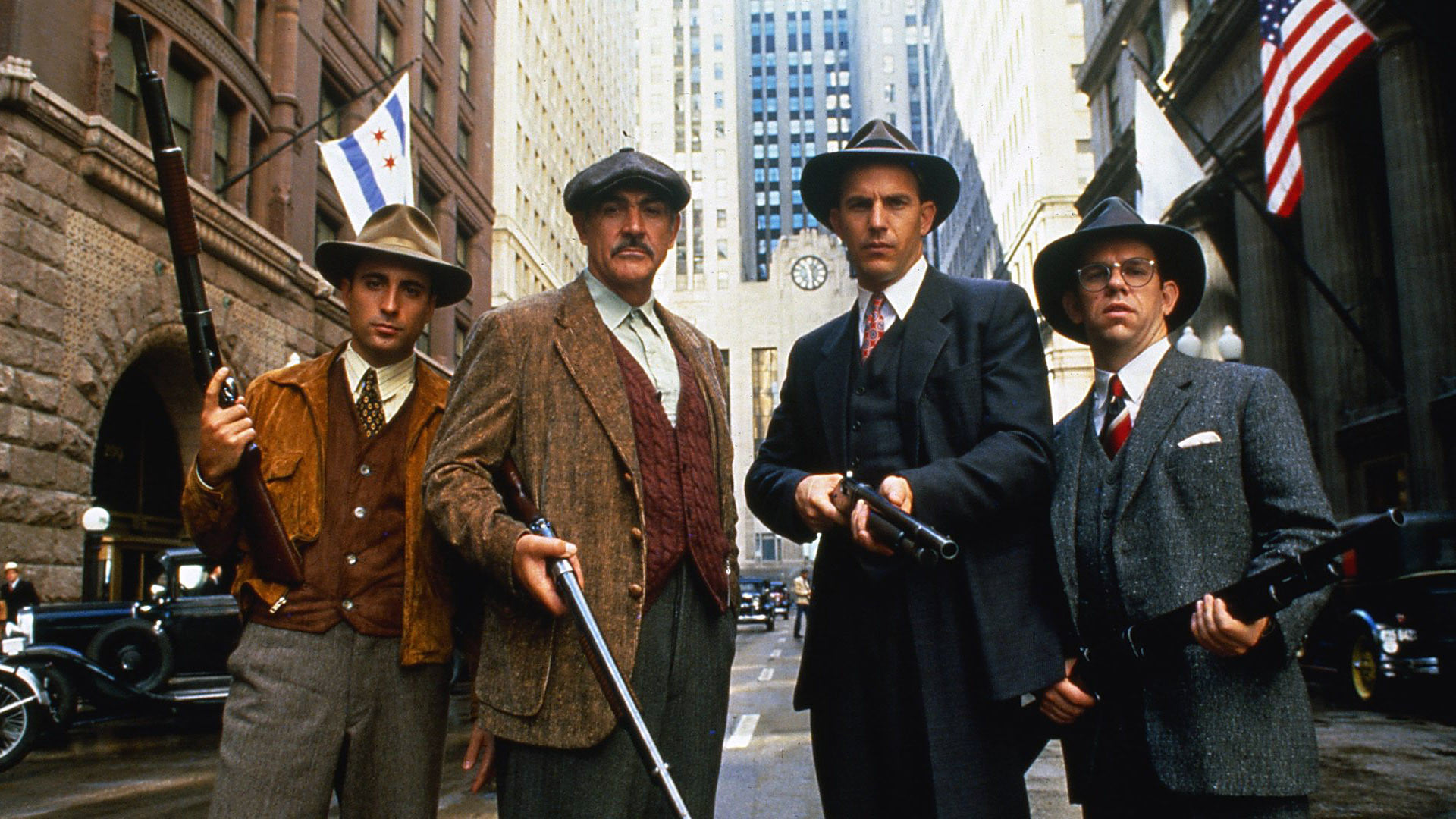
    Finally, we’ll turn our back on horror, to listen to music from a successful period crime thriller, loosely based on the real-life exploits of Eliot Ness and his fellow prohibition agents – “The Untouchables,” from 1987. Kevin Costner plays the by-the-book federal agent who is given a valuable lesson in street smarts by an Irish beat cop played by an Academy Award winning Sean Connery. (“He pulls a knife, you pull a gun. He sends one of yours to the hospital, you send one of his to the morgue. That’s the Chicago way, and that’s how you get Capone.”) Capone is played, incidentally, by a baseball bat wielding Robert De Niro.

    The score is by Ennio Morricone. Morricone, of course, was propelled to fame through his work on Sergio Leone’s spaghetti westerns. He applies some of that same mythmaking skill to this big screen adaptation, which had previously been published as a memoir and developed into a popular television series starring Robert Stack. The high point of the film must be the director’s nail-biting homage to Sergei Eisenstein, a slow motion shoot-out around a baby carriage as it teeters down the stairs of Chicago Union Station.

    Start your weekend with a step in the right direction, with music from the films of Brian De Palma, on “Picture Perfect,” this Friday evening at 6:00 EDT, on WWFM – The Classical Network and wwfm.org.
  • Verdi’s Goth Macbeth Witches Halloween Day 10

    Verdi’s Goth Macbeth Witches Halloween Day 10

    31 DAYS OF HALLOWEEN (DAY 10)

    For Giuseppe Verdi’s birthday, a totally Goth witches’ chorus from “Macbeth”

    https://www.youtube.com/watch?v=7b4tKhV5mcg

    Act III Witches’ Dance from Taiwan


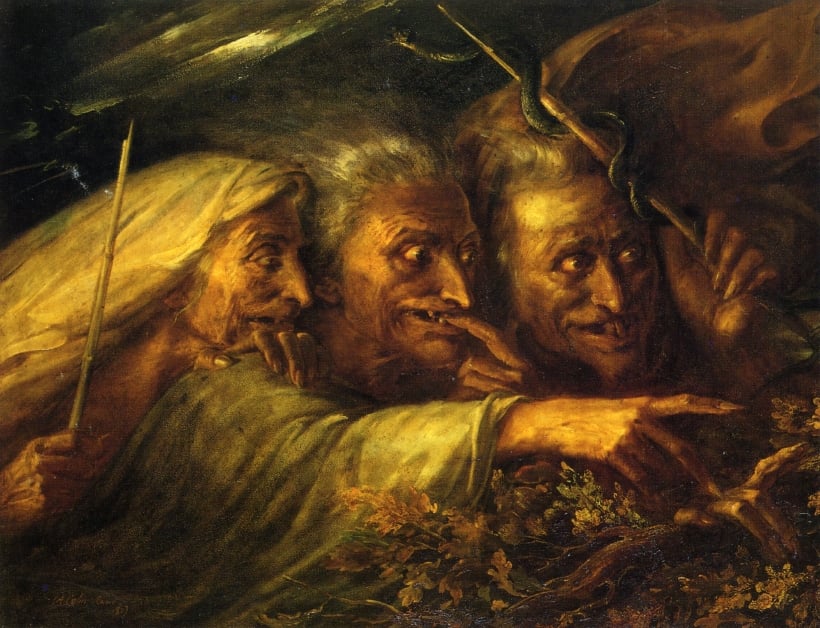
    IMAGE: “The Three Witches from Macbeth” (1827) by Alexandre-Marie Colin

  • Tam O’Shanter Overture Halloween Burns Poem

    Tam O’Shanter Overture Halloween Burns Poem

    31 DAYS OF HALLOWEEN (DAY 9)

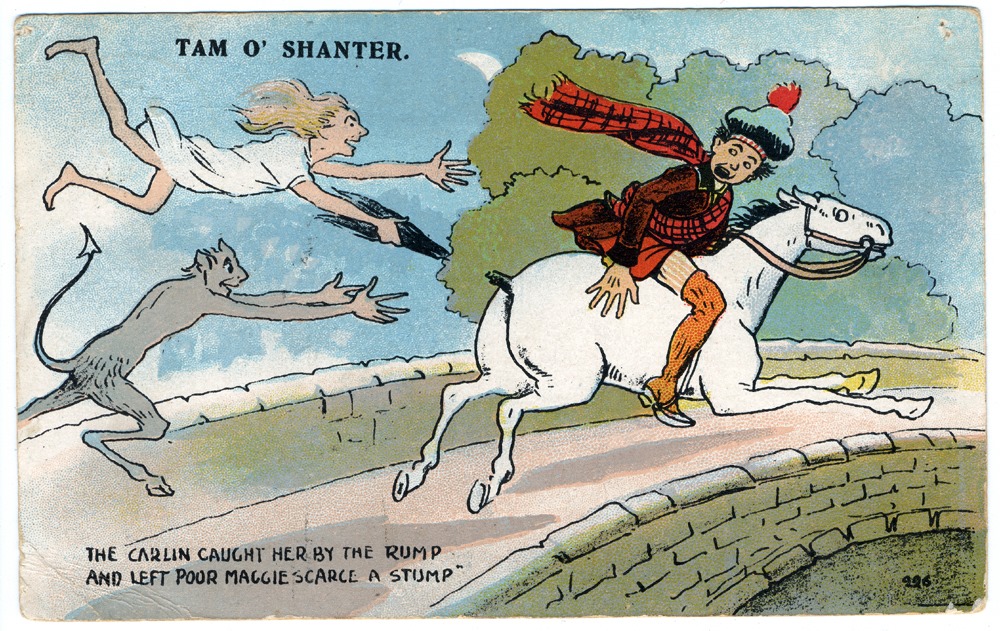
    Sir Malcolm Arnold’s “Tam O’Shanter Overture”

    With Robert Burns’ poem:

    http://www.robertburns.org.uk/Assets/Poems_Songs/tamoshanter.htm

  • Kreisler & Schoenberg: Vienna’s Odd Couple

    Kreisler & Schoenberg: Vienna’s Odd Couple

    Fritz Kreisler, the sweet-toned confectioner and purveyor of violin bonbons, and Arnold Schoenberg, the dour high priest of twelve tone music. Vienna’s fin-de-siècle odd couple reunite on this week’s “Music from Marlboro.”

    Both artists were born in Vienna, only five months apart – Schoenberg on September 13, 1874, and Kreisler on February 2, 1875. Kreisler’s father was a doctor. Schoenberg’s sold shoes.

    Both had Jewish parents. Kreisler, whose mother was Catholic, was baptized into the faith at the age of 12. Schoenberg converted to Lutheranism at 24. However, just when it would have been most dangerous to do so, he roared back to Judaism and – with the rise of Hitler in 1933 – defiantly embraced his heritage.

    In general, Kreisler seems to have enjoyed the easier life. He had a more comfortable start and a happier disposition. As a musician, he was content to entertain.

    Schoenberg was a revolutionary and probably a bit of a hard-nosed contrarian. He had a turbulent marriage, seldom smiled for photos, and indulged in expressionist painting. Also, he was superstitious. He especially suffered from triskaidekaphobia, fear of the number 13.

    On the other hand, he did orchestrate his share of Viennese operettas, arranged Strauss waltzes for performance with his friends, played tennis with George Gershwin, and was a fan of Hopalong Cassidy.

    Both men came to be regarded in some circles as mountebanks. Kreisler ruffled a few feathers when he let slip that many of the 18th century “rediscoveries” he had used to charm audiences, critics and musicologists were not in fact rediscoveries at all. Nor did they date from the 18th century. When the professionals complained, Kreisler made like Vinnie Barbarino. Wha-? Schoenberg triggered kneejerk reviews and outright hostility with his dismantling of tonality.

    Nevertheless, both also acquired some serious musical credentials. Kreisler gave the world premiere of the Elgar Violin Concerto and became a favorite recital partner of Sergei Rachmaninoff. Schoenberg blossomed into one the most influential composers of the 20th century.

    In 1941, Kreisler was hit by a milk truck, which fractured his skull and put him into a coma. Like something out of an early Woody Allen comedy, when he awoke he could only communicate in Latin and Greek. Thankfully, the effect was only temporary.

    It is Kreisler’s music that continues to communicate most effectively. We’ll hear his String Quartet in A minor, from 1922, performed at the 2013 Marlboro Music Festival by violinists Danbi Um and Nikki Chopi, violist Sally Chisolm, and cellist Lionel Cottet.

    That will be followed by Schoenberg’s Chamber Symphony No. 1 of 1906, a pre-serial work that nevertheless pushes harmony to the brink. It was presented at Marlboro in 1982 by an ensemble of fifteen players directed by Leon Kirchner.

    Was the glass half empty or the milk truck half full? Kreisler lived a good long life. He died in 1962 at the age of 86. Schoenberg died on his 76th birthday, Friday the 13th, 1951. Earlier in the day, he had been informed by his astrologer that 7 plus 6 equals 13.

    No matter how you tally, the performances will be top-notch on the next “Music from Marlboro,” this Wednesday evening at 6:00 EDT, on WWFM – The Classical Network and wwfm.org.
    Marlboro School of Music and Festival: Official Page


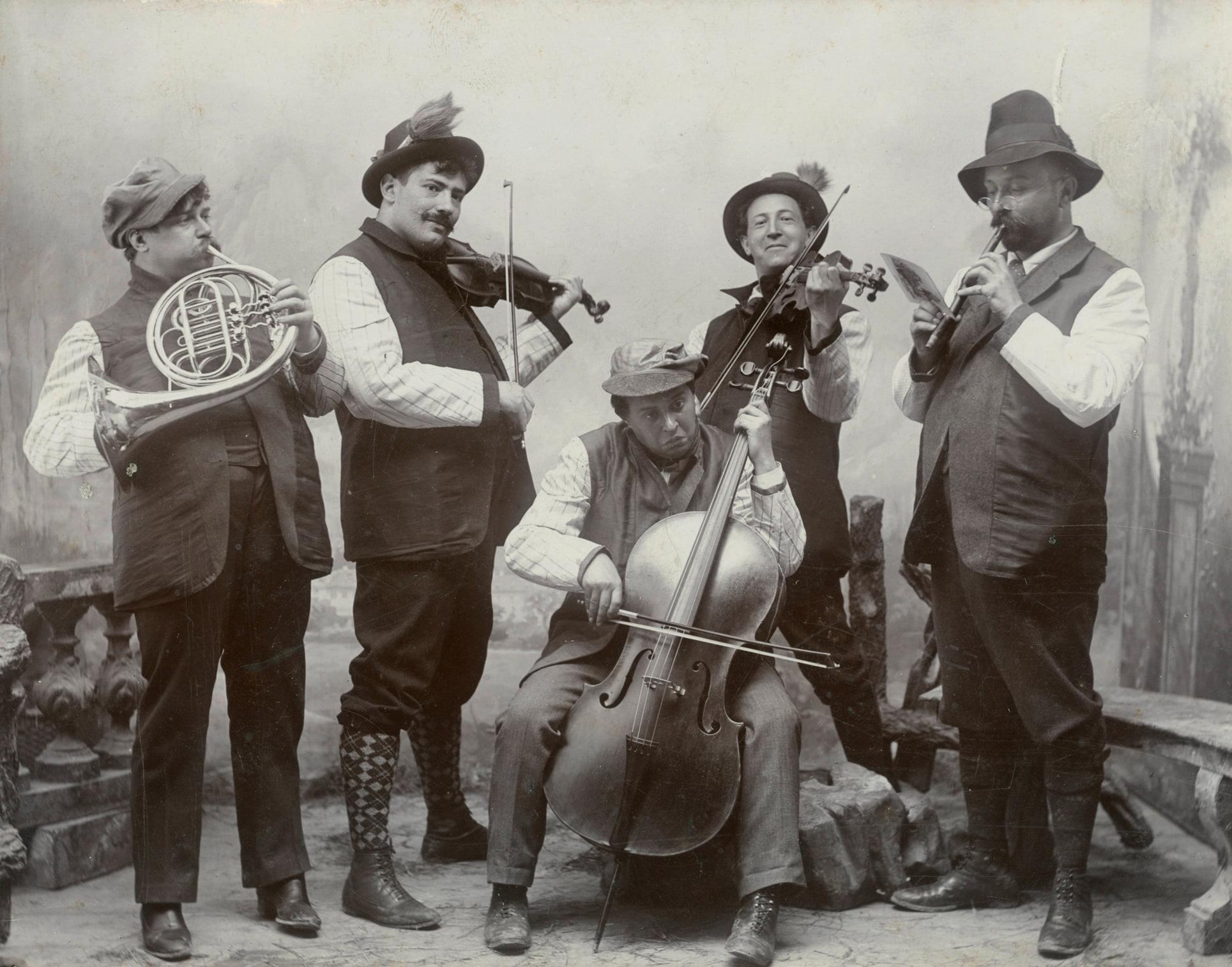
    PHOTO: Fritz Kreisler (second from left) and Arnold Schoenberg (cello) in 1900

  • Halloween Hospital Trip No Radio Show

    Halloween Hospital Trip No Radio Show

    31 DAYS OF HALLOWEEN (DAY 8)

    Unforeseen trip to the hospital precludes my being able to do my Tuesday air shift.

Tag Cloud

Aaron Copland (93) Beethoven (95) Composer (114) Film Music (137) Film Score (143) Film Scores (255) Halloween (94) John Williams (195) KWAX (229) Leonard Bernstein (103) Marlboro Music Festival (125) Movie Music (152) Mozart (88) Opera (208) Philadelphia Orchestra (89) Picture Perfect (174) Princeton Symphony Orchestra (108) Radio (88) Ross Amico (244) Roy's Tie-Dye Sci-Fi Corner (290) The Classical Network (101) The Lost Chord (268) Vaughan Williams (103) WPRB (396) WWFM (881)

DON’T MISS A BEAT

Receive a weekly digest every Sunday at noon by signing up here


RECENT POSTS