Category: Daily Dispatch

  • Composer Painters Music and Art

    Composer Painters Music and Art

    For some people, being a master in one field, it seems, just isn’t enough. This Sunday night on “The Lost Chord,” we’ll hear works by three successful composer-painters.

    Carl Ruggles (1876-1971), a friend of Charles Ives, lived 95 years. The cantankerous American modernist was the creator of a handful of meticulously-crafted, uncompromising works. His complete, authorized output amounts to four times the length of an LP side. We know this, because Michael Tilson Thomas recorded just about everything as part of a two-LP set, issued on the Columbia Masterworks label back in 1980.

    Ruggles’ method was described by musicologist Charles Seeger as “dissonant counterpoint,” a system wherein all the traditional rules of counterpoint are reversed, so that dissonance, rather than consonance, is the norm. The very practice smacks of contrarianism!

    Not surprisingly, he was beloved by Ives. When someone had the audacity to boo a work by Ruggles at a concert given in 1931, Ives berated the critic as a sissy. “Why can’t you stand up before fine, strong music like this, and use your ears like a man?” he challenged.

    In addition to his activities as a composer, Ruggles created hundreds of paintings. They were deemed successful enough that he was invited to hang shows and even sold many of his canvases.

    His musical composition “Sun-Treader” was inspired by Robert Browning’s poem, “Pauline” – in particular the line, “Sun-treader, light and life be thine forever!”

    In contrast to Ruggles, a gifted dilettante who tossed off paintings in an afternoon, Mikalojus Čiurlionis (1875-1911) is considered every bit as important a painter as he was a composer.

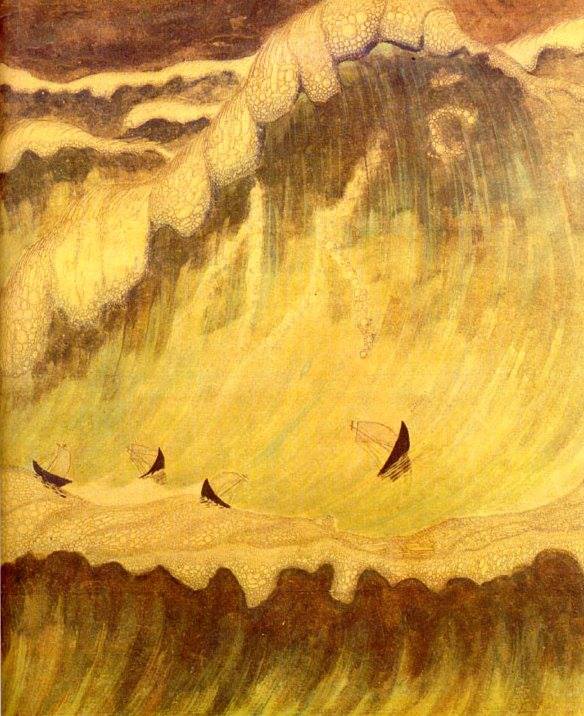
    In his 35 years, Čiurlionis managed to compose about 400 pieces of music and paint about 300 canvases. A pioneer of abstract art in Europe, he was an exemplar of the symbolist and art nouveau movements, a representative of the fin de siècle epoch, and a major figure in Lithuanian culture. Interestingly, Čiurlionis was also a synesthete; that is to say, he perceived colors and music simultaneously. We’ll hear his vibrant symphonic poem, “The Sea.”

    Lyonel Feininger (1871-1956), on the other hand, is known almost exclusively as a visual artist. Born and raised in New York, he moved to Germany at the age of 16. There, he became a leading practitioner of German Expressionism and the Bauhaus. With the rise of the Nazis in the 1930s and the party’s campaign against modern art, Feininger was driven out of Germany, and after 50 years returned to the United States, where he met with great success.

    Feininger had no formal music studies, beyond a few years of violin lessons. Regardless, he composed thirteen fugues (with extant sketches for a fourteenth). These, he wrote by ear, with the music of Johann Sebastian Bach being an undisguised influence. Feininger claimed that the influence of Bach was equally evident in his paintings.

    Prepare to see double this week. It’s an hour of music by ambidextrous artists. Join me for “Fixtures at an Exhibition,” this Sunday night at 10:00 EDT, on WWFM – The Classical Network and wwfm.org.


    “Sonata of the Sea: Finale” (1908), by Mikalojus Čiurlionis

  • Alaska Purchase & the Music of Space

    Alaska Purchase & the Music of Space

    On this date in 1867, the United States bought Alaska from Russia for $7,200,000 – two cents an acre. Celebrate “Seward’s Folly” with music by John Luther Adams. Adams, who lived most of his adult life in interior Alaska – about 100 miles south of the Arctic Circle – was awarded the Pulitzer Prize for Music in 2014.

    Here is Adams on his composition “In a Treeless Place, Only Snow” (1999):

    White is not the absence of colour. It is the fullness of light.

    Silence is not the absence of sound. It is the presence of stillness.

    As the Inuit have known for centuries, and as painters from Malevich to Ryman have shown us more recently, whiteness embraces many hues, textures and nuances.

    As John Cage reminded us, silence does not literally exist. Still, in a worlds going deaf with human noise, silence endures as a deep and resonant metaphor.

    In his “Poetics of Music,” Stravinsky speaks of music as a form of philosophical speculation. But music can also be a form of contemplation: the sensual reaching for the spiritual.

    I aspire to music which is both rigorous in thought and sensuous in sound.

    For many years now, I’ve worked with an ideal of “sonic geography” – music as place, and place as music. The treeless, windswept expanses of the Arctic are enduring creative touchstones for my work, and “In A Treeless Place” is an attempt to evoke an enveloping musical presence equivalent to that of a vast tundra landscape.

    But I want to go beyond landscape painting with tones, beyond language, metaphor and the extra-musical image.

    I no longer want to be outside the music, listening to it as an object apart. I want to INHABIT the music, to be fully present and listening in that immeasurable space which Malevich called “a desert of pure feeling.”

    Listen to the music here:

    On a much more ambitious scale, here is a selection from Adams’ “Inuksuit” (2009), as filmed by Paul Moon.

    FUN FACT: When I was in second grade, I played Seward in a school play!

  • Trains in the Movies: Drama on Rails

    Trains in the Movies: Drama on Rails

    Trains have always been very good for drama. They are symbols of departures and arrivals. They are conveyors of prisoners and vehicles of escape. They are objects of romance and objects to “hobo around” on. They are harbingers of civilization, and they are transports be robbed. You can fight on top of them. You can make out with Eva Marie Saint, or you can protect Marie Windsor so that she can testify against the mob. You can shuffle off to Buffalo.

    From the beginning, trains have provided good escapist fun at the movies. This week on “Picture Perfect,” we’ve got an hour of music from four memorable films in which trains play an important role.

    In “Strangers on a Train” (1951), arguably Alfred Hitchcock’s most underrated film of the 1950s, Farley Granger plays a tennis pro who unwittingly becomes involved in a double-murder plot (criss-cross!) through a chance encounter on a passenger train with a psychopath named Bruno (probably Robert Walker’s finest performance). The music is by Dimitri Tiomkin, who scored four films for Hitch – including “Shadow of a Doubt,” “I Confess,” and “Dial M for Murder.”

    Burt Lancaster stars in a film titled, simply, “The Train” (1964), as a reluctant railroad inspector who is persuaded to join the French Underground’s efforts to delay the transport of masterpieces looted from the museums of Paris by the Nazis, since Allied liberation of France is imminent. Paul Scofield plays the art-loving German officer determined to move the art at all costs. Real trains were destroyed in the making of the film, real dynamite was employed, and Lancaster, as was often the case, did all his own stunts. The score is by Maurice Jarre.

    “Murder on the Orient Express” (1974) is based on one of the best-known Agatha Christie vehicles involving her recurring character, celebrated detective Hercule Poirot. The late Albert Finney portrays Poirot most memorably in this, the first and best of the all-star Christie thrillers, set on a long-distance passenger train connecting Paris to Istanbul. The list of suspects includes Lauren Bacall, Martin Balsam, Ingrid Bergman, Sean Connery, John Gielgud, Anthony Perkins, Richard Widmark, and Michael York. The unforgettable score is by Richard Rodney Bennett (whose birthday it is today).

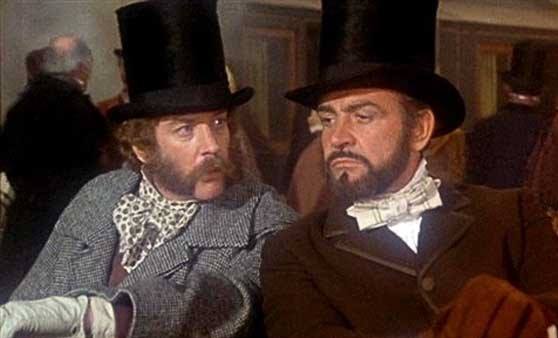
    Finally, we turn to the lighthearted caper “The Great Train Robbery” (1979), starring Sean Connery, Donald Sutherland, and Leslie-Anne Down. Michael Crichton wrote the screenplay, after his own novel, which in turn was based on an actual historical incident – an 1855 heist, in which an unbelievable amount of gold disappeared from a moving train. Crichton also directed the film. The music is by the great Jerry Goldsmith.

    All aboard! We’ll be taking the train today, on “Picture Perfect,” music for the movies, this Friday evening at 6:00 EDT, on WWFM – The Classical Network and wwfm.org.


    (Top) Sutherland and Connery; (bottom, left to right) Farley Granger and Alfred Hitchcock pass in the night; Finney as Hercule Poirot; Lancaster means business

  • Heinz Winbeck A Lost Symphony Found

    Heinz Winbeck A Lost Symphony Found

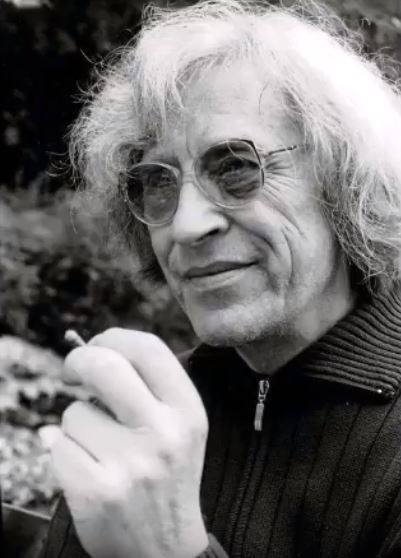
    The German composer Heinz Winbeck has died. I’m ashamed to say, before today I knew nothing about this man, who forged five epic symphonies. It would seem, upon listening to the Fifth, that my existence up until now has been a barren one.

    The symphony, composed in 2009, bears the subtitle “Jetzt und der Stunde des Todes” nach Motiven insbesondere des Finales der IX. Symphonie von Anton Bruckner (“Now and in the hour of death” on motives particularly from the finale of the 9th Symphony of Anton Bruckner).

    So much wonderful music in the world. It is one of life’s great tragedies that one will never be able to hear all of it. If you like Bruckner, prepare to be totally blissed out.

    https://www.youtube.com/watch?v=TmLmpqI2UX4&feature=youtu.be&t=2895

  • Vikings Sack Paris 845 plus Song of the Viking Guest

    Vikings Sack Paris 845 plus Song of the Viking Guest

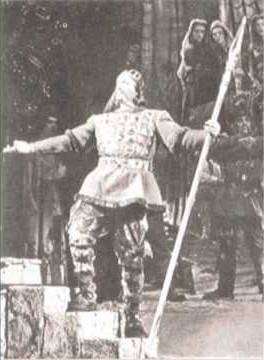
    The Vikings sacked Paris on this date in 845. Hear Mark Reizen sing the “Song of the Viking Guest” from Rimsky-Korsakov’s “Sadko.”

Tag Cloud

Aaron Copland (93) Beethoven (95) Composer (114) Film Music (137) Film Score (143) Film Scores (255) Halloween (94) John Williams (195) KWAX (229) Leonard Bernstein (103) Marlboro Music Festival (125) Movie Music (152) Mozart (88) Opera (208) Philadelphia Orchestra (89) Picture Perfect (174) Princeton Symphony Orchestra (108) Radio (88) Ross Amico (244) Roy's Tie-Dye Sci-Fi Corner (290) The Classical Network (101) The Lost Chord (268) Vaughan Williams (103) WPRB (396) WWFM (881)

DON’T MISS A BEAT

Receive a weekly digest every Sunday at noon by signing up here


RECENT POSTS