Category: Daily Dispatch

  • Bach, Schweitzer, Růžičková: Music for the Soul

    Bach, Schweitzer, Růžičková: Music for the Soul

    If there is any doubt that Bach is good for the soul, one need look no further than two spiritual titans whose birthdays we’ll celebrate today.

    Albert Schweitzer (1875-1965) is widely remembered for his humanitarian efforts. A lifelong scholar, a missionary, and a physician who brought medical assistance to the people of Gabon, he was awarded the Nobel Prize in 1952.

    A frail child, Schweitzer took to the organ as soon as he was tall enough to reach the pedals. His love of music paralleled his development as a philosopher and a theologian. In fact, no less an authority than Charles-Marie Widor was stunned by Schweitzer’s insights into Bach’s organ works, which were informed in part by a Lutheran background he shared with the composer. Schweitzer wrote extensively on Bach, in French, German, and English. In addition, he gave numerous organ recitals in Europe to finance his hospital in Africa.

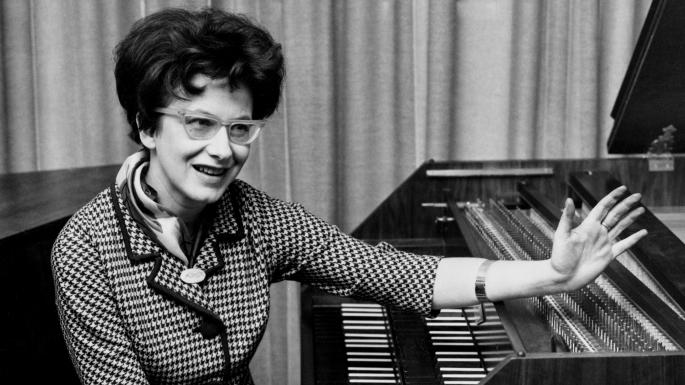
    A reverence for life was central to Schweitzer’s philosophy. While he continued his humanitarian work in Lambaréné throughout World War II, Zuzana Růžičková (1927-2017) weathered the incomprehensible in several Nazi concentration camps.

    Růžičková survived internment at Terezin, Auschwitz, and Bergen-Belsen. Of the latter, in particular, she recalled, “If ever there was Hell, this was the lowest part of Hell.” Following the war, she stood up for years against political and anti-Semitic persecution under Czechoslovakia’s communist rule. She survived Stalin and lived through the Velvet Revolution, maintaining her integrity and gaining recognition as “first lady of the harpsichord.” Růžičková became the first harpsichordist to record all of Bach’s keyboard music.

    Unlike Schweitzer, Růžičková was not particularly religious, but her spirit was large and her will indomitable. Her love of music was with her always, even in the camps. (At Terezin, she transcribed some of Bach’s music to take with her to Auschwitz.) Both she and Schweitzer were acutely aware of human suffering on a scale that most of us are lucky never to have encountered. Yet they also recognized a greater good. Perhaps it’s no coincidence that they both lived to be 90.

    I hope you’ll join me today as we sample their artistry, among my featured offerings from 4 to 7 p.m. EST, on WWFM – The Classical Network and wwfm.org.
  • Remembering Henry Varlack Sleepers Awake

    Remembering Henry Varlack Sleepers Awake

    I mentioned Henry Varlack today in an earlier post. Varlack was host of “Sleepers Awake,” the overnight show on WFLN in Philadelphia.

    He was also probably my favorite radio announcer. I mean, I loved Dave Conant’s resonance, and I enjoyed listening to Bill Shedden, Terry Peyton, and the rest, but there was something about Varlack’s unconventional timbre and the fact that the guy was on from midnight to 6:00 every night that kind of endeared him to me. Many were the times that the side of a record would run out and you could hear the stylus bumping around, wearing a groove at the end. I’d call him up later, and Varlack would apologize, admitting that he was in the bathroom and he’d miscalculated the time. He may even have fallen asleep once or twice.

    Not incidentally, he also happened to play some of my favorite music in those days, and introduced me to a number of pieces I’d never heard: Alan Hovhaness’ “And God Created Great Whales,” Morton Subotnik’s “Silver Apples of the Moon,” and Robert Schumann’s incidental music to “Manfred,” selections from which I’ll be airing tonight at 10:00 EST on “The Lost Chord,” on WWFM – The Classical Network and wwfm.org. Such was Varlack’s influence.

    I’d never met Varlack in person, when he was described to me by a former WFLN engineer as looking like a black Santa Claus. Our paths eventually crossed at a remote broadcast, and finally, after all those late night phone calls, I was able to shake his hand.

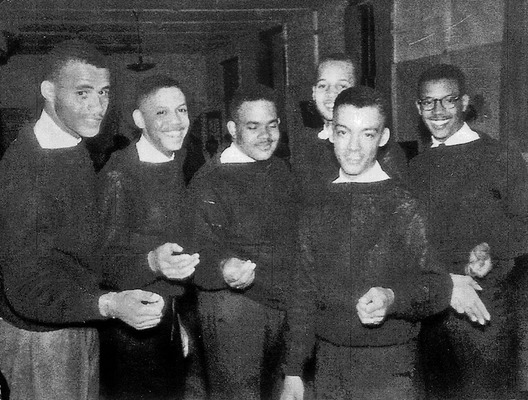
    Trying to find a photo of Varlack online is not an easy matter, since those were the days before social media, but I did find this very interesting picture of him singing in a Doo-Wop group called the Blend-Tones! Varlack is the one in the center, with his eyes closed. When he wasn’t spinning the vinyl, Varlack was also a baseball scout for the Chicago White Sox.

    He impressed me as a very interesting man, and a good-natured one, totally without pretense. I still think of him whenever I hear Gabriel Fauré’s “Pavane,” his signature music for “Sleepers Awake.” Varlack died in 2006 at the age of 65.


    Listen to some of the Blend-Tones’ records here:

    http://doo-wop.blogg.org/blend-tones-c26505866

    Gabriel Fauré’s “Pavane:”

  • Beecham’s Byron A Romantic Lost Chord

    Beecham’s Byron A Romantic Lost Chord

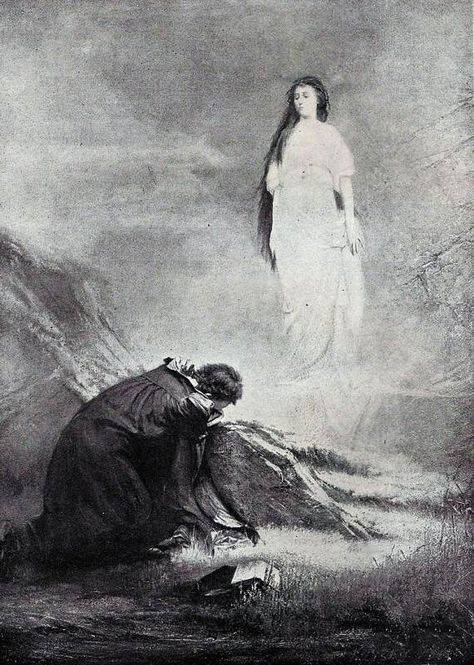
    “Oh God! If it be thus, and thou art not a madness and a mockery, I yet might be most happy…” So laments Lord Byron’s Manfred when confronted by the specter of Astarte.

    Manfred is the quintessential Byronic hero, a romantic superman who endures unimaginable sufferings and mysterious guilt in connection with the death of his beloved. He wanders the Alps, longing for extinction, and meets his fate defiantly, rejecting all authority, corporeal and supernatural.

    Robert Schumann was intoxicated by Byron’s dramatic poem from the time he first encountered it at the age of 19 in 1829. In 1848, he began to compose music for it, concurrently with that for his “Scenes from Goethe’s ‘Faust.’” Wrote Schumann, “I have never before devoted myself to a composition with such love and such exertion of my powers as to ‘Manfred.’” The piece was given its first performance in Weimar in 1852, with Franz Liszt conducting.

    This Sunday night on “The Lost Chord,” we’ll hear highlights from a recording made 102 years later by Sir Thomas Beecham.

    When Beecham came to record Schumann’s incidental music in 1954, it was an act of total reimagination. Unquestionably the work, as written, contains much attractive music. However, if we’re to be completely frank, it can be a bit dramatically static at those times when the music falls silent in deference to florid monologue. Beecham recognized this and enlisted the help of Eugene Goossens and Julius Harrison to assist him in orchestrating a number of Schumann’s piano pieces to be used as underscore for some of the spoken dialogue. He also incorporated a couple of part-songs and even invented a ballet. Fear not! Beecham’s license is nowhere in the same league as that he would later take with Handel’s “Messiah.”

    Beecham’s Byronic credentials are unimpeachable. Byron was among his favorite poets. Of course, he also happened to conduct one of the great recordings of “Harold in Italy” (after “Childe Harold’s Pilgrimage”), with the violist William Primrose. Furthermore, Beecham had been familiar with Schumann’s “Manfred” since at least 1918, when he led two performances of the complete incidental music at the age of 39. Some 36 years later, he decided to resurrect the work via a broadcast performance and then as a program at Royal Festival Hall.

    I first encountered this remarkable recording in the 1980s, in the middle of the night, when it was broadcast over the now-extinct WFLN, for 48 years Philadelphia’s classical music station. Henry Varlack used to play it from time to time on his program, “Sleepers Awake.” Finally, having not heard it for a while, I called in to his Friday night/Saturday morning request show, and he told me with regret that the record had become so worn that it was no longer suitable for airplay.

    Imagine my excitement, then, when I learned in the mid-‘90s that it was being reissued on CD. I promptly special-ordered it from England, and it couldn’t get here fast enough. That was on the Beecham Collection label – alas now long out of print. It has since appeared and disappeared (like Astarte?) on Sony.

    The recording featuring actors, chorus, and orchestra. Laidman Browne may be a bit long-in-the tooth for Byron’s anti-hero, but no one elongates “eeeeeeeeviiiiiiiiiiiiiiiiiiiiiiiiiilllllllll” quite like him.

    I hope you’ll join me for “Byronic Beecham,” this Sunday night at 10:00 EST, on WWFM – The Classical Network and wwfm.org.
  • Gramophone’s Decline & Vinyl’s Revenge

    Gramophone’s Decline & Vinyl’s Revenge

    The overall quality and sharp critical insights offered by Gramophone – “the world’s authority on classical music since 1923,” the magazine that still bills itself as offering “the world’s best classical music reviews” – have plummeted from the heights of when I first started reading it (in the early ‘90s). And I know there are codgers out there who, even then, felt that that the magazine had become a shadow of its former self.

    But contributors like John Steane and Alan Blyth were still around then, old timers who possessed encyclopedic knowledge of their respective fields and long, long memories that reached back into the 78 era. These reviewers’ assessments were invaluable – invariably erudite, articulate in a manner that is now lost, and spot-on in their ability to hone in on the most telling details expressed in often poetic ways. Performances were to be savored and records were to be cherished.

    Anxiety about format change was expressed in its pages by the magazine’s founding editor, Compton Mackenzie, all the way back in 1949 with the introduction of the 33 rpm long-playing record. While I am sure Mr. Mackenzie went on to enjoy more than his share of music released on the new format and even came to embrace it as superior to the old, we are now at a point, I feel, where a resistance to change is more than simply reactionary.

    It is dismaying to me that there are young men now at the helm of Gramophone (and just about everywhere, apparently) who are only too glad to forgo the pleasures of a hard-earned physical collection, assembled over many years – sometimes at great personal sacrifice, but not infrequently tinged with the thrill of the chase – in favor of downloads or streaming. Where the hell is the pleasure in that?

    https://www.gramophone.co.uk/blog/the-gramophone-blog/where-does-streaming-leave-your-record-collection

    Sure, their version of enjoyment saves space and spares the environment, due to the lack of packaging and physical “stuff.” But it is very far away from my happiest experiences, when I could hold an album in my hands and spend hours absorbed in concentrated listening. Does anyone really focus on anything anymore? Or are we more likely to click a mouse and use the music as background as we surf the internet, shop, pay bills, check Facebook?

    Yes, there are certain staples that could probably be left off of my shelves at this point. I didn’t even own a copy of the “Brandenburg Concertos,” beyond the set I picked up on LP back in my high school days, until perhaps the last year or two (the more recent ones I got for free). Recordings of these works are so pervasive, and they can be readily sampled online. Of course working at a classical music station, I also have access to the library there, such that it is. But I’m not about to get rid of my Bernstein Mahler Symphonies or my Boult Vaughan Williams set or the landmark Dorati Haydn just because they can be streamed.

    At any rate, there is tons of material in any collection that has been amassed over decades that will never be reissued in any form. It might be for reasons of copyright or small companies going out of business or a perceived lack of consumer interest. Whatever the case, only a fraction of what has been will ever appear again (and usually the same things over and over and over). Invariably things get “lost.”

    So I lament the constant technological “upgrades” (in most things), including the exclusion of CD players from many newer cars. It’s too often the case that the market drives consumer choice rather than the other way around. And astonishingly, people just roll with it. Then younger folks come up, and they never know the difference.

    The whippersnappers at Gramophone don’t seem to mind giving themselves over to the vagaries of a streamed catalogue from which items may be deleted at any time for whatever reason a provider sees fit. At least when I buy something, I know I own it. It may be destroyed by house fire, but it will never be retracted.

    Those who roll with change might be happier people, or think they are. For me, I’ll continue to build my collection by cherry-picking from everybody else’s cast-offs and by treasure-hunting at Princeton Record Exchange.

    Now get off my lawn.

  • Himalayan Adventures in Classic Film

    Himalayan Adventures in Classic Film

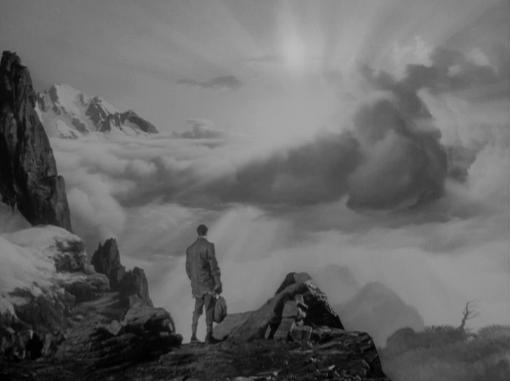
    How many times have you felt like dropping everything, heading to the Mountain in search of peace and clarity, and returning to the world cleansed? If only it were that simple. The path to salvation is narrow and as difficult to walk as the razor’s edge.

    This week on “Picture Perfect,” we journey through the awe-inspiring landscapes of India and Tibet, even as we feel our way to the inner realms of spirit and psyche, with an hour of Himalayan adventures.

    The Himalayas, in film, have frequently been the source of enlightenment; though occasionally their overwhelming influence has also led to madness. Intriguingly the latter is the case in the Powell-Pressburger classic, “Black Narcissus” (1947). Psychological and emotional tensions abound in this tale of repressed nuns struggling to maintain their composure in a voluptuous Himalayan valley.

    The stunning cinematography was by Jack Cardiff, and Brian Easdale (of “The Red Shoes” fame) wrote the music. Incredibly, the entire film was shot in England, mostly at Pinewood Studios. From a purely visual standpoint, “Black Narcissus” must be one of the most beautiful films ever made. It’s also one of the craziest, with unlikely object-of-desire Mr. Dean driving the sisters to the brink.

    The Himalayas also form the backdrop to “Seven Years in Tibet” (1997), based on a memoir of Austrian mountaineer Heinrich Harrer. Harrer escapes from a British internment camp in India during the Second World War. He travels across Tibet to its capital, Lhasa, where he eventually becomes the tutor of the 14th Dalai Lama. In the film, Brad Pitt plays Harrer. John Williams wrote the music, and Yo-Yo Ma performs the cello solos.

    “The Razor’s Edge” (1946) tells the story of a traumatized World War I veteran, who sets off in search of some kind of transcendent meaning to his existence. He finds it in India, at a Himalayan monastery. The 1946 adaptation of W. Somerset Maugham’s novel (which he claimed was thinly-veiled fact) features Tyrone Power, Gene Tierney, and Ann Baxter. The music is by Alfred Newman, who will conduct a selection from his score.

    Finally, we’ll hear a suite from the Frank Capra classic, “Lost Horizon” (1937). Based on the book by James Hilton, the film stars Ronald Colman, with a great supporting cast, including Jane Wyatt, Thomas Mitchell, Edward Everett Horton, H.B. Warner and Sam Jaffe. The novel, and the film, brought the term “Shangri-La” into popular usage, a Utopian paradise hidden in a secluded Himalayan valley, a place of ageless beauty and serenity.

    “Lost Horizon” provided composer Dimitri Tiomkin (a pupil of Alexander Glazunov) with his first major project. The result is one of his most colorful scores. The recording is one of the gems of RCA’s Classic Film Scores series, originally issued in the early 1970s. Made in the presence of the composer, it features 157 performers, with the chorus standing on a platform behind the conductor (Charles Gerhardt), and the various percussionists positioned in the encircling balcony.

    I can’t guarantee that you’ll find enlightenment, but there will be plenty to awe and inspire in these Himalayan adventures, on “Picture Perfect,” music for the movies, this Friday evening at 6:00 EST, on WWFM – The Classical Network and wwfm.org.

Tag Cloud

Aaron Copland (93) Beethoven (95) Composer (114) Film Music (137) Film Score (143) Film Scores (255) Halloween (94) John Williams (195) KWAX (229) Leonard Bernstein (103) Marlboro Music Festival (125) Movie Music (152) Mozart (88) Opera (208) Philadelphia Orchestra (89) Picture Perfect (174) Princeton Symphony Orchestra (108) Radio (88) Ross Amico (244) Roy's Tie-Dye Sci-Fi Corner (290) The Classical Network (101) The Lost Chord (268) Vaughan Williams (103) WPRB (396) WWFM (881)

DON’T MISS A BEAT

Receive a weekly digest every Sunday at noon by signing up here


RECENT POSTS