Category: Daily Dispatch

  • Waterfowl Farewell Last WPRB Show

    Waterfowl Farewell Last WPRB Show

    This morning’s program on WPRB will be my last of the season – that is to say, my swan song. What better way to go, then, than to play a whole lot of music about waterfowl?

    We’ll hear works inspired by swans, geese, and ducks, by composers such as Paul Hindemith, Gustav Holst, Engelbert Humperdinck, Sergei Prokofiev, Jean Sibelius, Heitor Villa-Lobos, and Siegfried Wagner.

    My goose is cooked, this Sunday morning from 7 to 10 EDT, on WPRB 103.3 FM and wprb.com. I’ll fowl the airwaves one last time, on Classic Ross Amico.

  • WPRB Farewell Show This Sunday

    WPRB Farewell Show This Sunday

    We’ll meet again
    Don’t know where
    Don’t know when…

    I hope you’ll join me this Sunday morning on WPRB for my final show of the spring season. It’s Memorial Day weekend, of course, so there are several ways I could go with this. Last year I played music by and about musician casualties of war. Another possibility would be to share music about memory and contemplation. I could also focus on the great outdoors, since Monday marks the unofficial beginning of the summer season. Or I could go for the low-hanging fruit and simply kick back and cruise with an all-American program. Any way you look at it, you know there will be plenty of music that will be worth your while.

    After a lot of hand-wringing, I am still conflicted about not submitting an application for the summer. I love doing the show at WPRB. I find the freedom to do my own thing to be highly rewarding, and I know many listeners respond to the creative themes and unusual discoveries. I have also had the satisfaction of interviewing dozens of visiting musicians and representatives of the local arts community. But I find in doing the early morning shift I frequently do not get a decent night’s sleep. This has had a ripple effect in my life. When I did the show on Thursdays, I’d break for lunch and then head over to my day job, where the law of diminishing returns meant that I often couldn’t finish my production work until after dark. On Sundays, I drift around in a fog and often wake up the next day with a headache. I am drinking more and more coffee in an attempt to overcome the perpetual fatigue.

    The recent change from five-hour classical music shifts to three has reduced my ability to secure interview subjects – as, probably, has my voluntary move from Thursdays to Sundays – and quite frankly I can’t explore the themes in a three-hour format to the depth I once could in five. A lot of the fun for me was in the challenge of coming up with five hours worth of circus music, or music inspired by Joan of Arc or the Olympics or arctic exploration, or exhaustive tributes to Einojuhani Rautavaara, Charles Koechlin, and Richard Arnell. It turns out I am a marathon runner, not a sprinter. Who knew?

    Without the interviews and without the long-form format, and without a good night’s sleep, the only things keeping me going are my unspoken pact with the audience and the friendships and relationships I have formed at and through the station. These I do not mean to undersell. Everything I have done at WPRB has been done for love and for personal satisfaction. It is a volunteer position, remember. I am simply getting too old and have been too busy to keep putting myself through the grind if it doesn’t bring the satisfaction a five-hour Thursday shift once did.

    Also, I suspect the listenership is a little more sluggish early on Sundays, something I had not anticipated when experimenting with a move to the weekend. The phone and internet activity doesn’t build until I am practically off the air. I guess when people have to work, they have to be up and they are listening.

    At any rate, I thank WPRB for the opportunities I have enjoyed over the past three years. Who knows, I may apply again in the fall, if they’ll have me. Or in a pinch I could step up as a substitute. I hope you will continue to support Marvin, Bob, Toby, and the rest, as they continue to provide the kind of fascinating and off-beat programming made possible only at a place like WPRB. It’s radio the way it used to be, before it was spoiled by The Man.

    Start stockpiling your rotten tomatoes. I sing my last, this Sunday morning from 7 to 10 EDT, on WPRB 103.3 FM and wprb.com. I’ll listen for your dispassionate “slow clap” as I take my final bow, on Classic Ross Amico.

  • Memorial Day Movie Music Tributes

    Memorial Day Movie Music Tributes

    It’s all about valor and sacrifice this week on “Picture Perfect,” as we anticipate Memorial Day.

    Memorial Day has its roots in Decoration Day, established in 1868 to honor the Civil War dead. We’ll hear music from “Glory” (1989), inspired by the extraordinary courage of Colonel Robert Gould Shaw’s 54th Massachusetts Voluntary Regiment, an all African American outfit that distinguished itself in an impossible assault on Fort Wagner, near Charleston, South Carolina. The outstanding cast features Morgan Freeman, Matthew Broderick, and Cary Elwes, with an Oscar-winning performance by Denzel Washington. The poignant score is by James Horner.

    Gary Cooper had one of his best roles as “Sergeant York” (1941), based on the true story of Alvin C. York, who went from backwoods hell-raiser to devout pacifist. After a period of soul-searching, York was able to reconcile his strong moral convictions with the unfortunate reality that sometimes it really is necessary to fight. He went on to distinguish himself on the battlefield and become one of the most-decorated soldiers of the First World War. The folksy score, evocative of York’s Tennessee roots, is by Max Steiner.

    In director Michael Cimino’s “The Deer Hunter” (1978), three men from a small Pennsylvania steel town serve in Vietnam, then struggle to cope with the war’s psychological impact. The harrowing film, especially memorable for its scenes of Russian roulette in a P.O.W. camp, won five Academy Awards, including Best Picture and Best Director. Christopher Walken was honored with the award for Best Supporting Actor. Stanley Myers wrote the music. We’ll hear his famous “Cavatina,” performed by guitarist John Williams, not to be confused with…

    … composer John Williams, who provided one of his sparser scores for “Saving Private Ryan” (1998). Steven Spielberg’s war-is-hell narrative yet manages to honor the sacrifice of the fighting men of World War II. The opening – a sustained “you-are-there” battle sequence on Omaha Beach – is unforgettable. Remarkably, it is presented wholly without music, Williams preferring to allow the tension of the mise-en-scène to speak for itself. Spielberg picked up his second Academy Award for Best Director. The film, however, inexplicably, lost to “Shakespeare in Love.”

    I hope you’ll join me for music from these cinematic meditations on the costs and consequences of war, as we honor the sacrifice of soldiers who died while serving in America’s armed forces, this Friday evening at 6:00 EDT, on WWFM – The Classical Network and wwfm.org.

  • WWFM As Time Goes By Play It Again

    WWFM As Time Goes By Play It Again

    Of all the gin joints in all the towns in all the world, she walks into mine…

    Okay, so maybe working your way to the bottom of a bottle while listening to Dooley Wilson play “As Time Goes By” isn’t the healthiest choice. But I venture to guess your favorite music is imbued with personal significance and may even offer solace when you need it most.

    What are some of your all-time favorite pieces? The ones that move you the most deeply or conjure cherished memories? The ones that have stayed with you the longest? WWFM The Classical Network wants to know.

    Next week, we will embark on a special fundraiser that should be full of personal significance for us all, as we share the music that is closest to our hearts. Add your most personal favorites to those of your favorite radio hosts. Your selections have a chance to become part of the programming, as we present “Play It Again,” May 29 to June 1.

    Playlists will be compiled from all-time favorites of WWFM hosts, guest programmers, and listeners just like you. The event will culminate in a countdown of most-requested pieces, which will be presented on June 1.

    It may be of interest to anyone who participates to discover a shared and perhaps unexpected affinity with some of our hosts. You can make your selections now by visiting wwfm.org and clicking on the “Play It Again” box, located on the upper right hand side of the homepage. There you’ll find a link to a form that will allow you to list twenty of your personal favorites.

    While you’re at it, consider making a contribution to the station. We’re coming up on the end of our fiscal year, and we could really use your support!

    There’s a reason why the classics are the classics. But who knows? Maybe a few unusual choices will find their way in. We look forward to hearing from you and sharing in the discovery. You could have a direct impact on the programming by filling out and submitting your list no later than Friday, May 25, at noon.

    Even more so, your financial contribution will help to ensure that The Classical Network is able to continue doing what it does best – providing a haven of great music and engaging programming any time you decide to tune us in.

    Thank you for supporting WWFM – The Classical Network, and we look forward to “playing it again!”

  • Bartók & Dohnányi: Contrasting Hungarians

    Bartók & Dohnányi: Contrasting Hungarians

    It’s all about contrasts on this week’s “Music from Marlboro.”

    While Béla Bartók is respected as the foremost Hungarian composer of the 20th century, Ernő Dohnányi, until recently, has been subject to neglect, at least in proportion to his significance. Sure, Bartók and his friend Zoltán Kodály were at the forefront of the whole nationalist movement, traipsing around the countryside in order to document authentic folk traditions before they were swallowed up forever by industrialization. But as director of the Budapest Academy of Music and music director of the Budapest Philharmonic Orchestra, Dohnányi would exert as much influence over his country’s musical development as that of his folk music-mad friends and contemporaries

    Unfortunately, he would become the target of character assassination campaigns after World War II, in which he was painted as a Nazi sympathizer. Dohnányi was investigated and cleared several times by the U.S. Military Government, and in fact has been defended as a forgotten hero of Holocaust resistance, since it was through his administrations that countless Jewish musicians survived. Also, between the wars, he went to bat for Kodály, a leftist, by refusing to fire him from the Budapest Academy. As a result, Dohnányi too lost his position, albeit temporarily. Nevertheless, he continued to be eyed with suspicion, and his slandered reputation never fully recovered.

    Equally fatal is the fact that much of his music bears a more cosmopolitan stamp than that of the Hungarian composers of his era that are now so celebrated. His composition teacher, the German-born Hans von Koessler (known in Hungary as János Koessler) was a cousin of Max Reger. Of course, Koessler also taught Bartók and Kodály. But Dohnányi was perfectly happy nestled in the world of Brahms. For his international career, he assumed the name Ernst von Dohnanyi.

    Dohnányi’s Piano Quintet in C minor, completed in June of 1895, one month before his 18th birthday, earned Brahms’ approval. We’ll hear it performed at the 1977 Marlboro Music Festival, by pianist Stephanie Brown, violinists Joseph Genualdi and Mayuki Fukuhara, violist Philipp Naegele, and cellist Lisa Lancaster.

    The program will open with Bartók’s “Contrasts,” a raw, fascinating work, from 1938. The piece, inspired by Hungarian and Romanian dance melodies, was commissioned by Benny Goodman, of all people. The trio – for clarinet, violin, and piano – contains passages of bitonality and frenzied dances for scordatura violin. We’ll hear it performed at the 1998 Marlboro Music Festival by clarinetist Anthony McGill, violinist Catherine Cho, and pianist Pierre-Laurent Aimard.

    I hope you’re hungry for Hungarian music. Variety is the spice of life on this week’s “Music from Marlboro,” Wednesday evening at 6:00 EDT, on WWFM – The Classical Network and wwfm.org.

    Marlboro School of Music and Festival: Official Page


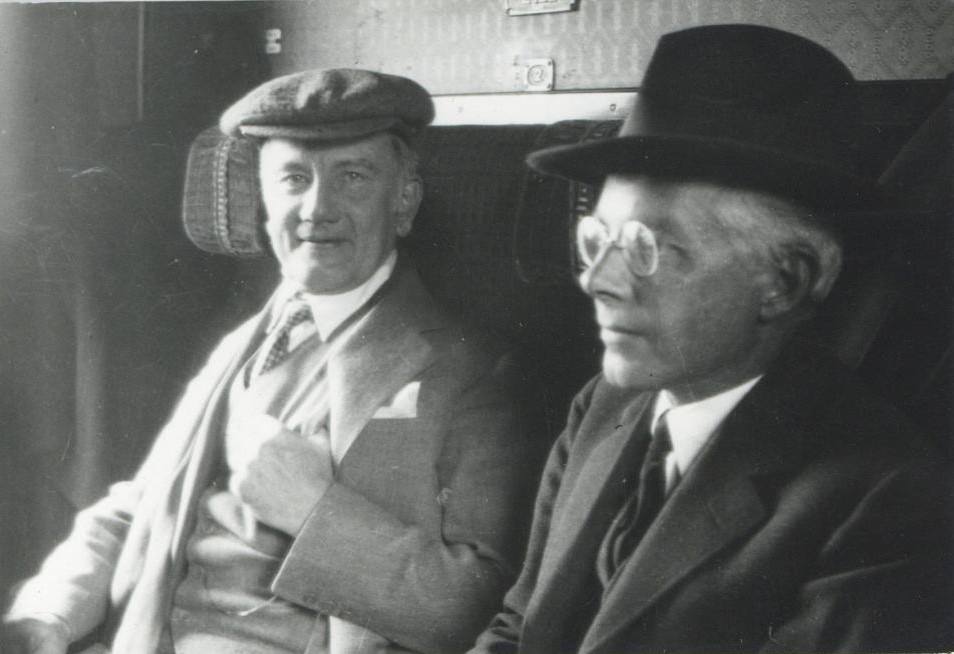
    Strangers on a Train: Ernő Dohnányi (left) and Béla Bartók

Tag Cloud

Aaron Copland (93) Beethoven (95) Composer (114) Film Music (137) Film Score (143) Film Scores (255) Halloween (94) John Williams (195) KWAX (229) Leonard Bernstein (103) Marlboro Music Festival (125) Movie Music (152) Mozart (88) Opera (208) Philadelphia Orchestra (89) Picture Perfect (174) Princeton Symphony Orchestra (108) Radio (88) Ross Amico (244) Roy's Tie-Dye Sci-Fi Corner (290) The Classical Network (101) The Lost Chord (268) Vaughan Williams (103) WPRB (396) WWFM (881)

DON’T MISS A BEAT

Receive a weekly digest every Sunday at noon by signing up here


RECENT POSTS