Category: Daily Dispatch

  • Rózsa Morricone South America Film Scores

    Rózsa Morricone South America Film Scores

    If you are a Miklós Rózsa fan, you’ll want to join me for this week’s “Picture Perfect,” as I dig deep into the archive for two contrasting scores to movies set in South America.

    Rózsa, who is probably best remembered for his work on Biblical and historical epics (he won his third Academy Award for “Ben Hur” in 1959) provides a lush symphonic tapestry for “Green Fire” (1954), starring Stewart Granger and Grace Kelly. Rózsa piles on the MGM gloss, for a conflict between love and lust for emeralds in the jungles of Colombia.

    Then we’ll hear perhaps Rózsa’s most unusual venture, “Crisis” (1950). “Crisis” starred Cary Grant and Jose Ferrer in the story of a brain surgeon who must weigh ethical considerations when faced with saving the life of a dictator who oppresses the people of an unnamed banana republic. Unusual for a composer who likes to swing for the fences, Rózsa set himself the limitations of writing for solo guitar.

    M-G-M must have felt it had scored a major coup when securing famed Brazilian composer Heitor Villa-Lobos to supply music for “Green Mansions” (1959). The big screen an adaptation of W.H. Hudson’s novel, set in the rainforests of southeastern Venezuela, starred Audrey Hepburn as Rima the Bird Girl. Unfortunately, the studio deemed what Villa-Lobos produced unusable, since the composer had begun writing based on his impressions of the novel, rather than wait for the completed film. M-G-M house composer Bronislau Kaper was brought in to salvage what he could.

    Finally, we’ll turn to one of Ennio Morricone’s best-loved scores – that for “The Mission” (1986). “The Mission” starred Jeremy Irons, as a Jesuit priest who penetrates the South American jungle to convert the native Guarani to Christianity, and Robert DeNiro, as a reformed slave hunter. The lovely and moving “Gabriel’s Oboe” became a recognizable hit, thanks in particular to its use by figure skaters and Aer Lingus.

    This is the score for which Morricone believed he should have won the Oscar.

    I hope you’ll join me for these South American adventures this week, on “Picture Perfect” – music for the movies – this Friday evening at 6:00 EDT, on WWFM – The Classical Network and wwfm.org.
  • Satie’s Surreal Film Debut Entr’acte Online

    Satie’s Surreal Film Debut Entr’acte Online

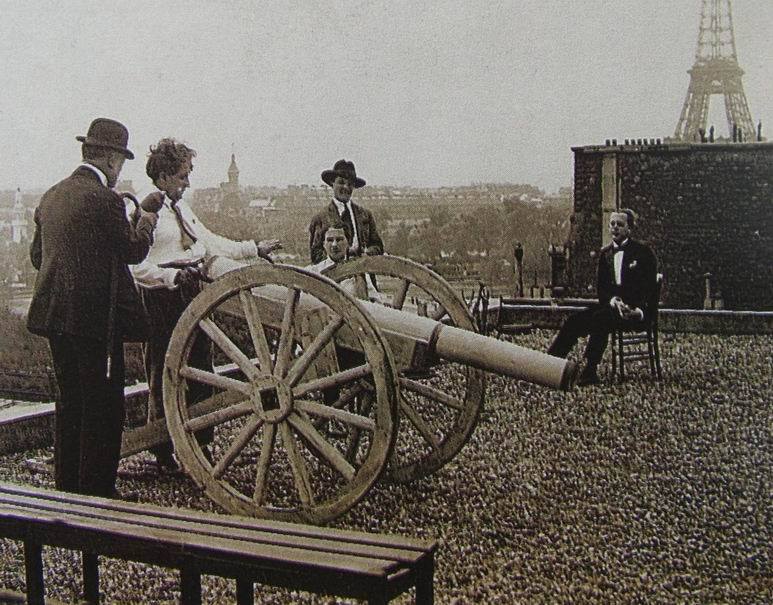
    For anyone who ever wanted to see Erik Satie fire a cannon, here’s the Velvet Gentleman himself, in trademark bowler and carrying an umbrella, with Francis Picabia. Picabia provided the scenario and designs for Satie’s ballet, “Relâche.” The film, titled “Entr’acte,” was made in 1924, the year before the composer’s death. As the title suggests, it was shown between the two acts of Satie’s ballet, with the cannon sequence used as prologue. The music, appropriately enough, is titled “Cinéma.”

    Satie appears only in the first 90 seconds or so of the film, so it’s up to you how much beyond that you’ll want to watch. Marcel Duchamp and Man Ray play chess around 4-5 minutes in; there’s a bearded ballerina around the 7-minute mark; and you may chuckle at a falling SCTV-style dummy around 9:30. Somewhere along the way you may also spot composers Georges Auric and Darius Milhaud.

    It certainly is a Dadaist romp. “Relâche,” by the way, is a word used on posters to indicate that a show is canceled or that the theater is closed.

    Happy birthday, Erik Satie (1866-1925).


    PHOTO: Satie (left) filming “Entr’acte” with Picabia and director René Clair

  • Danish Quintets Kuhlau and Nielsen

    Danish Quintets Kuhlau and Nielsen

    Into every life a little rain must fall. Tell that to Friedrich Kuhlau, the German-born Danish composer.

    At the age of seven, Kuhlau lost an eye when he slipped on the ice and fell on a bottle. In 1810, he fled to Copenhagen to avoid conscription into Napoleon’s army. There, he struggled to gain acceptance in Danish musical life. It was a bumpy ride, marked by modest success and spectacular failure.

    Then, only a few years after he scored his greatest hit in 1828 with incidental music to the play “Elverhøj” (“The Elf’s Hill”), his house caught fire. He was forced to spend most of the night out in the freezing cold, as a result of which he developed a chest ailment that drove him to an untimely death at the age of 46.

    Happily, his ill-fortune is nowhere in evidence in his flute quintets. We’ll hear one of them on this week’s “Music from Marlboro.” The Flute Quintet in D major, Op. 51, No. 1, will be performed by flutist Julia Bogorad, violinist Ralph Evans, violists Ira Weller and Samuel Rhodes, and cellist Marcy Rosen, at the 1979 Marlboro Music Festival.

    Then the winds will multiply for music by Denmark’s most famous composer, Carl Nielsen.

    Like “The Ugly Duckling” of his compatriot, Hans Christian Andersen, Nielsen emerged from humble beginnings to blossom into Denmark’s national composer. Internationally, Nielsen has flitted in and out of the seemingly inescapable shadow of Finnish master Jean Sibelius. Both men were born in 1865. In fact, Nielsen was six months older. But it is an unfair comparison, not so much apples and oranges; more like kipper and pickled herring.

    The very fact that Nielsen is not referred to reductively as “The Sibelius of Denmark” is attributable to an unusually strong individual voice. His music is modern, yet traditional; Scandinavian, yet Germanic. Most important, it is full of personality, freshness and vitality.

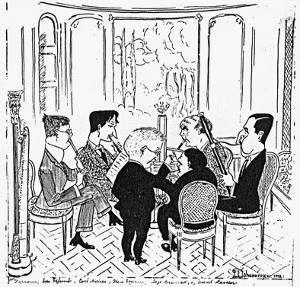
    Nielsen’s Wind Quintet of 1922 reflects the composer’s optimism and good humor. Each part was tailored to the personality of the individual performer for which it was written (members of the Copenhagen Wind Quintet). There is also something of the outdoors about the piece. Nielsen was always fascinated by nature, and there are ample suggestions of bird song woven into the texture of the work’s pastoral neoclassicism.

    We’ll enjoy a recording made at Marlboro in 1971, with flutist Paula Robison, oboist Joseph Turner, clarinetist Larry Combs, bassoonist William Winstead, and hornist Robin Graham.

    I hope you’ll “deign” to join me for an hour of Danish quintets, on the next “Music from Marlboro,” this Wednesday evening at 6:00 EDT, on WWFM – The Classical Network and wwfm.org.
    Marlboro School of Music and Festival: Official Page


    IMAGE: Period cartoon of the first performance of Nielsen’s Wind Quintet

  • Freehold Concert Dvořák Piazzolla and More

    Freehold Concert Dvořák Piazzolla and More

    Even an uptown listener like you will want to tune in for today’s Noontime Concert from the Downtown Concert Series in Freehold.

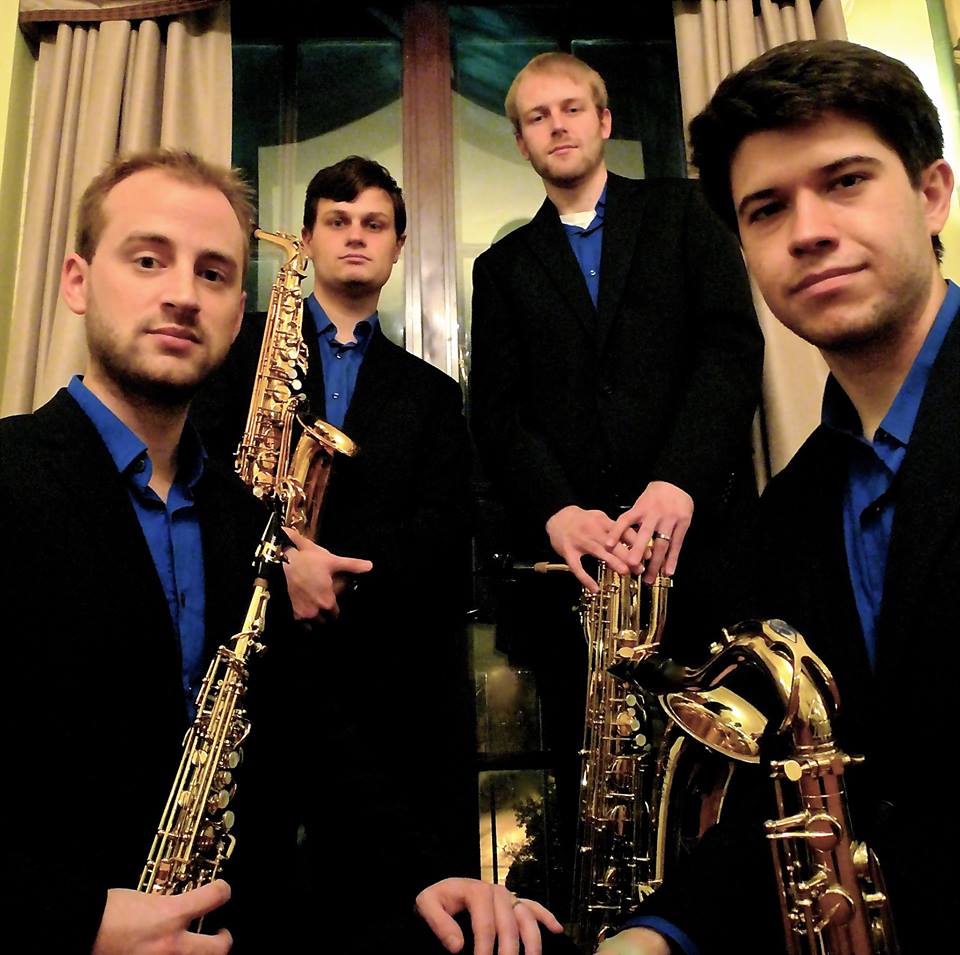
    The East End Quartet (made up of saxophonists Jonathan Wintringham, Myles Boothroyd, Matthew Amedio, and Timothy Harris) will join pianist Szu-Yi Li to present an eclectic and engaging program of music, including a fresh interpretation of Antonin Dvořák’s beloved Piano Quintet in A major, Op. 81.

    Also featured will be two of “Las Cuatros Estaciones Porteñas” (“The Four Seasons of Buenos Aires”), Astor Piazzolla’s response to Antonio Vivaldi’s masterwork, though of course from Piazzolla’s perspective, living as he did in the Southern Hemisphere, the significance of the individual seasons can be quite different.

    In between will be Graham Lynch’s “Symphony Cocteau,” a tribute to the multifaceted artist, who produced poetry, plays, films, novels, and visual art. Perhaps you were on hand for “Picture Perfect” on Friday, when I presented selections from George Auric’s score for Cocteau’s “La belle et la bête” (posted as a webcast here: http://wwfm.org/post/picture-perfect-may-11-cinematic-fairy-tales). Cocteau is also credited with having coined the name by which Auric and his colleagues – Francis Poulenc, Darius Milhaud, Arthur Honegger, Germaine Tailleferre, and Louis Durey – are collectively known, “Les six.”

    The concert took place on February 17 at historic St. Peter’s Church in downtown Freehold, NJ. The Downtown Concert Series is curated by Mark Hyczko. Hyczko will conduct the New Brunswick Chamber Orchestra in music by Christopher Cerrone, Howard Hanson, Mason Bates, and Bela Bartok in Freehold this Saturday at 7:30 p.m. The program will be repeated on Sunday at 5 p.m. at Christ Church in New Brunswick. For more information, visit downtownconcertseries.org and newbrunswickchamberorchestra.org.

    Following today’s Noontime Concert broadcast, I hope you’ll stick around for more music, beginning with two works by Piazzolla compatriot Alberto Ginastera, including his Harp Concerto, with soloist Ann Hobson Pilot. (Pilot was Rachel Katz’s guest on “A Tempo” this past Saturday; you can listen to the webcast here: http://wwfm.org/post/tempo-interviews-cleveland-institute-music-honorees-pilot-huang.) I’ll be spinning the platters until 4 p.m. EDT, on WWFM – The Classical Network and wwfm.org.

  • Otto Klemperer A Mad Genius Remembered

    Otto Klemperer A Mad Genius Remembered

    You were an associate, friend and disciple of Gustav Mahler. You championed new works by Schoenberg, Stravinsky and Hindemith. You tolerated no coughing or sneezing from your audience. You suffered from severe cyclothymic bipolar disorder. You answered the door to your dressing room in your boxers and covered in lipstick. You underwent surgery to remove a brain tumor “the size of a small orange.” When placed in an institution, you escaped. You took a severe spill, requiring you to conduct from a chair. You set yourself on fire and tried to douse the flames with spirits of camphor. You sired Colonel Klink. Your career was capped by a glorious Indian Summer that spanned 20 years. You lived to the ripe old age of 88. In short, you had all the qualifications to be one of the 20th century’s greatest conductors.

    Happy birthday, Otto Klemperer (1885-1973).

    Join me for a celebration of Klemperer’s artistry (alongside works of Lou Harrison, Johan Peter Emilius Hartmann, and Zygmunt Stojowski), between 4 and 7 p.m. EDT, on WWFM – The Classical Network and wwfm.org.


    PHOTO: Otto the Indestructible

Tag Cloud

Aaron Copland (93) Beethoven (95) Composer (114) Film Music (137) Film Score (143) Film Scores (255) Halloween (94) John Williams (195) KWAX (229) Leonard Bernstein (103) Marlboro Music Festival (125) Movie Music (152) Mozart (88) Opera (208) Philadelphia Orchestra (89) Picture Perfect (174) Princeton Symphony Orchestra (108) Radio (88) Ross Amico (244) Roy's Tie-Dye Sci-Fi Corner (290) The Classical Network (101) The Lost Chord (268) Vaughan Williams (103) WPRB (396) WWFM (881)

DON’T MISS A BEAT

Receive a weekly digest every Sunday at noon by signing up here


RECENT POSTS