No matter what your personal creed, the real reason for the season is the Winter Solstice, the shortest day, which is why this time of year so many of the world’s cultures pull out all the stops with music, drink, evergreen, gifts, and bizarre localized customs like the Yule Goat (see my post of Dec. 9). It all goes back to man’s primordial desire to restore the sun and drive the cold winter away.
This Thursday morning on WPRB, we’ll mark the year’s shortest day – and the longest night – with abundant reflection and revelry, all distilled into a cheering playlist of music for midwinter.
Of course, the morning will be heavily slanted toward the reigning midwinter festival of Christmas. There will be at least two large-scale Christmas works for chorus and orchestra – Josef Rheinberger’s “The Star of Bethlehem” and Rutland Boughton’s “Bethlehem” – to anchor all the pagan tomfoolery.
I hope you’ll join me in piling the wood high, in anticipation of a midwinter bonfire, this Thursday morning from 6 to 11 EST, on WPRB 103.3 FM and wprb.com. If all goes as planned, it should go something like this, on Classic Ross Amico:
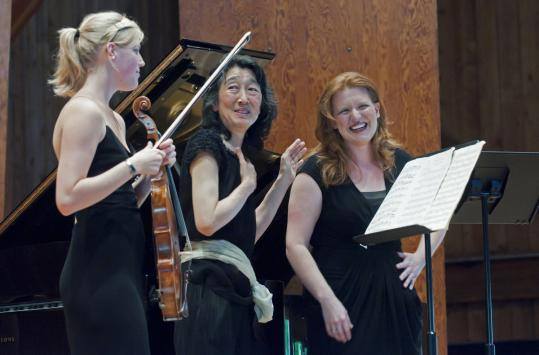
In addition to being one the world’s most celebrated pianists, Uchida has served as artistic director of the Marlboro Music School and Festival since 2013. We’ll honor her on this week’s broadcast of “Music from Marlboro” with two of her performances, documented in live recordings from the festival she manages.
The highlight of the hour will be Beethoven’s Piano Trio in B-flat, Op. 97, popularly known as the “Archduke.” Nicknamed for Beethoven’s patron and pupil, Archduke Rudolph of Austria, the trio is one of fourteen works Beethoven dedicated to Rudolph, who was the youngest child of Emperor Leopold II of Austria. We’ll hear a 2006 performance. Uchida will be joined by Soovin Kim, violin, and the venerable David Soyer, cello.
The hour will begin with music by Johannes Brahms. We’ll hear his “Zwei Gesänge” (Two Songs) for voice, viola and piano, Op. 91. The text of the first, “Gestillte Sehnsucht” (Longing at Rest), composed in 1884, is by Friedrich Rückert. That of the second, “Geistliches Wiegenlied” (Sacred Lullaby), composed in 1863, is by Emanuel Geibel, who in turn was inspired by Lope de Vega. The songs were published as a set in 1884.
The first, touched by nature and yearning, begins “Immersed in golden evening glow, how solemnly the woods stand!” Imagery of wind and birds whispering the world to slumber gradually metamorphose into a desire for wishes and longing to be hushed to slumber, as well. The song ends there, though in the original Rückert continues his poem for another stanza, acknowledging that these desires will only be silenced by death. So German…
The second song (written first) was composed for Brahms’ friend, the violinist Joseph Joachim, and Joachim’s wife, Amalie. It was intended as a wedding present, but resubmitted a year later on the baptism of the couple’s son (named after Johannes). Joseph also played the viola, and Amalie was a contralto. The work is a cradle song sung by Mary, mother of Jesus, who addresses the holy angels, requesting that they silence the rustling palms because her Child is sleeping. The viola quotes the Christmas melody “Joseph, lieber Joseph mein,” a sly reference on the part of Brahms, who incorporates the carol’s text, in order to include Joachim’s given name.
The performance, from 2011, again features Mitsuko Uchida at the keyboard, with mezzo-soprano Jennifer Johnson Cano and violist Hélène Clément.
That’s a cradle song for Baby Jesus by Johannes Brahms and music composed for Rudolph by Beethoven, on this week’s “Music from Marlboro,” this Wednesday evening at 6:00 EST, on WWFM – The Classical Network and wwfm.org.
Marlboro School of Music and Festival: Official Page
PHOTO: Hélène Clément, Mitsuko Uchida, and Jennifer Johnson Cano
Penna Rose will direct the Princeton University Chapel Choir in a special Advent program, on today’s Noontime Concert on The Classical Network, made up entirely of music and readings for the season. Among the featured highlights will be Daniel Pinkham’s “Christmas Cantata.”
Then stick around for Camille Saint-Saëns’ “Christmas Oratorio” in the 1:00 hour.
‘Tis always the season for great music, on WWFM – The Classical Network and wwfm.org.
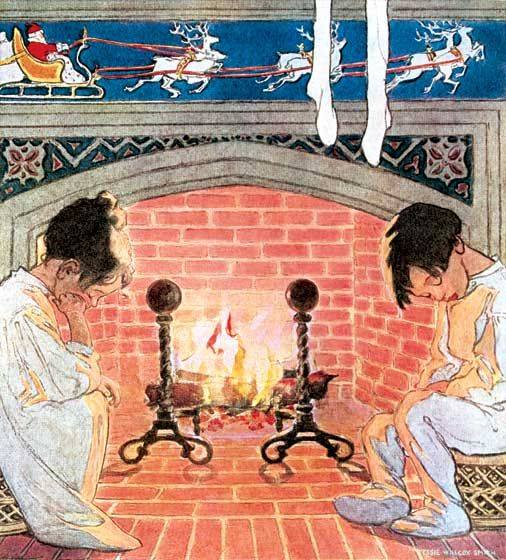
Cozy up to the “Fireside Tales” of American composer and pianist Edward MacDowell (born on this date in 1860) and bask in the warm glow of a carol medley performed by Russian-German soprano Rita Streich (born in 1920). They’ll be among our featured works, from 4 to 7 p.m. EST, on WWFM – The Classical Network and wwfm.org.
If you’ve ever had a nightmare about a grimacing nutcracker or found yourself profoundly disturbed by a Rankin-Bass Christmas special, then this one is for you.
This Sunday night on “The Lost Chord,” we present as our centerpiece Paul Hindemith’s unusual Christmas fairy tale, “Tuttifäntchen,” written in 1922, in which a wooden figure carved out of a fir by a master woodcutter comes to life and causes all sorts of havoc. He literally robs a young girl of her good heart, thrashes children, and sends all of the Christmas trees in the world out onto the marketplace – all en route to a desired reunion with the fir of his origin. (Fortunately, his reign of terror spans only 24 hours, and everything ends well.)
It may sound like a real horror show, but the music is disarming in its simplicity and warmth. Hindemith’s score incorporates familiar Christmas songs and a contagious foxtrot, called “Dance of the Wooden Puppets.” A delightful suite from “Tuttifäntchen” was released on the CPO label back in 1999. In 2013, CPO issued this complete recording, from which I excise most of the spoken dialogue, since it is in German.
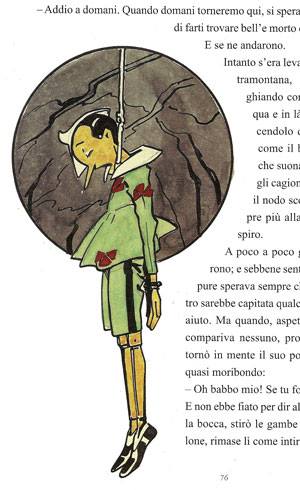
This allows time for two additional pieces. From “Tuttifäntchen,” my thoughts travel immediately to Pinocchio. In Carlo Collodi’s original story – published in the 1880s, over a half century before Walt Disney gave him a good scrubbing up – the boy-puppet is an absolute terror. He even kills Jiminy Cricket with a hammer!
His exploits inspired Ernst Toch, a Hindemith contemporary, to compose “Pinocchio: A Merry Overture,” in 1935. Toch was awarded the Pulitzer Prize for Music in 1956, for his Symphony No. 3.
The hour will open with the “Punch and Judy Overture,” from 1945, by American composer Leroy Robertson. Punch, of course, is the classic murderous puppet, who outsmarts the Devil and even Death himself.
“THAT’S the way to do it,” as he’s fond of saying. (If you’ll notice, Mr. Punch is always self-satisfied – hence the phrase “pleased as Punch.”)
“In my opinion the street Punch is one of those extravagant reliefs from the realities of life which would lose its hold upon the people if it were made moral and instructive. I regard it as quite harmless in its influence, and as an outrageous joke which no one in existence would think of regarding as an incentive to any kind of action or as a model for any kind of conduct. It is possible, I think, that one secret source of pleasure very generally derived from this performance… is the satisfaction the spectator feels in the circumstance that likenesses of men and women can be so knocked about, without any pain or suffering.”
– Charles Dickens (Mr. Christmas, himself), in a letter from 1849
I hope you’ll join me for “Hindemith Branches Out” – celebrating the holidays with the naughty puppet Tuttifäntchen and friends – this Sunday night at 10:00 EST, on WWFM – The Classical Network and wwfm.org.
For a teaser, here’s Hindemith’s “Dance of the Wooden Dolls,” in a version for solo piano:
In Collodi’s original, Pinocchio kills Jiminy Cricket, eats the Cat’s paw and pays the ultimate price. The publisher thought the ending too depressing and made Collodi change it. (The puppet still commits pesticide and maims the cat, though.)