
If Vaughan Williams died on this date in 1958… who’s driving?
Category: Daily Dispatch
-

Bernstein Conducts Martinů Unearthed Recording
On Leonard Bernstein’s birthday, in line with all the Martinů posts that have appeared on this page over the past weeks, I’m sharing a link to this live concert performance from 1963 – unearthed by my most recent Bard Music Festival acquaintance, Mather Pfeiffenberger – of Bernstein conducting Martinů’s Concerto for String Quartet and Orchestra, featuring the Juilliard String Quartet. This is a work Bernstein never recorded commercially. How cool is that?
The program and notes have been archived on the New York Philharmonic website. The concert also included Peter Mennin’s “Concertato for Orchestra: Moby Dick.”
Bernstein took a master class with Martinů at Tanglewood in 1942.
Martinů not your bag? In 1965, Bernstein reunited with the Juilliard Quartet, this time as pianist, for my favorite recording of Schumann’s Piano Quintet in E-flat Major.
Happy birthday, Leonard Bernstein!
PHOTOS (clockwise from left): Signed photo of Bohuslav Martinů; Bernstein recording at the piano; Julliard String Quartet in 1962
-

Bard Music Festival Martinů Deep Dive
One more post to mop up a few things I’d been meaning to address about the Bard Music Festival, and then I promise to try to find other things to talk about until next year’s schedule is announced in February.
One of the great challenges at Bard, when the only time one really seems to have to sit and focus is while actually attending concerts, is that there is very little opportunity to write while the festival itself is actually in progress. The rest of the time is taken up by travel and eating and sleeping and socializing. I lament all the observations and clever turns of phrases and natural flow between ideas that have been lost for the simple matter of not being able to drive and type at the same time. And no, despite any evidence to the contrary, I am not a great dictator. By that I mean, I am not the greatest extemporizer. For me, writing is more like sculpting. I am forever building up and chiseling away at the raw material. To converse with the actual Classic Ross Amico is a very different experience from reading him. You might say I am a life student of the Jimmy Stewart School of Articulation.
Then, of course, I also have other things I have to write about. I like to promote my radio shows, for instance, so that knocks out a couple of days a week. Occasionally I’ll even have an article due. I don’t know how I did it, back in the days when I had a weekly column, on top of sometimes multiple radio jobs.
At any rate – and thanks for hanging in there, as I am finally about to get around to the meat of the matter – there are just a few more details about my experiences at this year’s festival, “Martinů and His World,” I would like to share. These include a few photos of festival merch, which as I commented elsewhere, for whatever reason, was much diminished from previous years, when Rhinebeck’s Oblong Books offered tables of recordings for attendees to peruse and purchase. And despite the proliferation of streaming options, yes, people did buy. Classical music people are a breed apart; many of us still love physical media. By the end of the second weekend, the tables were always fairly well picked over.
This year, no Oblong, but there was still the tie-in volume of essays, “Martinů and His World,” edited by festival scholars-in-residence Michael Beckerman and Aleš Březina. Some of the unusual attractions include a section devoted Martinů’s operas, a recently discovered Martinů diary, and recollections from some who knew the composer during his years in the United States. The book is still available for order from University of Chicago Press and other fine booksellers (likely online).
https://press.uchicago.edu/ucp/books/book/chicago/M/bo258537662.html
Of course, there was also the festival t-shirt, which I’ve already mentioned, this year sporting one of the composer’s amusing self-caricatures, with his hedgehog-headed alter ego seated at the piano. A lavishly-illustrated 70-page festival program (free with ticket) is chock full of information and always a valued keepsake.
https://fishercenter.bard.edu/wp-content/uploads/2025/08/8-7-25_SinglePages_Martinu.pdf
Attempting to fill the vacuum left by Oblong, in its more modest way, was the Bohuslav Martinů Foundation and Institute. There was a table of paraphernalia laid out to entice one to join the Martinů Society, along with some attractive books and, all too briefly, some of their in-house-produced CDs. I purchased one that includes “The Epic of Gilgamesh,” dating from 1959, the year of the work’s first performance. The recording features Marilyn Horne and Walter Berry (in great voice) and is conducted by Martinů champion Paul Sacher. Later, I googled this to learn that it is not available anywhere else. Nor were many of the other recordings, so now I regret not buying more. I would have loved to have heard some of the other historic material, a lot of which hasn’t even been uploaded to YouTube, and some of which is now, sadly, sold out even on the Martinu Foundation website.
https://www.martinu.cz/en/institutions/bohuslav-martinu-institute-in-prague/
Oh well. More items to add to my Holy Grail list.
I am saving the best for last, as I often meet interesting people at the festival, but none more compatible than Mather Pfeiffenberger, next to whom fate seated me while I was shoveling down a wan Bard wrap outside one of the venues in my desperation for some sustenance between events. Mather is extraordinarily knowledgeable. It’s rare that I meet anyone with whom I can communicate so freely, on every level, about music. We share a language of refined geekdom that, in my experience, is quite beyond the capacity of your average classical music weirdo.
In two years, Bard will be tackling “Gershwin and His World,” so somehow he and I got to talking about American music. It turns out that Mather has done quite a bit of radio work himself, at WHRB, Harvard. I’ve looked at some of his playlists, and I assure you he is first-rate. In fact, there was plenty of stuff I wasn’t familiar with, especially some of the historic recordings I didn’t even know existed, that I wouldn’t mind checking out myself. Furthermore, the guy’s interviewed Aaron Copland and harassed Walter Piston for autographs (twice).
In the words of Rick Blaine, this looks like the beginning of a beautiful friendship. A lively correspondence began almost immediately and has been full of enlightening information and links to, again, audio files I didn’t even know existed. I don’t think I flatter myself in saying I have held my own in reciprocation. I’ve been very busy in the week since my return from Bard – in fact the reason I wasn’t able to finish writing this and get it posted this morning was because I had to be on the road yet again – but I look forward to learning and listening to more.
Next year at Bard: “Mozart and His World” – and as I say, in 2027, Gershwin!
BONUS: I’d been sitting on this video for many months, hoping to share, but then forgot all about it. It’s a performance of Martinů’s vigorous and optimistic “Bergerettes,” presented, incongruously, film noir style. Enjoy!
Fisher Center at Bard
-

Bernstein and Dvořák’s Graceful Exits
With summer winding down and Leonard Bernstein’s birthday right around the corner (on August 25), this week on “The Lost Chord,” I thought it would be a good time to enjoy a program of valedictory works by two complementary composers.
Bernstein’s autobiographical “Arias and Barcarolles” (1988) was winnowed from its original conception for four singers to a leaner combination of mezzo-soprano, baritone, and piano duet. The texts of the eight-movement song cycle, personal reflections on the nature of familial love, in all its layered harmonies and discords, are mostly by Bernstein himself. One of them, “Little Smary,” is a bedtime story his mother told him when he was a child. Others are propelled by witty repartee and amusing inside jokes.
The title is taken from a humorous episode Bernstein liked to recount, stemming from a meeting with President Eisenhower in 1960. After a performance at the White House, Eisenhower remarked, “I liked that last piece you played. It’s got a theme. I like music with a theme, not all them arias and barcarolles.”
The work was subsequently orchestrated, with the composer’s consent, by Bright Sheng, but personally, I think it works much better in this earlier form. It’s nimbler and more intimate, and the words land more cleanly.
Another composer whose influence on American music was incalculable was Antonin Dvořák. While director of the National Conservatory of Music in New York from 1892 to 1895, the revered Czech master was impressed by the character and individuality of what he heard all around him as only an outsider could be. He became intoxicated with the sounds of a diverse, vibrant culture, and was astonished that few had noticed what was so clearly evident – that the foundation of a nationally-identifiable school of music was not be achieved in emulating European models, but rather in assimilating the great American melting pot, through folk song, Native American elements, and especially what was then termed Negro spirituals. He led by example, composing works such as the “American” String Quartet and the “New World” Symphony.
Following his academic and administrative sojourn, Dvořák returned to Bohemia, where in his later years, he focused on opera and symphonic poems based on some astonishingly dark fairy tales. An exception was his final orchestral utterance, “A Hero’s Song” (1897). Admittedly, there is a somewhat sobering, somber interlude at its core, but this only serves to emphasize the swaggering exuberance of the 22-minute work’s outer, swashbuckling sections. It’s astonishing and gratifying to hear Dvořák go out in such a blaze of glory!
I hope you’ll join me for “Graceful Exits” – final works of Bernstein and Dvořák – on “The Lost Chord,” now in syndication on KWAX, the radio station of the University of Oregon!
Clip and save the start times for all three of my recorded shows:
PICTURE PERFECT, the movie music show – Friday at 8:00 PM EDT/5:00 PM PDT
SWEETNESS AND LIGHT, the light music program – Saturday at 11:00 AM EDT/8:00 AM PDT
THE LOST CHORD, unusual and neglected rep – Saturday at 7:00 PM EDT/4:00 PM PDT
Stream them, wherever you are, at the link!
PHOTOS: Dvořák receiving an honorary doctorate from Cambridge in 1891 (left); Bernstein letting it all hang out in Fairfield, CT, in 1988
-
Baroque Remixed: Handel, Brahms & More
Prior to the authenticity movement, musicians basically did whatever they wanted, employing works of the masters as so much grist for the mill. Bach and Handel were played by a hundred instruments, swooning portamenti applied, and trombones and bass drums added if it was felt the music required a good punch.
Hamilton Harty’s arrangement of Handel’s “Water Music” was one of the saner applications, though it has come to sound somewhat strange to our ears today. At the other end of the scale was freewheeling Thomas Beecham, who was not at all bashful about lending cymbal crashes to “Messiah.”
But you’ve got to remember, Sir Thomas was also crafting orchestral canapés and bonbons from Handel operas at a time when they were basically unknown outside of musicological circles.
A sample of Beecham’s arrangements for the 1932 “Handel” ballet “The Origin of Design” will cap this morning’s “Sweetness and Light.” The climactic battle music is an amalgam of selections from Handel’s “Giulio Cesare,” “Rinaldo,” and “Ariodante” – and we’ll hear Beecham conduct it hell-for-leather!
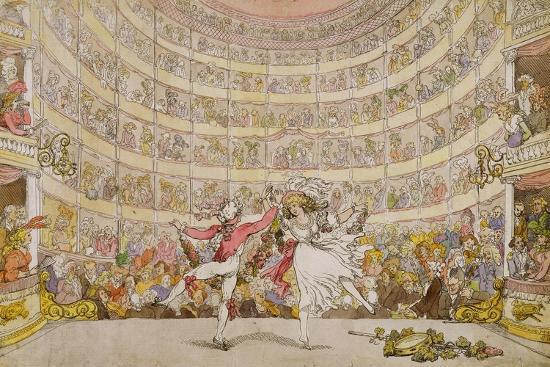
“The Origin of Design” was choreographed by Ninette de Valois, who also devised the scenario and choreography for Constant Lambert’s ballet “The Prospect Before Us (or, Pity the Poor Dancers).” Here, Lambert dips heavily into works of 18th century English composer William Boyce, whose eight delectable symphonies we still hear from time to time. Unsurprisingly, selections from some of these find their way into Lambert’s 1940 score, which he introduced with the Sadler’s Wells Ballet. Valois was inspired by a collection of drawings and prints by Thomas Rowlandson. (A reproduction of one is included with this post.)
In between, we’ll admire the handiwork of a quite reputable, 19th century intermediary. It was no less than Johannes Brahms who lifted a portion of a harpsichord suite as the basis for his “Variations and Fugue on a Theme by Handel,” a piece conceived for solo piano in 1861. In 1938, English composer Edmund Rubbra orchestrated the work. We’ll hear it, given the luxury treatment, in a 1960 recording with Eugene Ormandy and the Philadelphia Orchestra.
Yes, that’s right. Back in the day, the prevailing philosophy was “If It’s Baroque, Fix It.” 18th century inspirations will be polished up by 20th century hands on “Sweetness and Light,” this Saturday morning at 11:00 EDT/8:00 PDT, exclusively on KWAX, the radio station of the University of Oregon!
Stream it wherever you are at the link:
Tag Cloud
Aaron Copland (94) Beethoven (95) Composer (114) Film Music (149) Film Score (143) Film Scores (255) Halloween (99) John Williams (197) KWAX (233) Leonard Bernstein (105) Marlboro Music Festival (125) Movie Music (164) Mozart (91) Opera (215) Philadelphia Orchestra (90) Picture Perfect (174) Princeton Symphony Orchestra (110) Radio (90) Ross Amico (244) Roy's Tie-Dye Sci-Fi Corner (290) The Classical Network (101) The Lost Chord (269) Vaughan Williams (107) WPRB (397) WWFM (881)