On today’s Noontime Concert, Emily Burn, Victoria Couper, and Clemmie Franks, the female vocal trio known as Voice, will present a program titled “If Music Be the Food of Love.”
The concert will be made up of songs exploring the beauty, heartache, and humor of love, with repertoire drawn from medieval France and Germany, 18th century catches, and arrangements of Shakespearean and traditional songs from England and Scotland. Also on the program will be works commissioned by the group from contemporary British composers.
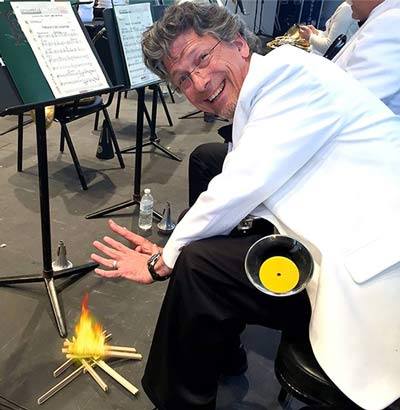
The concert took place at Temple Judea of Bucks County in February. Temple Judea is located in Furlong, PA. Voice will be joined by the Temple Judea Choir for several of the selections. To find out more about Temple Judea, which will host the Grammy Award winning Turtle Island String Quartet this Saturday at 7:30 p.m., visit templejudea.org.
Following the noontime concert broadcast, I hope you’ll stick around for Ralph Vaughan Williams’ Symphony No. 9, among our featured works. The concert will begin at 12:00 EST. I’ll be there, spinning the platters until 4, on WWFM – The Classical Network and at wwfm.org.
He was America’s foremost composer of “art music.” What he was not was George Gershwin.
Join me this afternoon, as we celebrate the birthday of Aaron Copland with, among other things, his Piano Concerto, composed in 1926. Copland was still feeling his way toward his “populist period” (which began with “El Salón México,” not given its premiere until ten years later), when he wrote this concerto, which spikes 1920s modernism with American jazz.
The composer was the soloist in the work’s first performance, which featured the Boston Symphony Orchestra conducted by Serge Koussevitzky. The critics panned it, but Copland’s mother beamed with pride. The composer wrote, “I was delighted when Ma said it was her proudest moment and that my playing in the Concerto made all those music lessons worthwhile!”
It retained its reputation as a shocker until 1947, when Leonard Bernstein revived it with Leo Smith as the soloist, and it struggles still, even next to Copland’s own Clarinet Concerto. In the meantime, Gershwin’s “Rhapsody in Blue” (from 1924) has never been out of the repertoire.
Hear this underexposed work today, between 4 and 7:00 p.m. EST, on WWFM – The Classical Network and at wwfm.org.
Felix Weingartner (1863-1942) is best-recognized as a conductor. However, he considered himself equally, if not more so, a composer. He was one of a number of prominent conductors of the day who fit the Mahler paradigm. However, the works of Wilhelm Furtwängler, Otto Klemperer and any number of other famed figures of the podium are very seldom heard.
Weingartner held many conducting posts over the years. He succeeded Mahler as principal conductor of the Vienna Hofoper, from 1908 to 1911. He led the Vienna Philharmonic in an official capacity until 1927. He was later chief conductor of the Vienna Volksoper.
He thought very deeply about the problem of the symphony. I remember reading a book he wrote in which he examined the strengths and weaknesses of all the major symphonies written in the shadow of Beethoven, down to the dawn of the 20th century.
He himself composed seven symphonies, among other symphonic works, and thanks to the enterprising cpo.de – classic production osnabrück label (CPO for short), all of them have been recorded. This Sunday night on “The Lost Chord,” we’ll hear the Symphony No. 2, from 1901, a fascinating mix of old and new, evidently romantic in disposition, yet very much of its time. The recording will feature the Basel Symphony Orchestra, which Weingartner himself directed from 1927 to 1934.
As a conductor, Weingartner was particularly well-regarded as a Beethoven interpreter. He’d been conducting the Beethoven symphonies as a cycle since at least 1902, and he was the first to complete an integral set of recordings. We’ll have time to sample the scherzo from the Symphony No. 9 from his superlative recording of 1935.
I hope you’ll join me as we raise a glass to Felix Weingartner. That’s “Wine from Weingartner,” this Sunday night at 10:00 EST, on WWFM – The Classical Network and at wwfm.org.
A few weeks back, I posted a cartoon by Jeffrey Curnow, associate principal trumpet of the Philadelphia Orchestra. I suppose it shouldn’t come as any surprise that he would be just as witty and inventive in real life. Here’s a YouTube video he whipped together demonstrating his unique solution to the challenges of practicing on the road.
Phil Smith, in case you don’t know, is principal trumpet of the New York Philharmonic. Joseph Alessi is the Philharmonic’s principal trombone. Matthew Vaughn is co-principal trombone of the Philadelphia Orchestra. Now that you’ve been forearmed with that brassy esoterica, enjoy!
More Curnow Cartoons and doctored photos on Jeffrey Curnow’s Facebook page.
OMG! He attended Wilson Area High School. As a native Eastonian, I would say that explains a lot.
This week on “Picture Perfect,” as the shadows lengthen, we revisit the world of film noir, a genre notoriously slippery to define, but easy to know when you see it – with its long shadows and moral ambiguities; cock-eyed camera angles and snappy repartee; isolation and innuendo. It’s a genre where a pair of gams is an invitation to the gallows; where a man’s best friend – and sometimes his worst enemy – is his Colt .38; where only cigarettes and bourbon can ease the pain.
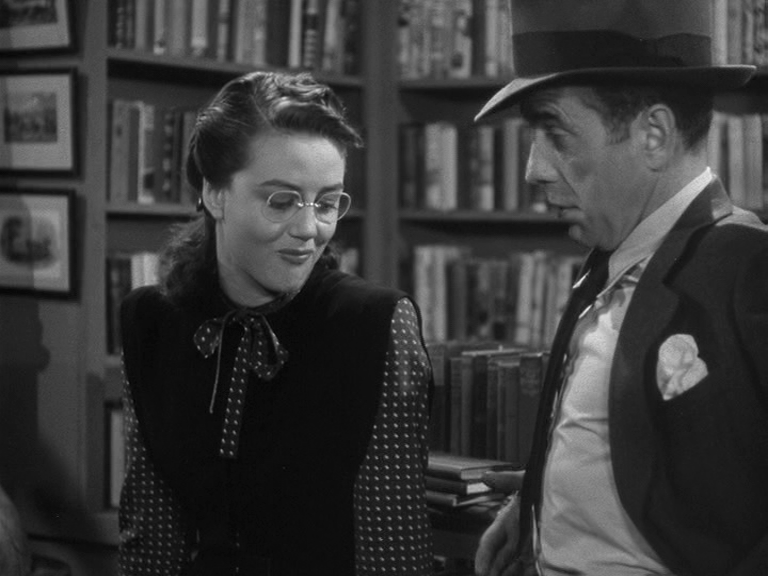
The labyrinthine mystery at the heart of “The Big Sleep” (1946) is so disorienting, even the book’s author, Raymond Chandler, couldn’t tell whodunit. Who cares? Humphrey Bogart and Lauren Bacall get some more steamy dialogue to satisfy fans of “To Have and Have Not,” and there’s plenty of Bogey pounding the pavement and tossing off tart one-liners in pursuit of the truth. But my favorite scene involves Dorothy Malone, who runs the hottest bookstore in town.
Whenever there are gallows to be built or gangsters to be beaten, Warner Brothers could be counted on to assign Max Steiner.
“Chinatown” (1974) is one of the best of the neo-noirs of the 1970s. This time, Jack Nicholson plays private dick J.J. Gittes, who takes on a seemingly routine case that begins to spiral out of control. When producer Robert Evans rejected Philip Lambro’s original score, Jerry Goldsmith stepped in as a last-minute replacement. The composer was hired with the understanding that he had only ten days to write and record new music. For his effort, Goldsmith received an Academy Award nomination.
The Coen Brothers clearly love noir, from their first feature, “Blood Simple,” to their Academy Award winners, “Fargo” and “No Country for Old Men,” to their absurdly entertaining reimagining of “The Big Sleep,” “The Big Lebowski.” “Miller’s Crossing” (1990) was one of the more underappreciated of these. The film follows the well-worn device of an anti-hero playing two sides off of one another, until he is the last one standing – shades of Dashiell Hammett’s “Red Harvest,” with a healthy dose of “The Glass Key” thrown in, for good measure. The Irish-inflected score is by Coen regular Carter Burwell.
Before he became stereotyped as a composer for epic films like “Ben-Hur,” “King of Kings” and “El Cid,” Miklos Rozsa was the king of noir, providing scores for genre classics such as “Double Indemnity” and “The Strange Love of Martha Ivers.” We’ll hear a suite assembled from three such projects: “Brute Force” (1947), a hard-hitting prison drama, starring Burt Lancaster as a desperate inmate and a contemptible Hume Cronyn as a sadistic guard; “The Killers” (1946), also starring Lancaster as a marked boxer; and “The Naked City” (1948), with Barry Fitzgerald leading a police investigation into the murder of a young model. The suite is titled “Background to Violence.”
Put on your rumpled linen suit, draw the Venetian blinds, and play the sap for nobody this week. It’s film noir in the gritty city, on “Picture Perfect,” music for the movies, this Friday evening at 6:00 EST, on WWFM – The Classical Network and at wwfm.org.
The theatrical trailer for “Brute Force”:
PHOTO: Bogart discusses literature with Dorothy Malone