• Election Day Music Escape American Composers

    Election Day Music Escape American Composers

    by 

    in
    7 responses

    It’s Election Day – AT LAST???

    In 24 hours, it will all be over, except for the lawsuits, the counter-lawsuits, and the recounts.

    Join me in rising above the the anxiety with an afternoon of inspirational music. We’ll begin with a concert featuring PUBLIQuartet, captured live during last season’s Downtown Concert Series in Freehold, NJ. The program will include music by Britten, Debussy, Piazzolla, and Villa-Lobos, alongside works by contemporary American composers, such as Pulitzer Prize winner Caroline Shaw.

    PUBLIQuartet reinvigorates the classical chamber repertoire with plenty of sass and panache. The ensemble caught the attention of The Late Show with Stephen Colbert. Colbert invited them to perform an improvised soundtrack to a live stream of the final presidential debate in real time on the show’s Facebook page.

    The Downtown Concert Series’ next concert will feature the Mobius Trio, which will appear at historic St. Peter’s Church in Freehold on Saturday at 7:30 p.m.

    Following today’s broadcast of PUBLIQuartet, I hope you’ll stick around for more American music. Aaron Copland will make a statement with his “Statements for Orchestra,” from 1934. Peter Boyer will remind us of the American Dream, with “Ellis Island: The Dream of America,” a work that employs the actual words of immigrants who came to this country in search of a better life. Peter Schickele will stir the musical melting pot with his String Quartet No. 1 “American Dreams,” from 1983, a piece reflective of Appalachian fiddle music, fox trots, waltzes, blues, bop, and even birdsong. And if you don’t like the way the returns are going, you can always contemplate foreign real estate with Michael Torke’s “An American Abroad,” from 2002.

    Why worry? It won’t change anything. So why not make us your stress-free zone? Relax, recharge, and rejoice in the American experience, from 12 to 4:00 p.m. EST. It will be the second leg of a marathon of American music, from 9 a.m. to 8 p.m., on WWFM – The Classical Network and at wwfm.org.
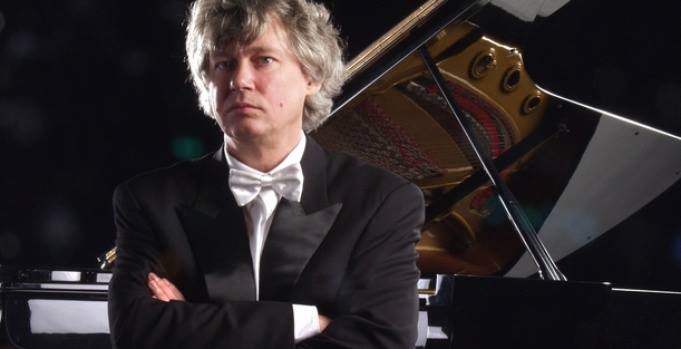

  • Zoltán Kocsis Hungarian Pianist Dies at 64

    Zoltán Kocsis Hungarian Pianist Dies at 64

    by 

    in
    2 responses

    A great pianist has died. Hungarian pianist and conductor Zoltán Kocsis died yesterday afternoon. He was 64 years-old. This is especially disturbing to me, since on all my recordings he looks like a kid. And then it occurred to me, he was only 38 when he received the Gramophone Award for his fine album of Debussy piano works. Is 1990 really so far away? Time is passing.

    Kocsis cofounded the Budapest Festival Orchestra with Iván Fischer in 1983 (again, so long ago). He became chief conductor and artistic director of the Hungarian National Philharmonic in 1997. His recordings of Debussy and Bartók are particularly fine. He was also a great champion of the works of György Kurtág (who, at 90 years-old, is still very much with us).

    I’ll be honoring Kocsis this afternoon with some of his recordings, between 4 and 7:00 EST, on WWFM – The Classical Network and at wwfm.org.

    Kocsis obituary in the Washington Post. Brace yourself for the photo.

    https://www.washingtonpost.com/entertainment/music/hungarian-pianist-and-conductor-zoltan-kocsis-dies-at-age-64/2016/11/06/de032dee-a457-11e6-ba46-53db57f0e351_story.html


  • Nordic Soul Autumn Music Langgaard Rautavaara

    Nordic Soul Autumn Music Langgaard Rautavaara

    by 

    in
    4 responses

    This Sunday night on “The Lost Chord,” it’s autumn in the North countries, as well as in the Nordic soul. We’ll test your limits on gratuitous vowels, with music by Danish composer Rued Langgaard and Finnish master Einojuhani Rautavaara.

    Langgaard lived from 1893 to 1952. Despite a promising start – born to musical parents, a prodigious childhood, meetings with major conductors, and a symphony performed by the Berlin Philharmonic – his personal and creative eccentricities worked against him.

    Perpetually out of step with the times, and particularly with the musical tastes of his countrymen, performances of his works were scarce. He found himself ignored by the musical establishment, with the result that his music really only started to be recognized in the 1960s – 16 years after the composer’s death.

    Langgaard was 46 by the time he managed to obtain a permanent job, as an organist at the cathedral in Ribe. It was the oldest town in Denmark, and situated far, far from Copenhagen, the center of Danish musical life. He would die in Ribe at the age of 59.

    He wrote 16 symphonies. The fourth of those bears the subtitle “Fall of the Leaf.” Beyond a simple evocation of autumnal nature, complete with thunderstorms, wind and rain, the symphony is one of moods related to, or symbolized, by autumn. The composer originally called the work “Nature and Thoughts.”

    Rautavaara, Finland’s grand old man of music, died in July at the age of 87. He studied at the Sibelius Academy in Helsinki, under Aare Merikanto, before receiving a scholarship to attend the Juilliard School. Among his teachers in the United States were Vincent Persichetti, Roger Sessions and Aaron Copland. He himself taught for extended periods at the Sibelius Academy.

    As a composer, he wrote eight symphonies, 14 concertos, and nine operas, as well as choral, chamber and instrumental music. His most famous piece is probably his “Cantus Arcticus,” for taped bird song and orchestra.

    Early on, Rautavaara experimented with serialism (though he was never a strictly serial composer), but in the 1960s, he left all that behind. His mature style is frequently one of austere beauty, marked by lyricism and even luminosity. His later works often bear something of a mystical stamp.

    We’ll be listening to music composed in 1999, titled “Autumn Gardens,” Rautavaara’s meditation on beauty in nature and the transience of life.

    I hope you’ll join me for “Fall of the Leif,” autumnal meditations from the North, this Sunday night at 10:00 EST, on WWFM – The Classical Network, and at wwfm.org.


    PHOTOS: Babe magnets Rued Langgaard (left) and Einojuhani Rautavaara


  • Guy Fawkes Night William Byrd’s Secret Plot

    Guy Fawkes Night William Byrd’s Secret Plot

    by 

    in
    8 responses

    Remember, remember, the Fifth of November – and don’t forget to turn your clocks for an extra hour of Guy Fawkes Night! Daylight Saving Time ends at 2 a.m. Sunday.

    https://en.wikipedia.org/wiki/Guy_Fawkes_Night

    William Byrd, a “Gentleman of the Chapel Royal,” was one of the best loved and certainly one of the most powerful musicians in England. In 1575, Queen Elizabeth granted him and Thomas Tallis (who had been a “Gentleman” from the time of Henry VIII) a 21 year monopoly on polyphonic music and a patent to print and publish music.

    Despite Byrd’s favored status within the Anglican church, he converted to Catholicism, and even rubbed shoulders with Robert Catesby, who formulated the Gunpowder Plot to blow up Parliament in 1605, during the reign of James I, for which Guy Fawkes gained his undying notoriety.

    Though Byrd was never subject to imprisonment for his religion, he was involved in numerous lawsuits and subject to heavy fines. Elizabeth interceded on his behalf at least once. He participated in illegal services, and the texts he chose to set to music could, at times, have a subversive edge. In particular, as a Catholic in a Protestant country, he became fond of texts relating to persecution. Comparatively speaking, he went unmolested, because of his record of allegiance to the crown.

    Learn more about Byrd here:

    https://en.wikipedia.org/wiki/William_Byrd

    The secret life of William Byrd:

    http://www.telegraph.co.uk/news/religion/10323301/The-secret-life-of-William-Byrd.html

    Byrd’s motet, “Ne irascaris Domine” (“Do not be angry, Lord”), from his “Cantiones sacrae”:


    PICTURED: Gunpowder Plot conspirators


  • Sherlock Holmes Movie Music on WWFM

    Sherlock Holmes Movie Music on WWFM

    by 

    in
    4 responses

    The game’s afoot! It’s an afternoon of mystery and imagination.

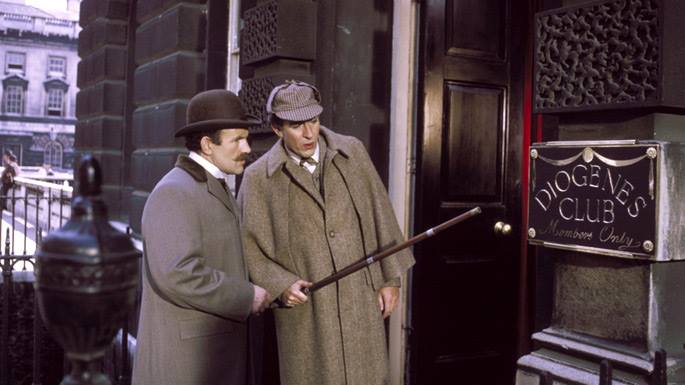
    This week on “Picture Perfect,” the focus will be on films inspired by the world’s greatest detective, including “Sherlock Holmes” (2009), with music by Hans Zimmer, “The Private Life of Sherlock Holmes” (1970), with music by Miklos Rozsa, “Without a Clue” (1988), with music by Henry Mancini, and “Young Sherlock Holmes” (1985), with music by Bruce Broughton. That’s all coming up at 6:00 EDT.

    To get you in the mood, I’ll be playing Rozsa’s Violin Concerto in the 4:00 hour, a work director Billy Wilder listened to incessantly while writing his screenplay for “The Private Life” and upon which he requested the composer base his film score.

    Then in the 5:00 hour, we’ll have the Sherlock Holmes ballet, in all-but-name, “The Great Detective,” by English composer Richard Arnell.

    In the words of Holmes himself, “Once you eliminate the impossible, whatever remains, no matter how improbable, must be the truth.” Join me for an afternoon of improbably good music, from 4 to 7:00 EDT, on WWFM – The Classical Network and at wwfm.org.


Tag Cloud

Aaron Copland (93) Beethoven (95) Composer (114) Film Music (144) Film Score (143) Film Scores (255) Halloween (94) John Williams (195) KWAX (229) Leonard Bernstein (104) Marlboro Music Festival (125) Movie Music (159) Mozart (91) Opera (213) Philadelphia Orchestra (89) Picture Perfect (174) Princeton Symphony Orchestra (109) Radio (88) Ross Amico (244) Roy's Tie-Dye Sci-Fi Corner (290) The Classical Network (101) The Lost Chord (269) Vaughan Williams (105) WPRB (397) WWFM (881)

DON’T MISS A BEAT

Receive a weekly digest every Sunday at noon by signing up here


RECENT POSTS