• Easley Blackwood Composer Dies at 89

    Easley Blackwood Composer Dies at 89

    by 

    in
    6 responses

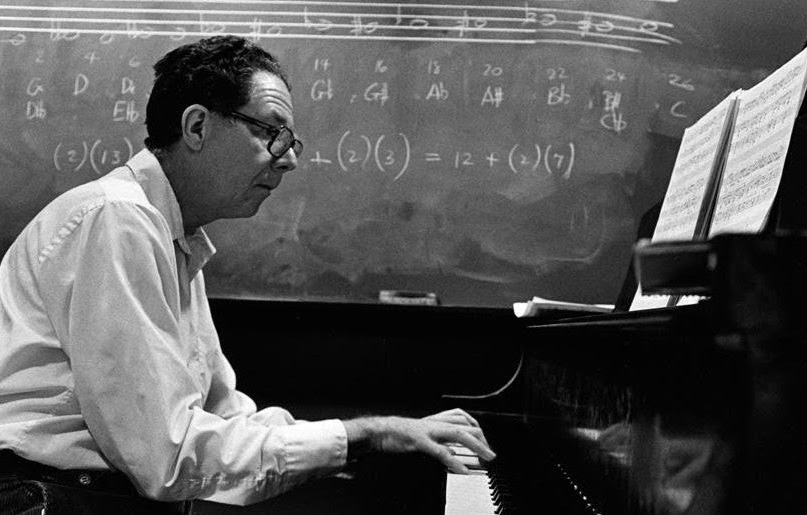
    A black day for admirers of Easley Blackwood. The composer, pianist, theorist, and teacher has died at the age of 89. Blackwood, who taught at University of Chicago for 40 years, studied with Olivier Messiaen, Paul Hindemith, and Nadia Boulanger. He was a founding pianist of the chamber group Chicago Pro Music, otherwise made up of musicians from the Chicago Symphony Orchestra. Among his original compositions are five symphonies, sundry concertos, and “Twelve Microtonal Etudes for Electronic Music Media.” His book, “The Structure of Recognizable Diatonic Tunings,” was published by Princeton University Press. A cross-section of his music and recordings of his performances of other composer’s piano works are available on Cedille Records. And yes, his father was the famed contract bridge player. R.I.P.


    Symphony No. 2, with George Szell and the Cleveland Orchestra

    Microtonal Compositions

    String Quartet No. 3

    Chaconne for Carillon!

    Blackwood’s arrangement of Rimsky-Korsakov’s “Capriccio espagnol”

    Interview with Bruce Duffie

    http://www.bruceduffie.com/blackwood.html


  • Lunar New Year Year of the Rabbit Classical Music

    Lunar New Year Year of the Rabbit Classical Music

    by 

    in
    4 responses

    新年快乐 / 新年快樂

    Happy Lunar New Year! And what’s up, doc? It’s the Year of the Rabbit!

    Celebrate with another colorful and substantial work by Zhou Tian. “Gift” was commission by the Shanghai Symphony Orchestra and given its premiere there in September 2019. It was first performed in the U.S. by the New York Philharmonic in January 2020.

    Then enjoy a festive playlist at the links below.

    Li Huanzhi, “Spring Festival Overture,” with the Philadelphia Orchestra

    Sun Yi Qian, “Spring Dance,” with Lang Lang

    Ma Sicong (Philly exile during the Cultural Revolution), “Spring Dance”

    Chen Yi, “Spring Rain” (text: Du Fu, “Happy Rain on a Spring Night”)

    Masked medley

    Happy New Year from the TENG Ensemble


  • Shostakovich Plays Shostakovich: A Lost Chord

    Shostakovich Plays Shostakovich: A Lost Chord

    by 

    in
    3 responses

    Of the great composers, none enjoyed football more than Dmitri Shostakovich. Russian football, that is. On one occasion he even invited the entire Leningrad Dynamo over to his apartment for dinner.

    This Sunday night on “The Lost Chord,” coinciding with the NFL playoffs, we’ll hear selections from a 5-CD boxed set, on the Melodiya label, of Russian state recordings of Shostakovich performing his own music.

    Admittedly, emphasizing Shostakovich’s rabid enthusiasm for football is something of a bait-and-switch. The show has nothing at all to do with the sport. However, Shostakovich really did love football (i.e. soccer) and all kinds of sports and games of chance.

    Concerning the show itself, Shostakovich was a fabulous pianist, who, early on, eked out a living with his improvisations at a local cinema. He began serious studies at the age of 9, and continued, formally, at the Petrograd Conservatory, upon his acceptance there, at the age of 13. Once he began to receive international attention for his original compositions, for works such as his Symphony No. 1, written when he was only 19, his principal focus began to shift. He did, however, continue to perform and record his own music.

    The documents in this Melodiya set, “Shostakovich Plays Shostakovich,” are riveting, not only for the musicianship they enshrine, but also on account of their biographical fascination and their sense of history.

    Perhaps no Shostakovich recording is imbued with a greater sense of time and place than a 1954 performance of his Symphony No. 10. An arrangement, for piano four-hands, was played by the composer at his apartment with his close friend and neighbor Mieczyslaw Weinberg.

    Weinberg found himself in a very precarious situation only the year before. He was arrested on a charge of “Jewish bourgeois nationalism,” in connection with the so-called Doctor’s Plot, at the command of Stalin himself, on the pretense that Jewish doctors were planning to assassinate Soviet officials. Weinberg’s father-in-law had been implicated, and killed. Shostakovich attempted to intercede on his friend’s behalf, but it was only with the sudden and fortuitous death of Stalin in 1953 that Weinberg was officially rehabilitated, and released.

    In a piece of living history, these two artists sit down to perform on Shostakovich’s home piano. This is music that was claimed, in Solomon Volkov’s “Testimony,” Shostakovich’s alleged memoir, to be about Stalin and the Stalin years.

    The pianos used in some of these recordings may be a little rough around the edges, but they only lend to the neurotic intensity of the music-making. It’s also a kind of window into what it must have been like to have been a musician in Soviet Russia, between 1946 and 1958, commandeering whatever means of expression you could lay your hands on.

    I hope you’ll join me for “Black and White and Red All Over.” Shostakovich tickles the keys, this Sunday night at 10:00 EST, on WWFM – The Classical Network and wwfm.org.


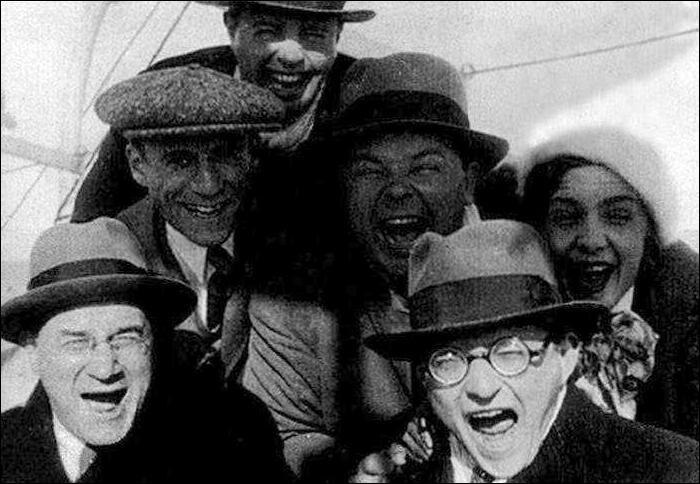
    PHOTO: Shostakovich (lower right), with fellow Soviet football fans


  • Destination Moon & Sci-Fi Nostalgia

    Destination Moon & Sci-Fi Nostalgia

    by 

    in
    4 responses

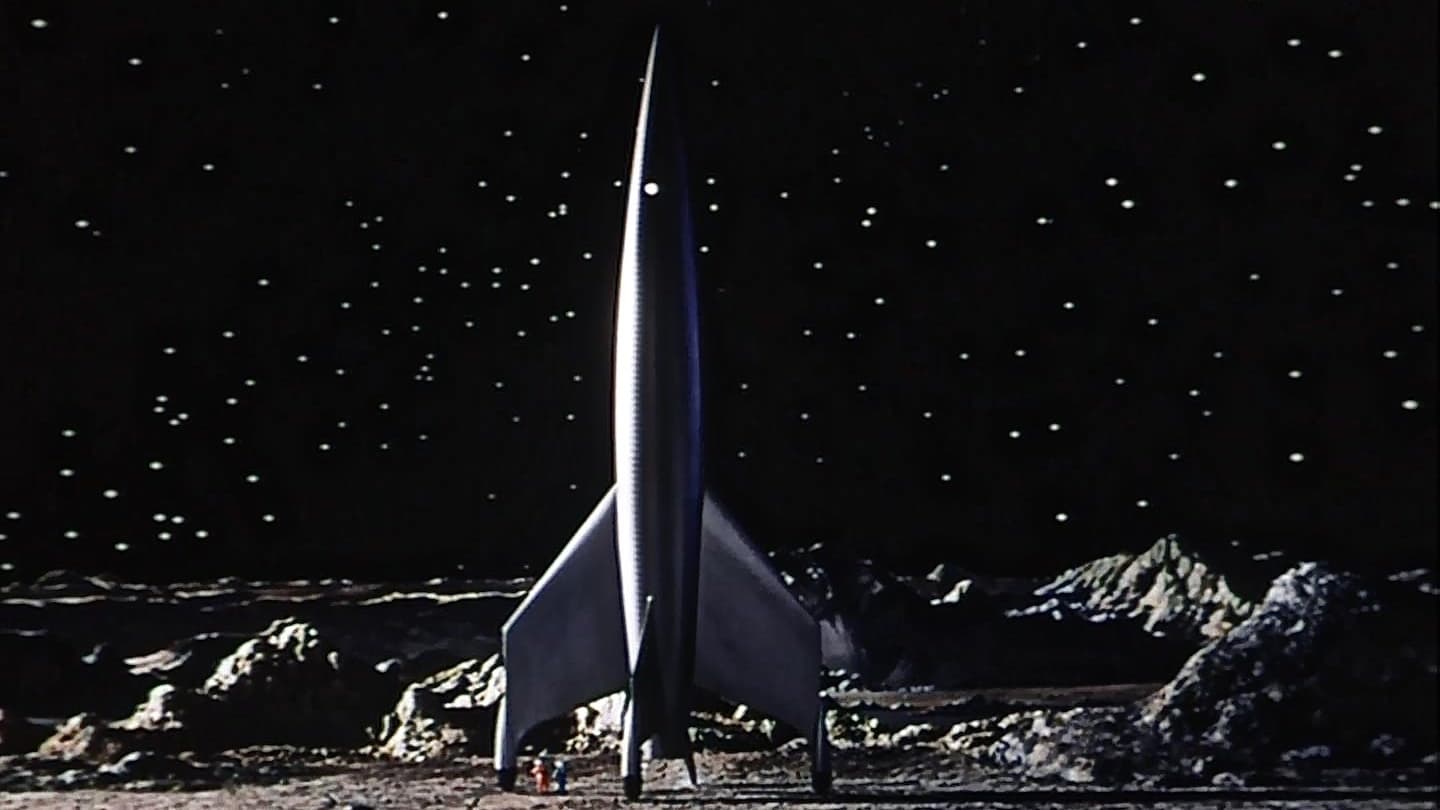
    We made it there and back again last night in our discussion of “Destination Moon” (1950). But unlike the astronauts in George Pal’s scrupulously scientific sci-fi classic, we were blithely unconcerned about stripping down our vessel for the return journey. For one thing, with a cup of coffee in me, there was no chance of running out of fuel. Hence, another two-hour conversation about a 90-minute movie.

    Highlight of the night: when Roy’s dad joined us by telephone to share his recollections of seeing the film in the theater on its original release as a ten year-old boy – the same age Roy and I were when we first saw “Star Wars.”

    Check out the movie, if you’ve never seen it, and marvel at everything they got right, even as you acknowledge everything they didn’t, years before anyone had ever been to space. And note the difference in tone from that of the grim world we live in today. A more hopeful time? Or an optimistic pose to suit the story?

    Then enjoy our exchange, with contributions from Mr. Bjellquist and viewer commenters, at the link.

    Next week, we’re very excited to welcome Patrick Read Johnson, whose own youthful obsession with science fiction propelled him to a career in Hollywood. His pet project, “5-25-77” (2022), reflects his coming-of-age as an aspiring filmmaker in a small Midwestern town around the time of the release of “Star Wars” (on May 25, 1977). A couple of weeks ago, we used the film as a springboard to discuss our own boyhood fascinations with “2001,” “Planet of the Apes,” “Star Wars,” and “Close Encounters of the Third Kind,” and how they informed our parallel experiments making Super-8 films.

    Now we’ll have a chance to hear all about Johnson’s career (including his work on the “Dragonheart” franchise) and hopefully plenty of behind-the-scenes morsels, like the details of his real-life meetings with Douglas Trumbull, John Dykstra, and Steven Spielberg – and what it was like to be one of the first people to be shown a rough cut of “Star Wars” before it ever reached a theater.

    Bring your nostalgic awe to the next Roy’s Tie-Dye Sci-Fi Corner, and bring your questions to the comments section, when we livestream on Facebook, YouTube, etc., next Friday evening at 7:30 EST!

    https://www.facebook.com/roystiedyescificorner


  • Fantastic 18th Century Adventures

    Fantastic 18th Century Adventures

    by 

    in
    3 responses

    The Enlightenment isn’t exactly remembered for its flights of fancy. If the odd novel embraced a fantastic tone, it was frequently in the service of satire, an entertaining means to send-up contemporary mores and pursuits or to mock authority figures and good old reliable human frailty. This week on “Picture Perfect,” we’ll explore a few of these fantastic adventures of the 18th century.

    “The Surprising Adventures of Baron Munchausen” (1785) pokes fun at one Hieronymus Karl Friedrich, Freiherr von Münchhausen, a German nobleman and veteran of the Russo-Turkish War, whose reputation for telling outrageous tall tales is lampooned by Rudolf Erich Raspe. Raspe, looking to avoid a libel suit, published the work anonymously, with the result that it was commonly believed that the Baron actually dictated the tales himself. Naturally, the real-life Munchausen was upset by the unwanted attention. Thanks to Raspe, his very name came to be associated with feigned illness and pathological lying.

    The book has been adapted to film several times, beginning with a silent version by Georges Méliès, all the way back in 1911. We’ll be listening to music from two subsequent adaptations. The first, “Münchhausen” (1943), is undeniably entertaining and exceptionally well-made. However, undermining one’s enjoyment is a sense of unease in the knowledge that the film was a pet project of Joseph Goebbels, who wanted to celebrate the 25th anniversary of the UFA film studio by producing a lavish spectacle worthy to stand toe-to-toe with foreign efforts like “The Wizard of Oz” and “The Thief of Bagdad.”

    Considering the source, one would have to look awfully hard to come up with anything resembling Nazi propaganda. The entire exercise comes across as a pastoral escape from the horrors of totalitarianism, total war, and the Final Solution. The elegant music, by Georg Haentzschel, would not be out of place in the concert hall. Haentzschel is regarded as perhaps the last representative of a generation of Middle European light music composers.

    More than 40 years later, director Terry Gilliam undertook another production design-driven adaptation that resembles nothing if not a series of Doré illustrations brought to life. Contrary to received wisdom, “The Adventures of Baron Munchausen” (1988) managed to pull in a respectable amount of per-screen capital. The film was a casualty of a management turnover at Columbia Pictures, with the new regime eager to bury the projects of the old. Hence, it was never seen theatrically beyond a very limited release. The score, by Michael Kamen, while in a romantic heroic style, wittily contains abundant allusions to music of the 18th century.

    “The Manuscript Found in Saragossa” (1805) is a transitional work, with its ecstatically lurid opening chapter – replete with gypsy storytellers, highwaymen, dueling skeletons, lesbian vampires, and a couple of corpses dangling in a gibbet – dragging the Enlightenment kicking and screaming into the Romantic age. It starts out as a masterpiece of surrealism, by way of Gothic convention, but the spell is eventually broken, sadly, by a large, cold bucket of Enlightenment water, in the form of a perfectly rational explanation at the end. But until then, the author, Jan Potocki, gets an A for effort. The interlocking structure, with stories inside stories inside stories looks ahead to postmodern experiments by writers like Italo Calvino and John Barth, to say nothing of Jorge Luis Borges.

    The book was made into an acclaimed Polish film, “The Saragossa Manuscript,” in 1965. Its cult status led to a restoration financed by Jerry Garcia, Martin Scorsese, and Francis Ford Coppola that was released on VHS and DVD in 2001.

    Who else could provide the perfect soundtrack to such a hallucinogenic experience but Krzysztof Penderecki? Penderecki intersperses spooky passages with neo-classical and baroque interludes.

    Finally, we’ll hear music from one of the many adaptations of Jonathan Swift’s “Gulliver’s Travels” (1726). “The Three Worlds of Gulliver” (1960) simplifies the book’s narrative and dispenses with a great deal of the misanthropic humor in favor of children’s fantasy. You won’t catch Gulliver extinguishing a fire in the Lilliputian Emperor’s palace with his urine in this version. What you will find is a good deal of technical wizardry and a delightful score by Bernard Herrmann.

    What, you doubt my veracity? Then surely the music must speak for itself. Join me for fantastic adventures in the 18th century, this Saturday evening at 6:00 EST, on WWFM – The Classical Network and wwfm.org.


    PHOTO: A fancy flight with Baron Munchausen

Tag Cloud

Aaron Copland (93) Beethoven (95) Composer (114) Film Music (145) Film Score (143) Film Scores (255) Halloween (94) John Williams (195) KWAX (229) Leonard Bernstein (104) Marlboro Music Festival (125) Movie Music (160) Mozart (91) Opera (213) Philadelphia Orchestra (89) Picture Perfect (174) Princeton Symphony Orchestra (109) Radio (88) Ross Amico (244) Roy's Tie-Dye Sci-Fi Corner (290) The Classical Network (101) The Lost Chord (269) Vaughan Williams (105) WPRB (397) WWFM (881)

DON’T MISS A BEAT

Receive a weekly digest every Sunday at noon by signing up here


RECENT POSTS