• Farrenc’s Third Symphony Shines in Philly

    Farrenc’s Third Symphony Shines in Philly

    by 

    in
    7 responses

    After attending a performance of Louise Farrenc’s Second Symphony by The Philadelphia Orchestra back in February 2020 (only weeks before everything would be shut down due the pandemic), I tagged the organization on Facebook, lauding its decision to include it in its programs and urging them to tackle Farrenc’s Third. The most compelling of her symphonies, the Third is bold and energetic, and it’s got some genuinely good tunes. I’ve played it on the radio many times. And now, lo and behold, here it is, this weekend, on a series of concerts with Brahms’ Piano Concerto No. 2.

    If you’re unfamiliar with Farrenc, she was the only female professor at the Paris Conservatory during the whole of the 19th century. A pupil of Moscheles (teacher of Mendelssohn) and Hummel (who studied with Mozart), she was a formidable pianist, who also took private lessons with Conservatory professor Anton Reicha. She paused in her career as a performer in order to start a successful publishing house with her husband, Éditions Farrenc, that flourished for nearly 40 years.

    In 1842, at the age of 38, Farrenc was finally hired as a professor at the Conservatory. There, she taught piano, but not composition. And she was only allowed to teach women. However, her stature was such that she was able to demand – and receive – equal pay.

    Before the Philadelphia performance of her Second Symphony, I have only ever encountered her works on recordings, issued on some of the more enterprising independent labels.

    With apologies to Brahms, a marvelous composer, but so insanely overexposed that his Second Piano Concerto appears on no less than three series of concerts in my area within a month (by the New Jersey Symphony, the Princeton Symphony Orchestra, and of course Philadelphia), I will be rocketing in to Philly this afternoon to attend the first half of today’s matinee, then will be on the road back at intermission, arriving home in time to enjoy a cup of coffee and get ready for tonight’s appearance on Roy’s Tie-Dye Sci-Fi Corner.

    Brahms is great, but he only wrote so many concertos (four, to be exact, and – even more abused – an equal number of symphonies). I’m not discouraging anyone from attending the second half of the Philadelphia concerts. The Second Piano Concerto is an inspiring piece, and the soloist, Seong-Jin Cho, was First Prize winner at the Chopin International Competition in Warsaw in 2015. But this month, he’s also in competition with Daniil Trifonov (with the New Jersey Symphony) and Inon Barnatan (with the Princeton Symphony Orchestra) in this repertoire. And they’re both performing in my hometown.

    BTW, the Philadelphia ticket was only $22 (before the handling fee). So don’t think you have to mortgage your house in order to hear some good music. This isn’t like attending a rock concert or a baseball game.

    The program will be presented at the Kimmel Center for the Performing Arts, Broad & Spruce Sts., today at 2 p.m. and tomorrow at 8 p.m. For more information, visit philorch.org.

    Thank you, Philadelphia Orchestra. I just want to let you know that it is Farrenc, not Brahms, that pulled me in!

  • Jerry Blavat Philly’s Geator Rocks On R.I.P.

    Jerry Blavat Philly’s Geator Rocks On R.I.P.

    by 

    in
    7 responses

    Broadcast legend Jerry Blavat, the Geator with the Heater, the Boss with the Hot Sauce, is dead at 82. My roommate and I used to call in to Blavat’s request program in Philadelphia back in the mid-1980s. Already, he seemed as if he had been around forever, but of course he was only in his 40s. On one memorable occasion, we got into an on-air contest of matching Woody Allen character names with their respective movies. These were simpler times, before the very mention of Woody stirred controversy. Of course, the Geator himself was not without his complexities. The Boss was saucy to the end, with his annual oldies all-star concert at Philadelphia’s Kimmel Center pending. As Jerry proclaimed in the title of his autobiography, you only rock once. R.I.P.

    Obituary in The Philadelphia Inquirer

    https://www.inquirer.com/obituaries/jerry-blavat-dies-82-philadelphia-geator-with-the-heater-20230120.html

    Talking Sinatra, the mob, and music in Philadelphia Magazine

    https://www.phillymag.com/news/2020/04/04/jerry-blavat-interview/

    With my editor, Dan Aubrey, in the Princeton weekly U.S. 1

    https://www.communitynews.org/news/legendary-dj-jerry-blavat-still-spinning-at-80/article_cf5b452a-ba38-5e2d-a45d-a6401b71050d.html


    PHOTOS: (left) The Geator strikes a characteristic pose; and (top to bottom) spinning discs at his club, Memories; with James Brown; and on “The Monkees”


  • Destination Moon Patriotic Space Travel

    by 

    in
    6 responses

    Damn the bureaucracy of government oversight – space travel is the patriotic duty of America’s entrepreneurs!

    Sure, George Pal’s “Destination Moon” (1950) is astonishing for revealing just how much was actually known or conjectured about space at that time. Really, it’s a remarkable film, in terms of scientific accuracy and educated guesswork as to what it would be like to actually travel to the moon. What a long way from Georges Méliès’ vision of being launched out of a cannon in 1902!

    But now the film is even more prescient than most of us ever realized, with the conquest of space having fallen to the tycoons and robber barons. Somehow, I think the creators of “Destination Moon” (including Robert A. Heinlein, upon whose story it is based) imagined more altruistic motives. They certainly held a more optimistic vision of humanity. Hence the pronouncement at the end of the film: “This is the end of the beginning!” How wonderful it must have been to live with such hope.

    This week on Roy’s Tie-Dye Sci-Fi Corner, we travel back to the future to talk about this genre classic, actually suggested to us by Roy’s dad, who will pop in to share some of his recollections of seeing the film as an impressionable boy. Hang around in the comments section (zero-G, of course) for a discussion of “Destination Moon,” when we livestream on Facebook, YouTube, etc., this Friday evening at 7:30 EST!

    https://www.facebook.com/roystiedyescificorner


  • Mimi Stillman Premieres Zhou Tian Flute Concerto

    Mimi Stillman Premieres Zhou Tian Flute Concerto

    by 

    in
    4 responses

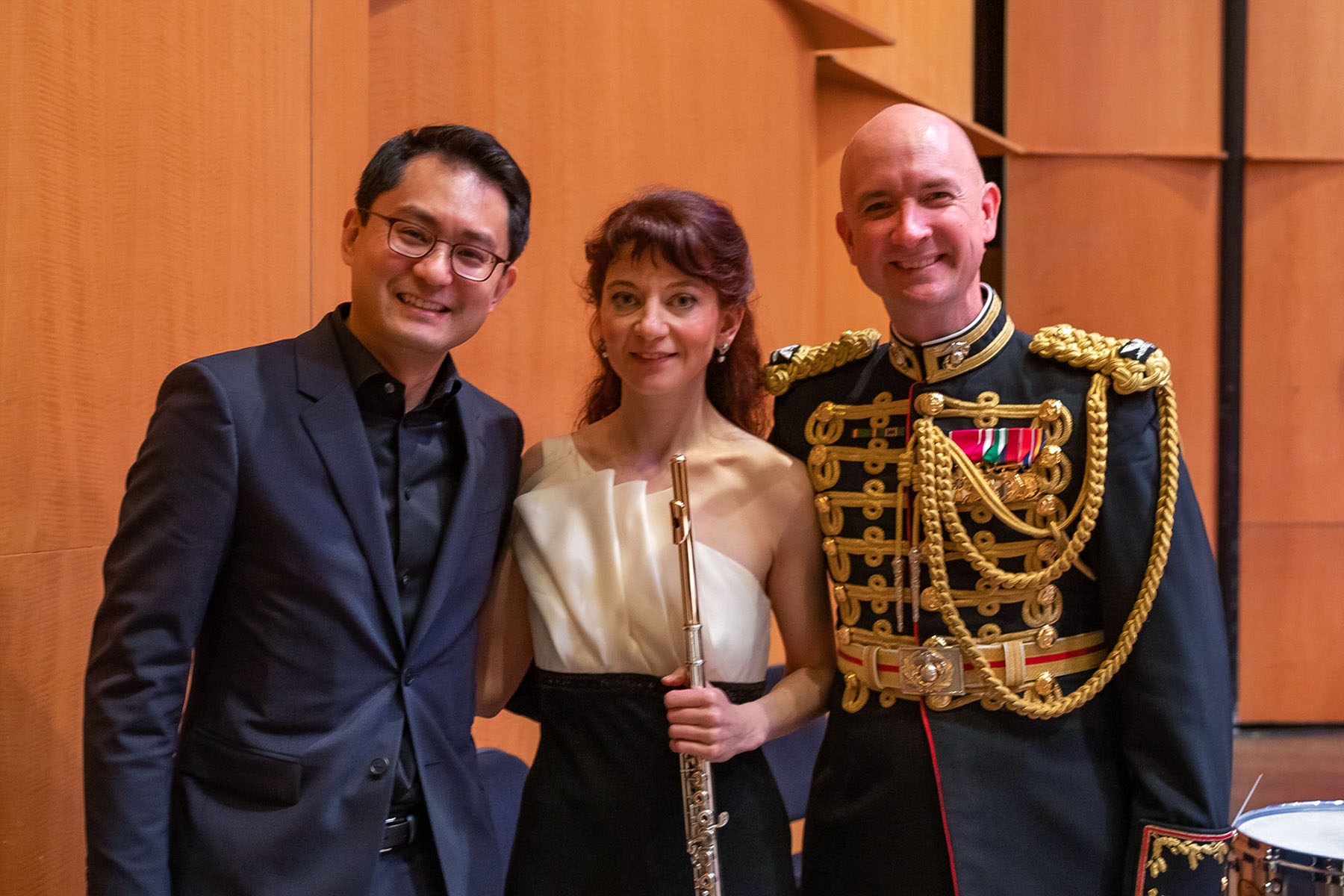
    Wow! Here’s Mimi Stillman with “The President’s Own” United States Marine Chamber Orchestra in the world premiere of a new flute concerto by Zhou Tian, composer. I’ve had the privilege to interview and record with Mimi a number of times over the years, and I know Zhou from having interviewed him for the Trenton Times and on the air during my days at WPRB. Both such personable and talented people! Definitely also do check out Zhou’s Grammy-nominated Concerto for Orchestra, recorded by the Cincinnati Symphony Orchestra. It’s a knockout! Mimi has many other wonderful videos posted on her page. Follow her! And congratulations to both.

    World premiere of Zhou’s Flute Concerto

    Live performance of his Concerto for Orchestra, with the Basque National Orchestra


    PHOTO: Zhou, Mimi, and the U.S. Marine Band’s Col. Jason K. Fettig


  • César Cui: The Forgotten Mighty Handful

    César Cui: The Forgotten Mighty Handful

    by 

    in
    One response

    Among the followers of Mily Balakirev that collectively came to be known as “The Mighty Handful” or “The Five,” unquestionably the least well-known is César Cui. Nikolai Rimsky-Korsakov, Modest Mussorgsky, and Alexander Borodin all went on to attain a kind of immortality in Russian music, each having left his indelible mark.

    Cui wrote 15 operas, believe it or not – one of them, “William Ratcliff,” earning the highest praise from Franz Liszt – but today, he is remembered, if at all, as a miniaturist, or perhaps as a composer of art song, and at that, the least Russian-sounding of the five.

    He shared in common with the others the fact that for him music was an avocation. He paid his bills as a military engineer. Beyond that, however, he was a bit of an outsider – born in Vilnius (now in Lithuania) to a father who had been a general in Napoleon’s army, who stayed and married a local. In addition to Russian, Cui grew up speaking French, Polish and Lithuanian. Perhaps this broader cultural perspective led to a more cosmopolitan approach to music.

    As a critic, he was prolific, and he could be blistering in his sarcasm. Perhaps most notorious was his reception of Rachmaninoff’s First Symphony:

    “If there were a conservatory in Hell, and if one of its talented students were to compose a program symphony based on the story of the Ten Plagues of Egypt, and if he were to compose a symphony like Mr. Rachmaninoff’s, then he would have fulfilled his task brilliantly and would delight the inhabitants of Hell. To us this music leaves an evil impression with its broken rhythms, obscurity and vagueness of form, meaningless repetition of the same short tricks, the nasal sound of the orchestra, the strained crash of the brass, and above all its sickly perverse harmonization and quasi-melodic outlines, the complete absence of simplicity and naturalness, the complete absence of themes.”

    The assessment plunged Rachmaninoff into a two-year depression, during which he was unable to compose until being lifted out of his funk by hypnotic therapy. Of course, today everyone knows Rachmaninoff’s music (if not his First Symphony). How many, I wonder, know Cui’s?

    On the anniversary of Cui’s birth, enjoy his “Deux morceaux” for cello and orchestra.

    25 Preludes for Piano, Op. 64

    Nocturne in F-sharp minor

    Suite No. 3 “In modo populari”

    Cui’s greatest hit? Perhaps “Orientale” from his collection for violin and piano “Kaleidoscope,” for many years a popular encore. Here are two contrasting treatments.

    Efrem Zimbalist

    and Midori

    Finally, the Carmen Dragon treatment

    A work that’s received a lot of notice since Covid: the one-act opera “A Feast in Time of Plague”

    Happy birthday, César Cui!


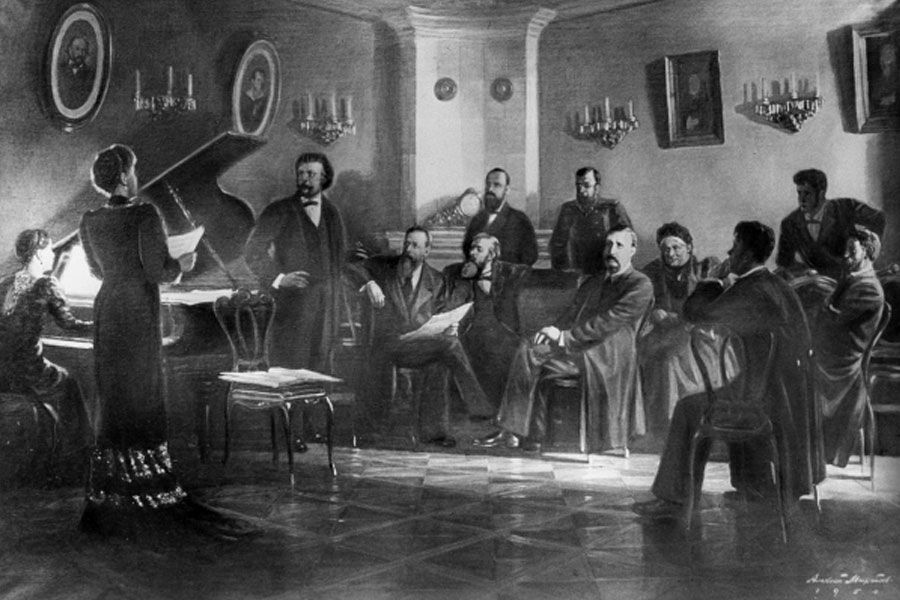
    IMAGE: With so many whiskers in the room, you know you must be in the company of The Five. Center, left to right: Modest Mussorgsky (standing, by the piano), Nikolai Rimsky-Korsakov, critic and champion Vladimir Stasov (seated), Mily Balakirev (standing behind), César Cui (standing, with spectacles), and Alexander Borodin (seated).


Tag Cloud

Aaron Copland (93) Beethoven (95) Composer (114) Film Music (145) Film Score (143) Film Scores (255) Halloween (94) John Williams (195) KWAX (229) Leonard Bernstein (104) Marlboro Music Festival (125) Movie Music (160) Mozart (91) Opera (213) Philadelphia Orchestra (89) Picture Perfect (174) Princeton Symphony Orchestra (109) Radio (88) Ross Amico (244) Roy's Tie-Dye Sci-Fi Corner (290) The Classical Network (101) The Lost Chord (269) Vaughan Williams (105) WPRB (397) WWFM (881)

DON’T MISS A BEAT

Receive a weekly digest every Sunday at noon by signing up here


RECENT POSTS