Last night’s concert of the @[100043116381457:2048:Princeton Symphony Orchestra] was a triumph, with possibly the best “Knoxville: Summer of 1915” I have ever heard. Congratulations to the PSO for securing Angel Blue on such short notice. (Pretty Yende, the scheduled artist, was forced to cancel due to illness.) The “encore,” for which Blue invited a voice student from the audience to join her in Puccini’s “O mio babbino caro,” was a masterstroke. Yasmine Swanson rose to the occasion, sending the audience into the night with smiles on their faces. The concert will be repeated this afternoon at 4:00 at Princeton’s Richardson Auditorium.
-
PSO’s Angel Blue thrills in Princeton
by
-
Patsy Kelly Steals the Show in Freaky Friday
by
One response
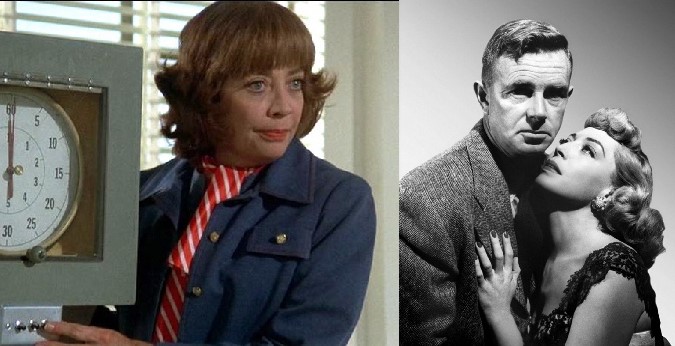
Well, once again, I’m eating humble pie. The morning after Roy and my discussion of “Freaky Friday” (1976), during which I was not entirely convinced the housekeeper wasn’t played by Marie Windsor, I discover Roy was correct and that the unflattering character was indeed played by Patsy Kelly.
In common with Windsor, Kelly was another Golden Age actor, a brash supporting player, who often (yes) played a maid. Or a gun moll. Or a wacky sidekick. She was one smart-talking, sassy dame. In 1933, a serious accident that compromised her lungs brought a diagnosis of only ten years to live, but Kelly wound up carrying on for decades. Likely, she was just too cantankerous to die.
At first, she didn’t think much of Hollywood, but she came to adore film in all its facets. However, it was the stage that was her first love, and she won a Tony Award for her work in the 1971 Broadway revival of “No, No, Nanette.” To my knowledge, the only other “modern” movie I’ve seen her in is “Rosemary’s Baby,” and there, I have to say, she looks quite different, on account of the coke bottle glasses.
Because of her unfortunate proximity to several actors who suffered untimely deaths (including Thelma Todd, Lyda Roberti, and Jean Malin), early on Kelly developed a reputation for being “bad luck.” So even though “Freaky Friday” is in itself set on Friday the 13th, Kelly only reinforces the appropriateness of our choice.
As for Windsor, I guess I just assumed that noir can age you hard, what with all the bourbon and cigarettes (to say nothing of the bullets). However, here it turns out Windsor is still looking quite well as Mrs. Murphy, Jodie Foster’s typing teacher. Like most of the supporting cast, she was onscreen for such a short time that if you blink, you’ll miss her. I must have been caught up in the drama of Annabelle’s typing exam.
In addition to always being easy on the eyes, Windsor had a sharp sense of humor. Though a beauty pageant winner, she got her real break in Hollywood after submitting jokes to Jack Benny under an assumed name. After she retired from acting, she devoted herself to painting and sculpture.
Favorite line in a Marie Windsor movie? It’s from the 1952 noir “The Narrow Margin,” uttered by Charles McGraw as the hardbitten police detective assigned to protect her, a mob boss’s widow, on a train ride from Chicago to L.A., where she’s expected to testify before a grand jury. Asked by his partner what he thinks of her, McGraw replies, “She’s a sixty-cent special: cheap, flashy, strictly poison under the gravy.”
Anyway, here she is, pictured upper left, still looking quite the dish, in “Freaky Friday,” and upper right, in her heyday with Sterling Hayden in Stanley Kubrick’s “The Killing.” I guess I must have been distracted by Barbara Harris. I’m glad Windsor didn’t have to suffer Kelly’s indignity of spinning on the back tire of a bicycle during the eyerolling final chase.
You can watch our whole “Freaky” conversation here:
Next week, Roy and I will tackle a George Pal classic fondly recollected by his dad, “Destination Moon” (1950). Breathe a sigh of relief in the comments section that we’re actually covering sci-fi, for a change, on the next Roy’s Tie-Dye Sci-Fi Corner. (Robert A. Heinlein contributed to the screenplay.) As always, the journey is the destination when we livestream on Facebook, YouTube, etc., next Friday evening at 7:30 EST!
-
Dystopian Visions in Film Scores
by
One response
If you think the world is in rough shape now, consider tomorrow.
This week on “Picture Perfect,” gaze into the crystal ball for an hour of dystopian visions – glimpses of a bleak future rendered hopeful, in large part, through music.
“Fahrenheit 451” (1966), based on the Ray Bradbury novel, presents a society in which books are outlawed by the state and burned as a means to control the masses. The title refers to the temperature at which paper will ignite. Oskar Werner and Julie Christie star in this Francois Truffaut-directed film. Composer Bernard Herrmann finds the heart at fire’s center.
A robot is left behind to clean up a long-abandoned Planet Earth, in “WALL-E” (2008), one of Pixar’s finely-crafted entertainments. This one has a serious subtext, about rampant consumerism and its impact on an earth made uninhabitable by the sheer volume of garbage. But there’s also a love story, as WALL-E pursues another robot into outer space, with fate-changing consequences. The inventive score is by Thomas Newman.
As dystopias go, Steven Spielberg’s “A.I.: Artificial Intelligence” (2001) is a little more unpleasant than most. “A.I.” grew out of an incomplete project of Stanley Kubrick. Based on Brian Aldiss’s short story, “Super-Toys Last All Summer Long,” the film stars Haley Joel Osment as a child-like android programmed to love, only to be rejected by his adopted family. Abrasive blood sport, unpleasant visions of a debauched city, and human extinction ensue. A great time is had by all!
Also, the film doesn’t know when to end. Oh, how I hate this movie.
That said, John Williams gives it his usual best. The voice of soprano Barbara Bonney graces the admittedly gorgeous soundtrack.
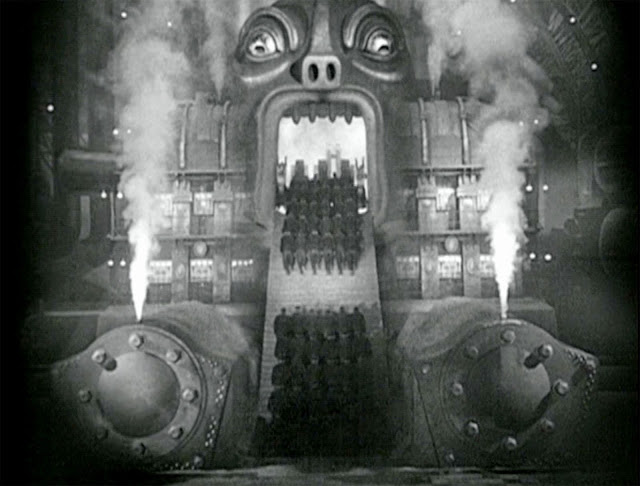
One of the landmarks of silent cinema, Fritz Lang’s “Metropolis” (1927) is an eerily prescient vision of a world divided between the “haves” and “have-nots.” Once seen, the subterranean hell of the workers “hive” is not soon to be forgotten. So much of the film continues to resonate, even as its iconography is shamelessly recycled.
Gottfried Huppertz’s original score already adheres to the Straussian model of Golden Age film scores, with leitmotifs representing the characters and ideas. It’s a concept that became associated with Max Steiner and Erich Wolfgang Korngold, and which has had an enormous influence on film composers down through the decades, all the way to John Williams and beyond.
Learn more about the challenges of writing such a complex score – which was performed live, with orchestra, at showings of the movie, even as the film was still being edited right up until its premiere – when listening to tonight’s show.
In the meantime, hang on to your humanity! Join me for these cautionary tales about totalitarian government, corporate control, and technology gone awry, on “Picture Perfect,” music for the movies this Saturday evening at 6:00 EST, on WWFM – The Classical Network and wwfm.org.
-
John Williams Of Grit and Glory ESPN College Football
by
4 responses
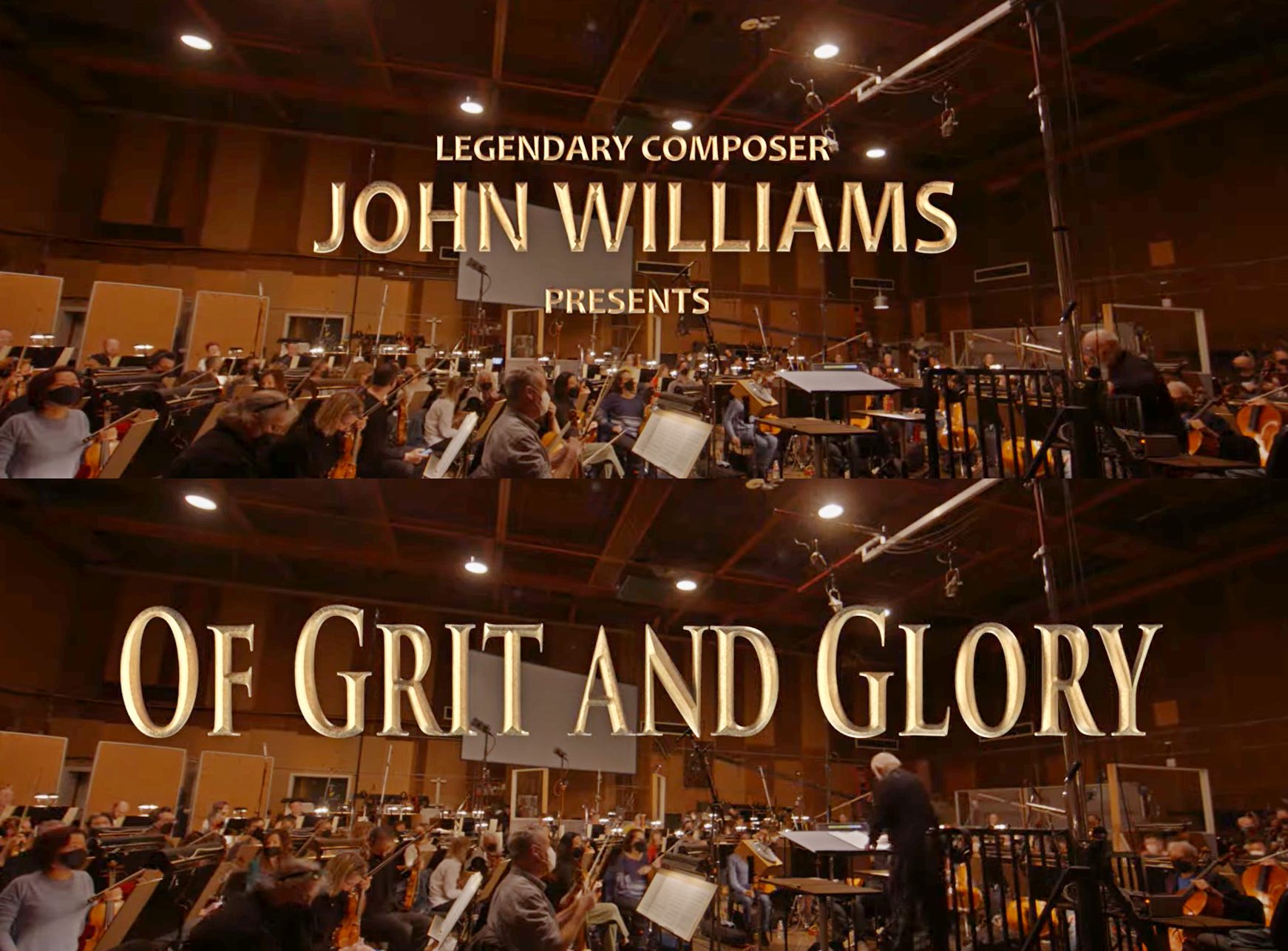
Just finally got around to watching the video for John Williams’ “Of Grit and Glory.” The new piece, composed for ESPN’s College Football Playoff National Championship, was heard for the first time on Monday, during the sports channel’s broadcast of the TCU-Georgia game at SoFi Stadium in Inglewood, CA. Watch it now, or save it for when you need an inspiring three minutes. Williams will be 91 on February 8.
-
Friday the 13th Composer Bad Luck and Triskaidekaphobia

by
4 responses
Suffering from triskaidekaphobia? On this Friday the 13th, here are just a few composers who were afflicted with extraordinarily bad luck.
Jean-Baptiste Lully, also an accomplished dancer, injured his toe while pounding the floor with a heavy stick to mark time; the resultant infection killed him.
Anton Webern violated curfew when he snuck out on his porch for a smoke and was shot by an American soldier.
Ernest Chausson lost control of his bicycle and fatally slammed into a brick wall.
Fire tore through Geirr Tveitt’s cabin and destroyed four-fifths of his compositional output, driving him to alcoholism.
Friedrich Kuhlau blinded himself when he fell on a bottle at the age of seven; later, he died of complications after being left out in the cold all night as his house burned to the ground.
Charles-Valentin Alkan was reaching for a copy of the Talmud, located on a high shelf, when his bookcase toppled, crushing him.
Henry Purcell developed pneumonia after his wife locked him out of the house for coming home late after one too many pub crawls.
Alexander Scriabin died of a septic carbuncle.
Tchaikovsky drank cholera-contaminated water.
Jean-Marie Leclair was found murdered in his room.
Alessandro Stradella was set upon by unidentified assassins.
None of these misfortunes occurred on Friday the 13th.
On the other hand, Arnold Schoenberg, a notorious triskaidekaphobe, died on his 76th birthday, Friday the 13th, 1951. Earlier in the day, he had been informed by his astrologer that 7 plus 6 equals… 13.
Paraskevidekatriaphobia – derived from the Greek words “paraskevi” (Friday) and “dekatria” (thirteen), with “-phobia” appended as a suffix to indicate “fear,” was coined in the early ‘90s by American psychotherapist Dr. Donald E. Dossey. He wryly remarked that when you’re able to pronounce the word, you’re cured.
In the meantime, don’t open any umbrellas indoors and try not to walk under any ladders. I’ll check in to see how your day went tomorrow.
BONUS! Giuseppe Verdi and the Evil Eye:
https://www.classicfm.com/composers/verdi/guides/verdis-curse-evil-eye/
Tag Cloud
Aaron Copland (93) Beethoven (95) Composer (114) Film Music (145) Film Score (143) Film Scores (255) Halloween (94) John Williams (195) KWAX (229) Leonard Bernstein (104) Marlboro Music Festival (125) Movie Music (160) Mozart (91) Opera (213) Philadelphia Orchestra (89) Picture Perfect (174) Princeton Symphony Orchestra (109) Radio (88) Ross Amico (244) Roy's Tie-Dye Sci-Fi Corner (290) The Classical Network (101) The Lost Chord (269) Vaughan Williams (105) WPRB (397) WWFM (881)
One response