With the lingering evidence of Thanksgiving both in our refrigerators and around our waistlines, it’s hardly surprising that our thoughts and memories would be full of home. Perhaps you still are “home,” with family and a full day of travel ahead of you, or you can’t wait to get home (your own).
Whatever the case may be, this Sunday night on “The Lost Chord,” we’ll have music by American composers inspired by the idea of home.
Our featured work will be “Magna Mysteria,” by John Fitz Rogers, from 2010. Rogers weaves together Latin biblical texts and poetic verse of the 6th century philosopher Boethius, to elevate the idea of home – and the seeking of home – to a metaphorical or spiritual realm. If you have a fondness for the choral music of Morten Lauridsen or Stephen Paulus, I think you’ll really enjoy this, though Rogers is very much his own man. The music is tonal, melodic, and quite lovely.
Also on the program will be Aaron Copland’s “Letter from Home,” from 1943-44. The work was commissioned by Paul Whiteman for his Radio Hall of Fame Orchestra, and suggests the emotions of an American soldier, as he experiences a bittersweet reprieve, if only for a few moments, while savoring a letter from his family.
There’s no place like home for the holidays. I hope you’ll join me for “Homebodies,” this Sunday night at 10:00 EST, on WWFM – The Classical Network and wwfm.org.
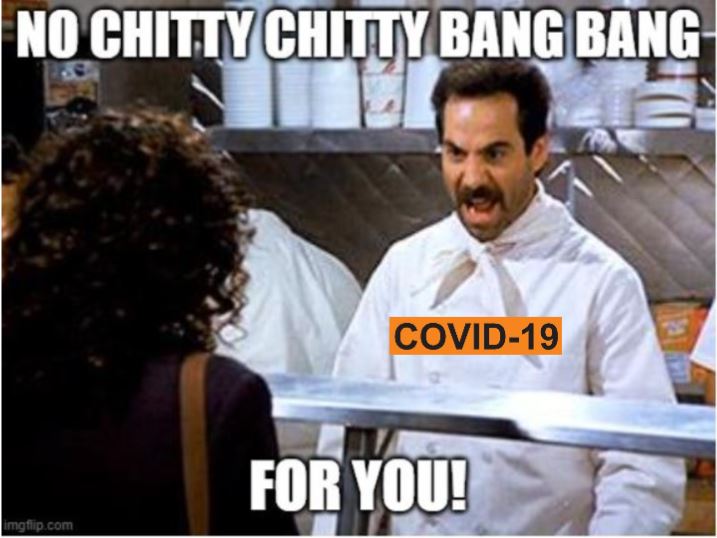
It pains me once again to have to deny you the “Chitty” you deserve!
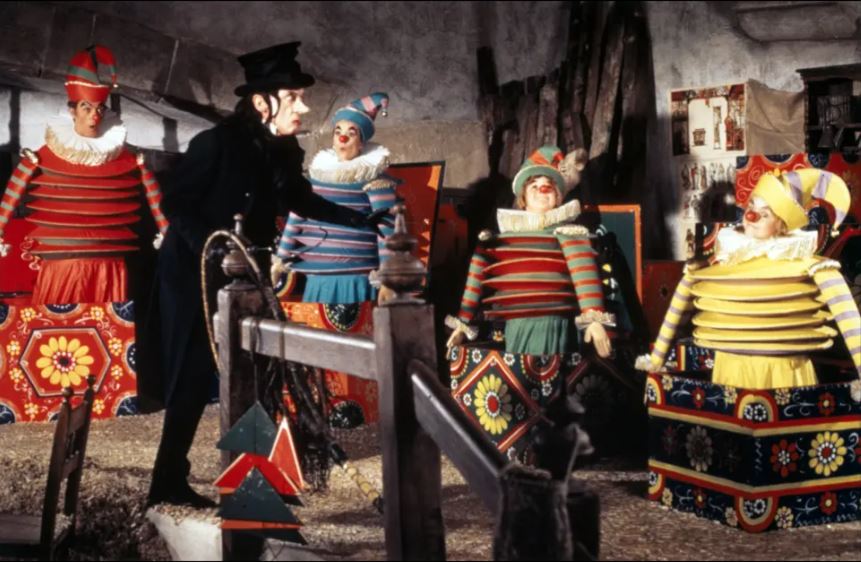
Alas, we must once again beg your indulgence as we postpone our holiday discussion of “Chitty Chitty Bang Bang” (1968), on Roy’s Tie-Dye Sci-Fi Corner.
Next attempt will be Friday evening at 7:30 EST. In the meantime, wish Roy a speedy recovery. We suffer for our soup, so you don’t have to!
Once upon a time, before 1700+ cable channels set to work eroding our collective intelligence, there used to be three networks, a few independent stations operating out of Philadelphia and New York, PBS, and the odd UHF channel.
During the holidays, once everyone’s stomachs were distended, and the adults were engaged in conversation in the kitchen or dining room, the kids would find somewhere in the house to huddle around a special broadcast of “The Wizard of Oz” or “Willy Wonka and the Chocolate Factory.”
A reminiscence of those halcyon days was to have been an important component of our discussion of “Chitty Chitty Bang Bang” (1968) on tonight’s Roy’s Tie-Dye Sci-Fi Corner. Unfortunately, the program has had to be postponed. I blame the Child Catcher and those infernal lollies!
I hope you’ll join us now on SUNDAY EVENING AT 7:00 EST. Bring the last of the leftovers to the comments section, when we livestream on Facebook, YouTube, and elsewhere! We apologize for the inconvenience.
Years in advance of modern cable, at the very dawn of color television, the National Geographic Society aired its first “special” on September 10, 1965. The program, titled “Americans on Everest,” featured stunning footage taken from the summit of the world’s tallest peak. These specials really were special, with breathtaking images and real-life adventures unlike anything previously experienced in American living rooms.
Three months later, viewers were introduced to the familiar “National Geographic Theme,” which was composed by Elmer Bernstein for the third of the broadcast specials, “Voyage of the Brigantine Yankee.” When one realizes that Bernstein also wrote the score for “The Magnificent Seven,” it becomes one of those “Of course!” moments. Both themes remain among the most recognized by American audiences.
National Geographic went on to work with a number of the top film composers of the day. This week on “Picture Perfect,” we’ll travel the world with four of them.
Bernstein, who was also responsible for the music for “The Ten Commandments,” “The Great Escape,” and “To Kill a Mockingbird,” returned in 1967 to write the music for a follow-up to “Voyage of the Brigantine Yankee,” called “Yankee Sails Across Europe.”
Ernest Gold, composer of “Exodus,” was engaged in 1972 to write the score for “The Last Vikings,” a documentary about the inhabitants of the rugged northern coast of Norway, who at the time still practiced some of the traditions followed centuries before by their Norse forebears. Gold’s score is a good example of what a talented composer can accomplish through an economy of means – in this case, a wind ensemble, harp, cello and percussion.
Leonard Rosenman, a pupil of Arnold Schoenberg, Roger Sessions, and Luigi Dallapiccola – a most unlikely pedigree on which to build a career in Hollywood – wrote classic scores for “East of Eden,” “Rebel Without a Cause,” and “Fantastic Voyage.” He also composed the music for one of the best known of the National Geographic specials, “Dr. Leakey and the Dawn of Man,” in 1966.
Finally, Jerome Moross wrote a charming and buoyant Americana score for “Grizzly!,” which aired in 1967. Moross, of course, was the composer of one of the all-time great western scores, for “The Big Country.”
Of course we’ll also get more than our share of that iconic National Geographic theme. All of this music was issued on limited edition compact discs from the Intrada label.
I hope you’ll join me for music from outstanding television documentaries produced by National Geographic, on “Picture Perfect,” this Saturday evening at 6:00 EST, on WWFM – The Classical Network and wwfm.org.
I apologize if, when writing about Howard Pollock’s Copland biography the other week, I may have come across as a tad immodest, when stating that, because of my lifelong mania for classical music, I was likely to have a more rounded understanding of the material than your average reader. As always, pride comes before the fall, as I’ve since encountered at least one name in the book that was entirely unfamiliar to me.
On the anniversary of the birth of Virgil Thomson, here’s a photo of the composer, left, with his assistant and copyist, Ned Rorem, right. New to me is the figure at center, the composer William Flanagan.
In his day, Thomson was an extraordinarily important figure in American music, both as a composer and as critic at the New York Herald-Tribune. Rorem, who died earlier this month, at the age of 99 (outliving even Thomson, who died at 92), is regarded one of the foremost composers of American art song.
Rorem provided the entry for Flanagan in the “New Grove Dictionary of Music and Musicians.” In his book, “Music and People,” he described his musical style thusly: “Flanagan yearns… for the more easy communicative style that ripened in America nearly twenty years ago [in the 1940s]…. Flanagan’s musical ‘birth’ is of that time, and in growing he has remained faithful to its premise, if not to the specific mannerisms of the period.”
Flanagan wrote a lot of music for the plays of Edward Albee, who was his longtime companion, as well as an opera with Albee after Melville’s “Bartleby the Scrivener.” At the time of his death, at 46, he was planning an artists’ colony in Montauk. This is now the William Flanagan Memorial Creative Persons Center (commonly referred to as “The Barn”), maintained by the Edward F. Albee Foundation.
Flanagan was unusual among composers of his generation in expressing an unqualified and heartfelt enthusiasm for Copland’s music. He was among Copland’s students at Tanglewood in 1947.
From Pollock’s book:
“[A]ccording to Ned Rorem, Copland was, along with Ravel, “the twentieth-century musician closest to his heart.” “You know well that I have always been hopelessly addicted to your music,” Flanagan once wrote to Copland. “But addicted or not, I couldn’t be convinced that there is a composer living who could move ME, at any rate, as you do with the music of the mother’s closing song [in ‘The Tender Land’].” He also defended “Connotations” against the widely circulated “Total gloom descriptions” surrounding the work. In 1962, he described Copland as “the guy whose work has been the most important single influence on one’s way of thinking about the profession he has chosen to occupy his life.” Over the years, Copland regularly offered Flanagan advice and guidance; after Flanagan took his life in 1969, Copland eulogized him at a memorial concert.”
Later in the book, Pollock writes:
“William Flanagan similarly thought that whatever its strengths and weaknesses, the libretto [for ‘The Tender Land’] “falls into its properly subordinate place and the music moves in – a phenomenon that has occurred with many works in the standard operatic repertory. And this music is almost without question the finest composed for an American opera.”
Flanagan managed to resist the dueling gravitational forces of both Stravinsky’s neoclassicism and Schoenberg’s dodecaphony. In common with Rorem, though less prolific, he was best-received as a song composer. His songs “Horror Movie” and “The Upside-Down Man” have been recorded, but so far I have been unable to locate any sound files. In fact, the only one of Flanagan’s pieces I’ve been able to find on the internet is “A Concert Ode” (1951):
Happy birthday, Virgil Thomson; R.I.P., Ned Rorem; and hello, William Flanagan!
The perfect Thanksgiving music? Virgil Thomson’s “Symphony on a Hymn Tune.”
Another seasonal work: the Concertino for Harp, Strings and Percussion, “Autumn” – according to Thomson, actually more of a “portrait of an artist aging.”
A fairly recent production of Thomson’s Susan B. Anthony opera “The Mother of Us All,” on a libretto by Gertrude Stein


4 responses