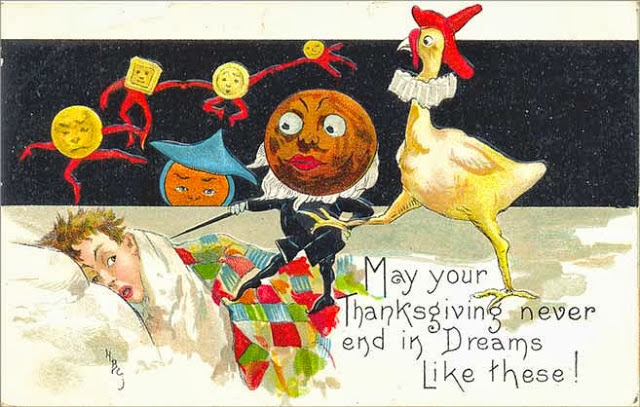
So many of my acquaintances have suffered horrible things in the past weeks – physical and mental illness, deaths in the family, the loss of pets. So remember to count your blessings. We’re all here for a limited time, and life is unpredictable. Embrace happiness and be thankful!
-
Count Your Blessings Embrace Thankfulness
by
-
Manuel de Falla’s Bewitched Love a Powell Masterpiece
by
4 responses
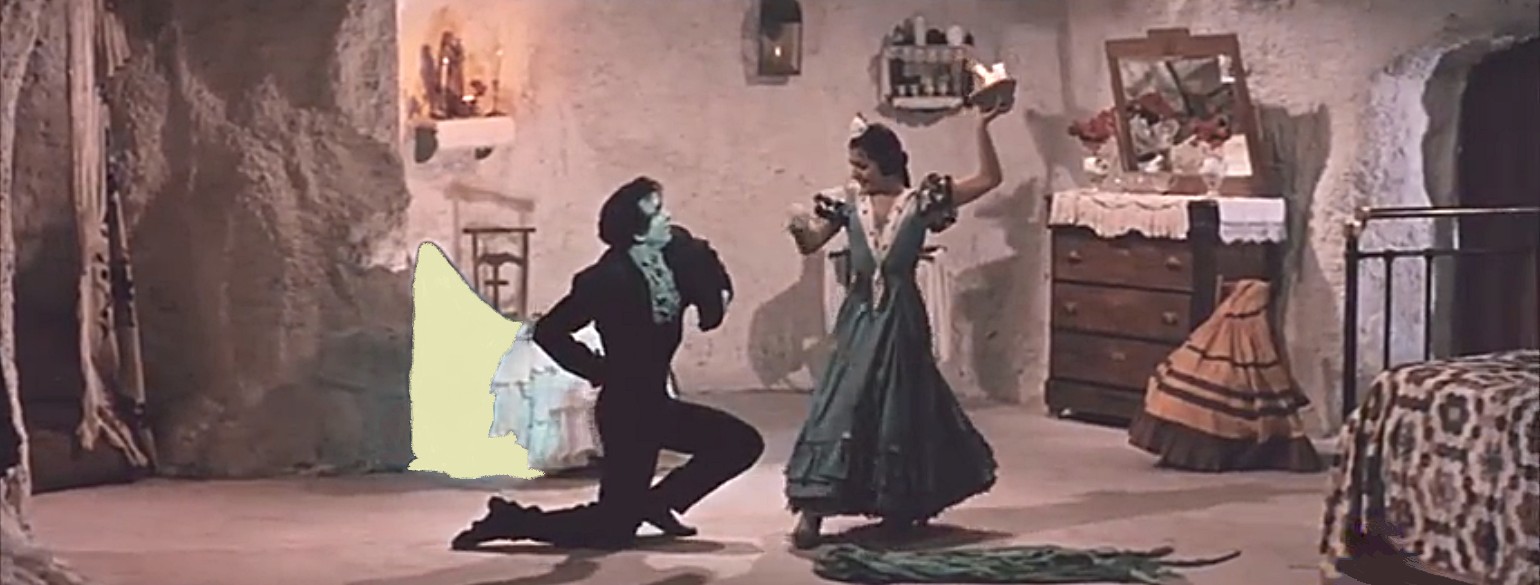
I have always been a great admirer of the team of Michael Powell and Emeric Pressburger, who made such strange, astonishing films as “The Red Shoes” (1948) and “The Tales of Hoffmann” (1951). Yet somehow I never encountered this one until a couple of years ago. It was made by Powell alone, after the two had amicably split to pursue their own projects.
“Honeymoon” (1959) reunited Powell with legendary Ballets Russes principal dancer and choreographer Léonide Massine, for a film based in part on Manuel de Falla’s ballet “El Amor Brujo” (here translated as “Bewitched Love”). Massine created the role of the Miller in Falla’s “The Three-Cornered Hat” with the Ballets Russes and a specially-assembled all-Spanish company, back in 1919. Naturally, after his turn as the sinister shoemaker in “The Red Shoes,” Massine assumes the role of the creepy Ghost. Sir Thomas Beecham conducts.
If you can’t be bothered to watch the whole thing – and you should – check out the freaky graveyard scene at 6:49 (linked below). It leads directly into the ballet’s most famous music, the “Ritual Fire Dance.” Like a Goya painting brought to life.
Alicia de Larrocha gives “Ritual Fire Dance” a whirl at the piano.
Manuel de Falla plays his Harpsichord Concerto, a very different piece.
Documentary, “When the Fire Burns: The Life and Music of Manuel de Falla” (1991)
¡Feliz cumpleaños, Manuel de Falla!
-
Fikret Amirov Centenary A Celebration
by
4 responses
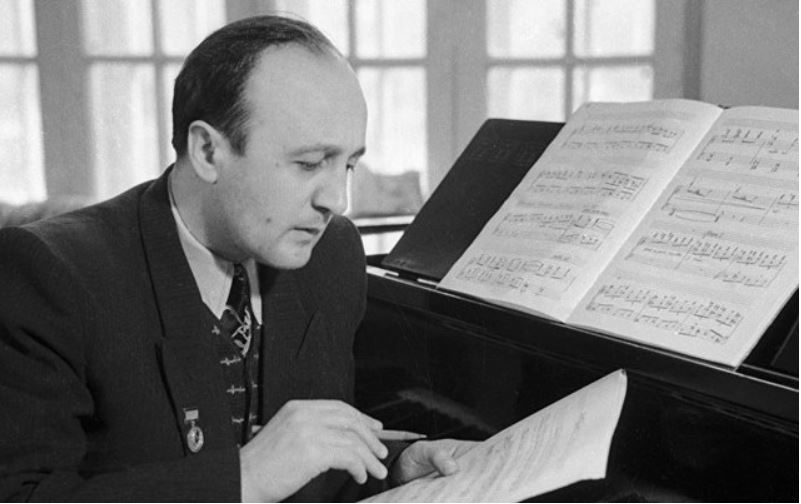
Today is the 100th anniversary of the birth of Azerbaijani composer Fikret Amirov (1922-1984).
Amirov was much decorated in Soviet Russia, awarded the Stalin Prize in 1949, honored as People’s Artist of the USSR in 1965, and the recipient of the USSR State Prize in 1980.
In 1959, he was one of several Soviet composers – including Konstantin Dankevich, Dmitri Kabalevsky, Tikhon Khrennikov, and Dmitri Shostakovich – who traveled to the United States at the invitation of the U.S. State Department, as part of a Soviet-American cultural exchange agreement, which had allowed American composers Roy Harris, Ulysses Kay, Peter Mennin, and Roger Sessions to visit the Soviet Union the previous year.
And look what I found! A 30-minute broadcast, “Aaron Copland Meets the Soviet Composers,” produced by WGBH Boston in 1959. Nicolas Slonimsky pitches a question to Amirov, and he responds, around 16:40. Shostakovich speaks around 12:00 and 24:00.
The Soviet composers arrive in Philadelphia on November 6, 1959.
Amirov is perhaps best known in the West from Leopold Stokowski’s recording of “Kyurdi Ovshari” – issued as “Azerbaijan Mugam”
Though unquestionably his largest audience was thanks to Michelle Kwan, whose “Taj Mahal” routine was skated to Amirov’s “Gulistan Bayati-Shiraz”
https://youtu.be/KHpA1_3R0BU?t=214
More recently, Yo-Yo Ma recorded “Kor Arab” (“Song of the Blind Arab”) with the Silk Road Ensemble.
In honor of Amirov’s centenary, I devoted “The Lost Chord” on Sunday night to two of his works: “Six Pieces for Flute and Piano” and selections from the ballet “Arabian Nights.” Here’s a link to my Facebook teaser.
https://www.facebook.com/photo?fbid=984611895791207&set=a.883855802533484
You’ll find the actual program, “Azerbaijani Come Lately,” now posted as a webcast on the WWFM – The Classical Network website at wwfm.org.
If you happen to be in New York City tonight, there is a tantalizing program scheduled for Carnegie Hall, with the New York International Virtuosi Orchestra and pianist Nargiz Aliyarova. The concert, “Bridge of Friendship,” is dedicated to Amirov and will include music by Turkish, Azerbaijani, and Jewish composers. Among the selections will be Amirov’s “Azerbaijan Capriccio” and the U.S. premiere of the “Piano Concerto on Arabian Themes.” Alexander Markov will be the soloist in Mendelssohn’s Violin Concerto. You’ll find more information at the link.
If, like me, you won’t be able to make it, there’s some consolation to be found in this video of Aliyarova playing the concerto in Azerbaijan.
Happy birthday, Fikret Amirov!
-
St Cecilia’s Day Playlist Celebrate Music’s Patron

by
5 responses
November 22 is St. Cecilia’s Day. Celebrate the patron saint of music with a playlist of Cecilia inspirations. All hail!
William Boyce, “Ode for St. Cecilia’s Day” (overture also published as Boyce’s Symphony No. 5)
Benjamin Britten, “Hymn to St. Cecilia” (Britten was born on this date)
Ernest Chausson, “La légende de Sainte Cécile”
Norman Dello Joio, “To Saint Cecilia”
Gerald Finzi, “For St. Cecilia”
Charles Gounod, “St. Cecilia Mass”
https://www.youtube.com/watch?v=YwUhEgJllzk
George Frideric Handel, “Ode for St. Cecilia’s Day”
Franz Joseph Haydn, “Missa Sanctae Caecilia”
https://www.youtube.com/watch?v=QhA7LEd56ts
Herbert Howells, “A Hymn for St. Cecilia” (text by Ursula Vaughan Williams)
Franz Liszt, “Hymn to St. Cecilia”
Arvo Pärt, “Cecilia, vergine romana”
Henry Purcell, “Ode on St. Cecilia’s Day (Hail! Bright Cecilia)”
Joaquin Rodrigo, “El Album de Cecilia” (written for the composer’s daughter; Rodrigo was born on this date)
Alessandro Scarlatti, “St. Cecilia Mass”
-
Malcolm Williamson: Master Outlier

by
8 responses
He wrote the music for “The Brides of Dracula” and “The Horror of Frankenstein,” and a ballet after a scenario of Robert Helpmann (of “The Red Shoes” notoriety) inspired by the vision of a naked Katharine Hepburn. Sounds like Master of the Queen’s Music material to me. Not to have included Malcolm Williamson in a subplot on “The Crown” was surely a wasted opportunity.
Williamson, born in Sydney, Australia, in 1931, was the first non-Briton to be appointed Master, in 1975. From the start, the decision was not without controversy. Sir William Walton quipped that they had given the job to the wrong Malcolm. He was implying that Malcolm Arnold would have been a better choice – a bold statement, since Arnold was prone to alcoholism, promiscuity, manic-depression, and possible bi-polar disorder. He once shot himself in the foot to get out of war service and attempted suicide several times. Still, he did manage to churn out much delightful music-to-order, often lickety-split, and in an immediately accessible idiom. So who knows, maybe Arnold would have been a good choice.
Williamson was always an establishment outlier. Though he arrived in England in his late teens, his antipodean origins led to sotto voce grumblings that his Royal appointment was but a utilitarian one, “cementing the cracks in the Commonwealth,” as Walton put it.
Whether or not a sense of alienation contributed to a kind of paralysis in the face of overwhelming pressure, Williamson developed an unfortunate reputation of being very bad with deadlines. Most particularly, he failed to complete a symphony in time for the Queen’s Golden Jubilee in 1977. His ambitious “Mass for Christ the King,” also intended for the occasion, was also delivered late. Significantly, he was the first Master of the Queen’s (or King’s) Music in over a century not to be knighted.
Following the Jubilee debacle, his output slowed, though he was seldom unproductive. In all, he wrote seven completed symphonies, concertos for piano, violin, organ, harp, and saxophone, and numerous other orchestral, choral, chamber, and instrumental works.
Williamson suffered from ill health in his later years. He too may have turned to the bottle as a means to numb himself against stress and depression. However, those close to him assert that, toward the end of his life, he never drank, but rather struggled with aphasia, the effect of a series of strokes.
Be that as it may, following his death in 2003, the parameters of the appointment were revised. The position is no longer one for life, but rather a fixed, ten-year term. Sir Peter Maxwell Davies was the first to serve under the new guidelines. He was succeeded in 2015 by Judith Weir, the first woman to hold the post (and yes, she is still referred to as “Master”).
What’s puzzling is that, for someone who had a reputation for being unable to meet deadlines, Williamson was able to write a fair amount of music for the cinema. The films were admittedly of varying quality. It’s always amusing to find his name in the opening credits of Hammer horror movies. But it proves that he could write to order, and he could write very quickly, perhaps when he wasn’t under the microscope.
The ballet “The Display” (1964) takes its name from the fanciful mating dance of the lyrebird. Robert Helpmann first witnessed the lyrebird’s courtship display on a visit to Victoria’s Sherbrooke Forest at the behest of Katharine Hepburn. The pair visited Australia in 1955 as leads in a touring Shakespeare company underwritten by the Old Vic. There are lots of fun photos of Helpmann and Hepburn on the internet (here seen holding koalas). Helpmann claimed that his idea for the ballet was inspired by a dream, in which he witnessed Hepburn naked on a dais surrounded by lyrebirds. He would dedicate his contribution to the ballet to her.
The scenario presents a competition between several suitors, young men at a picnic, preening and practicing their football moves, hoping to earn the affections of a young woman. Things become more aggressive as the action unfurls. Debussy’s “Jeux” could have been a lot different had it been conceived in the wilds of Australia!
What’s especially interesting is the decision to portray the barbarity in a picnic setting, as opposed to making it just another lurid Aboriginal showpiece put together by white men.
You can see it performed here:
Happy birthday, Malcolm Williamson!
Williamson plays his attractive Piano Concerto No. 2
A rare recording of his Symphony No. 6
“Mass of the Feast of Christ the King”
“With Proud Thanksgiving”
Two Christmas Hymns
Lento for Strings
Theme music for “The Brides of Dracula”
End credits for “The Horror of Frankenstein”
“Nothing But the Night,” starring Christopher Lee and Peter Cushing
Malcolm Williamson in conversation with Bruce Duffie
Tag Cloud
Aaron Copland (93) Beethoven (95) Composer (114) Film Music (145) Film Score (143) Film Scores (255) Halloween (94) John Williams (195) KWAX (229) Leonard Bernstein (104) Marlboro Music Festival (125) Movie Music (160) Mozart (91) Opera (213) Philadelphia Orchestra (89) Picture Perfect (174) Princeton Symphony Orchestra (109) Radio (88) Ross Amico (244) Roy's Tie-Dye Sci-Fi Corner (290) The Classical Network (101) The Lost Chord (269) Vaughan Williams (105) WPRB (397) WWFM (881)
5 responses