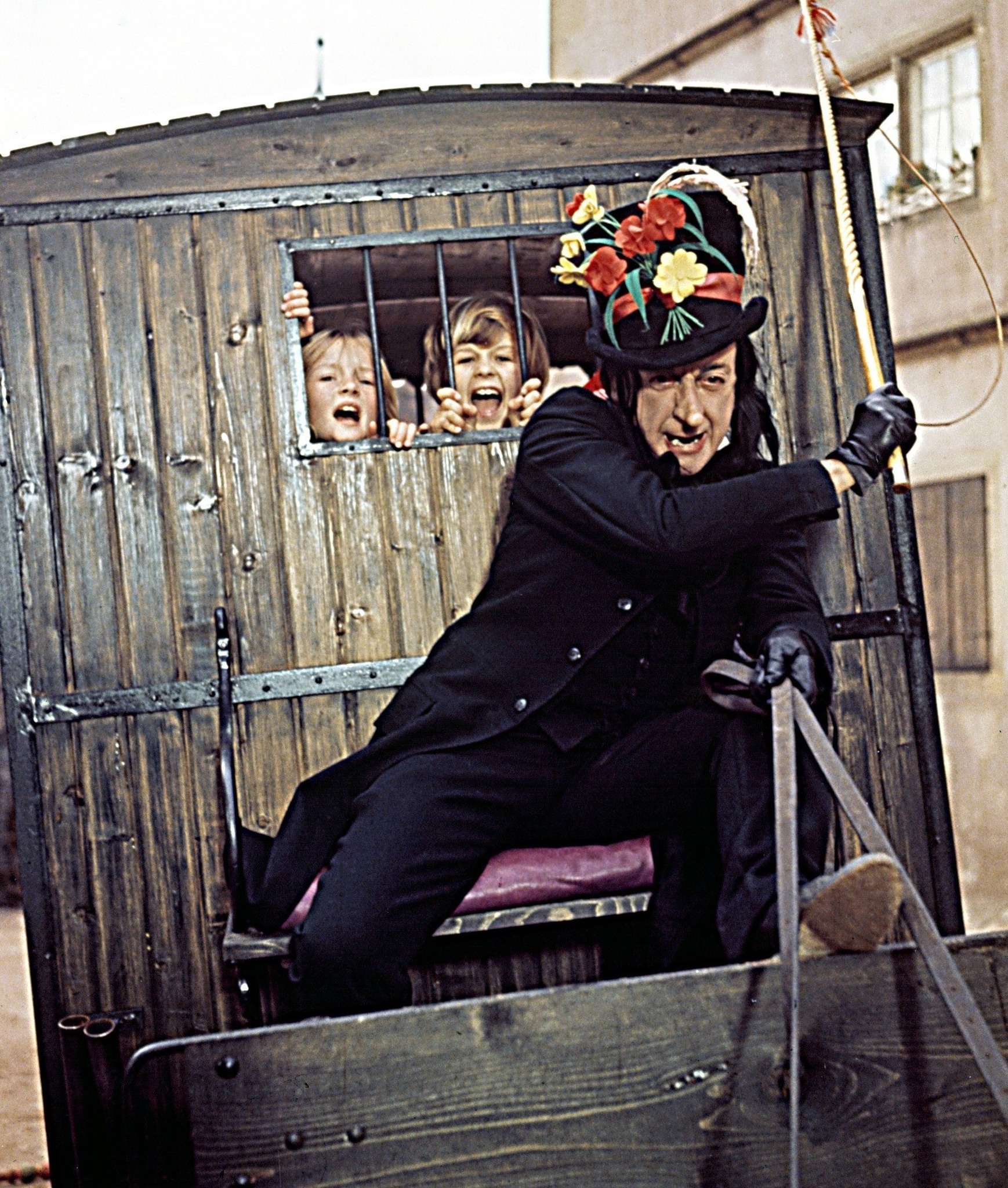
I mentioned Robert Helpmann this morning in my post about composer Malcolm Williamson, in connection with the ballet “The Display.” By coincidence, Helpmann, then one of the world’s most famous dancers, played the Child-Catcher in “Chitty Chitty Bang Bang” (1968), a film that we’ll be discussing on Friday, on a special holiday edition of “Roy’s Tie-Dye Sci-Fi Corner.”
You can detect Helpmann’s natural grace in his sinister portrayal. (He was also creepy in the Powell-Pressburger classics “The Red Shoes” and “The Tales of Hoffmann.”) Ironically, it was he himself who was imperiled by an accident during the making of “Chitty Chitty Bang Bang.” But according to Dick Van Dyke, he emerged from the life-threatening situation with élan. At the time, Helpmann, a Sadler’s Wells veteran, was co-director of the Australian Ballet.
“Chitty Chitty Bang Bang” is based on a children’s book by James Bond creator Ian Fleming. Like Helpmann himself, we’ll enjoy our cranberry sauce shaken, not stirred, on the next Roy’s Tie-Dye Sci-Fi Corner. Bring your Thanksgiving leftovers to the comments section. There will be plenty of turkey to go around when we livestream on Facebook, YouTube, and elsewhere, this Friday evening at 7:30 EST!
Behind-the-scenes anecdote about the Child Catcher here:
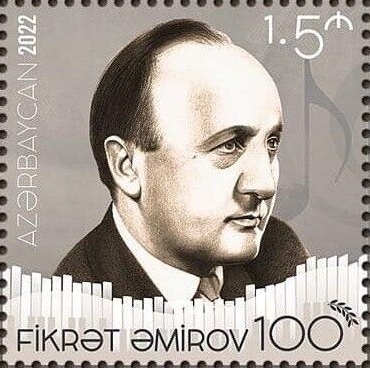
Despite the admiration of Leopold Stokowski (who recorded “Azerbaijan Mugam”) and Michelle Kwan (who skated to “Gulistan Bayati-Shiraz”), the music of Fikret Amirov is still rarely-encountered in the West. This Sunday night on “The Lost Chord,” for the centenary of Amirov’s birth (on November 22, 1922), get to know Azerbaijan’s best-kept secret.
Collectors of a certain vintage may recall Stokowski’s recording, with the Houston Symphony Orchestra, of “Azerbaijan Mugam.” Its native title is “Kyurdi Ovshari.” That language barrier may in part explain Amirov’s relative obscurity in the West. Even taking into account the more accessible title, what exactly is a mugam? Why, it’s a highly rhapsodic and improvisatory form, alternating between song and dance episodes, characteristic of Azeri music. But you see what I mean.
It is that very “exoticism” which makes Amirov difficult to market, yet at the same time, it is what makes him so interesting. In an increasingly multicultural climate, with light being shed now in all corners of the repertoire, perhaps Amirov’s day has finally come.
Tonight, we’ll sample his “Six Pieces for Flute and Piano” of 1970, consisting of “Song of the Aushug,” “Lullaby,” “Dance,” “In the Azerbaijan Mountains,” “At the Spring,” and “Nocturne.” If Amirov’s music at times reminds one of Khachaturian, one need only remember that Azerbaijan shares a border with Armenia. Without getting too much into politics, relations between the two countries are tense, to say the least. His music is also colored by the influence of other neighboring and nearby countries – Turkey, Russia, and Iran.
This is something to bear in mind when approaching his full-length ballet, “The Arabian Nights.” The work, given its premiere in 1979, is one of the rare adaptations to come out of a region which gave us the original stories that make up “A Thousand and One Nights.” The world famous adventures of Sinbad, Ali Baba, and Aladdin are enshrined in these tales, and each of them make an appearance in the ballet’s second act.
This week, we’ll hear selections from Act I, which sets up the framing device, with the unfaithful wife Nurida, the Sultan’s declaration of vengeance against all womankind, and the introduction of Scheherazade, the vizier’s daughter who enthralls the Sultan with her wit and creativity and finally restores his ability to love.
I hope you’ll join me for “Azerbaijani Come Lately” – late works by Fikret Amirov, for his 100th anniversary – this Sunday night at 10:00 EST, on WWFM – The Classical Network and wwfm.org.
Stokowski conducts “Azerbaijan Mugam”
Michelle Kwan’s “Taj Mahal” routine, skated to Amirov’s “Gulistan Bayati-Shiraz”
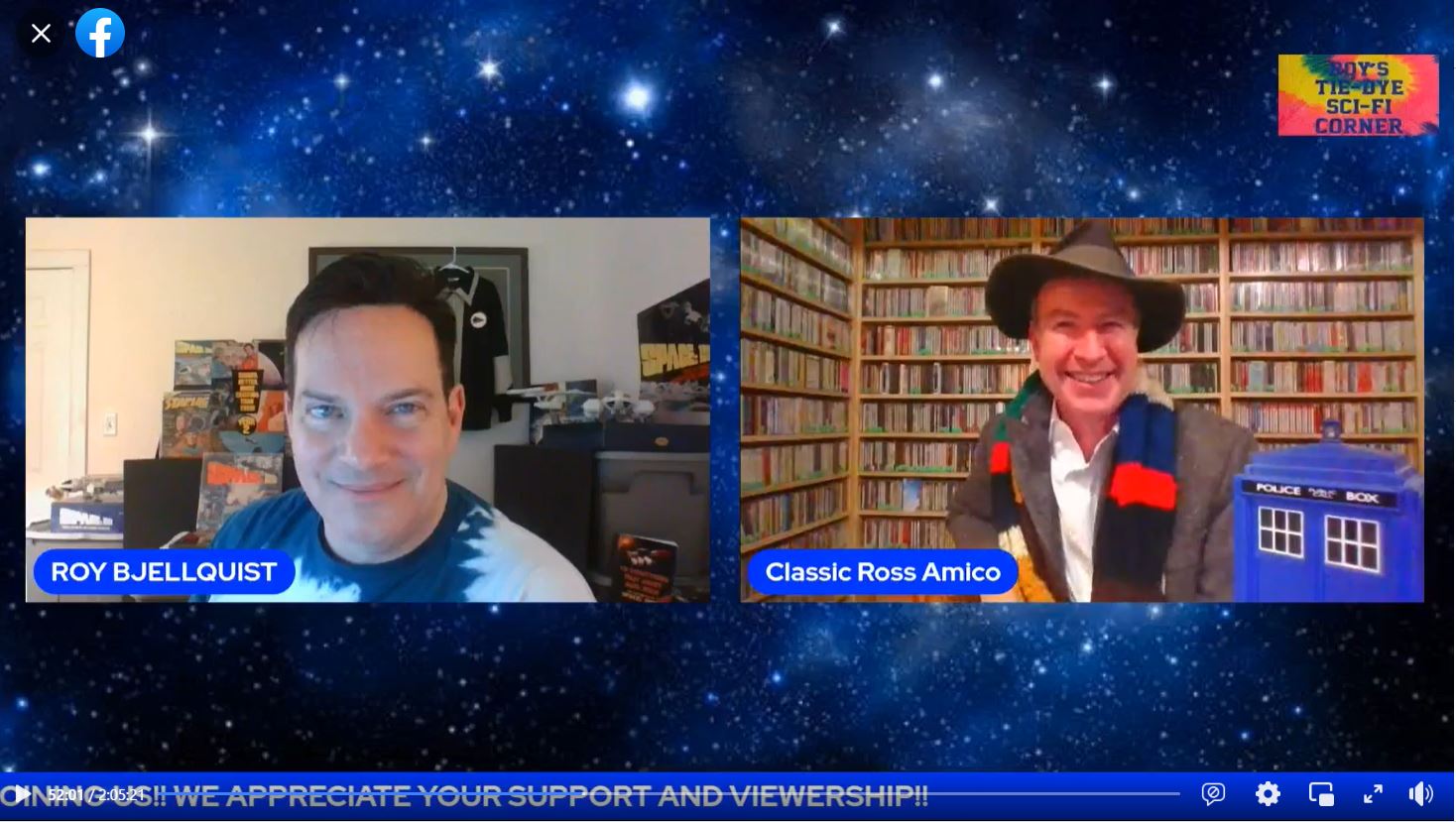
Last night, the Doctor was “in,” for our discussion of “City of Death” (1979) on Roy’s Tie-Dye Sci-Fi Corner. I even donned my 19-foot “Doctor Who” scarf, knitted for me by my aunt as a Christmas gift in 1984. (Apparently Tom Baker’s was only 18 feet, but this was before people could confirm such things on the internet.) I also recollected a tiny TARDIS given to me by my sister. While not exactly a Whovian, 38 years ago, I suppose I did have the hair.
All in all, not a bad show for two casual “Who” watchers, thanks in part to the lively viewer comments and an unexpected visit by the “Chat Girls.”
I hope you’ll join us next week for a special holiday edition, and our memories of the family classic “Chitty Chitty Bang Bang” (1968), based on the book by Bond-creator Ian Fleming. Sing along in the comments section, when we livestream on Facebook, YouTube, and Twitter (if it still exists), next Friday evening at 7:30 EST!
After writing up a little salute to Ned Rorem the other week, on the occasion of his 99th birthday, I happened to read an interview he gave with Bruce Duffie, in which he confessed that it was important to him that his music will be remembered. It made me recollect how, upon hearing of the death of Aaron Copland, I wished I had written him a letter to let him know how much his music meant to me. I easily could have. Copland died in 1990.
Similarly, Rorem’s remark made me think maybe I should send him a note. But I let the moment pass. In truth, his music never occupied the same kind of place in my heart as does Copland’s, but I am certainly grateful for it.
Rorem died yesterday at the age of 99. Here’s a sampler of his music, with links to the Duffie interview and my write-up, in case you missed it.
Leon Fleisher plays “3 Barcarolles” (1949)
With Thanksgiving right around the corner, here’s a piece for string orchestra, called “Pilgrims” (1958). The composer hastens to point out that it has nothing to do with Plymouth Rock. Rather, it was inspired by a novel of Julien Green called “Le voyageur sur la terre.” The title in turn is borrowed from the Book of Hebrews: “These also died in faith, not having received the promises, but having seen them afar off… and confessed that they were strangers and pilgrims on the earth…” (Hebrews 11:13). Rorem points out that the music is less programmatic than it is a mood of remembrance.
Typical of many of Rorem’s larger works, his Violin Concerto (1984) eschews a classical three-movement structure in favor of a suite of shorter movements, generally becoming lovelier and more heart-felt the closer you get to the center. In this case, there’s also a programmatic element, in that the movements are supposed to mirror a dusk-to-dawn progression.
Bernstein conducts the world premiere of Rorem’s Symphony No. 3 at Carnegie Hall (1959)
Anyone who’s ever read Rorem’s writings knows he definitely had his saucy side. He confessed he was shocked at having been awarded the Pulitzer Prize (for “Air Music” in 1976), since he figured the establishment would prefer to punish him for being such a naughty boy. “But it sort of gives you a certain authority,” he reflected. “My name is now always preceded by ‘Pulitzer Prize-winning composer.’ So if I die in a whorehouse, at least the obit will say ‘Pulitzer Prize-Winning Composer Ned Rorem Dies in Whorehouse.’”
“Air Music” can be heard at the link, as part of a collection recorded by the Louisville Orchestra. The opening work, “Design for Orchestra” (1953), is certainly attractive.
Rorem was always most highly-regarded for his art songs. He himself thought his song cycle “Evidence of Things Not Seen” (1998) – 36 songs for voice and piano – his finest work. Here are just a few selections.
There’s more to Thanksgiving than just turkey and football. This week on “Picture Perfect,” we count our blessings and aspire to do better, with music from movies reflective of what’s best in human nature and most admirable in the American character.
Aaron Copland’s work on “The Cummington Story” (1945), a semi-documentary produced by the Office of War Information, underscores the gradual acceptance of European war refugees into a cautious but fundamentally decent New England community. The music is pure Americana, with some of the material later finding its way into Copland’s Clarinet Concerto and “Down a Country Lane.”
“Field of Dreams” (1989) is one of those rare films that has the ability to reduce manly men – even those without father issues – to a pool of tears. Phil Alden Robinson’s superior adaptation of W.P. Kinsella’s novel, “Shoeless Joe,” is a male wish-fulfillment fantasy, in which a man finds redemption, and a new understanding of his father, in the enchanted cornfields of America’s heartland. And it’s all brought about courtesy of America’s pastime, baseball. The evocative score, much indebted to Copland, is by James Horner.
“The Best Years of Our Lives” (1946) is one of the great American classics. This touching film tells the tale of the three WWII veterans struggling to readjust to civilian life. It isn’t easy, but with the support of family and friends, there’s plenty of hope for the future. Hugo Friedhofer wrote the Academy Award-winning score, earning the film one of its seven Oscars. The orchestrations were by Copland protégé (and composer of “The Big Country”) Jerome Moross.
Finally, Daniel Day-Lewis elevates Steven Spielberg’s “Lincoln” (2012) to greatness with one of the uncanniest performances ever captured on film. Day-Lewis’ gentle but shrewd Man of Destiny would go to any lengths to hold the country together. John Williams taps into America’s proud musical heritage, clearly influenced by Copland and Ives to create a score of stirring nobility.
I hope you’ll join me as we give thanks for family, community and country on “Picture Perfect,” music for the movies, this Saturday evening at 6:00 EST, on WWFM – The Classical Network and wwfm.org.


7 responses