• Estonian Composers Eller Kapp & More

    Estonian Composers Eller Kapp & More

    by 

    in
    5 responses

    One needn’t vault the Baltic in order to enjoy tones from Estonia.

    This Sunday night on “The Lost Chord,” we’ll hear music by the so-called father of Estonian music, Heino Eller. Eller, born in Tartu in 1887, studied violin at the St. Petersburg Conservatory. He also studied law. For 20 years, he taught theory and composition at the Tartu Higher School for Music. In 1940, he became a professor of composition at the Tallinn Conservatory, where he remained until his death in 1970.

    Eller composed many beautiful tone pictures. We’ll hear his violin concerto, in a performance taken from a concert given in celebration of the composer’s 80th birthday.

    Among Eller’s pupils were Eduard Tubin, Arvo Pärt, and Lepo Sumera. Sumera was born in Tallinn in 1950. In his teens, he studied with Veljo Tormis; then, beginning in 1968, with Eller, at what was then the Tallinn State Conservatory. He went on to compose six symphonies, as well as many chamber and choral works.

    In the 1980s, he became interested in electro-acoustic music. He founded the Electronic Music Studio at the Estonian Academy of Music in 1995. He served as its director until 1999. Sumera died of heart failure in the year 2000, at the age of 50.

    His Symphony No. 4, subtitled “Serena Borealis,” was composed in 1992. Western ears may detect the influence of minimalist techniques, but it’s worthwhile to note that the folk tradition of Estonian runo songs, handed down orally, relies equally on repetition. And the Estonian nationalists were nothing if not in tune with their musical past.

    Finally, we’ll hear from Artur Kapp, who lived from 1878 to 1952. Like Eller, Kapp studied at the St. Petersburg Conservatory, where Rimsky-Korsakov was among his teachers. He himself became a professor at the Tallinn Conservatory, where he taught many notable Estonian composers, among them, his sons, Eugen and Villem. Kapp is regarded as the head of the Tallinn school of composition, a counterbalance to Eller, who was the head of the Tartu school.

    We’ll be listening to the finale from one of Kapp’s most enduring works, the oratorio “Job,” in a recording sent to me by the very generous Neeme Järvi (also born in Tallinn), while he was music director of the New Jersey Symphony Orchestra.

    I’ll share the wealth, on this hour of musical discoveries from Estonia. “Tallinn’s Got Talent,” this Sunday night at 10:00 EST, on WWFM – The Classical Network and wwfm.org.


    Speaking of wealth, The Classical Network is celebrating its 40th anniversary. Please help ensure the future of extraordinary music on the air and online with your donation today. Your support helps make shows like “Picture Perfect” and “The Lost Chord” possible. It is thanks to the generosity of listeners just like you that classical music has been easily accessible in our communities over the past four decades. Thank you, as always, for your financial contribution, and please continue to enjoy the music!

    https://wwwfm.secureallegiance.com/wwfm/WebModule/Donate.aspx?P=DEFAULT&PAGETYPE=PLG&CHECK=vOU2bz5JCWmgCDbf53nm9ezWDeZ%2BeA1M&fbclid=IwAR0rdP0GPvy4nlgDYOed9GSRk9qEcG-c3AQvfvNjjbVNZKlsvyc-RgT9CSE


  • Doreen Carwithen Unsung Film Composer

    Doreen Carwithen Unsung Film Composer

    by 

    in
    5 responses

    This week on “Picture Perfect,” we’ll shine a light on the shamefully underutilized talent of Doreen Carwithen.

    In 1941, Carwithen studied harmony and composition with William Alwyn at London’s Royal College of Music. For both, it was love at first sight. Their fateful pairing led to a decades-long romance that culminated in their marriage, finally, in 1975.

    The reason for the delay was, unfortunately, at the time of their meeting, Alwyn happened already to be married. The double-life caused tremendous stress. Alwyn, in particular, descended into alcoholism and suffered a nervous breakdown. Finally, his doctor urged him that, if he was going to live at all, he should get on with it already and live honestly.

    In the concert hall, Alwyn – a contemporary of William Walton and Michael Tippett – enjoyed comparative success as a symphonist. Carwithen, too, got off to a promising start. Her overture “ODTAA (One Damn Thing After Another)” was conducted by Adrian Boult at Covent Garden in 1947. She also wrote two award-winning string quartets. But the cinema promised more lucrative employment. Carwithen was the first selected by J. Arthur Rank to enter the college’s new film music program.

    Combined, during their heyday, in the 1940s and ‘50s, Alwyn and Carwithen wrote the music for over 100 films. Alwyn, in particular, scored such high-profile projects as “The Crimson Pirate,” “A Night to Remember,” and “The Swiss Family Robinson.” Carwithen, although groomed for the very purpose, was not given the same opportunities. In all, she scored only six dramatic features. The rest were documentaries and shorts.

    Neither were her concert works, though well-received, met with the same enthusiasm or eagerness by either programmers or publishers. In 1961, she became Alwyn’s secretary and amanuensis, and following his death in 1985, devoted herself to the preservation of his legacy.

    After her own death, in 2003, discovered among her papers were sketches for an unfinished string quartet (her third), a symphony, and a cello concerto. One can only imagine that, as an artist, her potential remained unfulfilled.

    In anticipation of the centenary of Carwithen’s birth (on November 15, 1921), we’ll do our best to level the playing field, dividing the hour between Alwyn and Carwithen, 50/50, this week, on “Picture Perfect,” music for the movies, this Saturday evening at 6:00 EST, on WWFM – The Classical Network and wwfm.org.

    Watch this space: I’ll be writing more about Carwithen and her efforts for the concert hall this Tuesday!


    If you enjoy either of my weekly shows (or both!), or any of the other music you hear on The Classical Network, please consider making a contribution today. We’re celebrating our 40th anniversary on the air and online. If you’re in a position to do so, why not make a donation right now at wwfm.org. Thank you in advance for your generosity and for your continued support of WWFM The Classical Network!

    https://wwwfm.secureallegiance.com/wwfm/WebModule/Donate.aspx?P=DEFAULT&PAGETYPE=PLG&CHECK=vOU2bz5JCWmgCDbf53nm9ezWDeZ%2beA1M


  • Copland’s Lost “Miracle at Verdun” Score

    Copland’s Lost “Miracle at Verdun” Score

    by 

    in
    6 responses

    On the 11th hour of the 11th day of the 11th month in 1918 (Paris time), the Armistice went into effect that formalized Allied victory and the end of World War I.

    In 1954, at the urging of U.S. veterans, Armistice Day was renamed Veterans Day. Though the intent of the holiday is frequently confused with that of Memorial Day, Veterans Day is a time to honor ALL military veterans, not just those who died in service to their country.

    While the content of today’s post would certainly be appropriate for Memorial Day, all too many veterans, I’m sure, could relate to the experience of returning home and having difficulty reassimilating, making others feel uncomfortable, and perhaps even feeling unwanted themselves.

    Hans Chlumberg’s 1930 drama, “Miracle at Verdun,” follows an international brigade of dead soldiers of the Great War who rise from their graves only to find themselves irritants to their wives who have taken new husbands, to the workers who have replaced them at their jobs, and to powerful captains of finance and government. In the end, the veterans are ordered back to their graves.

    I was very interested to discover that the first U.S. production of the play featured incidental music by none other than Aaron Copland. It was first presented in New York by The Theatre Guild on March 16, 1931. Among the cast was a young Claude Rains.

    Critic Brooks Atkinson characterized it as a “ghoulish war play.” “…[T]he fantastic idea of bringing all the war dead to life again, and then measuring their sacrifice against the brazen greed of the world that has climbed up on their broken bodies is certainly a startling theme for a play, and certainly ought to harrow us,” he observed.

    Sadly, he was less than enthused about the production, which incorporated three motion picture screens and ear-shattering amplified sound. He was impressed with Rains, though. “Claude Rains, as the Prime Minister of Belgium, makes himself heard above the general din, and gives a splendid, potent performance,” he wrote.

    Dorothy Parker declared the whole “pompous, pretentious, pseudo-artistic, and stuffy.”

    The production closed after 49 performances.

    Prior to its arrival in America, “Miracle at Verdun” caused a sensation at its debut in Leipzig and circulated throughout Europe on stage and radio. It was the last anti-war play permitted in German theaters during the early 1930s. Of course, it wouldn’t be long before the world would be plunged into war all over again. Tellingly, the action is set in 1934.

    No doubt the gathering clouds were the impetus for Chlumberg writing the play in the first place. Chlumberg, who was Austrian, experienced the horrors of the Great War first-hand as a teenager, while serving as a cavalry officer on the Italian front.

    The enormous casualties suffered during the ten-month Battle of Verdun – two million took part; 700,000 died, with no perceptible gain – made it an enduring symbol of the futility and senselessness of war.

    Ironically, Chlumberg would die from injuries sustained in a fall into the orchestra pit during the dress rehearsal for the play’s premiere.

    “Miracle at Verdun” combines elements of expressionism and realism. By its very nature, the play invites experimental stagings. While the content itself is unsettling, its reception varied from country to country, depending on the local political situation. Compared to its electric opening in Germany, for instance, the U.S. debut was met with relative complacency.

    Copland’s music remains unpublished. Scored for chamber orchestra and chorus, it includes a grim funeral march for the rising of the dead, quotations from Gregorian chant, the “Marseillaise,” and the German soldier’s song “Morgenrot,” and for its more satiric moments, recycled material from some of the composer’s works of the 1920s, including “Ukulele Serenade.”

    It’s one of several plays for which Copland wrote incidental music (including Orson Welles’ “The Five Kings,” adapted from Shakespeare), the best-known of which – thanks to Copland’s concert arrangement – is Irwin Shaw’s “Quiet City,” a play that never even opened.

    There should be plenty of material for an interesting concert and potentially concept album for anyone who cares to pursue it. You could even throw Copland’s World’s Fair puppet-play music, “From Sorcery to Science,” into the bargain. Just be sure to comp me in or send me a promotional copy, please!


  • Ennio Morricone Rome Mural Celebrates Maestro

    by 

    in
    5 responses

    Big Ennio is watching you!

    Ennio Morricone mural dedicated in Rome yesterday on what would have been the composer’s 94th birthday.


  • Star Trek Time Travel Tomorrow Is Yesterday

    Star Trek Time Travel Tomorrow Is Yesterday

    by 

    in
    3 responses

    I don’t claim to be an authority on the matter, but it seems like in the original “Star Trek” series, the Starship Enterprise went back to Earth like every other week. But mostly it was the crew encountering worlds that, for whatever reasons, developed into parallels of different periods of Earth’s history. So we got replica-Earths populated by plague-resistant children, Kirk and Spock battling Nazis, and Vic Tayback as a gangster in pinstripes.

    But the first time the Enterprise went back to 20th century Earth for REAL (don’t worry, I know it’s fiction) was in the first season episode “Tomorrow Is Yesterday” (1967). Not to spoil anything, but this is the episode that introduces the “slingshot effect,” a convenient physics loophole later exploited in the movies.

    Roy and I will attempt to perform the maneuver, in order to erase your memory of our original plan to cover “The Day After Tomorrow” (1975) – Gerry Anderson’s TV pilot that went nowhere – and to give the illusion that we are thorough, thoughtful programmers. Come to think of it, wouldn’t it be a lot easier just to employ a Jedi mind trick?

    Be that as it may, we’re changing the program and moving it to a different night this week. I hope you’ll join us in the comments section for a discussion of “Tomorrow Is Yesterday,” on the next Roy’s Tie-Dye Sci-Fi Corner. We’ll still be screwed up from the time-change, when we livestream on Facebook, Twitter, and YouTube, this SUNDAY EVENING AT 7:00 EST!

    https://www.facebook.com/roystiedyescificorner


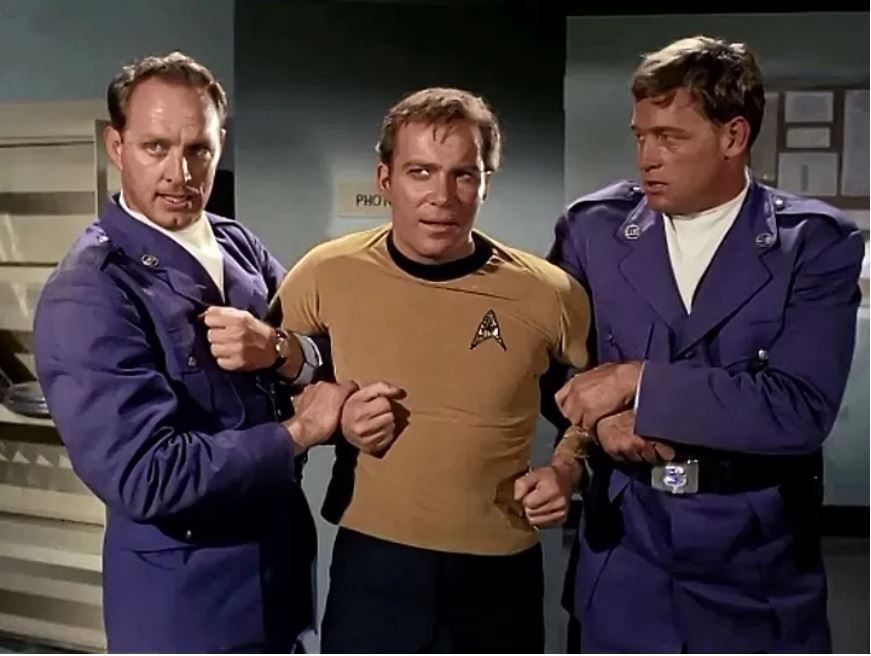
    PHOTO: Who needs Jedi, when you’ve got crafty Kirk to play mind games?


Tag Cloud

Aaron Copland (93) Beethoven (95) Composer (114) Film Music (145) Film Score (143) Film Scores (255) Halloween (94) John Williams (195) KWAX (229) Leonard Bernstein (104) Marlboro Music Festival (125) Movie Music (160) Mozart (91) Opera (213) Philadelphia Orchestra (89) Picture Perfect (174) Princeton Symphony Orchestra (109) Radio (88) Ross Amico (244) Roy's Tie-Dye Sci-Fi Corner (290) The Classical Network (101) The Lost Chord (269) Vaughan Williams (105) WPRB (397) WWFM (881)

DON’T MISS A BEAT

Receive a weekly digest every Sunday at noon by signing up here


RECENT POSTS