Did you know, the composer of “Old Nassau” was a pupil of Franz Liszt? That Princeton was the birthplace of one of the great stride pianists? That a colleague of Igor Stravinsky rests in St. Paul’s Parish Cemetery?
Put on some sensible shoes, and grab your coffee to go. Just in time for Halloween, I lead a “dead composers” tour of Princeton cemeteries in this week’s U.S. 1 Newspaper – PrincetonInfo, available online and in area vending machines today.
Scored the cover in this week’s U.S. 1, out today. And they chose the best sentence to tease it.
If you’re curious to explore any of the composers’ music, you’ll find lots to sample on YouTube. Except for Carl Langlotz, destined always to be known for one song.
I would venture to guess that most admirers of Aaron Copland are unaware that, as a young man in Paris, he wrote a vampire ballet.
That’s right, the composer of “Billy the Kid” and “Rodeo,” who basically codified the sound of the American West, first tipped a toe into the world of dance by way of the undead.
It was Copland’s teacher, Nadia Boulanger, who suggested he undertake a ballet to cash in on the success – or notoriety – of recent Ballets Russes premieres like the riot-inducing “The Rite of Spring.”
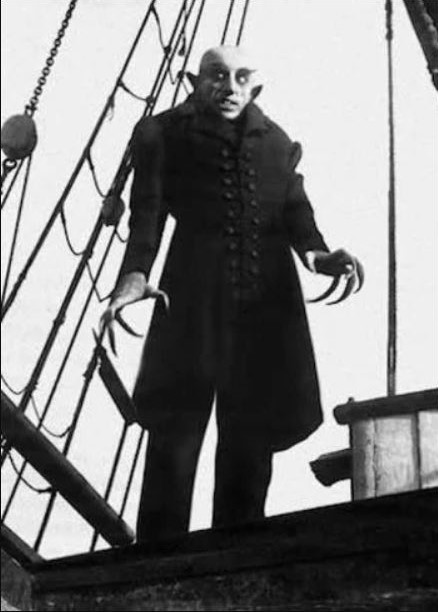
It was F.W. Murnau’s new film, “Nosferatu,” freely based on Bram Stoker’s “Dracula,” that provided just the inspiration he was looking for. Just as Murnau tweaked Stoker’s novel – enough, he thought, to skirt the possibility of a lawsuit from the author’s estate (he was wrong) – Copland and his scenarist, Harold Clurman, jettisoned most of Murnau, but hung on to the Expressionist elements and some of the Gothic iconography.
It’s been observed that the ballet’s narrative shares more in common with another German Expressionist classic, “The Cabinet of Dr. Caligari.” Either way, Copland’s first ballet is very far away from high-kicking buckaroos and Appalachian springs.
Copland and Clurman created as their antihero Grohg, a necromancer, a “sorcerer who loves the dead and vainly seeks affection among them. He can make them dance in so far as he does not touch them.”
Like Nosferatu, he bears a hooked nose and bulging eyes. He is a figure of desperate yearning. The four dead he calls forth to dance for him are an adolescent, an opium-eater, a streetwalker, and a beautiful young girl.
When he loses control and gently kisses the latter, she awakens from her trance and repulses him, and he’s set upon by his servitors. Grohg hurls the streetwalker into the mob and then wanders into the shadows gloomily. It seems like a scenario that Béla Bartók would have loved. (Bartók was already at work on “The Miraculous Mandarin,” but his ballet would not receive its premiere until 1926.)
Copland’s ballet, composed between 1922 and 1925, was never produced. He and Boulanger played through the score at the piano, and he cannibalized portions of the music for other works (including the even more obscure ballet “Hear Ye! Hear Ye!”).
Eventually, the score was lost, and the only bits that could be heard were those recycled in Copland’s concert pieces “Cortège macabre” (1923), which the composer withdrew, and the “Dance Symphony” (1929). “Grohg” was finally rediscovered, miscatalogued at the Library of Congress, and given its first performance in 1992, two years after the composer’s death.
The original title of the piece was “Le Nécromancien.” According to Copland, the spelling “Grohg,” with the peculiar inclusion of an “h,” was “to avoid an alcoholic connotation.”
So the first orchestral work by a figure who came to be known as the “Dean of American Composers” was inspired by a vampire movie released 100 years ago.
This year, for its centennial, special showings of “Nosferatu” abound. This weekend, organist Brett Miller will accompany a screening at The Colonial Theatre in Phoenixville, Pennsylvania.
The Colonial gained notoriety for its use in the 1958 film “The Blob,” when the title menace oozes into the theater, setting off a panic, which is reenacted every summer during Phoenixville’s Blobfest. (FUN FACT: the film-within-a-film, shown during that sequence, is “Daughter of Horror,” also known as “Dementia,” which features a demented film score by Trenton’s own George Antheil.)
The Phoenixville showing of “Nosferatu” will take place this Sunday at 2 p.m. On Saturday, Miller will accompany a showing of the film at the United Palace, 4140 Broadway, in Washington Heights, New York City, at 5:56 p.m. (sundown!).
Genial, esteemed, self-effacing and beloved – the conductor Libor Pešek has died.
Pešek was a regular presence on the podiums of his native land for some 70 years and did much to promote Czech music abroad.
In particular, he was instrumental in raising the awareness of the works of Josef Suk outside the Czech Republic, especially the wounded, even morbid scores of the composer’s maturity.
Suk, the pupil and son-in-law of Antonín Dvořák, lost both his mentor and his young wife, Otylie (Dvořák’s daughter), at the age of 30. Already, when Suk was a young man, Dvořák detected a melancholy strain in his music and set him the challenge of writing something sunny. The result was Suk’s Serenade for Strings, which became one of the composer’s most frequently performed works.
Suk could do Czech nationalism with the best of them, but as he entered his prime, his works became as gloomily introspective as anything by Gustav Mahler, without the ecstatic peaks. Pešek’s recording of the “Asrael Symphony” (which takes its name from the Angel of Death) did much to increase the work’s international reputation. It was a piece he performed not only in Liverpool, where he was music director, but also took with him (much to the chagrin of tour agents) to Spain and the United States.
Pešek, who studied with conductors Václav Smetáček and Karel Ančerl, began his professional career in the opera houses of Plzeň and Prague. He founded the Prague Chamber Harmony in 1958.
As his stature grew, he assumed posts with the Slovak Philharmonic (1981-82), the Czech Philharmonic (1982-90), the Royal Liverpool Philharmonic (1987-98), and the Czech National Symphony Orchestra (2007-19).
Pešek stepped down in Liverpool over budgetary difficulties, but continued to work with the orchestra in the capacity of laureate conductor for the next quarter century. Liverpool came to be regarded as “the best Czech orchestra this side of Prague.”
Among his many honors, he was made Knight Commander of the British Empire by Queen Elizabeth II. He retired from the podium at the age of 85. Most of his recordings were issued on the Supraphon and Virgin Classics labels.
Happily, he also appears to have been an amiable person, both professionally and personally, refreshingly lacking in ego and able to enjoy relaxed times with musicians, family, friends, and animals.
At the time of his death, Pešek was 89 years-old. R.I.P.
Pešek’s recording of Suk’s “Asrael Symphony” (with appropriately Halloweeny cover):
And a score from Suk’s happier days, “Pohádka,” or “Fairy Tale.” He arranged it from music he composed for a play called “Radúz and Mahulena,” in which true love conquers all. The work took on special significance for the composer, since he happened to be secretly in love with his teacher’s daughter and feared the day of reckoning, when all would be revealed. He needn’t have worried. Dvořák was delighted. Sadly, Suk’s happiness was to be short-lived.
Pešek also championed the music of Vítězslav Novák, another Dvořák pupil (and Suk’s classmate at the Prague Conservatory). See what you think of the “Slovak Suite.”
Also, Novák’s tone poem “Toman and the Wood Nymph,” in which a youth is seduced by an alluring dryad on St. John’s Eve:
Pešek certainly knew his way around the symphonies of Dvořák, if not always quite scaling the heights of the composer’s grandeur. I find he was often more satisfying in the “filler” material, as it were, and works like Dvořák’s lesser-known “American Suite.”
You don’t often encounter Dvořák’s earlier symphonies (i.e. those before No. 7), either in the concert hall or on the radio. I’ve always been partial to Pešek’s recording of No. 3. Here, the movements are posted separately (probably with ads in between). If you like it, you can let the feed run directly into No. 4.
It is fortuitous indeed that George Crumb’s birthday falls so close to Halloween. It’s not for nothing that his work for electric string quartet, “Black Angels,” was used in “The Exorcist” (though it was actually inspired by the Vietnam War).
It’s a piece I first encountered on a Friday night radio show, called “Music Through the Centuries,” broadcast on Philadelphia’s now-defunct classical music station, WFLN. The host, George Diehl, was at one time WFLN’s program director, if you can believe it. He also provided program notes for the Philadelphia Orchestra. I credit his show with having inspired my own radio program, “The Lost Chord,” on WWFM The Classical Network.)
What made this particular episode so indelible (I heard it probably 35 years ago) is that Diehl introduced Crumb’s otherworldly, often hair-raising quartet by placing it in context, deftly illuminating its structure, and supplementing it with recordings of other works referenced within the piece. It was fascinating radio.
Also, having cut my teeth on the station’s usual, more traditional fare, my mind was officially blown. “Black Angels” scared the hell out of me and enthralled me completely. I immediately determined to pick up everything I could find by George Crumb.
A few years later, I heard “A Haunted Landscape” on a Philadelphia Orchestra concert, with William Smith conducting. On the same program was Maurice Ravel’s “Le tombeau de Couperin” and Ralph Vaughan Williams’ “A London Symphony!” By then, I already owned the work’s first recording, with Arthur Weisberg conducting the New York Philharmonic.
Crumb didn’t compose that many orchestral works. He was more like a master jeweler, working in miniature, and revealing a surprising number of facets in his unique – and uniquely memorable – creations.
Of course, he was more than just a “horror” composer, though his music could be creepy as hell. Many of his chamber works, especially those that employ percussion and voice, are models of economy and elegance. I always think of him as a kind of spiritual descendent of Charles Ives, in that many of the curious sonorities he explored, especially in the context of his song settings, seem to suggest truths beyond our workaday concerns.
That said, here’s some sensational Crumb to play when you’re alone with the lights out.



5 responses