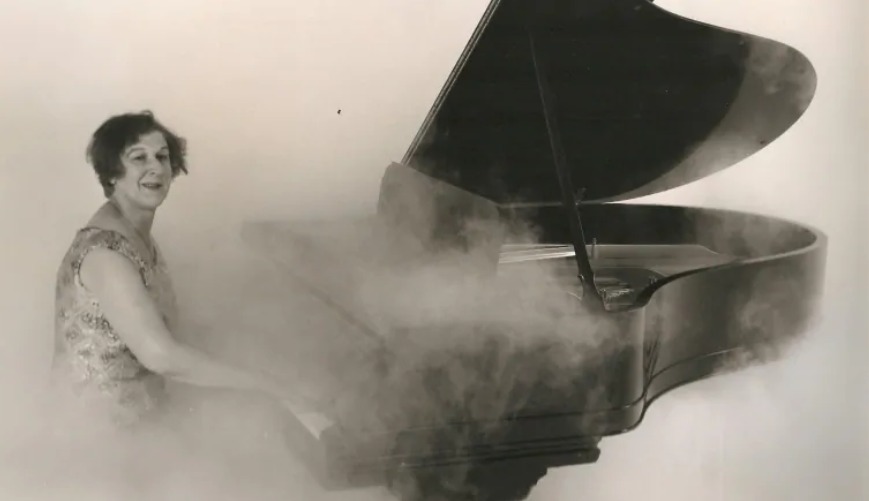
• Ned Rorem: French or German?

    Ned Rorem: French or German?

    by 

    in
    10 responses

    Composer Ned Rorem has a famous bit, wherein he sorts everything in the world into two categories, French and German. He’s repeated it, with variations, many times over the years, perhaps most definitively in his autobiography, “Knowing When to Stop,” published in 1996:

    “It is a truth universally acknowledged that the entire solar system is torn between two aesthetics: French and German. Virtually everything is one or the other. Blue is French, red is German. ‘No’ is French, ‘yes’ is German. Formal gardens are French, oceans are German. The moon is French, the sun German. Gay men are French, lesbians are German. Crows’ feet are French, pigs’ knuckles are German. Schubert on his good days is French, Berlioz is forever German. Jokes are French, the explanation of jokes is German. If ‘French’ is to be profoundly superficial, like Impressionism, which depicts a fleeting vision of eternity, then ‘German’ is to be superficially profound, as when Bruckner’s music digs ever deeper into one narrow hole. If you agree with all this, you’re French. If you disagree, you’re German.”

    Rorem signed my copy after a reading at Borders in Philadelphia. I must have caught him in a good mood. He was very pleasant and conversational, even after I told him I was German.

    Rorem is notorious for his candid (some would say bitchy) diaries and musical assessments. He had a lively intelligence and a razor wit. Also, he must have had an aging portrait in an attic somewhere, transfigured by his abundant sins. At the time of the signing, he was in his 70s, but he could have easily been mistaken for someone twenty years younger.

    He was still teaching composition at the Curtis Institute of Music in those days. Philadelphia has always been a small town masquerading as a big city, and wouldn’t you know it, Rorem was also the uncle of the (equally-ageless) woman who managed an architecture and design bookstore at which I worked in my early 20s. Rorem would come in to the shop occasionally to have some things framed. I also saw him at student concerts at Curtis and attended the world premiere of his Piano Concerto for Left Hand and Orchestra, written for Curtis’ then-director, Gary Graffman.

    Rorem has composed in all forms – symphonies, concertos, chamber music, opera – but he has always been most highly regarded for his art songs. Here’s a lovely piece of nostalgia, called “Early in the Morning.” It’s easy to see how Rorem, who spent his formative years in Paris, would connect to the text, by Robert Hillyer.

    Early in the morning
    Of a lovely summer day,
    As they lowered the bright awning
    At the outdoor café,
    I was breakfasting on croissants
    And café au lait
    Under greenery like scenery,
    Rue François Premier.
    They were hosing the hot pavement
    With a dash of flashing spray
    And a smell of summer showers
    When the dust is drenched away,
    Under greenery like scenery,
    Rue François Premier.
    I was twenty and a lover
    And in Paradise to stay,
    Very early in the morning
    Of a lovely summer day.

    Although Rorem also worked in larger forms, his true genius was for the miniature. Even when he tackled longer works, it was not unusual for them to be built out of smaller individual units. In the case of his Piano Concerto for Left Hand and Orchestra, there are eight short movements – as opposed to three epic statements in the grand German tradition. Very French, you might say.

    At his most lyrical, I always thought Rorem shared an affinity with Francis Poulenc. But you need to get to the middle movements to appreciate that. Especially the one that starts about 22 minutes in. I always thought the approach to the theme that opens the work – and returns in the last movement – as kind of like scat-singing. I was present in the hall for this recording, made at the work’s world premiere at Philadelphia’s Academy of Music in 1993.

    Happy birthday, Ned Rorem, 99 years-old today!


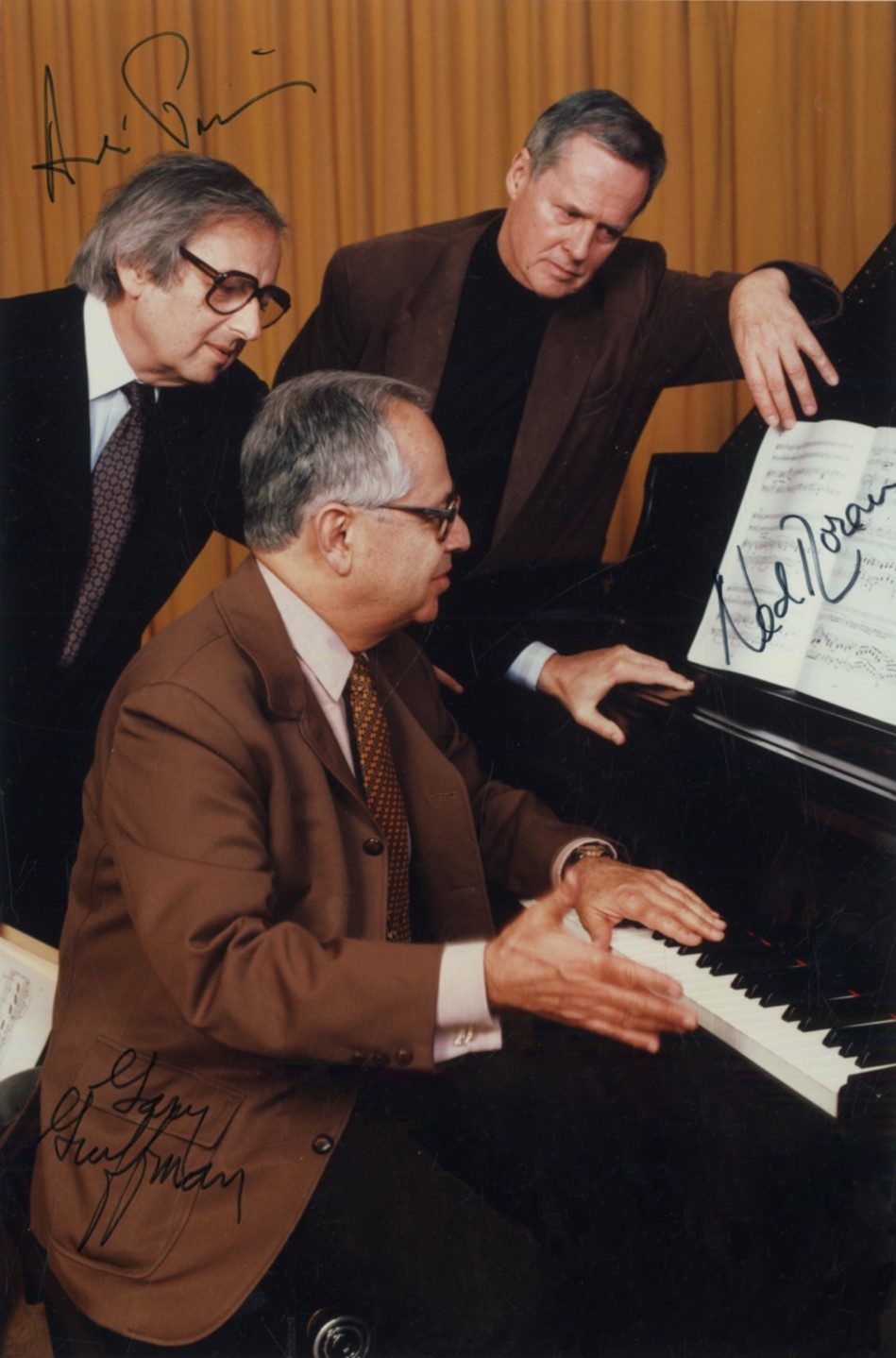
    PHOTO: (counterclockwise from top) Rorem, André Previn, and Gary Graffman rehearse the Piano Concerto for Left Hand and Orchestra. In support of my “aging portrait” theory, Rorem is five years older than Graffman, and 5 1/2 years older than Previn!

  • Harry Potter Lord of the Rings Music

    Harry Potter Lord of the Rings Music

    by 

    in
    4 responses

    Lumos Solem!

    This Sunday night on “The Lost Chord,” it’s an hour of musical enchantments inspired by “Harry Potter” and “The Lord of the Rings.”

    Herbert Chappell composed the occasional concert work (including an impressive guitar concerto for Eduardo Fernandez), in between writing television scores and producing documentaries for the BBC. Unquestionably, his greatest coup was in cutting a deal on behalf of Decca Records for his telecast of “The Three Tenors.” No one, not even the tenors themselves, anticipated its staggering success.

    According to Chappell, his concert overture “Boy Wizard,” an impression of Harry Potter, is meant to conjure “an academy of wizardry and witchcraft, owls that deliver letters, cats that act as lie-detectors, unicorns with silvery blood, and a helter-skelter death-defying game of aerial acrobatics, where one whizzes around the sky on turbo-charged broomsticks.” The work appeared in 2001, the same year as the first of the “Harry Potter” film adaptations.

    In 1995, American composer Craig Russell was reading “The Hobbit” and “The Lord of the Rings” aloud to his family, when he became “an unexpected party” to a commission for string orchestra. Russell responded with a seven-movement suite. In 1997, he added two more movements and expanded the orchestration to create “Middle Earth.”

    We’ll hear “Frodo Leaves the Shire,” “Gimli, the Dwarf,” “Galadriel and Her Elvin Mirror,” “Gollum,” “Gandalf: The White Rider,” “Shelob’s Lair,” “Orcs and Ring Wraiths,” “Strider and the Crowning of Aragorn,” and “Frodo and Company Return.”

    Aulis Sallinen is one of the most respected of contemporary Finnish composers. In 1996, he completed his Symphony No. 7, on a commission from the Gothenburg Symphony Orchestra, which he gave the subtitle “The Dreams of Gandalf.” Its origins were in a projected ballet inspired by “The Lord of the Rings.” However, the composer hastened to add that the symphony doesn’t actually depict any of the events in the story, but rather its atmosphere and its poetry.

    To round out the hour, we’ll have a few minutes to enjoy selections from a fondly-remembered song cycle on Tolkien texts, “The Road Goes Ever On,” by Donald Swann (of Flanders and Swann fame).

    I hope you’ll join me for this program of music inspired by pop-cultural and quasi-literary wizards. The effect is guaranteed to be pure magic, on “Spellbound,” this Sunday night at 10:00 EDT, on WWFM – The Classical Network and wwfm.org.


    In addition to the considerable achievements noted above, Herbert Chappell also wrote “The Gonk,” employed so memorably in George A. Romero’s “Dawn of the Dead.” Get your hit of whimsical zombie music while awaiting tonight’s broadcast by following the link below.


  • Night of the Living Dead Discussion

    Night of the Living Dead Discussion

    by 

    in
    4 responses

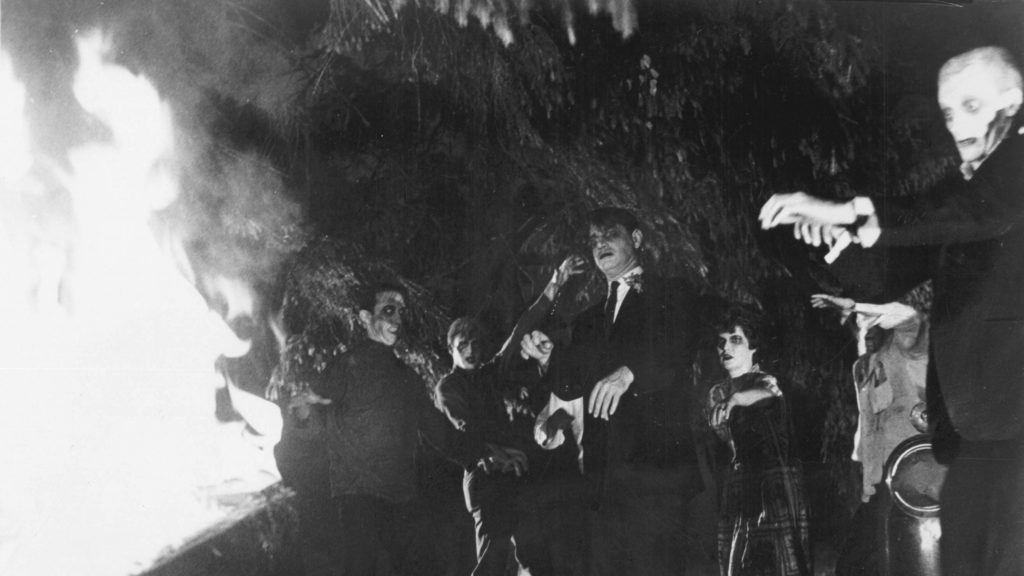
    Thanks to Bill Scurato, managing director of Country Gate Players, for joining us last night on Roy’s Tie-Dye Sci-Fi Corner, for a lively discussion about “Night of the Living Dead” (1968). We talked about the actual making of the film, its social relevance, and its undying influence. Reanimate the archived program by clicking here:

    George A. Romero’s underground masterpiece was featured as part of a Saturday night film series Bill is curating this month at Country Gate Playhouse in Belvidere, NJ. Tonight at 8 pm, there will be a showing of the original, Roger Corman-directed “Little Shop of Horrors” (not to be confused with the later Mencken & Ashman musical).

    On October 29th & 30th the Players will present a “live experience” that will incorporate a screening of Ed Wood’s masterpiece of incompetence, “Plan 9 from Outer Space.” Think “Rocky Horror” meets “Mystery Science Theater 3000.” Among other horrors, Roy will actually sing. And dance. For more information, visit https://www.countrygateplayers.org/upcoming-shows-events

    Next week, we’ll conclude Halloween month with special guests Michael Rizzo and Marybeth Ritkouski of the weekly webcast SciFi Distilled. In what has now become something of a holiday tradition, M&M will join R&R for a lighthearted conversation about the classic television series “The Munsters” (1964-66). Costumes will be worn!

    We’ll be looking for you on Mockingbird Lane. Leave your macabre, comical comments, when we livestream on Facebook, Twitter, and YouTube, next Friday evening at 7:30 EDT!

    https://www.facebook.com/roystiedyescificorner


  • Horror Behind the Camera Movie Music

    Horror Behind the Camera Movie Music

    by 

    in
    6 responses

    When it comes to classic horror, not all the screams are on-screen.

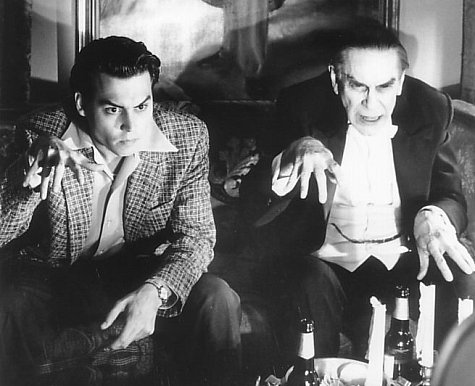
    This week on “Picture Perfect,” we’ll peer around the shower curtain for selections from “Hitchcock” (2012), a behind-the-scenes look at the making of “Psycho,” with music by Danny Elfman; “Matinee” (1993), with John Goodman as a William Castlesque filmmaker, promoting his latest B-movie monsterpiece against the backdrop of the Cuban Missile Crisis, with music by Jerry Goldsmith; “Gods and Monsters” (1998), set during the final days of James Whale, director of “Frankenstein” and “The Invisible Man,” with music by Carter Burwell; and “Ed Wood” (1994), Tim Burton’s love-letter to a director notorious for having helmed some of the worst movies ever made, including “Plan 9 from Outer Space,” with bongo-and-theremin-laden music by Howard Shore.

    Art imitates life, on “Behind-the-Scenes Horror,” on “Picture Perfect,” music for the movies, this Saturday evening at 6:00 EDT, on WWFM – The Classical Network and wwfm.org.


  • Rosemary Brown Liszt’s Medium?

    Rosemary Brown Liszt’s Medium?

    by 

    in
    7 responses

    The medium is the message.

    On the birthday of Franz Liszt, I conjure Rosemary Brown. Brown was the English spiritualist who claimed that the great composers were still very much active and dictating posthumous works to her.

    At the age of 7 (circa 1923), Brown maintained she was confronted by a curious specter with long white hair and a flowing cassock. The specter prognosticated that one day he would make her famous. It was ten years before she stumbled across an old photograph and realized that what she had encountered was no less than the shade of Liszt.

    Brown was born into a family of alleged psychics. Both her parents and grandparents claimed extrasensory powers. Brown took up the piano at the age of 15. Her period of study is unclear, as she seems to have changed her story over the decades, but she would have us believe she was basically a dilettante with little formal training.

    Then, in 1964, the ghost of Liszt reappeared and she began “transcribing” new works by the great composers – Bach, Mozart, Beethoven, Schubert, Schumann, Chopin, Brahms, Grieg, Debussy, Rachmaninoff, and Stravinsky. And Liszt, of course. These included two symphonies she attributed to Beethoven, a new “Fantaisie-Impromptu” by Chopin, and a 40-page sonata by Schubert.

    She claimed that some of the composers directed her hands on the keyboard (Chopin and Liszt); others sang (Schubert) or dictated notes (Bach and Beethoven). All of them communicated in English.

    Skeptics abounded. A number of critics and musicologists dismissed the new compositions as substandard pastiches, claiming that the great composers tended to reinvent themselves and push boundaries, while these freshly “dictated” works offered nothing of the sort.

    Some psychologists attributed the phenomena to extraordinary activity on the part of Brown’s subconscious, with the medium essentially reworking and synthesizing all the music she had been exposed to as a child.

    Still, they had to admit it was impressive. Over the course of her life, Brown produced hundreds of such pieces. One expert described it as “the most convincing case of unconscious composition on a large scale.”

    Respected concert pianists Howard Shelley, Peter Katin, Cristina Ortiz, and John Lill have all included these perhaps spurious works on their programs.

    Brown died in 2001. Whether or not she herself is now dictating is anyone’s guess.


    Rosemary Brown plays a piece allegedly transmitted to her by Liszt

    Brown meets the Amazing Kreskin. (She makes her appearance 9 minutes in; she plays at 12:30.) She claims Liszt helped her son with his homework!

    Documentary on Brown from 1976

    Her obituary in The Guardian:

    https://www.theguardian.com/news/2001/dec/11/guardianobituaries


Tag Cloud

Aaron Copland (93) Beethoven (95) Composer (114) Film Music (145) Film Score (143) Film Scores (255) Halloween (94) John Williams (195) KWAX (229) Leonard Bernstein (104) Marlboro Music Festival (125) Movie Music (160) Mozart (91) Opera (213) Philadelphia Orchestra (89) Picture Perfect (174) Princeton Symphony Orchestra (109) Radio (88) Ross Amico (244) Roy's Tie-Dye Sci-Fi Corner (290) The Classical Network (101) The Lost Chord (269) Vaughan Williams (105) WPRB (397) WWFM (881)

DON’T MISS A BEAT

Receive a weekly digest every Sunday at noon by signing up here


RECENT POSTS