• Remembering Pianist Michael Ponti

    Remembering Pianist Michael Ponti

    by 

    in
    4 responses

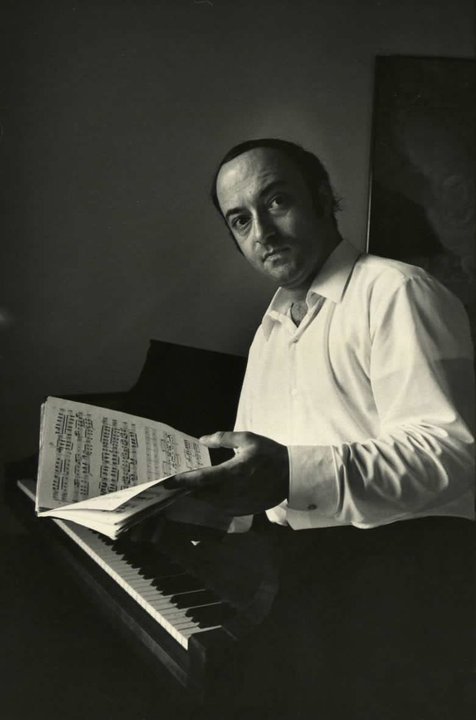
    Back in the day when the big labels recorded standard repertoire and not much else, Michael Ponti was like a seismic disturbance.

    Now the volcano has gone quiet. Ponti died on Monday at the age of 84.

    Sure, Ponti recorded Beethoven and Scarlatti and Tchaikovsky and Rachmaninoff. But he will always be dearest to my heart for the material he exhumed for his groundbreaking, barnstorming Romantic Piano Concerto series on Vox.

    Predating by decades a similar venture on the Hyperion label, Ponti showed what he was made of, in a time before digital trickery. AND he did it all himself. (The Hyperion series draws on a bullpen of capable pianists.)

    The orchestras that accompanied him could be a little rough-and-ready, but often, in its way, this just made the recordings all the more thrilling. In at least one of the concertos, Ponti, caught up in his own bravura, starts doubling the orchestra and adds a flourish or two to the coda. I still return to the series (reissued as seven double-compact discs), with my personal favorites including piano concertos by Anton Rubinstein, Josef Rheinberger, Christian Sinding, Joachim Raff, and Sergei Lyapunov. Also on Vox, Ponti broke more than a few lances for the solo piano works of Carl Tausig and Charles-Valentin Alkan.

    Somehow, he was never picked up by a major label – a rare exception being a recording he made with Dietrich Fischer-Dieskau of the songs of Charles Ives for Deutsche Grammophon – but he did enjoy an active career, especially in Europe. He appeared with such conductors as Sir Georg Solti, Wolfgang Sawallisch, Stanislaw Skrowaczewski, Kirill Kondrashin, and Kurt Masur, and performed in some of the world’s great concert venues, including Carnegie Hall, the Sydney Opera House, and the Teatro Colón.

    He also formed, with violinist Robert Zimansky and cellist Jan Polasek, the Ponti-Zymansky-Polasek Trio (from a marketing standpoint, perhaps not the catchiest name).

    In his 60s, calamity struck, when he suffered a massive stroke. But he was able to revive his career somewhat by drawing from the vast catalogue of music composed for the left hand.

    In all, he made over 80 recordings, most of them for Vox. For some reason, perhaps because he was recorded on smaller labels, often paired with minor league orchestras, he was often overlooked in surveys of important pianists. He is conspicuously absent, for instance, from New York Times critic Harold C. Schonberg’s bestseller “The Great Pianists.”

    Ponti was also a baseball fanatic, who possessed an encyclopedic knowledge of the sport. I saw a picture of him being interviewed later in life, and there are baseball books stacked all the way up the side of his couch. This obituary does a great job of a putting a human face on a super-virtuoso.

    https://www.legacy.com/us/obituaries/washingtonpost/name/michael-ponti-obituary?id=36842554

    It’s a shame Hyperion Records wasn’t around in the ‘60s and ‘70s, because Ponti could eat fire with the best of them. He played with greater Romantic temperament than most of the pianists in the latter’s Romantic Piano Concerto series (again, no relation to the Vox set).

    Admittedly, Ponti’s recordings weren’t always as polished as those in the top tier. I get the impression that, unlike with the majors, there was no room in the budget for retakes or first-class orchestras. These days, when even the most modest professional orchestras are crammed with hungry graduates of the world’s top conservatories, Ponti would mop the floor with much of the competition. He had talent and exuberance to burn.


    Michael Ponti talks to David Dubal, now host of WWFM – The Classical Network’s “The Piano Matters”

    Josef Rheinberger, Piano Concerto in A-flat major

    Joachim Raff, Piano Concerto in C minor

    IN CONCERT: Franz Liszt, “12 Transcendental Etudes”


  • Cat Halloween Costume Ideas Fur Hats & Spooky Music

    Cat Halloween Costume Ideas Fur Hats & Spooky Music

    by 

    in
    2 responses

    It’s that time of year again. With less than two weeks until Halloween, you may be starting to experience that low-level anxiety. How exactly are you going to dress your cat?

    For those in need, here are some great tips on crafting hats and hairstyles out of your little one’s own fur.

    https://www.boredpanda.com/cats-in-hats-made-from-their-own-hair-part-2/?utm_source=google&utm_medium=organic&utm_campaign=organic&fbclid=IwAR3rO8nkSiuMo_5Um8N5YOY6-2zoKDx8ThSKPRQ97fYZgsNpaP9fmcJR_3A

    Now that you’ve got brush in hand, how about some appropriate background music? Some altruistic chap took the effort to compile all the classical music adapted for use in “The Back Cat” (1934), with Boris Karloff and Bela Lugosi.

    Liszt features prominently, with an orchestration of his Piano Sonata in B minor, the orchestral version of his “Hungarian Rhapsody No. 3,” the symphonic poem “Tasso: Lament and Triumph,” and of course “Les Preludes.”

    There’s more Liszt in this “faux” trailer (with Bach and Schubert and near-Tchaikovsky too):

    MEEEEEOWWWWW…


  • Film Score Monthly Memories and Back Issues

    Film Score Monthly Memories and Back Issues

    by 

    in
    2 responses

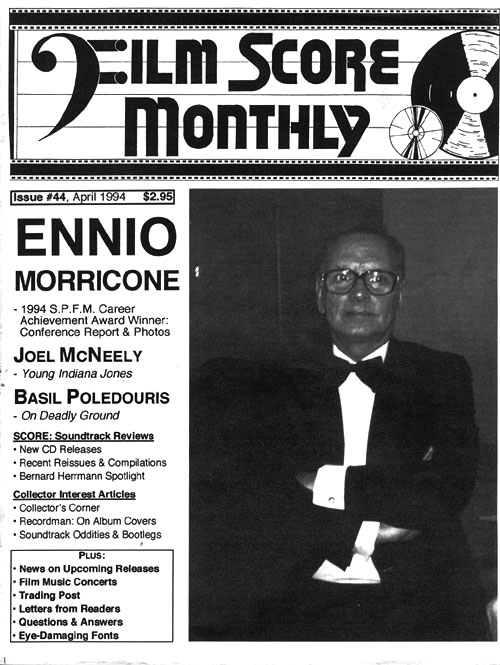
    Anybody else remember Film Score Monthly?

    It’s a film score magazine that’s existed in many forms over the years. It was begun basically as a pamphlet; then it was expanded into a black-and-white print magazine; then it went glossy. Finally, like everything else, it went online.

    The magazine was founded by Lukas Kendall in June 1990, when he was still a student at Amherst. After he graduated, Lukas relocated to Los Angeles, and FSM really upped its game. Many of the great living film composers were friends of the magazine and granted interviews over the years, and a number of the writers, now authorities in the field, have gone on to other things.

    I stumbled across this back-issue from April 1994 (the black-and-white cover days), for which I provided two CD reviews. One of them is for a release appropriate to the season, so I am sharing it here. Maybe I was a little hard on the content. For broadcast purposes, it’s given me moderate enjoyment in small doses, but on a scale of 1 to 5, I think 2 is probably about right. Maybe I’d give it a 3 now, though the running time is ridiculously short. People who were familiar with the original record were going to buy it anyway.

    I know I received at least one letter from a disgruntled Hans J. Salter fan. And I mean a physical letter, since this was before everyone lived on the internet.

    At a point, FSM expanded into producing its own film score CDs, 250 limited edition discs of diverse fare from the ‘40s, ‘50s, ‘60s & ‘70s, for which I will be forever grateful. Many of these are now available only on the collector’s market at astronomical prices, but you can still pick up some of the titles for around $15-$20. Good luck getting the rest!

    I hasten to point out, Film Score Monthly still exists, as a website. I haven’t really followed it for some time now, but I know “Picture Perfect” has been mentioned on its message board.

    Back issues of the print incarnation of the magazine are archived online to read free of charge.

    https://www.filmscoremonthly.com/fsmonline/backissues_print.cfm?

    Here’s the current digital issue:

    https://www.filmscoremonthly.com/daily/index.cfm

    Lukas now has his own blog, full of interesting and often nostalgic observations on film, music, pop culture, and fandom. You can check it out here:

    https://www.lukaskendall.com/blog

    Some affordable FSM CDs still available from Screen Archives Entertainment:

    https://www1.screenarchives.com/display_results.cfm/category/317/Film-Score-Monthly/

    Listen to Dick Jacobs’ atmospheric (and campy) “Themes from Classic Science Fiction, Fantasy and Horror Films” here:


  • Romanian Classical Gems Unearthed

    Romanian Classical Gems Unearthed

    by 

    in
    6 responses

    In this season when you can’t hear “Transylvania” without imagining a wolf howl, we’ll set aside creepy castles in the Carpathian Mountains for the more congenial sounds of Romania’s concert halls.

    This Sunday night on “The Lost Chord,” we’ll look beyond George Enescu, Romania’s most celebrated musical polymath, to hear music by three of his compatriots, only one of whom managed to achieve recognition beyond the borders of his homeland.

    George Stephănescu (1843-1925) was a seminal figure in the development of Romanian opera. He founded the nation’s first opera company in 1885. He is also credited with having composed the first Romanian symphony. Stephănescu conducted at the National Theater and taught at the Bucharest Academy of Music. His “National Overture” of 1876 reflects his patriotic concerns.

    By contrast, György Ligeti (1923-2006) was destined to be a bit of an outlier. Born into a Jewish family in an ethnically Hungarian region of Transylvania, Ligeti went on to become one of the most important composers of his generation, but much of his music is in a style that would have been deemed “avant-garde.” However, he also had his playful side. In 1951, he wrote his “Concert românesc” (“Romanian Concerto”), a wholly accessible and little-known work based on actual Romanian folk tunes he had studied at the Folklore Institute in Bucharest. Despite this being one of his most overtly delightful pieces, the work was banned after a single rehearsal in Bucharest and not heard publicly until 1971. “Totalitarian regimes do not like dissonances,” he observed ruefully.

    Finally, Paul Constantinescu (1909-1963) was part of a generation of Romanian composers that came of age in the shadow of Enescu. He composed in most musical forms: opera, ballet, oratorio, incidental music, symphonic, chamber and choral music, and music for film, yet he remains little-known in the West. His concertante output includes works for violin, cello, piano and harp, in addition to a concerto for string orchestra. We’ll hear Constantinescu’s Piano Concerto, from 1952.

    Children of the night! What music they make.

    Go batty for exhumed Romanian classics. The Count invites you to join him in his box, for “Romania Mania,” this Sunday night at 10:00 EDT, on WWFM – The Classical Network and wwfm.org.


  • Night of the Living Dead Livestream This Friday

    by 

    in
    4 responses

    A great compliment from Vinny Foti regarding our show on Friday evening. Everything goes better with a cheesesteak and pierogies. Be sure to order out in advance of our discussion of “Night of the Living Dead” (1968), on the next @[100063986017424:2048:Roy’s Tie-Dye Sci-Fi Corner]. We livestream on Facebook, Twitter, and YouTube, this Friday at 7:30 pm EDT. Thank you, Vinny!


Tag Cloud

Aaron Copland (93) Beethoven (95) Composer (114) Film Music (145) Film Score (143) Film Scores (255) Halloween (94) John Williams (195) KWAX (229) Leonard Bernstein (104) Marlboro Music Festival (125) Movie Music (160) Mozart (91) Opera (213) Philadelphia Orchestra (89) Picture Perfect (174) Princeton Symphony Orchestra (109) Radio (88) Ross Amico (244) Roy's Tie-Dye Sci-Fi Corner (290) The Classical Network (101) The Lost Chord (269) Vaughan Williams (105) WPRB (397) WWFM (881)

DON’T MISS A BEAT

Receive a weekly digest every Sunday at noon by signing up here


RECENT POSTS