• Rosh Hashanah Gershwin’s Jewish Soul

    Rosh Hashanah Gershwin’s Jewish Soul

    by 

    in
    2 responses

    Shana tova! Rosh Hashanah began last night at sundown. To my Jewish friends, best wishes for a good and sweet 5783. Apples and honey all around.

    This year’s observance happens to coincide with the birthday of George Gershwin (born Jacob Gershowitz to Jewish immigrant parents who settled on New York City’s Lower East Side).

    Many sources claim that Gershwin, while culturally Jewish, was not particularly observant. Nevertheless, Kitty Carlisle recollected a zany Seder at the Gershwin home with Oscar Levant in attendance; Gershwin was an active supporter of Jewish charities; allegedly he wouldn’t marry Kay Swift, his lover of over ten years, because she wasn’t Jewish (Gershwin’s mother disapproved); and following his untimely death at the age of 38, he was remembered in bicoastal Jewish funeral services.

    Furthermore, sharp-eared listens with some familiarity with Jewish tradition have identified Jewish themes and motifs in his music. It’s been remarked that you could keep Gershwin out of shul, but you couldn’t keep shul out of Gershwin. Here’s an interesting article on the subject.

    George Gershwin’s Jewish Music

    Sadly, we’ll never know what an abandoned opera on Szymon Ansky’s “The Dybbuk” would have sounded like. (It was scrapped because of copyright issues.)

    Early on, Gershwin expressed interest in writing for the Yiddish theater. He even made some piano rolls of Yiddish songs. Here’s one from 1917, a rendition of a 1903 Yiddish theater tune by Meyerowitz titled “Gott un Sein Mishpet Is Gerecht.”

    Happy birthday, George Gershwin, and have a sweet New Year!


  • John Williams Knighted!

    John Williams Knighted!

    by 

    in
    5 responses

    Well, whaddya know? Just when you thought there wasn’t an award he hasn’t already received, John Williams has been knighted.

    On Queen Elizabeth II’s final awards list, Williams was granted the honorary title of KBE (Knight of the British Empire). Of course, in order to be formally addressed as “Sir,” he would have to become a British citizen.

    Musically, Williams has been a lifelong anglophile. He has also been a frequent collaborator with the London Symphony Orchestra.

    His scores to “Star Wars,” “The Fury, “Superman,” “Dracula,” “The Empire Strikes Back,” “Raiders of the Lost Ark,” “Monsignor,” “Return of the Jedi,” “Harry Potter and the Sorcerer’s Stone,” “The Phantom Menace,” “Attack of the Clones,” “Harry Potter and the Chamber of Secrets,” “Harry Potter and the Prisoner of Azkaban,” and “Revenge of the Sith” were all recorded with the LSO.

    Furthermore, there would be no “Star Wars” or “Williams sound,” for that matter, without the influence of Sir William Walton, Ralph Vaughan Williams, Sir Edward Elgar, and Gustav Holst.

    “You have chosen… wisely.”

    A brief history of Williams’ special relationship with the London Symphony Orchestra

    A “Super” Orchestra

    The Queen’s final list of honorary awards

    https://www.gov.uk/government/publications/honorary-british-awards-to-foreign-nationals-2022/honorary-awards-to-foreign-nationals-in-2022?fbclid=IwAR1l-gep0H1Z6_76VXGqwHl4wGdjEdF5Pnc-WjGsMm-gHgfnYMGVL_PmxLM


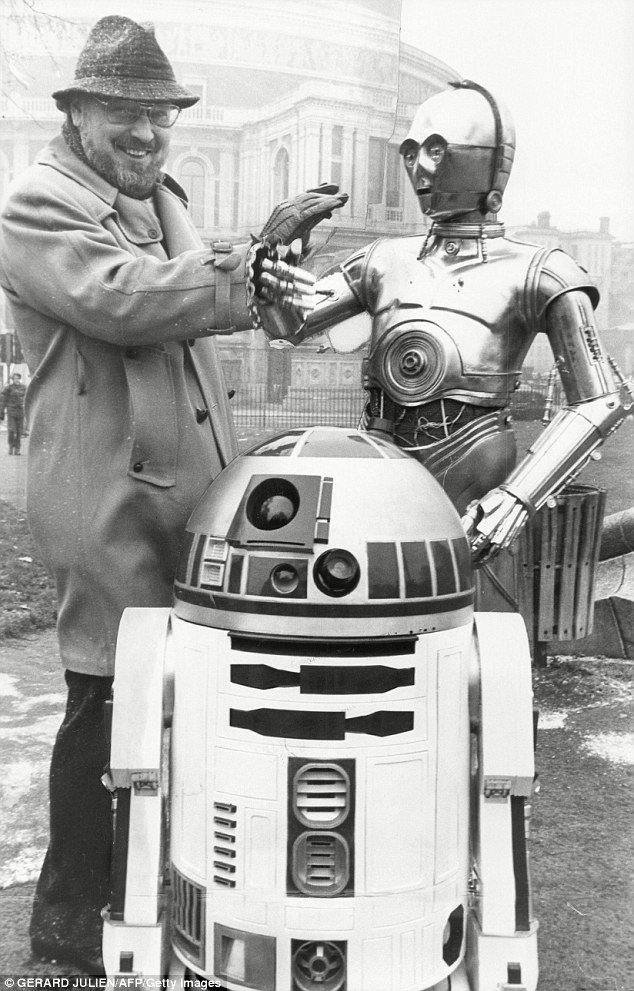
    PHOTO: Before a concert at the Royal Albert Hall with the LSO in February 1978


  • Romeo Cascarino Lost American Composer

    Romeo Cascarino Lost American Composer

    by 

    in
    4 responses

    O Romeo, Romeo, wherefore art thou Romeo? Why does no one play your music?

    It is well-crafted. It has heart. It is full of beauty. All it lacks is exposure.

    This Sunday night on “The Lost Chord,” we salute Romeo Cascarino, in anticipation of the 100th anniversary of his birth on September 28, 1922.

    Cascarino grew up in an unforgiving neighborhood in South Philadelphia. With a name like Romeo, he had to learn how to use his fists! While navigating the School of Hard Knocks, he taught himself privately, gleaning the mechanics of music theory from books checked out of the Free Library of Philadelphia. He was discovered by composer Paul Nordoff, who recognized his genius, and the two formed a bond that was more like a friendship than master-disciple.

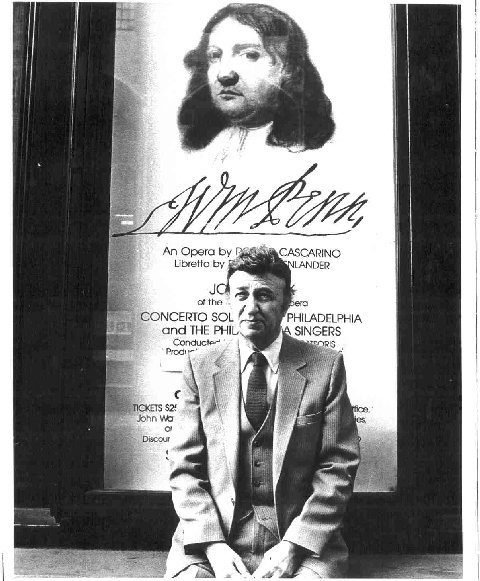
    For many years, Cascarino was a professor of composition at Combs College of Music. The recipient of two Guggenheim Fellowships, he labored at his magnum opus, the opera “William Penn,” for the better part of three decades. The work received its premiere at Philadelphia’s Academy of Music in 1982 to mark the 300th anniversary of the founding of the city.

    Metropolitan Opera singer bass-baritone John Cheek sang the title role, Cascarino’s wife, soprano Dolores Ferraro, created the part of Gulielma, Penn’s wife, and Christofer Macatsoris conducted the Philadelphia Singers and the Concerto Soloists of Philadelphia.

    Ferraro and arts writer Tom Di Nardo will join me to share their reminiscences and insights into Cascarino, the man and the composer, who died in 2002. I’ve assembled some of their remarks and punctuated the conversation with rare audio from the family archives, as well as studio recordings made by JoAnn Falletta and Sol Schoenbach, former principal bassoonist of the Philadelphia Orchestra.

    A seductive, twilit beauty informs much of Cascarino’s output. If only he had completed “William Penn” 30 years earlier, it would now be regarded one of the great American operas of mid-century, spoken of in the same breath as Carlisle Floyd’s “Susanna” and Robert Ward’s “The Crucible.”

    I hope you’ll join us in “Remembering Romeo,” this Sunday night at 10:00 EDT, on WWFM – The Classical Network and wwfm.org


  • Alphaville & Don’t Be Afraid of the Dark Review

    Alphaville & Don’t Be Afraid of the Dark Review

    by 

    in
    5 responses

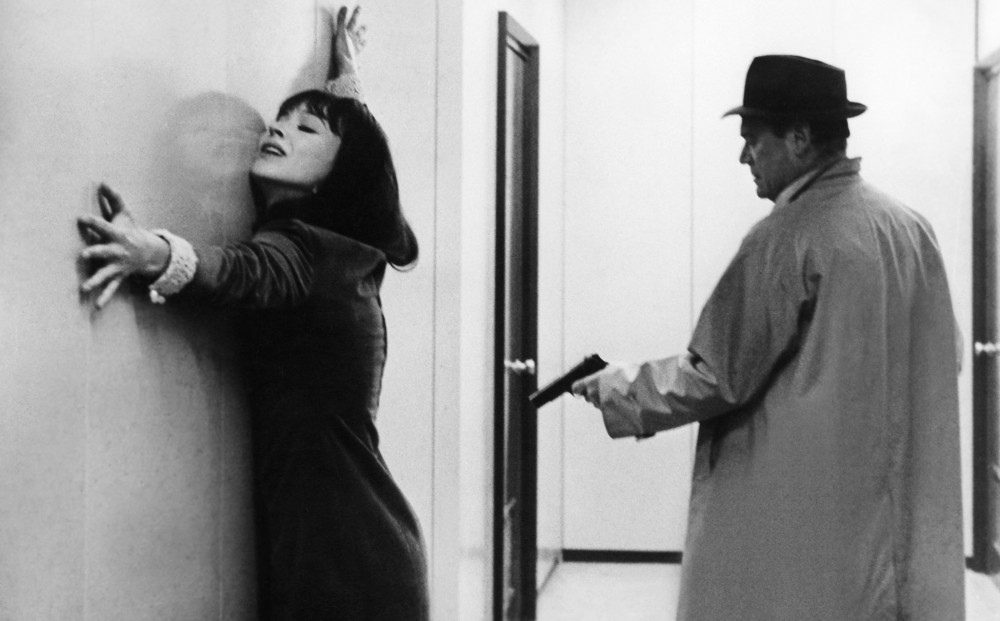
    Last night on Roy’s Tie-Dye Sci-Fi Corner, we embraced the disorienting film noir dystopia that is Jean-Luc Godard’s “Alphaville” (1965). Special thanks to Christian Lalancette for joining us for this three-way conversation. If you disagree with any of the observations, Alpha 60 will have them redacted. Or you can simply employ Orwellian Newspeak, so that everything means its opposite.

    Next week, we dive headlong into October a day early to kick off our annual month-long celebration of Halloween, as we recollect “Don’t Be Afraid of the Dark” (1973), the unforgettably creepy TV movie that brought trauma to all our childhoods.

    Everyone drink in the comments section whenever we whisper “Sally, Sally….” I’ll have the crankiest disposition this side of William Demarest when we livestream on Facebook, next Friday evening at 7:30 EDT!

    https://www.facebook.com/roystiedyescificorner


  • Liz & Dick: Music from Their Movies

    Liz & Dick: Music from Their Movies

    by 

    in
    2 responses

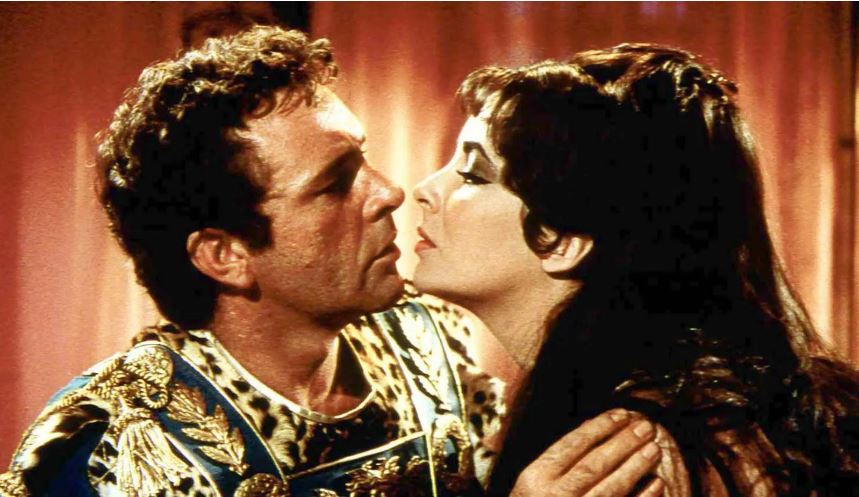
    Elizabeth Taylor and Richard Burton made no fewer than a dozen films together, but it was their tempestuous personal life that made them a source of ceaseless fascination. This week on “Picture Perfect,” enjoy a diverse assortment of musical selections from their movies.

    Regardless of their relative merits, the films of Liz and Dick could be counted on to feature scores by some very fine composers, not the least of whom was Alex North. North is probably most celebrated for his music for “Spartacus.” He would seem a natural fit, then, to write the music for “Cleopatra” (1963).

    “Cleopatra” is the film that first paired Burton and Taylor, on and off-screen. Contrary to popular belief, the epic teaming made a mint. It was the highest-grossing release of its year. However, it simply wasn’t enough to cover the costs of production, marketing, and distribution. “Cleopatra” nearly bankrupted 20th Century Fox. Despite its reputation, there’s still much to enjoy, perhaps most of all in its music.

    For a true sense of North’s versatility, we’ll also sample selections from “Who’s Afraid of Virginia Woolf” (1966), based on the play by Edward Albee. Both Burton and Taylor’s performances were nominated for Academy Awards. Taylor would win – her second Oscar – but despite seven nominations over the course of his career, Burton would never be so honored. It’s not any easy film to watch. There’s always a sneaking suspicion that Liz and Dick were merely playing versions of themselves. The comparatively understated music is full of Baroque touches and characterized by a chamber-like intimacy.

    The dysfunctionality continues, as allegedly “The V.I.P.s” (1963) was inspired by the real-life love triangle of Vivien Leigh, Laurence Olivier, and Peter Finch. The story is set at London Heathrow Airport, where flights are delayed because of a dense fog. The film was written by Terrence Rattigan, and co-starred Louis Jourdan, Maggie Smith, Rod Taylor and Orson Welles. Margaret Rutherford won an Academy Award for Best Supporting Actress.

    The composer was the Miklós Rózsa. Rózsa is perhaps most associated in people’s minds with his work on historical and biblical epics. Here it’s the film’s costars that are larger than life.

    We’ll conclude with music from the Shakespearean romp, “The Taming of the Shrew” (1967), Franco Zeffirelli’s fleet adaptation that also introduced the world to Michael York. The roles of Katherina and Petruchio suit Liz and Dick most satisfyingly.

    The composer was Nino Rota. Zeffirelli and Rota would score a bulls-eye with their Shakespearean follow-up, “Romeo and Juliet,” released the following year. That film became an international hit, and Rota’s love theme immortal.

    Ironically, Taylor and Burton’s final filmed collaboration was a 1973 television movie, “Divorce His, Divorce Hers.” The two, of course, would divorce in real life, only to remarry less than 16 months later, though their second union was short-lived. The exes would pair for one last time, ten years later, for a staged revival of Noel Coward’s “Private Lives,” which was witheringly received.

    It’s a bouquet of dysfunction, but a chocolate box of classic film scores for the films of Taylor and Burton, on “Picture Perfect,” music for the movies, this Saturday evening at 6:00 EDT, on WWFM – The Classical Network and wwfm.org.

Tag Cloud

Aaron Copland (93) Beethoven (95) Composer (114) Film Music (145) Film Score (143) Film Scores (255) Halloween (94) John Williams (195) KWAX (229) Leonard Bernstein (104) Marlboro Music Festival (125) Movie Music (160) Mozart (91) Opera (213) Philadelphia Orchestra (89) Picture Perfect (174) Princeton Symphony Orchestra (109) Radio (88) Ross Amico (244) Roy's Tie-Dye Sci-Fi Corner (290) The Classical Network (101) The Lost Chord (269) Vaughan Williams (105) WPRB (397) WWFM (881)

DON’T MISS A BEAT

Receive a weekly digest every Sunday at noon by signing up here


RECENT POSTS