If you’re curious, here’s a program of all the music played at the Queen’s funeral today.
Happy to see a selection from Vaughan Williams’ 5th Symphony made it, albeit in transcription for organ. Also “O Taste and see,” his setting of Psalm 34, first sung at the Queen’s coronation in 1953.
Curious to find Malcolm Williamson on the roster, as surely he was the most controversial of Masters of the Queen’s music. (He was notorious for missing deadlines.) Pleased to note his inclusion, nonetheless. An underappreciated composer.
Judith Weir, current Master of the King’s Music, and Sir James MacMillan have written new works for the occasion.
This Sunday night on “The Lost Chord,” we mark the passing of an era in English history with music that had its origin in the twilight of another.
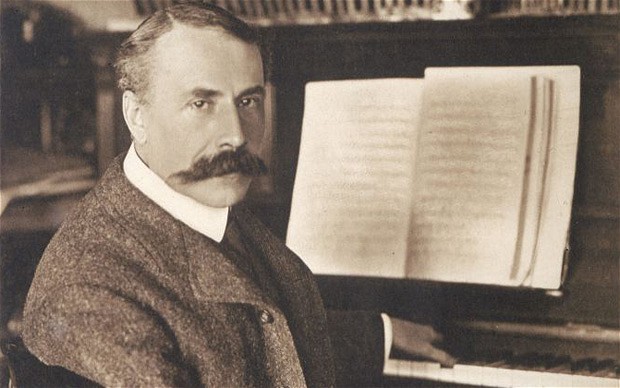
Sir Edward Elgar produced no major works following the death of his wife in 1920. It was his friend and champion, George Bernard Shaw, who, in an attempt to keep one of England’s greatest composers from withering on the vine, persuaded the BBC to commission from Elgar a Third Symphony.
Elgar, who died in 1934, worked at the piece during the last year of his life, jotting down his ideas – some merely a few bars in length; others, pages in full score. As his health deteriorated, he realized he would never be able to complete the work, and he made contradictory remarks concerning his intentions over the fate of the sketches.
Another of his friends, the violinist W.H. Reed, passed many hours playing through what existed of the piece, with the composer at the piano. After Elgar’s death, Reed published 40 pages’ worth of sketches into a memoir, which kept the work at the periphery of the public consciousness.
Several attempts were made over the decades to make something more of the sketches, but musicians and musicologists have always been stopped short by the Elgar estate.
The composer Anthony Payne became interested in the fragments in 1972. For many years, he worked at a realization of the symphony, again meeting resistance from Elgar’s heirs, until it became apparent that, due to the publication of the sketches in Reed’s book, the material would soon fall into the public domain. The family opted to capitalize on what control it had left and finally authorized Payne’s efforts.
Payne’s realization was given its premiere in 1998 and granted broad exposure through performances by major orchestras, particularly in England and the United States (including the Philadelphia Orchestra), and the piece has been recorded at least four times.
The formal title is “Edward Elgar: The Sketches for Symphony No. 3 Elaborated by Anthony Payne,” or the “Elgar/Payne Symphony No. 3,” for short. It’s an uncanny piece of work, and you’ll have a chance to hear it tonight.
It’s hard to believe, but the lives of Elgar and the long-lived Elizabeth actually did overlap. In 1930, the composer was commissioned to write a “Nursery Suite” for then-Princess Elizabeth and her sister Margaret. And what do you know, Payne actually quotes from one of the suite’s movements, “The Waggon Passes,” to conclude what would have been Elgar’s valedictory symphony. There are also quotations from the composer’s incidental music to Laurence Binyon’s dramatic account of “King Arthur.”
Lots of history packed into this piece, then, which serves as a musical farewell – from our perspective, in more ways than one.
I hope you’ll join me for “No Payne, No Gain,” this Sunday night at 10:00 EDT, on WWFM – The Classical Network and wwfm.org.
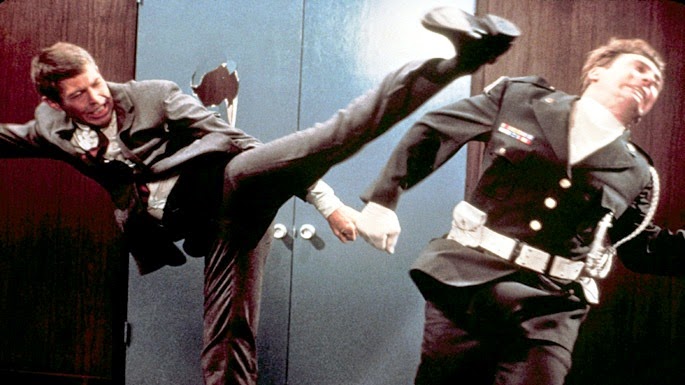
We get a kick out of James Coburn during last night’s discussion of “Our Man Flint” (1966). Surprisingly lots to talk about in our discussion of this James Bond parody that yet manages to be its own cool, breezy thing. If only I could have used my weather machine to disrupt the rehash of the plot.
Join us next time as three alpha males strive for dominance in a discussion about “Alphaville” (1965). Cinephile Christian Lalancette will join us for this broadcast in memory of New Wave pioneer Jean-Luc Godard. Fedoras and cigarettes will abound as we wander the labyrinthine corridors of this dystopian sci-fi film noir.
Bring your Zippo lighters to the comments section, when we livestream on Facebook. There will be plenty of pulp in our poetry, on the next Roy’s Tie-Dye Sci-Fi Corner, next Friday evening at 7:30 pm!
What has often been regarded in the United States as “hack work,” in England has been accepted as just another aspect of what it means to be a working artist. There is no disgrace in a composer earning a living, and some of the nation’s greatest musicians – including those in the employ of the Royal Family – have contributed finely-crafted scores to its body of cinema.
This week on “Picture Perfect,” it’s an hour of English documentary music. We’ll hear selections by Ralph Vaughan Williams, from “The People’s Land” (1941), Benjamin Britten, from “The King’s Stamp” (1935), William Alwyn, from “The Green Girdle” (1941), and Master of the Queen’s Music, Sir Arthur Bliss, from “The Royal Palaces of Britain” (1966). All four films are patriotic utterances on distinctly English themes.
You may not have seen any of these shorts, but the music is beautiful. I hope you’ll join me for music from English documentaries, this Saturday evening at 6:00 EDT, on WWFM – The Classical Network and wwfm.org.
In the meantime, if you’re having a slow day, why not get a taste of the films themselves?
Merveilleuse was the “Boulangerie” that produced sisters Nadia and Lili.
Their mother, Raissa Myshetskaya (Mischetzky), was a Russian princess, who married Ernest Boulanger, a teacher and prize-winning composer at the Paris Conservatory. His associates included Charles Gounod, Jules Massenet, and Camille Saint-Saëns. Their grandfather, who had also taught there, was a notable cellist. Their grandmother sang at the Théâtre de l’Opéra-Comique. Suffice it to say, from their earliest years, the girls were exposed to the finest musical minds of Paris.
On Nadia Boulanger’s birthday, much respect to these marvelous musical sisters.
Nadia (1887-1979) became what has been described as the most influential teacher since Socrates. Her students included everyone from Dinu Lipatti to Igor Markevitch, from Aaron Copland to Elliott Carter, from Astor Piazzolla to Philip Glass, from Michel Legrand to Quincy Jones, from Leonard Bernstein to “What Makes It Great?” radio host Rob Kapilow.
Her influence on American music, in particular, has been incalculable. Hopefuls flocked to her American Conservatory at Fontainebleau, where she accepted applicants from all backgrounds, provided they were determined to learn. It was Virgil Thomson who quipped, “She was a one-woman graduate school, so powerful and permeating that legend credits every United States town with two things: a five and dime and a Boulanger pupil.” The five and dimes may have faded, but not so the legacy of the “Boulangerie.”
Beneath those grey hairs and pince-nez lurked an iron will that brooked no nonsense, yet Boulanger was surprisingly accepting, astonishingly objective, and generally dead-on in her assessments.
Nadia’s younger sister, Lili (1893-1918), was one of the great hopes of French music, the first woman to win the Prix de Rome composition prize. She won the prize in 1913, at the age of 19, for her cantata “Faust et Hélène.” It was actually Lili’s second attempt. The year before, she collapsed during her performance.
Unfortunately, Lili suffered from chronic ill health, contracting bronchial pneumonia at the age of 2. Her compromised immune system left her vulnerable to Crohn’s disease, which ended her life in 1918 at the age of 24.
Nadia too had had ambitions to compose. She attempted to win the Prix de Rome (as their father had done in 1835), but was repeatedly frustrated. She got as far as second place in 1908. It became evident that her sister was the real talent in that regard, so Nadia pursued organ and, of course, pedagogy.
Both sisters were greatly influenced by Gabriel Fauré, who was director of the Paris Conservatory – Lili, a musical prodigy, had been accompanying her sister to the conservatory from before the age of 5 – and of course Debussy’s impact in those days was inescapable. Like Debussy, Lili gravitated toward a kind of indirection in her music, more characteristic of Symbolism than the evocative sorts of atmospheres often attempted by the Impressionists (a classification, by the way, Debussy disliked).
Lili was greatly affected by the death of her father in 1900, and many of her works are marked by grief and loss. Ernest fathered his children quite late in life. He was 72 when Nadia was born, and 77 at the time of Lili’s birth. The girls’ mother was 41 years his junior. Despite the inherent melancholy that pervades much of her music, Lili displayed a colorful mastery of harmony and orchestration.
Often she was perceived as destined for greatness. Her music has actually been programmed fairly frequently for a woman composer of her era. But now with greater sensitivity to male dominance in the world’s concert halls, we are bound to hear even more Lili Boulanger. It’s just a pity she didn’t leave us more.
Nadia’s life was as long as her sister’s was brief. She died in 1979 at the age of 92.
Fascinating documentary about Nadia Boulanger, including first-hand accounts, historical footage, and terrific insights. Leonard Bernstein is interviewed in French, beginning around the 7-minute mark:
Nadia conducts Fauré’s Requiem
Nadia’s own “Fantaisie variée” for piano and orchestra
Lili Boulanger’s “Faust et Hélène”
“D’un soir triste” (“Of a Sad Evening”)
“Vieille prière bouddhique” (“Old Buddhist Prayer”)
BREAK BREAD WITH THE BOULANGERS ON NADIA’S BIRTHDAY: Nadia, left, with Lili in 1913. The bread was baked fresh this morning.


6 responses