• Elgar Remastered Accidental Stereo

    Elgar Remastered Accidental Stereo

    by 

    in
    7 responses

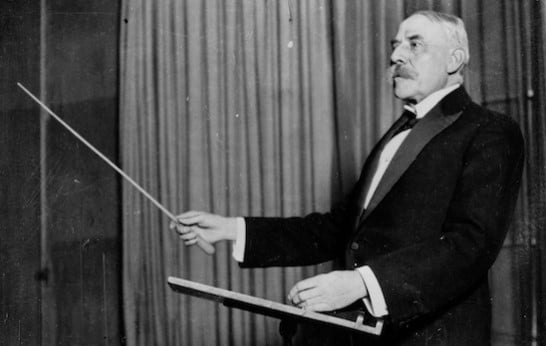
    This Sunday night on “The Lost Chord,” there may not be glorious Technicolor or breathtaking Cinemascope, but what would Cole Porter say, to hear Sir Edward Elgar in stereophonic sound?

    Elgar was one of the first of the great composers to endeavor to set down “definitive” interpretations of his own works on recordings. Or so it has been thought. But did Elgar really regard these performances as definitive? In fact, Elgar took great care to “grade” the various takes from his recording sessions. Some of these, he instructed, were to be destroyed outright; others were held, as the composer took the time to consider.

    What emerges, upon listening to a 4-CD set, “Elgar Remastered,” on the SOMM Recordings label, are the impressions that (1) Elgar was fairly meticulous when it came to preserving his legacy, and (2) he also understood that there’s more than one way to skin a cat. Rediscovered alternative takes make clear that the composer was amenable to looking at his own works from a variety of perspectives.

    For their parts, the conscientious engineers at EMI employed multiple machines to guard against technological failure. This was back in the late 1920s and early ‘30s. Now, for the first time, the elements have been brought together and skillfully combined to create a kind of “accidental” stereo.

    Engineer Lani Spahr has worked wonders with these recordings, from the private collection of Arthur Reynolds, chairman of the North American Branch of the Elgar Society. He also goes into considerable detail in his liner notes – in fact, to a degree that would be impractical to relate here.

    A good deal of the set is devoted to recordings and alternative takes of Elgar’s Cello Concerto. As on the composer’s authorized recording, issued on EMI, Beatrice Harrison is the soloist. These include the first complete electrical recording, from 1928 – the one which would ultimately be published, in mono – with previously unissued, alternative takes from the same sessions. There is also an earlier, truncated recording from 1920, set down using the acoustic process, and a performance of the concerto’s Adagio movement alone, with Harrison accompanied at the keyboard by Princess Victoria.

    The gem of the set is Harrison’s celebrated 1928 recording, heard here for the first time entirely in stereo, or what passes for stereo.

    Harrison was Elgar’s preferred soloist. He lavished praise on her performances, even as she took liberties with the score. At the session for this particular recording, he was overheard to say, “Give it ‘em, Beatrice, give it ‘em. Don’t mind about the notes or anything. Give ‘em the spirit.”

    Worlds away from the effusive, heart-on-the-sleeve approach of Jacqueline du Pré, Harrison’s interpretation is nonetheless riveting on its own terms. As with the other recordings in the collection, it is a kind of time capsule of period performance practice – with swooping portamenti (audible slides between notes) – and the musicians’ flexibility in regard to both tempo and phrasing.

    And Elgar can be such a volatile conductor! In addition, we’ll hear a cracking rendition of the “Cockaigne Overture” and a performance of the prelude to the oratorio “The Kingdom,” which really takes flight.

    Hear Elgar as you’ve never heard him before – in “accidental” stereo – on “Pomp and Happenstance,” this Sunday night at 10:00 EDT, on WWFM – The Classical Network and wwfm.org.
  • Star Trek City on the Edge of Forever Discussion

    Star Trek City on the Edge of Forever Discussion

    by 

    in
    One response

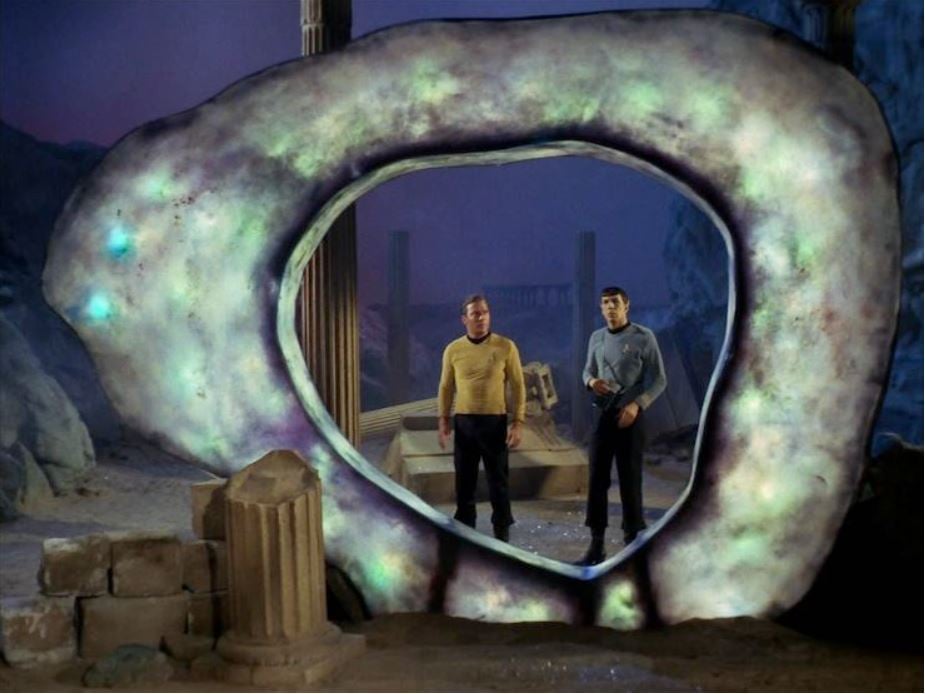
    Only Dr. McCoy would leap through a time-displacing doughnut for a shot at a pot of Joan Collins’ coffee. After all, you can’t have doughnuts without coffee.

    And you can’t discuss “Star Trek” without Mike and Marybeth of SciFi Distilled. Thanks to both for dropping by last night for our discussion about the original series episode “The City on the Edge of Forever” (1967). Lots of interesting insights into the episode’s genesis. In the end, what was filmed wound up being quite different from writer Harlan Ellison’s original vision.

    This is the “Trek” episode most fans genuflect before. Our conversation on “the Edge of Forever” went by very quickly, if I do say so myself. The show is now archived here:

    We’ll be BACK with yet another time-travel adventure, supposedly, on the next Roy’s Tie-Dye Sci-Fi Corner. Roy will be making the announcement by the end of the weekend. Set your clocks for the next Facebook livestream, next Friday evening at 7:00 EDT.

    https://www.facebook.com/roystiedyescificorner


  • Patrick Doyle’s Shakespeare Sound

    Patrick Doyle’s Shakespeare Sound

    by 

    in
    6 responses

    “Is it not strange that sheep’s guts should hale souls out of men’s bodies?”

    This week on “Picture Perfect,” on the presumed birthday of William Shakespeare (April 23, 1564), we’ll make much ado about Patrick Doyle, with selections from his scores written for the films of Kenneth Branagh.

    In 1987, Doyle joined Branagh’s Renaissance Theatre Company, for which he provided incidental music. Two years later, Branagh – and by extension, Doyle – made a leap to the big screen, where they achieved a remarkable feat, rethinking Shakespeare’s “Henry V.” Remember, this is the play that propelled Laurence Olivier to worldwide fame in 1944, both as a filmmaker and the Bard’s most celebrated interpreter, and William Walton’s score is regarded as one of the best of all time.

    Branagh’s version is quite different. Though equally rousing, it doesn’t shy away from Henry’s more complicated nature and the grittier aspects of what it means to go to war. It was a bold gamble, but one that paid off. Not only did this revisionist “Henry” receive nearly universal acclaim, the film was a box office success, and Branagh would be nominated for two Academy Awards, like his predecessor, in the categories of Best Actor and Best Director. Certainly, the film’s score deserved to be recognized – but in the year of “The Little Mermaid,” it failed even to secure an Academy Award nomination.

    An interesting footnote: Doyle himself is the baritone who introduces “Non nobis Domine,” a prayer of thanksgiving, following the Battle of Agincourt.

    In 2006, Branagh directed an adaptation of “As You Like It.” As has become his custom, he took a celebrity approach to its casting, although perhaps not so widely uneven as some of the cameos in his big screen “Hamlet.” Kevin Kline plays Jacques; Alfred Molina the fool, Touchstone; and Branagh regulars, Brian Blessed and Richard Briers appear, as well.

    The most radical liberty taken with the play is that Branagh transplants the action to 19th century Japan. The language remains firmly rooted in Shakespeare’s text, although there are striking cross-cultural elements, including ample kimonos, kabuki theatre, ninjas, and a sumo wrestler. Still, it’s a long way off from the astounding bomb that was Branagh’s American Songbook-interpolated “Love’s Labour’s Lost.”

    While Olivier’s “Hamlet” won four Academy Awards in 1948, including those for Best Picture and Best Actor, Branagh’s 1996 version is cinema’s first adaptation of the complete text. It is, perhaps, an uneven interpretation, with some puzzling casting choices – including walk-ons by Jack Lemmon, Robin Williams, and Gerard Depardieu – but there are enough merits, certainly, to make the four-hour trek worthwhile.

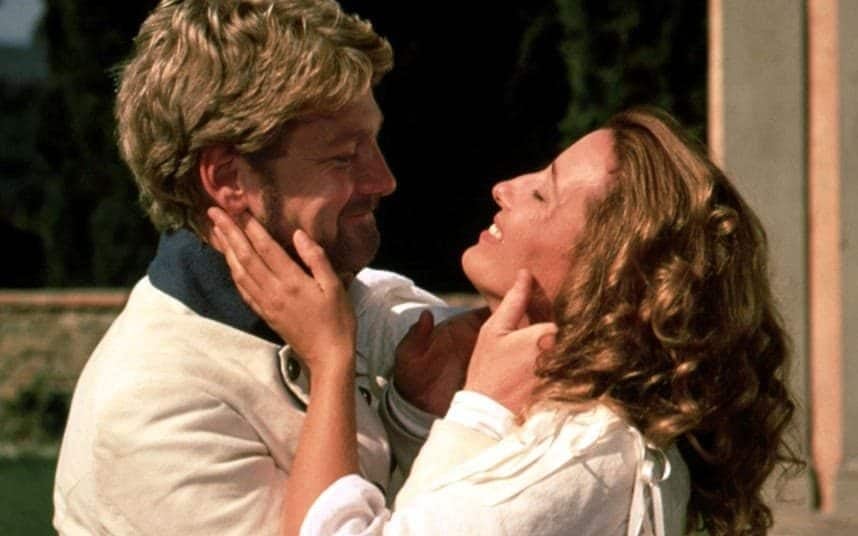
    Finally, Branagh teamed with his then-wife, Emma Thompson, for a “merry war” of wits, as Benedick and Beatrice, in his 1993 adaptation of “Much Ado About Nothing.” Again, the film features an eclectic supporting cast of classically trained actors and pop Hollywood phenomena. Briers, Blessed, and Imelda Staunton share screen time with Denzel Washington, Michael Keaton, and Keanu Reeves. Yet, somehow, despite the different nationalities, ethnicities, and accents, the entire enterprise works. There is an exuberance to the over-the-top opening sequence which sets up a momentum that carries through the rest of the film.

    Sigh no more, but join me for the Shakespeare scores of Patrick Doyle on “Picture Perfect,” music for the movies, this Saturday evening at 6:00 EDT, on WWFM – The Classical Network and wwfm.org.


    How could you not love this opening?

    Faith and sheep’s guts in “Much Ado About Nothing”

    https://www.tandfonline.com/doi/abs/10.1080/17450918.2014.968607#:~:text=In%20Benedick’s%20response%20to%20Balthasar’s,member%20of%20Shakespeare’s%20original%20audience.


  • City on the Edge of Forever Star Trek Review

    City on the Edge of Forever Star Trek Review

    by 

    in
    7 responses

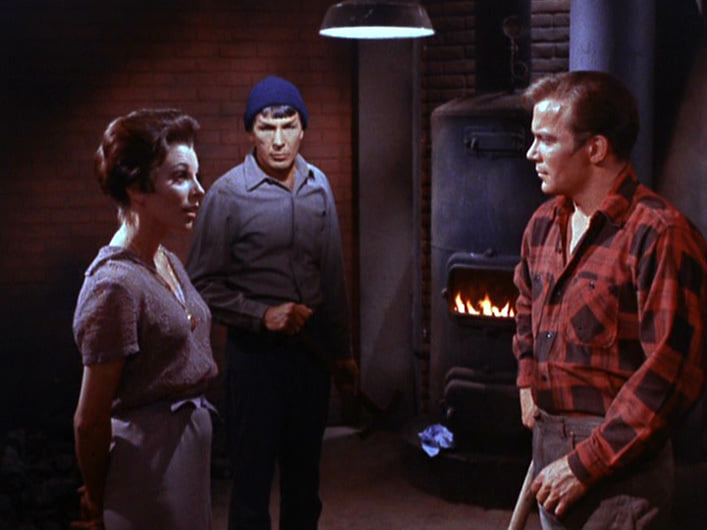
    McCoy goes sweaty crazy, Kirk falls for Joan Collins, and Spock does his best Michael Nesmith impression. That’s right, it’s what many consider to be the greatest of the original “Star Trek” episodes, “The City on the Edge of Forever” (1967).

    Roy and I will be slumming it in a Depression-era soup kitchen with our esteemed colleagues, Mike and Marybeth of SciFi Distilled, as we mop up the minutiae of this fan favorite.

    We’ll search for “Bones” in a time-displacing doughnut, on the next Roy’s Tie-Dye Sci-Fi Corner. Construct your mnemonic memory devices using stone knives and bear skins in the comments section. It will be a “flop,” even if the show’s a hit, when we livestream on Facebook, this Friday evening at 7:00 EDT!

    https://www.facebook.com/roystiedyescificorner


  • Dame Ethel Smyth A Spirited Birthday

    Dame Ethel Smyth A Spirited Birthday

    by 

    in
    3 responses

    Today is the birthday of Dame Ethel Smyth.

    By coincidence, I am getting close to the end of Smyth’s memoirs (abridged from nine volumes). While I don’t find her the most compelling writer, she does offer some fun glimpses of Brahms, Tchaikovsky, Grieg, Mahler, Arthur Nikisch, and Sir Thomas Beecham, among others. Also, she was a great lover of dogs.

    However, too often the narrative, such that it is, devolves into a blur of name-dropping. Fine for a diary; not so much for a reader. After a while, I just gave up trying to keep everyone straight. It’s all the same anyway. Whether or not this “shortcoming” was exacerbated by editorial decisions, I don’t know.

    That’s not to say the book is not worthwhile. Smyth’s personality definitely comes through. She was indefatigable, I’ll say that for her, and spirited. Often almost giddy. This is a person who would never take no for a definitive answer, but kept looking for new solutions, and when she couldn’t find any, she picked herself up, and peddled her music elsewhere.

    Though she regrets that her pieces hardly ever get programmed, it seems she managed to have her operas and orchestral works played all over Germany and, to a slightly lesser extent, England. Her opera “Der Wald” was picked up by New York’s Metropolitan Opera (though she deemed the performances less-than-satisfactory). Gabriel Fauré even helped to organize a concert of her chamber music in Paris.

    What is striking is how impromptu the concert programming seemed to be back then. In Leipzig (at the Gewandhaus, no less), in Weimar, Berlin, and Prague, it seems like one could get an opera picked up fairly quickly, on a whim, almost. Of course, the commitment could just as rapidly fall through.

    While history, and, to some extent, even her contemporaries, may have undervalued her, I’d say, all in all, she did pretty well – if having to wait 30 years for some of her works to be revived is tolerable. Happily, she never seemed to let it get her down, and she was always writing new things. Now her music is being performed again.

    I wrote more about her, only just last month. If you’re interested, you can read it here, with plenty of links to her music:

    Happy birthday, Dame Ethel!


Tag Cloud

Aaron Copland (93) Beethoven (95) Composer (114) Film Music (145) Film Score (143) Film Scores (255) Halloween (94) John Williams (195) KWAX (229) Leonard Bernstein (104) Marlboro Music Festival (125) Movie Music (160) Mozart (91) Opera (213) Philadelphia Orchestra (89) Picture Perfect (174) Princeton Symphony Orchestra (109) Radio (88) Ross Amico (244) Roy's Tie-Dye Sci-Fi Corner (290) The Classical Network (101) The Lost Chord (269) Vaughan Williams (105) WPRB (397) WWFM (881)

DON’T MISS A BEAT

Receive a weekly digest every Sunday at noon by signing up here


RECENT POSTS