Watching Roy’s Tie-Dye Sci-Fi Corner makes you feel so brainy. Too bad we forgot to come up with a topic for next week’s show! Stay tuned for the impending announcement.
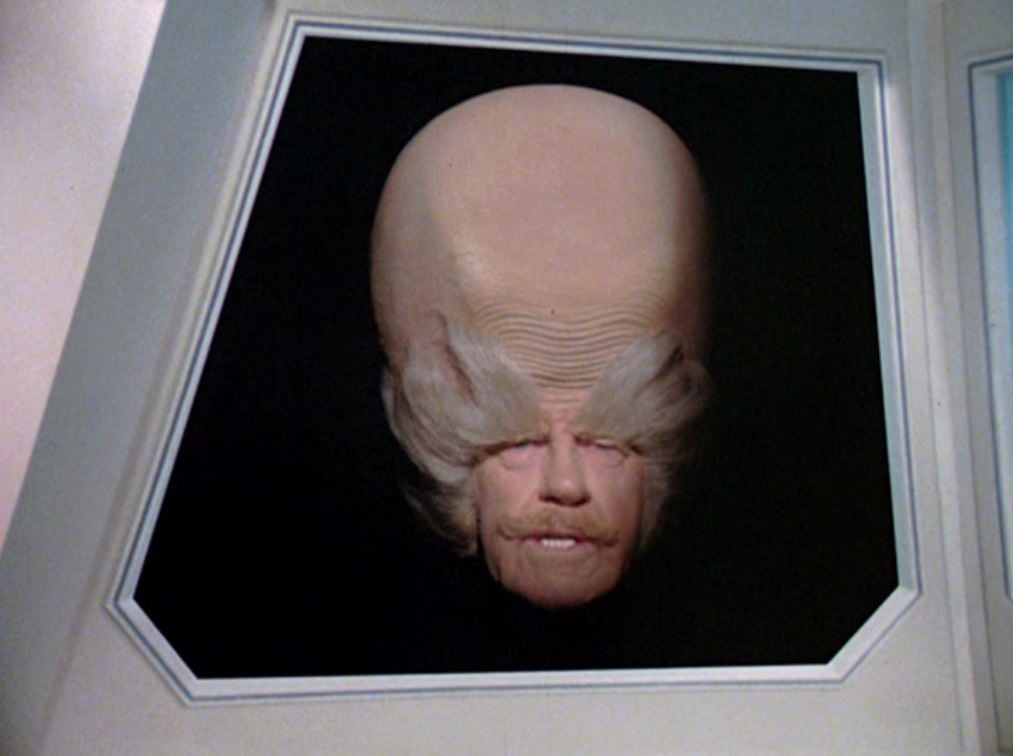
In the meantime, you can enjoy last night’s stream with special guest Randy Lee, winner of this month’s Viewer’s Choice, and our discussion of Buck Henry’s short-lived 1970s sci-fi parody “Quark.”
Find out which cast member played jazz trombone with stride legend James P. Johnson (of “The Charleston” fame), which wrote 52 novels (when he wasn’t busy serving in the Royal Army or working as a game hunter), and which one actually attempted to put a hit out on series star Richard Benjamin. HINT: It wasn’t the Doublemint Twins.
There are quirks aplenty, even if the “Quark”s were few.
Join us on our continuing mission to patrol the entertainment universe for lingering debris. We’ll reserve your space in the comments section, when we livestream on Facebook, next Friday evening at 7:00 EST!
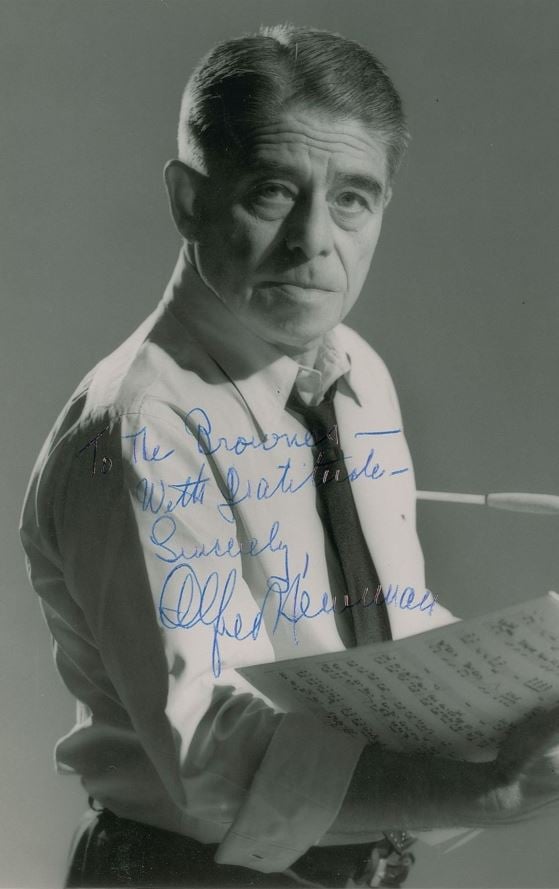
This week on “Picture Perfect,” experience the Power of Alfred Newman – TYRONE Power, that is. It’s all music from Power swashbucklers made at 20th Century Fox, where Newman served as music director for 20 years.
“Captain from Castile” (1947) was one of Power’s most opulent vehicles. Based on the novel by Samuel Shellabarger, the film relates Pedro de Vargas’ escape from persecution at the hands of the Inquisition and his accompaniment of Hernán Cortéz in the conquest of Mexico. Also starring Jean Peters and Cesar Romero (as Cortéz), the film capitalizes on the happenstance of a real-life erupting volcano. The climactic march, known as “Conquest,” went on to become one of Newman’s greatest hits. It’s entered the marching band repertoire and has been recorded many times.
“The Black Swan” (1942) costars Maureen O’Hara and Laird Cregar (as Henry Morgan). Also, if you ever wanted to see George Sanders in a red beard, then this is the movie for you. This time the source material is a novel by Rafael Sabatini, who also created “Captain Blood,” “The Sea Hawk,” and “Scaramouche.”
Of course, it was “The Mark of Zorro” (1940) that solidified Power’s reputation as 20th Century Fox’s resident swashbuckler. In its own way, the remake manages to match the delights of Douglas Fairbanks’ 1920 original, which was one of the silent era’s most thrilling adventures.
Finally, it’s back to Shellabarger for “Prince of Foxes” (1949). This time, the setting is the Italian Renaissance. Orson Welles is Cesare Borgia, with an oddly cast Everett Sloane playing an assassin. Sloane was a veteran of Welles’ Mercury Theatre. You may remember him as Mr. Bernstein from “Citizen Kane,” or perhaps from the famous funhouse finale from “The Lady from Shanghai.”
It’s interesting that all of the films represented this week were inspired by books. (Zorro was introduced in “The Curse of Capistrano” by Johnston McCully.) It was another day, as they say.
I hope you’ll join me for music by Alfred Newman, written for the swashbucklers of Tyrone Power, on “Picture Perfect,” music for the movies, this Saturday evening at 6:00 EST, on WWFM – The Classical Network and wwfm.org.
A fun reminiscence of Newman (“the best conductor who ever picked up a baton in Hollywood”) by composer David Raksin:
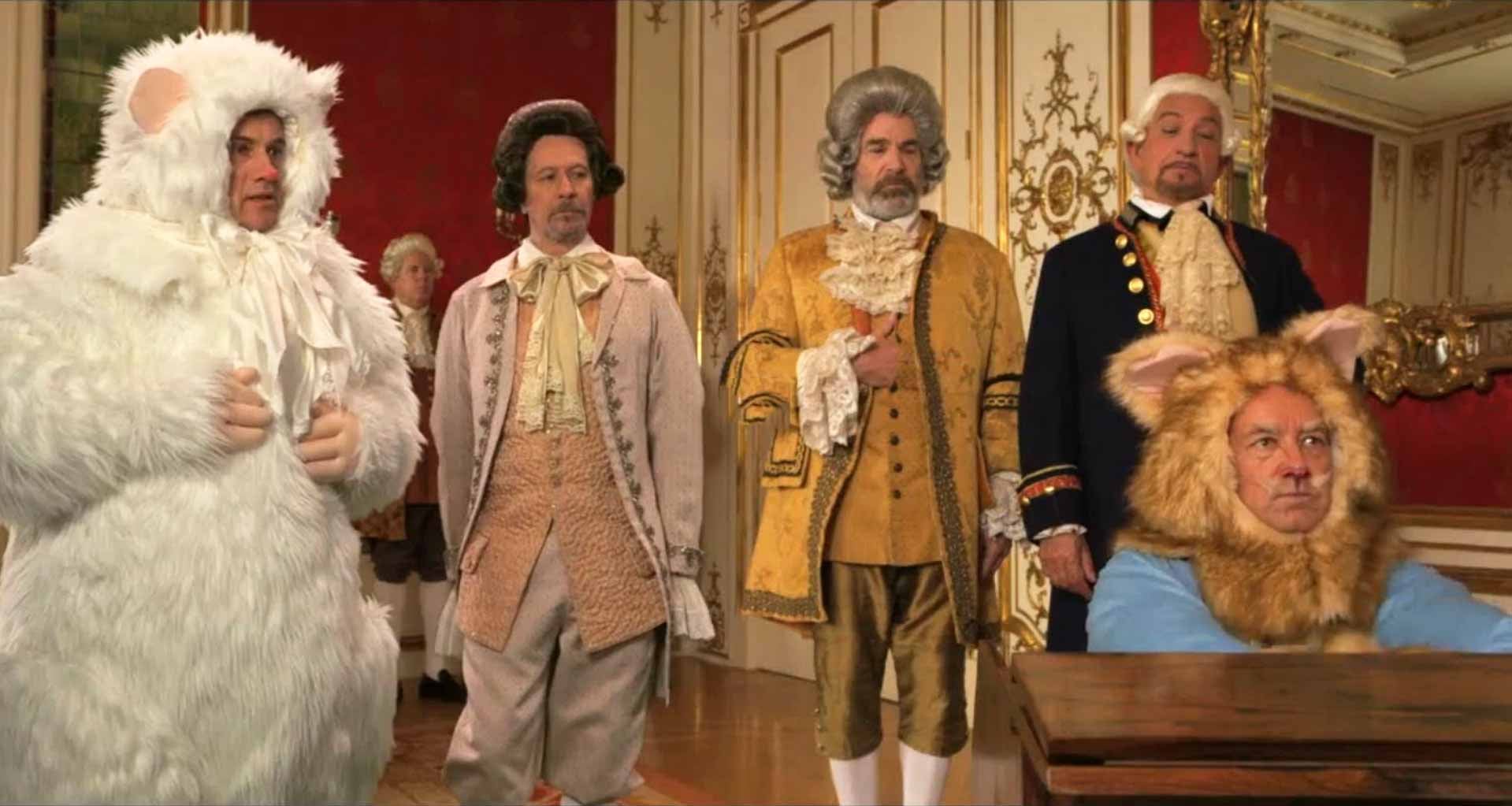
In the wake of yesterday’s marathon Mozart birthday celebration, revisit this star-studded Jimmy Kimmel mash-up of “Amadeus” and YouTube sensation Keyboard Cat.
What’s that, you say? You don’t remember Keyboard Cat?
As if that were not enough to demonstrate the decline of Western civilization over the past 230 years, behold – “Hamster on a Piano.”
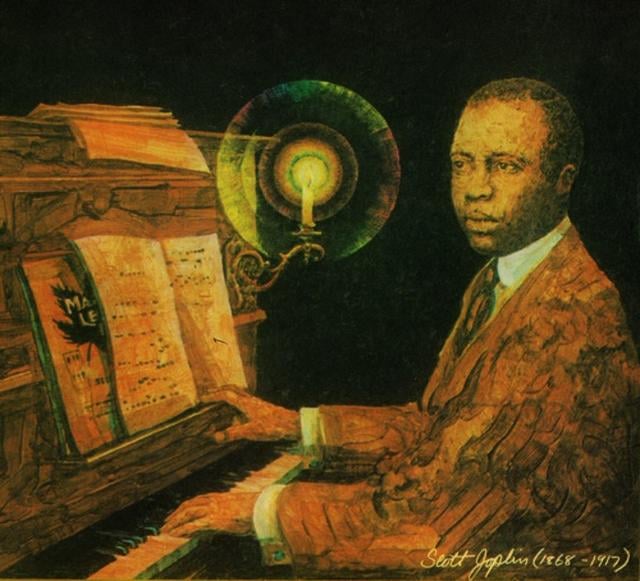
50 years ago today, the most ambitious work by America’s premier Ragtime composer received its belated first performance in Atlanta. Scott Joplin’s “Treemonisha” was presented by the Atlanta Symphony Orchestra and the Morehouse Glee Club, with Robert Shaw conducting. The chorus was prepared Wendell Whalum, and the direction and choreography were provided by Katherine Dunham.
In attendance was Eubie Blake, then a few weeks shy of his 85th birthday. Blake had known Joplin in Washington, D.C.
The plot of Joplin’s opera is set in a rural African American community near Texarkana, Arkansas, around 1884. The protagonist is 18 year-old Treemonisha, who was found under a sacred tree as a baby and raised as the daughter of Monisha and her husband Ned. As the community has no schools, her adoptive parents send her to away for her education. When she returns, she is the only member of her community who can read and write.
As the opera opens, Treemonisha foils the efforts of a conjurer, Zodzetrick, to sell a “bag of luck” to her mother. In retribution, conjurers kidnap Treemonisha and plan to toss her into a wasps’ nest. Happily, she is rescued by Remus, a townsman disguised as a scarecrow. The conjurers in turn are captured by field workers and taken into custody. However, at Treemonisha’s urging, they are forgiven and let go. Treemonisha is acknowledged as the community’s leader, and she and Monisha lead the people in a ragtime dance.
And so, in the contest between ignorance and education, superstition is overcome and grace attained through hard work, sound leadership, commitment to learning, and absolution. All well and good, but the opera also happens to be chock full of good tunes.
Joplin completed “Treemonisha” in 1910 and paid for the publication of a piano-vocal score. He sent a copy to the American Musician and Art Journal, which, in 1911, gave the work a glowing, full-page review. Presciently, the piece was lauded as an “entirely new phase of musical art and… a thoroughly American opera.”
Unfortunately, “Treemonisha” failed to gain traction. Joplin’s original orchestrations were completely lost (along with his first opera, “A Guest of Honor,” composed in 1903), and modern performances have required editing and orchestration by other hands, including T.J. Anderson (in Atlanta), Gunther Schuller (for Houston Grand Opera), and Rick Benjamin (for more intimate forces, akin to the theater pit orchestras Joplin would have known).
The work has often been characterized as a “Ragtime opera” – Joplin was, after all, the king of the rag – but “Treemonisha” encompasses a broader range of influences than such a description would suggest. The composer aspired to write a “serious” stage work in the European tradition, but one propelled by a uniquely New World vitality. As a unified artistic statement, it couldn’t have been written by anyone else. “Treemonisha” is engaging, tuneful, and very, very American.
Sadly, Joplin never lived to see his magnum opus fully staged. The work received its sole read-through in his lifetime in 1915 – two years before his untimely death at the age of 48 – at the Lincoln Theater in Harlem. Joplin himself was at the keyboard. The score then languished in obscurity for decades, until its rediscovery in 1970.
In 1971, selections were performed at the New York Public Library for the Performing Arts, with a group of singers supported by William Bolcom, Joshua Rifkin, and May Lou Williams. Following its Atlanta premiere, the complete work went on to be performed by companies all over the United States, making its Broadway debut in 1975.
In 1976, Joplin received a citation from the Pulitzer Prize committee “for his contributions to American music.” Of course, by then, he had already been dead for 59 years.
In this fascinating, poignant segment, we learn that Joplin’s orchestrations were probably trashed in 1962:
The historic Houston Grand Opera production – in English with Portuguese subtitles!
In Rick Benjamin’s orchestration for pit orchestra, with spoken introduction:
Eubie Blake plays his “Charleston Rag” in 1972 – a work he composed in 1899!
It’s true, we’ll go to any length so that we don’t have to do “Orca” (1977).
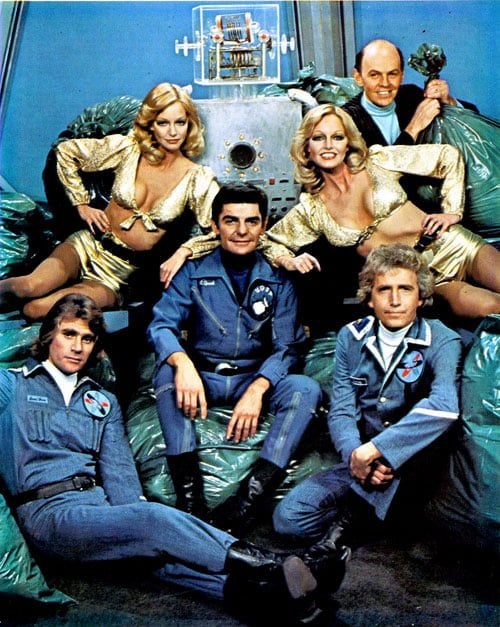
To this end, we’re happy to announce our latest viewer’s choice: the short-lived television series “Quark” (1977-78).
This sporadically amusing science fiction spoof, created by Buck Henry (with Richard Benjamin as the commander of an interplanetary garbage scow), ran for exactly eight episodes before its untimely cancellation. And what do you know, they’re all posted on YouTube.
The principal targets are “Star Trek” and “Star Wars” (hardly surprising), but there’s also plenty of old-fashioned objectification and fill-in-the-blank “phobic” schtick of a kind they would never be able to get away with today.
Without Mel Brooks, Henry’s “Quark” is no “Get Smart,” but it’s at least as worthy as (the admittedly awful) “Spaceballs.”
Special thanks to Randy Lee, whose choice this was. He’ll be joining us as we open up this 1970s time capsule, on the next Roy’s Tie-Dye Sci-Fi Corner. Leave your trash talk in the comments section, as we livestream on Facebook, this Friday evening at 7:00 EST!
2 responses