What’s in name? Wolfgang Amadeus Mozart went by many in his lifetime.
He was baptized on January 28, 1756 (the day after his birth), as “Joannes Chrysostomus Wolfgangus Theophilus Mozart.”
Following the custom of the Catholic Church, the first two names represent his saint’s name (“Chrysostomus” meaning “golden mouth”). “Wolfgangus” is the Latin form of “Wolfgang” – “walks with wolves” – the name of Mozart’s maternal grandfather. “Theophilus” is from the Greek – “lover of God.” In German, this would be “Gottlieb,” and in Latin “Amadeus.”
Later in life, Mozart would refer to himself using the Italian (“Amadeo”) or the French equivalent, which is why you will sometimes encounter the pedantic “Amadè” in concert program notes.
Admittedly, after 1777, Mozart himself did seem to have a preference for “Amadè,” although he played a little fast and loose with the French accent (variously “Amadè,” “Amadé,” or just plain “Amade”).
He did use “Amadeus,” albeit facetiously, when signing some of his letters, in mock-Latin (“Wolfgangus Amadeus Mozartus”). But it was only after his death that this form really gained traction, employed even by the composer’s widow. This was taken up by biographers, critics, and musicians and became prevalent by the early 19th century.
In more recent times, Peter Shaffer’s play and its now-classic film adaptation have cemented “Amadeus” in the public consciousness.
But Mozart by any other name would smell as sweet. And with his scatological sense of humor, I’m sure he would have something to say about that!
Enjoy a bouquet of Mozart on his birthday, as WWFM – The Classical Network celebrates one of music’s greatest masters. It will be all-Mozart through 7 pm EST. Support classical music on the air waves and via internet streaming with your gift by calling today at 1-888-232-1212 or contributing online at wwfm.org. Thank you for your generous support!
By coincidence, I just happened to rewatch “Amadeus” (1984) earlier this week, for the first time in many years. Of course, I’d seen it a bunch of times before.
This was the theatrical cut. With all apologies to Miloš Forman, it has been my experience that directors’ cuts tend to be in most ways inferior, especially when recut so long after the fact. (Forman’s was issued in 2002.) Or maybe George Lucas has just made me skittish.
Unfortunately, once a director’s cut appears on home video, it tends to displace the original in all formats, including streaming.
Thankfully I’ve got my trusty old, double-sided DVD. Yeah, I have to flip it an hour and 50 minutes into the movie, but I grew up during the LP era, so I can take it.
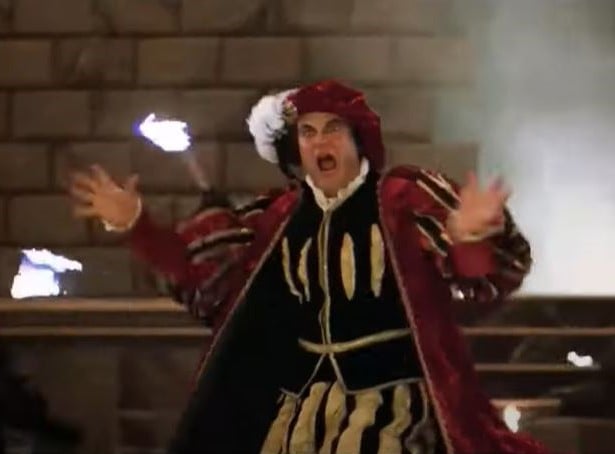
All that aside, has there ever been a staged “Don Giovanni” as cool as this one?
One hundred years ago, in the same week as the debut of Carl Nielsen’s Symphony No. 5, another war symphony received its first performance. Ralph Vaughan Williams’ “A Pastoral Symphony” was given its premiere on January 26, 1922.
What’s that? “A Pastoral Symphony,” a war symphony? From the pen of Uncle Ralph???
Vaughan Williams may very well be enshrined in our collective memory as the embodiment of rural contentment. But that aspect of the composer, while clearly appealing to some (among whom I count myself), tends to limit his currency. Which is a shame – especially in this, his sesquicentennial year – as it really is only one facet of a larger, more complicated personality.
A good many of RVW’s bucolic reveries are tinged with a sense of lost innocence, and in more ambitious works like the Third Symphony, there is a haunted undercurrent that belies its idyllic moniker.
The very title is an invitation to misunderstanding. As the composer emphasized, what he attempts to convey in the symphony is “not really Lambkins frisking at all, as most people take for granted.”
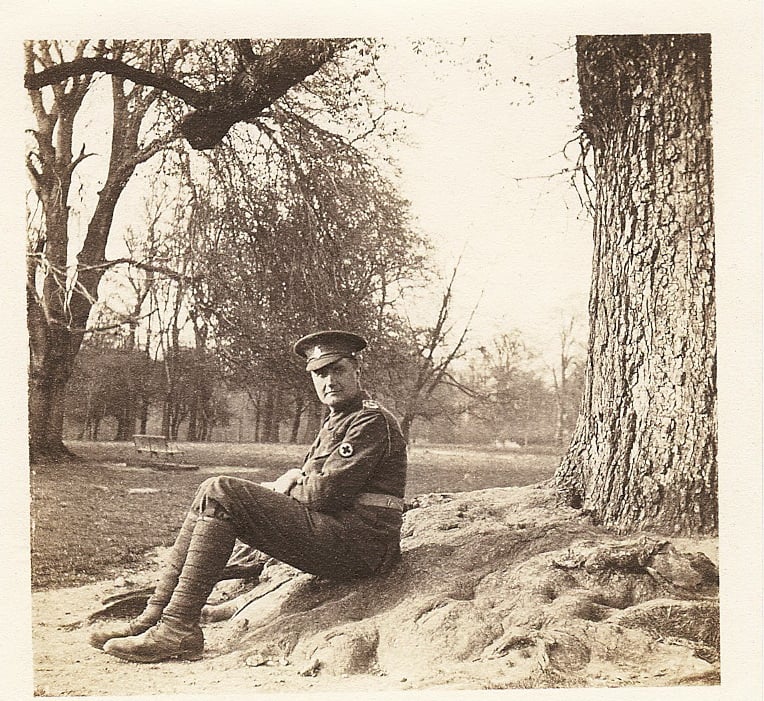
Vaughan Williams served with the Royal Army Medical Corps in France during the First World War – service from which he could easily have been exempted on account of his age (he was 42 years-old), but he was insistent about doing his part. His duties in this capacity placed him on the front lines, as he recovered wounded and dying soldiers from areas under heavy bombardment. Some of these rescues took place at night, in no-man’s land, as he staggered with an unwieldy stretcher over uneven ground in total darkness.
At the end of a day, he would drive his ambulance up to the top of a hill to take in the Corot-like landscape at sunset, while listening to a bugler practice the “Last Post.” The execution could be a little rough at times. Once, instead of an octave, the bugler accidentally hit the interval of a seventh. The trumpet solo in the second movement of “A Pastoral Symphony” recollects this experience. The work is pastoral, all right. As peaceful as the dead.
At 45, Vaughan Williams became a second lieutenant in the Royal Garrison Artillery. Prolonged exposure to shell fire from the 60-pounder guns took its toll on his hearing and likely contributed to his deafness later in life. On one occasion, he also drove 200 horses on a retreat, to get them out of harm’s way.
He saw his share of horrors, to be sure. He also lost too many friends. A number of these were promising young artists, like the composer George Butterworth, cut down at the Battle of the Somme at the age of 31. Butterworth was the primary reason for Vaughan Williams ever tackling an orchestral symphony to begin with. (You’ll recall, the First Symphony, “A Sea Symphony,” was a large-scale work for chorus and orchestra.) Butterworth was indispensable in guiding the composition of RVW’s Symphony No. 2, “A London Symphony,” which Vaughan Williams dedicated to him.
It’s sobering to contemplate that had Vaughan Williams himself died in the conflict, he would have been a two-symphony composer. As it was, he lived to complete nine. He died in 1958, only months after the premiere of his Ninth Symphony, at the age of 85.
RVW cast his “Pastoral Symphony” in four movements, “all of them slow.” That may be, but I always think of the galumphing third movement, which the composer described as a slow dance, as rather Falstaffian.
The last movement includes a wordless part for soprano. It comes to us like the song of a distant milkmaid. But there is also something ghostly about it. Perhaps the composer intended to suggest that the distance in this case is not merely spatial, but temporal. Agrarian innocence has been gassed, shredded by bullets, and shelled to pieces.
Imagine someone born in 1872, who lived into the mid-20th century, and all the changes he must have experienced in his lifetime. I often reflect on composers of that generation and how quickly the old world must have faded for them. Hell, the older I get, the more it’s happening to me.
Vaughan Williams, like his Hungarian counterparts, Béla Bartók and Zoltán Kodály, recognized that the world was accelerating and that many of his country’s traditions were hanging on by a thread. It is part of what spurred RVW and his colleague, Gustav Holst, to hit the muddy back roads of the provinces, to document as many folk songs as they could, before they were all swept away, ground up and swallowed by an increasingly homogenous, mechanized world. Vaughan Williams may not have foreseen television, or chain stores, or pop culture, or the internet, but he knew that transformation was in the air.
On its surface, English pastoralism is warm and sentimental. It provides a nostalgic escape, an illusory security in tradition. But in works like “A Pastoral Symphony,” it can also serve as a kind of elegy, a memorial for a faded world.
“A Pastoral Symphony,” conducted by Sir Adrian Boult in 1968. Boult conducted the work’s first performance on this date in 1922.
George Butterworth, “A Shropshire Lad,” from 1912. The composer was 27 years old. Four years later, he was felled by a sniper’s bullet.
He was regarded by some as the greatest Polish composer since Chopin. He certainly made his mark on music of the 20th century.
Witold Lutoslawski’s early works were influenced by Polish folk music, but as he matured, he began to experiment with twelve-tone and aleatoric techniques. (Aleatoric, broadly speaking, describes a kind of music in which certain aspects of a performance are left to chance.) However, he never wholly abandoned the traditional melodic and harmonic signposts that allowed his music to remain comprehensible to a broader audience.
Several of Lutoslawski’s major works were played in Philadelphia during my peak concertgoing years, back in the ‘80s and ‘90s. I remember seeing Lynn Harrell play the Cello Concerto there. However, I was shut out of the old Academy of Music when the composer himself came to conduct a complete program of his own music. Disappointing, to be sure, but also heartening that so many listeners cared enough to attend a concert of contemporary music by a living composer.
A most enjoyable introduction to Lutoslawski is his “Variations on a Theme by Paganini” (1941). This is a surviving relic of the war years, during which public gatherings in Warsaw were banned by the Nazis. The composer was able to get around it by forming a piano duo with Andrjez Panufnik that played in the local cafes. Here, Princeton’s own Christina and Michelle Naughton perform:
Of the orchestral works, this one is easy enough to follow – the Symphonic Variations (1939):
Then give a listen to the Concerto for Orchestra (1950-54). Just don’t go into it expecting anything like Béla Bartók’s late masterpiece!
Also folk-inflected is “Dance Preludes” for clarinet and piano (1954):
More challenging is the Cello Concerto (1970), with the introduction of chance elements:
Another one of his more frequently performed works – the Symphony No. 3 (1973-83):
And a documentary that begins with a man-on-the-street segment, “Do you know, who is Witold Lutoslawski?”
If Winter leaves you with a long face, imagine what it was like to be Edith Sitwell and William Walton. Both had very long faces indeed.
It was on this day 100 years ago that Walton’s “Façade” was first performed at Sitwell’s home. An eccentric poet from an eccentric family of artistically-inclined English aristocrats, Sitwell also participated in the work’s first public performance, on June 12, 1923. She declaimed her verses through a megaphone from behind a painted screen to the accompaniment of a seven-piece jazz band.
Cheekily, Walton set the poems to popular dance-styles of the period, with breakneck allusions to and quotations from other composers. The music is protean in its invention, encompassing paso doble and patter song, waltz, foxtrot, and mazurka. The texts are nonsense, most immediately striking for their rhythmic value – the settings are as much about the abstract SOUND of words as they are about their meaning – but once the listener acclimates, they actually do start to make a kind of sense.
The June premiere was a succés de scandale, with much pearl-clutching and face-fanning by public and press alike. Needless to say, the work’s notoriety ensured its frequent revival.
Worlds away from the coronation marches and Shakespeare scores for which Walton would be so well remembered, the music from “Façade” is also among his most popular. It is perhaps even more frequently performed without the texts. The composer arranged two suites for orchestra. In 1931, Frederick Ashton choreographed the piece as a ballet.
Walton would go on receive a knighthood in 1951. Sitwell would be awarded a damehood in 1954. So it is that yesterday’s eccentricity becomes today’s respectability.
There must be something to it, if it could make dour Paul Scofield sound like this, in my favorite recording of the work:
Sitwell and Constant Lambert in the first recording in 1929. Is this the English “Pierrot Lunaire?”
Selections from Sitwell’s later recording, from 1953, with Peter Pears:
Having attained respectability, the orchestral suites:
An interview with Dame Edith Sitwell:
Walton remembers the Sitwells and the Roaring ‘20s:


3 responses