• Fritz Reiner Birthday The Tyrant Conductor

    Fritz Reiner Birthday The Tyrant Conductor

    by 

    in
    3 responses

    December 5th is when Krampus, the Christmas demon, descends from his Alpine lair to flog fearful girls and boys. And December 19th is the birthday of Fritz Reiner.

    From a musician’s standpoint, Reiner was one of the most dreaded conductors, in an era when tyrants of the podium still very much roamed the earth. With a glower that could make Bela Lugosi quake – and sporting quite the similar hairline – Reiner was forged in Hungary at the twilight of the Austro-Hungarian Empire. Hungary at the time had quite the reputation for churning out great conductors. George Szell, Eugene Ormandy, Antal Doráti, Ferenc Fricsay, Sir Georg Solti, and István Kertész all achieved considerable international success.

    Among Reiner’s own teachers was Béla Bartók, with whom he studied piano. Reiner would later repay the favor with what many consider to be the benchmark recording of Bartók’s “Concerto for Orchestra.” He also worked closely with Richard Strauss in Dresden, and his recordings of Strauss’ works are equally revered. All in all, the Chicago Symphony under Fritz Reiner was a surefire choice to give the ol’ hi-fi a good workout in the early days of stereo.

    In 1928, Reiner became a naturalized American citizen. He began to teach conducting at the Curtis Institute of Music in Philadelphia, where among his pupils was Leonard Bernstein. His first American post was as principal conductor of the Cincinnati Symphony. He took over the Pittsburgh Symphony for a decade, beginning in 1938. Then he spent several years at the Met. But it was as music director of the Chicago Symphony that he attained legendary status.

    For a master interpreter of some of the largest and most challenging works in the repertoire, his baton technique was notable for its precision and economy. Much of what he achieved, unfortunately, was through the brutality he exuded in rehearsals. Reiner emerged from an Old World steeped in aristocratic privilege. At the top of their profession, conductors then were regarded as gods-on-earth. When drive and ego were bolstered by absolute power, working conditions could become downright perilous. Before strong musicians’ unions, conductors exercised the authority to fire anyone on a whim. So when musicians played for Reiner, they played as if their lives depended on it – or at the very least their livelihoods.

    Did it make for better musicmaking? You can’t argue with the excellence of Reiner’s Chicago Symphony.

    Read this account of the day Reiner finally gave his “perfect concert.”

    https://csosoundsandstories.org/125-moments-101-fritz-reiners-perfect-concert/?fbclid=IwAR1XCI9gDY-L5-Z-wSxZyYMlWjDU2IbhvhlVSgZ17SA0ekYHWECHuQw4L3A

    Even autocrats have their soft side. Happy birthday, Fritz Reiner.


    Reiner conducts Beethoven

    Big band Bach

    Benchmark Bartók

    Strauss’ “Salome”

    And, to keep it seasonal, “Waltz of the Flowers” from “The Nutcracker”
    https://www.youtube.com/watch?v=mgaS9CZ7KsQ


  • Twilight Zone Christmas & Santa vs Devil Discussion

    Twilight Zone Christmas & Santa vs Devil Discussion

    by 

    in
    4 responses

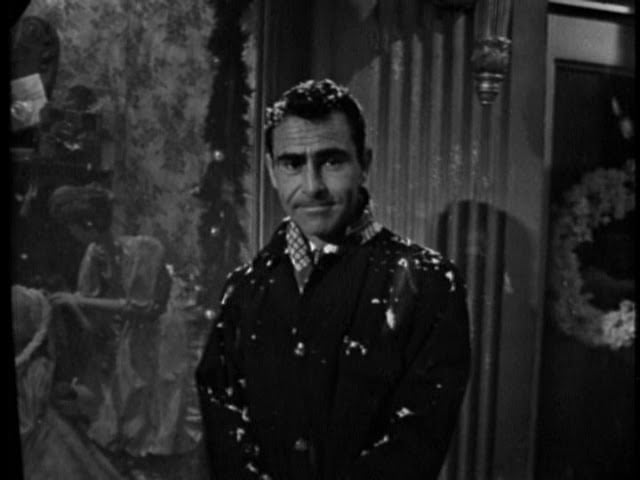
    Roy and I were in the “Zone” last night – “The Twilight Zone,” that is – for our discussions of both Rod Serling’s “Carol for Another Christmas” and “The Night of the Meek.” In case you missed it, the show’s been archived.

    We’ll revisit Serling’s “middle ground between light and shadow” on New Year’s Day.

    In the meantime, so as not to conflict with your Christmas Eve, next week we’ll convene a day earlier than usual. So be sure to have plenty of scotch tape on hand – or perhaps just scotch – as we finish up our giftwrapping to a merry conversation about “Santa Claus vs. The Devil” (1959).

    If you think we were punchy last night, wait until we’re ladling out the wassail. Meet us under the mistletoe – WAY under the mistletoe – for the next Roy’s Tie-Dye Sci-Fi Corner. Leave your souls in the comments section, as we livestream on Facebook, this THURSDAY EVENING AT 7:30 EST. Happy holidays!

    https://www.facebook.com/roystiedyescificorner


  • Classic Christmas TV Specials Music

    Classic Christmas TV Specials Music

    by 

    in
    2 responses

    TV or not TV?

    This week on “Picture Perfect,” we’ll think inside the box, with music from classic Christmas television specials.

    “The Snowman” (1982), based on the picture book by Raymond Briggs, is about boy whose snowman comes to life and whisks him away on a journey to the North Pole. The show became enormously popular in the UK and through occasional showings on U.S. television. It was nominated for an Academy Award for Best Animated Short. Like the book, the film is wordless, using animation and music to tell its story, with the exception of an enchanting interlude, known as “Walking in the Air,” which employs a boy treble. “Walking in the Air” is easily the best-known music by Howard Blake.

    The television film “The Homecoming” (1971) stars Patricia Neal and Richard Thomas in a heart-warming story about a rural family Christmas in 1933. Written by Earl Hamner, the film’s success spawned the television series “The Waltons.” Jerry Goldsmith wrote the music. He would return to work on “The Waltons” – though as of “The Homecoming,” he had yet to write the show’s indelible theme.

    An adaptation of Charles Dickens’ “A Christmas Carol” (1954) was the subject of a special episode of the anthology series “Shower of Stars.” Fredric March plays Ebenezer Scrooge, and Basil Rathbone is Jacob Marley’s ghost. But it is Ray Middleton, who appears as both Scrooge’s nephew and the Spirit of Christmas Present, who is given arguably the show’s most memorable tune, “A Very Merry Christmas.” The teleplay and lyrics are by Maxwell Anderson, and the music is by Bernard Herrmann!

    Finally, Christmas time is here, happiness and cheer, with “A Charlie Brown Christmas” (1965). We’ll hear the Vince Guaraldi Trio perform selections from this most beloved of Christmas classics.

    For once, the snow has nothing to do with your television reception. I hope you’ll join me for a cookie plate full of classic Christmas specials, on “Picture Perfect,” this Saturday evening at 6:00 EST, on WWFM – The Classical Network and wwfm.org.


  • Serling’s Christmas Carol Twilight Zone on Friday

    Serling’s Christmas Carol Twilight Zone on Friday

    by 

    in
    2 responses

    Serling’s surly Sterling is at the wounded heart of “Carol for Another Christmas” (1964). Sterling Hayden plays Daniel Grudge, a 20th century counterpart to Ebenezer Scrooge, in Rod Serling’s update of Charles Dickens’ “A Christmas Carol.”

    A damaged Grudge, who suffered a personal loss during World War II, now adheres to a selfish doctrine. He shuns cultural exchange programs, humanitarian aid, and diplomacy (advocated by his nephew, Fred), in favor of isolationism, “America first,” and nuclear escalation. Three spirits – played by Steve Lawrence, Pat Hingle, and Robert Shaw – offer him a chance to connect with his humanity. The all-star cast also includes Ben Gazzara, Percy Rodriguez, Eve Marie Saint, James Shigeta, and Peter Sellers.

    We’ll talk about it tonight, alongside one of Serling’s classic “Twilight Zone” episodes, “The Night of the Meek” (1959). Art Carney plays a disillusioned department store Santa, for whom a chance discovery restores meaning to his life – and the spirit of the season for everyone he encounters.

    We’ll be hanging our stockings with care for a Rod Serling double-bill, on the next Roy’s Tie-Dye Sci-Fi Corner. Leave your lumps of coal in the comments section, as we livestream on Facebook, this FRIDAY EVENING AT A SPECIAL TIME, 7:30 EST.

    https://www.facebook.com/roystiedyescificorner


  • Saturnalia Ancient Rome’s Wild Winter Festival

    Saturnalia Ancient Rome’s Wild Winter Festival

    by 

    in
    6 responses

    December 17. Io Saturnalia!

    In keeping with winter solstice tradition, it is a day to visit friends and bear gifts, especially candles. Schools are closed. Courts are not in session. Oh yeah, there’s also a sacrifice to Kronos (a.k.a. Saturn) and a riotous feast with benefits.

    On this most popular holiday to emerge from Ancient Rome, the social order is inverted and strictures are loosened. Slaves are served by their masters. Gambling is permitted in public. There is drinking, noise, mirth, and wantonness. The populace is showered with figs, nuts, and dates, women fight in the arena, and cranes are hunted by dwarfs. In short, it’s an old-fashioned Christmas, before there was even such a thing as Christmas. Hey, if the Flintstones can celebrate the birth of Jesus, why not?

    In the interest of converting rather than alienating, Christianity kept the candles, but frowned on the orgies, or at least looked the other way. But Saturnalia traditions continued to be practiced down the centuries, as evidenced in the medieval Feast of Fools, in the Victorian revival of gift-giving, in the lighting of candles, and in the eating, drinking, singing, and dancing.

    Saturnalia, at its peak, was practiced through December 23. Wishing you and yours a merry one!


    As you set the table for Saturn, here’s John Ireland’s “Satyricon Overture:”


Tag Cloud

Aaron Copland (93) Beethoven (95) Composer (114) Film Music (145) Film Score (143) Film Scores (255) Halloween (94) John Williams (195) KWAX (229) Leonard Bernstein (104) Marlboro Music Festival (125) Movie Music (160) Mozart (91) Opera (213) Philadelphia Orchestra (89) Picture Perfect (174) Princeton Symphony Orchestra (109) Radio (88) Ross Amico (244) Roy's Tie-Dye Sci-Fi Corner (290) The Classical Network (101) The Lost Chord (269) Vaughan Williams (105) WPRB (397) WWFM (881)

DON’T MISS A BEAT

Receive a weekly digest every Sunday at noon by signing up here


RECENT POSTS