• Korngold’s “Die Tote Stadt” Lives Again

    Korngold’s “Die Tote Stadt” Lives Again

    by 

    in
    6 responses

    One hundred years ago today, Erich Wolfgang Korngold achieved his greatest operatic success at the age of 23, with the double-premiere, in Cologne and Hamburg, of “Die tote Stadt” (“The Dead City”). One of music’s most astounding child prodigies, Korngold had been the talk of Vienna since the age of 11, when his ballet-pantomime “Der Schneemann” (“The Snowman”) was first performed at the Vienna Court Opera. By then, Gustav Mahler had already declared him a genius. Richard Strauss would express terror at the boy’s frightening precocity.

    Undoubtedly, Korngold is much better known to movie-lovers for his contributions to the Golden Age of Hollywood, including his classic scores for the swashbucklers of Errol Flynn (“Captain Blood,” “The Adventures of Robin Hood,” and “The Sea Hawk,” among them). Sadly, fascism and war gutted the Vienna of Korngold’s youth, and avant-garde arbiters and ideologues ensured that his brand of tonal, melodic music would be pushed out of the concert halls for decades

    Interestingly, the opera’s scenario bears a striking resemblance to that of Alfred Hitchcock’s “Vertigo,” with an overwrought protagonist falling for a free spirit, who happens to be the spitting image of his dead wife. The dysfunctional relationship quickly spirals out of control.

    For 18 years after its debut, “Die tote Stadt” was the most frequently performed opera in Vienna. Then for half a century, it fell virtually silent. Performances were rare, but in recent decades, once more, it’s begun to pick up steam. “The Dead City” lives again, in the affections of opera companies and their audiences, though too many modern productions clash with the essentially Romantic nature of its music. There are psychological depths to be plumbed, for sure, but the imagery should never be aesthetically unpleasant.

    I’ve been privileged to see “Die tote Stadt” twice on stage, but of course I’ve listened to it many more times on recordings. It is a melancholy masterpiece by one of my favorite composers. It’s only a pity he didn’t live to enjoy the fruits of its belatedly revived fortunes.


    Carol Neblett and René Kollo perform the opera’s famous duet, “Glück, das mir verblieb” (“Joy, that near to me remained”), commonly presented in recital as “Marietta’s Lute Song” (actually just the first five minutes of this video):

    https://www.youtube.com/watch?v=wRrLvKVF2ME

    Joyce DiDonato coaches baritone Germán Enrique Alcántara in “Mein Sehnen, mein Wähnen,” Pierrot’s aria, the opera’s second best-known number:
  • Sibelius’s Symphony No 5 Day 4 of 8

    Sibelius’s Symphony No 5 Day 4 of 8

    by 

    in
    10 responses

    EIGHT DAYS OF SIBELIUS – DAY 4

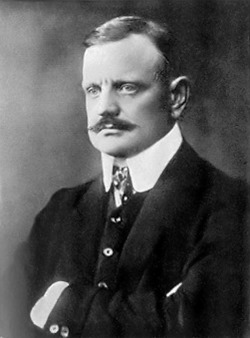
    With his 50th birthday imminent, Jean Sibelius received a commission from the Finnish government to write a brand-new symphony. The Symphony No. 5 was given its world premiere in 1915, with the composer conducting the Helsinki Philharmonic – though the original version was quite different, in many respects, from the masterwork we know today. In a remarkable feat of objectivity, Sibelius extensively revised his symphony twice, in 1916 and then again in 1919.

    One of the work’s major innovations (showing the influence of Liszt, whom Sibelius greatly admired) involved the elimination of the break between the first two movements of the original four-movement structure. The demarcations are blurred so that the first movement now slips inexorably into a scherzo, and the listener is swept along, as if caught up in a powerful current, or precipitated into a sublime avalanche, to thrilling effect.

    The transition has always been a challenge for conductors, since this sneaking accelerando should feel as if it’s completely organic. It has to unfurl naturally. Sibelius would further experiment with the telescoping of movements and the subversion of classical expectations in his Symphony No. 7.

    Perhaps the most striking revision is in how the final movement builds to a climax of impressive grandeur, a sublime apotheosis of its ennobling “swan theme,” only to come up against a series of powerful, monolithic chords, each isolated from the next by a moment of silence. The first five serve to suspend the effect. The sixth falls, like Thor’s hammer, with an indisputable sense of finality. Truly, this is music of the gods.

    The Sibelius 5th is among the noblest in the entire literature. I have long regarded it as my favorite symphony.


    Herbert von Karajan conducts the 5th Symphony:

    Osmo Vänskä conducts the original 1915 version!


  • The Thing Krampus Night Sci-Fi Horror

    The Thing Krampus Night Sci-Fi Horror

    by 

    in
    2 responses

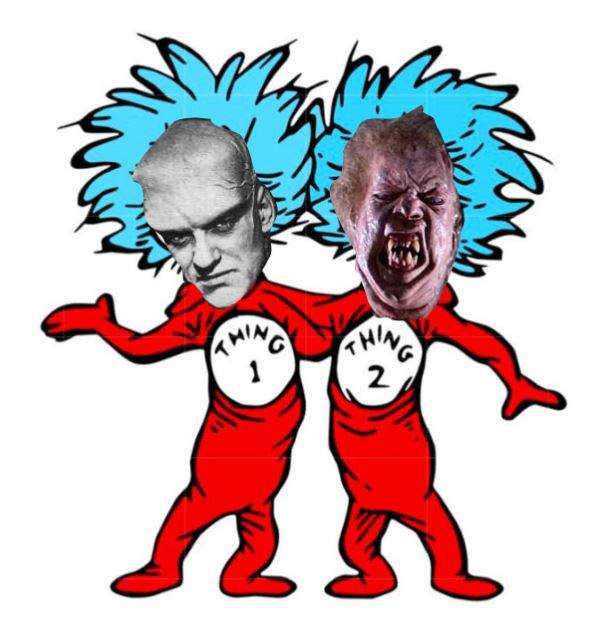
    On this eve of Krampus Night, ‘tis the season… for THE THING.

    Roy Bjellquist and I confront Howard Hawks’ “The Thing from Another World” (1951) – with perhaps a few feints toward John Carpenter’s remake – on the next Roy’s Tie-Dye Sci-Fi Corner.

    Leave your comments, but no husky carcasses, if you please, as we live-stream on Facebook, this Friday evening at 7:00 EST.

    https://www.facebook.com/roystiedyescificorner/timeline


  • Sibelius & the Kalevala Finnish Epic

    Sibelius & the Kalevala Finnish Epic

    by 

    in
    3 responses

    EIGHT DAYS OF SIBELIUS – DAY 3

    No celebration of Sibelius would be complete without a post dedicated to the influence of the “Kalevala.” This disparate collection of long narrative poems, frequently referred to as the Finnish national epic, tells of the creation of the Earth, the loves, antagonisms, and retaliations of its peoples, and the forging, theft, and attempted recovery of a mysterious talisman called the Sampo.

    Its fantastic and heroic tales informed the work of Finland’s greatest artists at a time when the country began its surge toward independence, after 700 years of Swedish rule, and another century as a duchy of the Russian Empire. The “Kalevala” resonated with Finns to an extent it may be difficult for foreigners to comprehend. It has inspired holidays, the naming of cities, and innumerable paintings, books, and pieces of music.

    Sibelius, fiercely patriotic, was “Kalevala”-crazy. A significant portion of his output was influenced by this fount of Finnish lore – “Four Legends from the Kalevala,” “Kullervo,” “Pohjola’s Daughter,” “Tapiola,” “The Origin of Fire,” and “Kyllikki,” to name a few. Some of the symphonic poems had their roots in a projected opera, “The Building of the Boat,” which was never completed.

    I’ve done several radio shows, over the years, programmed around themes from the “Kalevala.” This one, “Epic Finnish,” last aired on January 6, 2019, on “The Lost Chord,” on WWFM – The Classical Network.

    https://www.wwfm.org/post/lost-chord-january-6-epic-finnish

    The playlist includes “Aino” by Sibelius champion Robert Kajanus, the “Kalevala Suite” by Uuno Klami, and a Sibelius rarity, “A Song for Lemminkäinen.”

    I am also appending, as an added bonus, Leonard Bernstein and the New York Philharmonic in Sibelius’ “Pohjola’s Daughter.” I’m a little mixed on Bernstein’s recordings of the symphonies, but here I think he really excels. The performance is a wonder. Steadfast old Väinämöinen, the wizard, attempts to woo the Daughter of the North, whom he espies seated atop a rainbow, weaving a cloth of gold. She agrees to marry him only if he is able to complete a series of impossible tasks. (My favorite is tying an egg into invisible knots!) Unfortunately, Väinämöinen, always unlucky in love, wounds himself grievously with an axe while attempting to construct a boat from fragments of her distaff.

    In addition, I know I posted the link recently, on Eugene Ormandy’s birthday, but here it is again. This is, quite simply, one of my favorite Sibelius recordings of all time. Ormandy conducts the Philadelphia Orchestra in “Four Legends from the Kalevala.” Its four movements evoke the swashbuckling Lemminkäinen and his adventures among the maidens of Saari; the Swan of Tuonela gliding through the realm of the dead; the resurrection of Lemminkäinen, treacherously slain; and finally, Lemminkäinen’s homeward journey.

    As an encore, Ormandy raises a ruckus, in an even more hair-raising rendition of the finale, from 1940.

    https://www.youtube.com/watch?v=FzQMyCsB8eQ


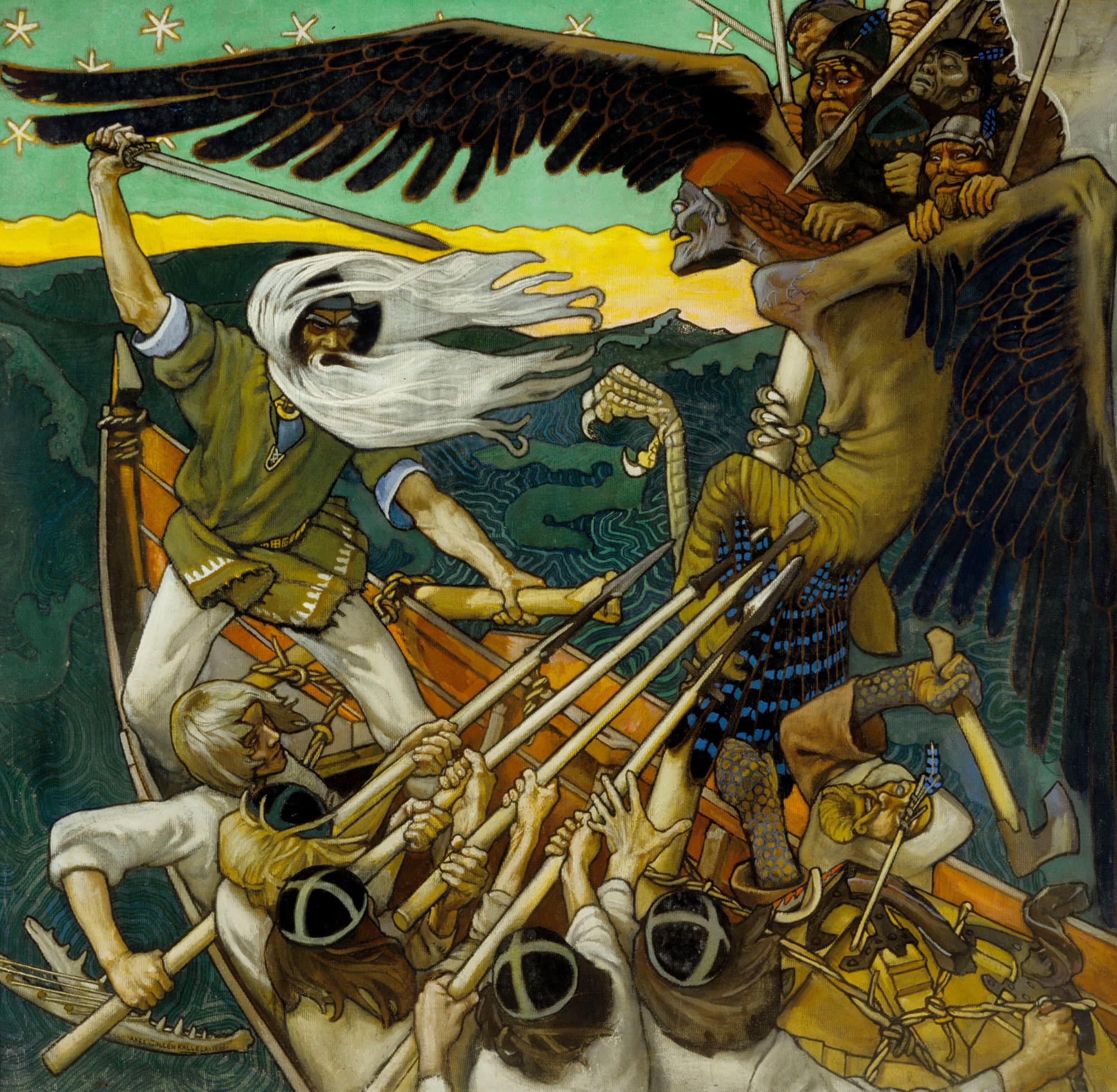
    “The Defense of the Sampo” (1896), by Akseli Gallén-Kallela. Väinämöinen the wizard faces off against the evil witch Louhi.


  • The Thing From Another World SciFi Review

    The Thing From Another World SciFi Review

    by 

    in
    3 responses

    Santa is not the only one lurking at the North Pole.

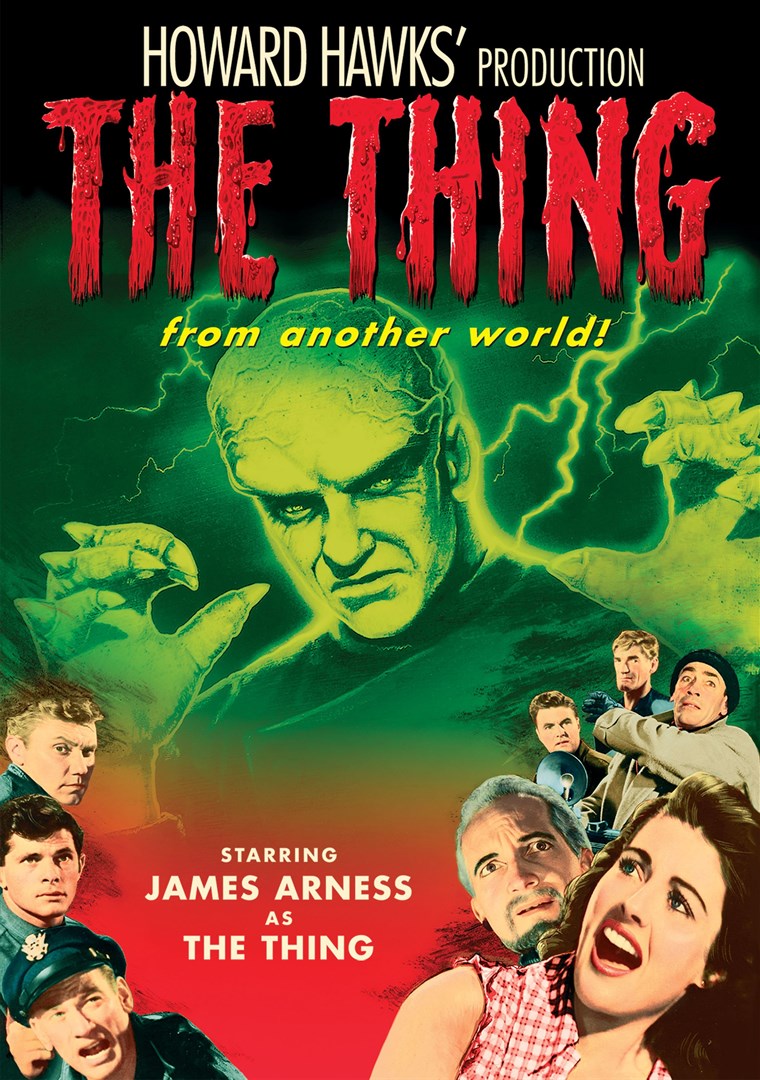
    James Arness plays a rampaging, extraterrestrial “carrot,” who feeds off U.S. scientific and military personnel at a remote Arctic outpost, in “The Thing from Another World” (1951). This knockout thriller was the first film adaptation of John W. Campbell’s durable novella, “Who Goes There?”

    “The Thing” stands apart from the standard B-movie science-fiction of the era, building genuine suspense and verisimilitude through its claustrophobic setting, realistic, post-World War II military equipment, and revolutionary use of overlapping dialogue. This is one surprisingly contemporary film!

    Producer Howard Hawks reportedly had a hand in every aspect of the production, doing an uncredited rewrite of the screenplay with the great Ben Hecht, and always on the set to offer his “advice” on every scene. Essentially, he directed the film himself, and it shows. Furthermore, the eerie title design and Dimitri Tiomkin’s go-for-broke, theremin-laden score are not to be undersold.

    Keep watching the skies! And leave your comments, as Roy Bjellquist and I dissect “The Thing,” on the next Roy’s Tie-Dye Sci-Fi Corner, live-streamed on Facebook, this Friday evening at 7:00 EST!

    https://www.facebook.com/roystiedyescificorner/timeline


    What’s for Christmas? THE THING.


Tag Cloud

Aaron Copland (93) Beethoven (95) Composer (114) Film Music (145) Film Score (143) Film Scores (255) Halloween (94) John Williams (195) KWAX (229) Leonard Bernstein (104) Marlboro Music Festival (125) Movie Music (160) Mozart (91) Opera (213) Philadelphia Orchestra (89) Picture Perfect (174) Princeton Symphony Orchestra (109) Radio (88) Ross Amico (244) Roy's Tie-Dye Sci-Fi Corner (290) The Classical Network (101) The Lost Chord (269) Vaughan Williams (105) WPRB (397) WWFM (881)

DON’T MISS A BEAT

Receive a weekly digest every Sunday at noon by signing up here


RECENT POSTS