• Books and Music Crossword Puzzle Summer Fun

    Books and Music Crossword Puzzle Summer Fun

    by 

    in
    5 responses

    Summer is a great time to catch up on your reading. Rain or shine, this week’s Classic Ross Amico crossword celebrates two of life’s great pleasures – books and music!

    To fill out the puzzle, follow the link and select “solve online” at the bottom of the page. You’ll then be able to type directly into the squares. Once you feel you’ve exhausted the puzzle, you’ll find the solutions by clicking on “Answer Key PDF.”

    Relax, and enjoy!

    https://www.armoredpenguin.com/crossword/Data/2020.08/0206/02062839.850.html


  • Inner Emigration Composers Under the Nazis

    Inner Emigration Composers Under the Nazis

    by 

    in
    6 responses

    Is it really “emigration” when you don’t go anywhere?

    This Sunday night on “The Lost Chord,” we’ll have music by flagrantly anti-fascist composers who remained in Germany during the Nazi regime. This type of opposition was described by Thomas Mann as “inner emigration.”

    There were plenty of opportunists who joined the Nazi Party as a means to curry favor, in the hopes of securing prominent posts. Then there were those who, while critical of the Nazis, nevertheless joined the Party to protect their families and to continue working.

    A group which seems to have faded from memory is that made up of composers who remained, opposed the regime, and yet somehow survived. These artists were condemned by the Nazis, their music labeled degenerate and banned from performance. They were either prevented from escape or remained of their own accord. Some justified the decision to stay as an act of social consciousness. Some were active in resistance circles. Others simply withdrew into ostentatious silence.

    Reinhard Schwarz-Schilling is not a terribly well-known composer, largely for the reasons I just mentioned. Schwarz-Schilling had been a professor of music at the Berlin Academy of Music. During Hitler’s reign, his family was subjected to frequent interrogations by the Gestapo. Luckily, it was never found out that Schwarz-Schilling’s wife, the concert pianist Dusza von Hakrid, was of Jewish descent. It was only through the beneficence and courage of a sympathetic official who falsified documents that the Schwarz-Schillings escaped arrest.

    Schwarz-Schilling may have survived the Nazis, but following the war, he had to deal with the musical establishment, which had grown hostile to such flagrantly tonal music. Something like his Violin Concerto of 1953 couldn’t be taken seriously. It starts out sounding a bit like Hindemith, but embraces Korngoldian sentiment at its candy core. If you can’t stick around for the whole show, I hope at least you’ll stay tuned for the gorgeous slow movement of this concerto.

    We’ll also hear music by Karl Amadeus Hartmann, regarded in some circles as the most important German symphonist of the mid-20th century, yet is now largely overlooked. In his 30s, Hartmann was viewed as politically undesirable in his homeland. He completely withdrew from musical life during the Nazi era. On the rare occasion any of his works would have been permitted performance, Hartmann would not allow it. Alas, most of his greatest champions were also his contemporaries. Therefore, performances of his music nearly died with them.

    After the war, Hartmann was one of the few prominent surviving anti-fascists in Bavaria whom the Allied Forces could promote to a position of responsibility. Hartmann used that trust to reintroduce the world to music which had been banned since 1933 under National Socialist aesthetic policy. He remained in Munich for the rest of his life, where his administrative duties cut heavily into what would have been his compositional time and energy. He died in 1963. We’ll hear Hartmann’s Symphony No. 6, composed between 1951 and 1953.

    I hope you’ll join me for “Staying Power” – music by anti-fascist composers who remained in Nazi Germany – this Sunday night at 10:00 EDT, on WWFM – The Classical Network and wwfm.org.

  • Forbidden Planet Sci-Fi Crossover Tonight

    Forbidden Planet Sci-Fi Crossover Tonight

    by 

    in
    2 responses

    Gams and robots!

    Roy and I will be joined by Marybeth and Michael, from SciFi Distilled, for a special crossover episode, on which we’ll explore “Forbidden Planet.” 2,000 centuries of Krell civilization, down the drain!

    The show will be live-streamed on Facebook tonight at 7:00 EDT on Roy’s Tie-Dye Sci-Fi Corner.

    Beware Monsters from the Id!


  • Sci-Fi Nerds Unite Spielberg & Forbidden Planet

    by 

    in
    3 responses

    Reuniting with Roy and my cousin Joe was definitely a close encounter of the nerd kind. Here, we jawbone about Steven Spielberg’s sublime extraterrestrial essay, on last night’s “Roy’s Tie-Dye Sci-Fi Corner.”

    Enjoy a double-dollop this weekend. Roy and I will be joined by Marybeth and Mike of SciFi Distilled, for a discussion about the 1956 classic “Forbidden Planet.” Robby the Robot meets Shakespeare’s “The Tempest.” Beware monsters from the id!

    It will be a tempest in a tea pot, and we’ll all be high on rocket fuel. Join us for the Facebook live-stream, this Sunday night at 7:00 EDT.


  • Moross’s Wild West Film Music

    Moross’s Wild West Film Music

    by 

    in
    3 responses

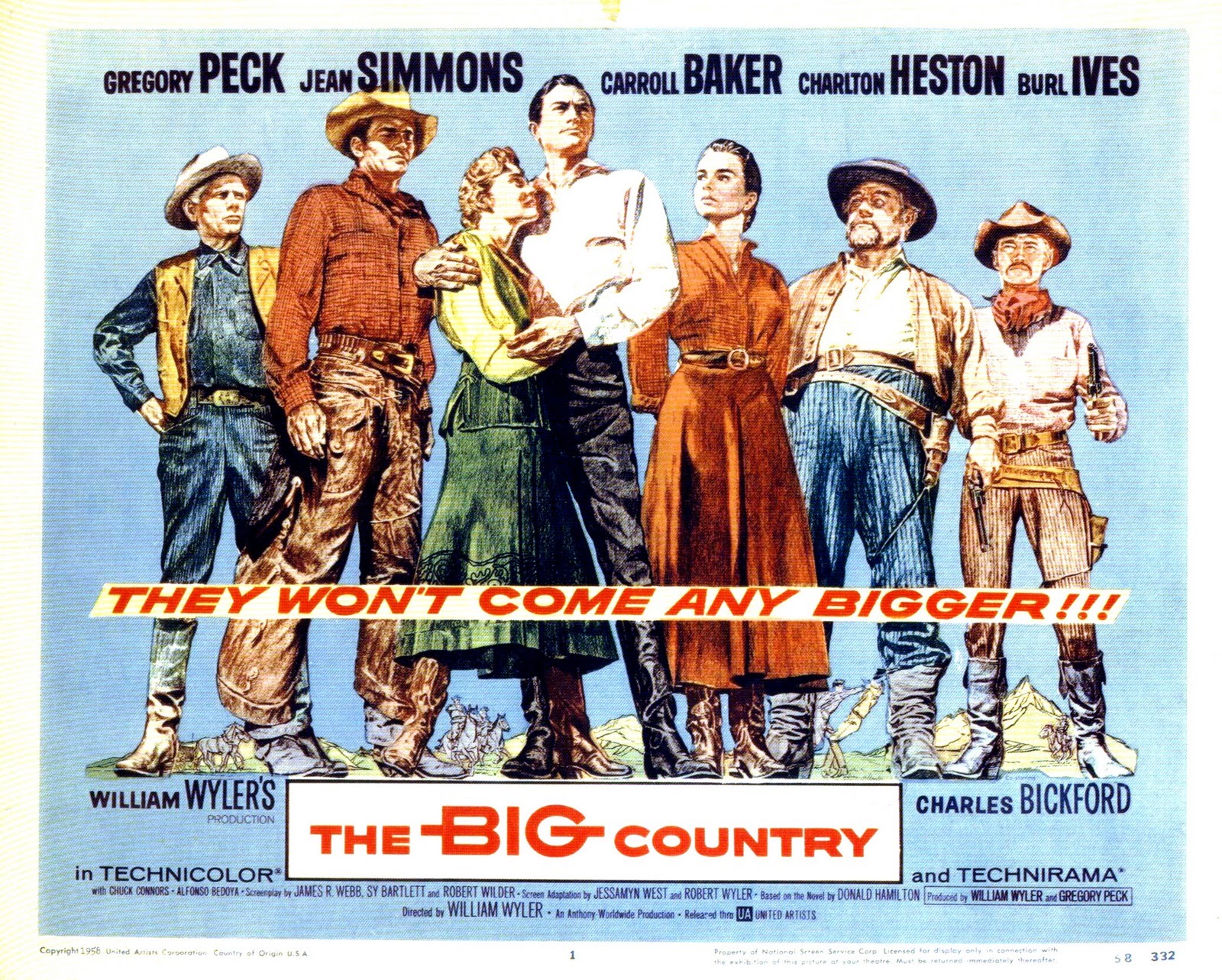
    “[A]s we hit the Plains I got so excited,” recollected composer and pianist Jerome Moross. It was 1936 and, at George Gershwin’s invitation, he was en route to Los Angeles to participate in the West Coast premiere of “Porgy Bess.” When he stepped off the bus in Albuquerque, it changed him forever. “…I got to the edge of town and then walked out onto the flat land with a marvelous feeling of being alone in the vastness, with the mountains cutting off the horizon. The whole thing was just too much for me… it was marvelous, and I just fell in love with it.”

    He would recall this powerful communion with the American West decades later when he came to write his best-known music, the Academy Award-nominated score for “The Big Country” (1958). Indeed, the “western” sound would color many of his future film and concert works, with the energetic syncopations of his native New York City supporting an easy lyrical gift that could easily pass for genuine American folk music.

    This week on “Picture Perfect,” we’ll saddle up for selections from four of Moross’ big screen westerns. The success of “The Big Country” put Moross much in demand as Hollywood’s troubadour of the great outdoors. The trail was still fresh when he was enlisted for “The Proud Rebel” (1958). The film starred Alan Ladd, as a Civil War veteran with a troubled past, and the late Olivia De Havilland, as the ranch owner who takes responsibility for him. Tensions mount as a corrupt landowner and his sons attempt to drive the woman off her ranch.

    While “The Proud Rebel” tapped into predictable western archetypes, “The Valley of Gwangi” (1969) exploded all expectations. A cross-genre western that might best be described as “Annie Get Your Gun” meets “King Kong,” the film’s premise hinges on the discovery by an enterprising band of cowboys of an Allosaurus in a lost valley in Mexico, which of course they press into service at their Wild West show. What could possibly go wrong? In a time before starships and superheroes dominated the cinematic landscape, “Gwangi” must have been very heady stuff for six-year old boys everywhere.

    The project was conceived decades earlier by Willis O’Brien, the special effects legend who created Kong. But it was left to his protégé, the great Ray Harryhausen, to bring the film to fruition. The result, while never scaling the operatic heights of “Kong,” is a fascinating mélange, a movie that is part cowboy, part creature-runs-amok.

    For those of a certain age, one of Moross’ most recognizable melodies must surely be the theme to the television series “Wagon Train.” Unfortunately, that music was soon discovered to bear a striking resemblance to a secondary theme in “The Jayhawkers” (1959). Fortunately for Moross, competing studios were willing to look the other way. “The Jayhawkers,” which starred Jeff Chandler and Fess Parker, is set in the days of Bleeding Kansas.

    We are borne west on music of great vitality. Breathe the open air with Jerome Moross, on “Picture Perfect,” music for the movies, this Friday evening at 6:00 EDT, on WWFM – The Classical Network and wwfm.org.

Tag Cloud

Aaron Copland (93) Beethoven (95) Composer (114) Film Music (145) Film Score (143) Film Scores (255) Halloween (94) John Williams (195) KWAX (229) Leonard Bernstein (104) Marlboro Music Festival (125) Movie Music (160) Mozart (91) Opera (213) Philadelphia Orchestra (89) Picture Perfect (174) Princeton Symphony Orchestra (109) Radio (88) Ross Amico (244) Roy's Tie-Dye Sci-Fi Corner (290) The Classical Network (101) The Lost Chord (269) Vaughan Williams (105) WPRB (397) WWFM (881)

DON’T MISS A BEAT

Receive a weekly digest every Sunday at noon by signing up here


RECENT POSTS