Tea time for Lady Marian and Sir Guy of Gisbourne.
-
Lady Marian Sir Guy Tea Time

by
-
Dog Days Crossword Test Your Classical Music Knowledge

by
4 responses
Well, here we are – the Dog Days!
Beat the heat by contemplating 50 clues about classical music canines, in this week’s Classic Ross Amico crossword.
To fill out the puzzle, follow the link and select “solve online” at the bottom of the page. You’ll then be able to type directly into the squares. Once you feel you’ve exhausted the puzzle, you’ll find the solutions by clicking on “Answer Key PDF.”
Now is your time to howl. We’re off the leash and gone to the dogs! Collect your treats here:
https://www.armoredpenguin.com/crossword/Data/2020.07/2607/26075759.076.html
-
Lars-Erik Larsson’s Lost Radio Suites
by
5 responses
During his time with the Swedish Broadcasting Corporation (1937-1944), Lars-Erik Larsson provided music for everything from cantatas to radio plays to brief vignettes to accompany the recitation of poetry.
Material from these projects would frequently find its way into the composer’s concert works. Most notably, three of the six movements of “Hours the Day,” from 1938, were organized into what went on to become the composer’s most famous piece, the “Pastoral Suite.”
This Sunday night on “The Lost Chord,” we’ll hear the world premiere recording, from 1994, of the complete, original, six-movement work, alongside another one of Larsson’s poetic suites for radio, “God in Disguise,” from 1940.
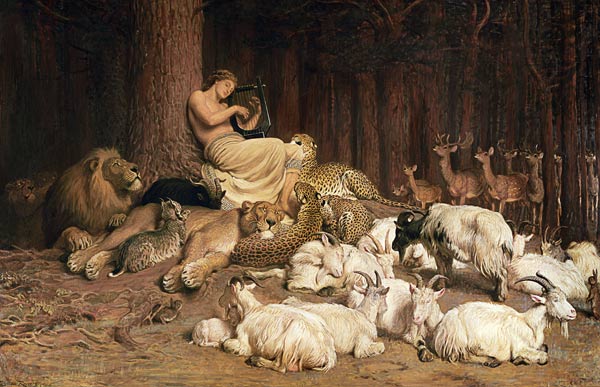
Larsson had been asked as early as 1930 if he would be interested in setting to music Hjalmar Gullberg’s cycle of poems. Gullberg, then the head of Swedish Radio’s drama division, took as his starting point Euripides’ “Alcestis,” in which the god Apollo, temporarily exiled from Olympus, acts as servant and shepherd to King Admetus of Thessaly.
It would be a full decade before the project was realized, in part due to the scale of the undertaking. By then, neighboring Denmark and Norway were under Nazi occupation. Gullberg wrote additional text to mold the work into a protest against violence in the world. In spite – or perhaps because – of the harsh reality of the times, “God in Disguise” retains an optimistic and indeed a determinedly pastoral outlook.
This too will be heard in a world premiere recording, from 1956, featuring speaker Lars Ekborg, soprano Elisabeth Soderstrom, and the orchestra and chorus conducted by Stig Westerberg.
Brush up on your Swedish, as we celebrate all that is worthy and simple. I hope you’ll join me for “Best at Verse” – Lars-Erik Larsson’s poetic suites for radio – this Sunday night at 10:00 EDT, on WWFM – The Classical Network and wwfm.org.
-
Westworld 1973 Roy’s Sci-Fi Rewind
by
8 responses
Just in case you happened to miss Roy and my musings on “Westworld” (1973), Michael Crichton’s animatronic amusement resort run amok, here it is again for your Saturday morning delectation.
Don’t forget, tomorrow night, Roy will welcome special guest Jimmi Simpson, who plays Will on the current HBO revival of “Westworld.”
“Roy’s Tie-Dye Sci-Fi Corner” streams on Facebook every Friday and Sunday evening at 7:00 EDT.
Thanks again, Roy, for having me back!
-
Sea Movies Hornblower Bounty Windjammer
by
5 responses
Taste the “cat” and prepare to be keelhauled!
This week on “Picture Perfect,” we give in to the impulse to run away to sea.
Though Gregory Peck cuts a dashing figure as “Captain Horatio Hornblower” (1951), the movie itself is a bit episodic, adapted as it was from three of C.S. Forester’s Hornblower novels. Canadian-born master of British light music Robert Farnon wrote the music, lending another dimension to this nautical adventure.
Alan Ladd and James Mason engage in a battle of wills in “Botany Bay” (1953). Ladd plays a doctor, wrongly convicted of a crime, who is transported to a penal colony in New South Wales on a ship under the harsh command of Mason. In perhaps the film’s most memorable sequence, Mason has one of his charges keelhauled! Franz Waxman wrote the score.
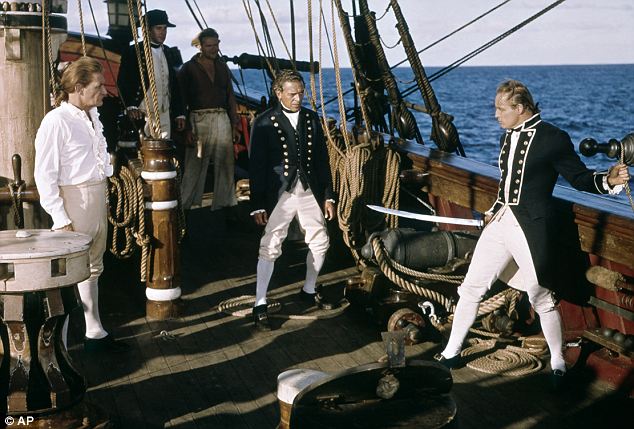
If it all sounds a mite familiar, it’s because the story is by Charles Nordhoff and James Norman Hall, who also wrote the book that became the basis for “Mutiny on the Bounty” (1962). The classic film version of “Bounty” dates from 1935, with Clark Gable butting up against Charles Laughton’s Captain Bligh. The ‘60s version bears a certain notoriety, mostly for Marlon Brando’s eccentric performance, which turns Fletcher Christian into a fop, and the fact that he essentially directed all his own scenes himself. The film was colossal failure, earning back only $13 million of its $19 million budget. Nonetheless, it managed to inspire Bronislau Kaper to compose one of his most monumental scores.
Interesting fact: the enlarged replica of the 1787 HMS Bounty, constructed specifically for the 1962 film, sank off the coast of North Carolina during Hurricane Sandy in 2012. The ship had also been used in the “Pirates of the Caribbean” franchise.
Finally, we’ll hear selections from “Windjammer” (1958), the only film shot using the Cinemiracle process. The film documents the round-trip, transatlantic journey of a Norwegian vessel from Oslo to the Caribbean to New York to Portsmouth, NH, and then back home again. Morton Gould wrote the evocative score, which alternates dance rhythms and sea shanties with a recurring melody suggestive of the sweeping romance of the high seas.
Prepare to set sail! It’s tall ships recommissioned, on “Picture Perfect,” music for the movies, this Friday evening at 6:00 EDT, on WWFM – The Classical Network and wwfm.org.
Tag Cloud
Aaron Copland (93) Beethoven (95) Composer (114) Film Music (145) Film Score (143) Film Scores (255) Halloween (94) John Williams (195) KWAX (229) Leonard Bernstein (104) Marlboro Music Festival (125) Movie Music (160) Mozart (91) Opera (213) Philadelphia Orchestra (89) Picture Perfect (174) Princeton Symphony Orchestra (109) Radio (88) Ross Amico (244) Roy's Tie-Dye Sci-Fi Corner (290) The Classical Network (101) The Lost Chord (269) Vaughan Williams (105) WPRB (397) WWFM (881)
4 responses