• Simpson Nielsen and More Composers Celebrate!

    Simpson Nielsen and More Composers Celebrate!

    by 

    in
    7 responses

    English composer Robert Simpson really loved Beethoven and Carl Nielsen. Hear for yourself, as I share a performance of Simpson’s Symphony No. 4, in celebration of his birthday.

    We’ll also mark the anniversaries of the births of composers Marc Blitzstein, John Gardner, George Alexander Macfarren, and Bedřich Smetana, violinist and composer Eugène Ysaÿe, guitarist and composer Celedonio Romero, and conductor and composer Leif Segerstam.

    The first round is on me (Gardner’s “Midsummer Ale”). Belly up to the bar, from 4 to 7 p.m. EST, on WWFM – The Classical Network and wwfm.org.


  • St David’s Day Welsh Harp Music on WWFM

    St David’s Day Welsh Harp Music on WWFM

    by 

    in
    6 responses

    St. David’s Day (March 1st) has been a national day of celebration in Wales since the Middle Ages. This Sunday night on “The Lost Chord,” we’ll honor the country’s patron saint, with an hour of Welsh music – interestingly, all of it in some way connected to the harp.

    Structurally, Grace Williams’ “Penillion” (1955) draws on the ancient Welsh practice of improvising vocal counterpoint to a traditional melody played on the harp. However, in this instance, the role of the harp is assigned to the trumpet, so as not to be swallowed up by the rest of the orchestra.

    We’ll also hear a set of variations on “Megan’s Daughter,” by the 19th century harpist John Thomas. In 1861, Thomas was given the bardic title, “Chief Musician of Wales.” In 1872, he became official harpist to Queen Victoria.

    Then bass-baritone Bryn Terfel will be heard, in his first ever commercial recording, in a Welsh song employing a text by Caradog Pritchard, extolling the virtues of the Ogwen River. “The River’s Song” is sung to the accompaniment of a harp, in this setting by Elsbeth M. Jones. Terfel will be joined by his former school mate, the tenor John Eifion.

    We’ll conclude with a personal favorite, the Harp Concerto (1970) by William Mathias. According to the composer, the first movement is connected with the land and seascapes of South West Wales, where the music was composed. The slow movement is a landscape of the mind, reflective of the great elegies of early Welsh poetry. The third movement is a spritely jig, which brings the piece to a rhythmic and joyful conclusion.

    Dydd Gŵyl Dewi Hapus!

    There’s a giant leek in the fridge. Yes, you heard correctly, and no, it’s not broken.

    I hope you’ll join me in celebrating St. David’s Day. That’s “And God Created Great Wales,” this Sunday night at 10:00 EST, on WWFM – The Classical Network and wwfm.org.


  • Leap Day Frederic Age Spoiler Young Genius

    Leap Day Frederic Age Spoiler Young Genius

    by 

    in
    4 responses

    Leap Day spoiler alert! Young Frederic is only five (and a little bit over).

    https://www.youtube.com/watch?v=b5VMp2pTVAM


  • Leap Day Baby Rossini Turns 55

    Leap Day Baby Rossini Turns 55

    by 

    in
    6 responses

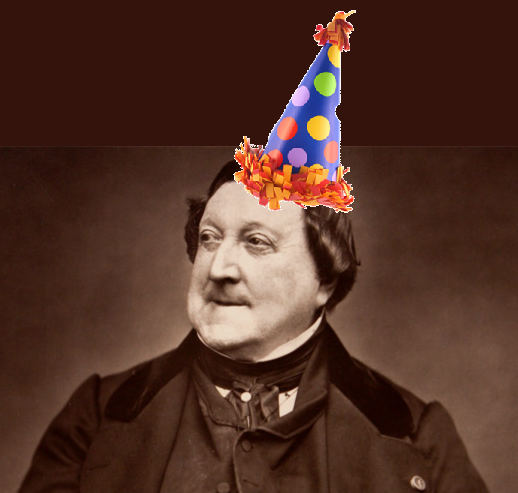
    Leap baby Gioachino Rossini is 55!

    Rossini was born on February 29, 1792. Of course, there’s a Leap Day only once every four years. I can tell by your furrowed brow that you’re trying to check my math. Before you quibble, you had better have a look at this:

    https://www.classicalwcrb.org/post/music-note-rossini-turns-54#stream/0

    Then enjoy “Rabbit of Seville”:

    https://www.dailymotion.com/video/x2u8f09


  • Viking Movie Music Hour of Runes and Tunes

    Viking Movie Music Hour of Runes and Tunes

    by 

    in
    5 responses

    We’ve got the need for mead!

    It’s an hour of swords and fjords this week, on “Picture Perfect,” as we travel north for music from movies about the Norsemen.

    In “The Long Ships” (1963), two Viking brothers, played by the unlikely pair of Richard Widmark and Russ Tamblyn, make off with a king’s funeral ship – and the king’s daughter – as they set sail on a quest for the fabled “Mother of Voices,” an enormous solid gold bell – also coveted by a Moorish prince, played by Sidney Poitier. Needless to say, camp value is high. The music for this British-Yugoslavian production is by the Serbian composer Dusan Radic.

    “Prince Valiant” (1954), based on the enduring comic strip by Hal Foster, is set in the days of King Arthur, though Val himself is a Viking prince of the kingdom of Scandia. And indeed Vikings play an important role in the film. Victor McLaglen is Val’s Viking pal Boltar, Janet Leigh is Princess Aleta, James Mason the villainous Sir Brack, and Sterling Hayden a ridiculous Gawain. Robert Wagner dons the signature page-boy haircut.

    The score is every bit as vivid as the film’s Technicolor. We’ll hear selections from a very special recording, with the composer himself, Franz Waxman, conducting.

    Michael Crichton’s 1976 novel, “Eaters of the Dead,” presents an unlikely, fish-out-of-water alliance, between historic Persian ambassador of the 10th century, Ahmad ibn Fadlan, and a band of Vikings. They overcome their cultural differences to face off against the Wendol, humanoid creatures who periodically emerge from the mist to feed on human flesh.

    Crichton’s story was filmed in 1997 and ultimately released as “The 13th Warrior” (1999), with Antonio Banderas as Ibn Fadlan. The production was plagued by misfortune. The original director, John McTiernan, who found success with “Die Hard,” was fired for running over-budget, and Crichton himself was brought in to re-shoot a number of the scenes. Nevertheless, the film proved to be a box office failure. But any movie to feature a Jerry Goldsmith score – and Vikings! – can’t be all bad.

    The legendary Jack Cardiff, who actually directed “The Long Ships,” provided the stunning cinematography for “The Vikings” (1958). The film stars Kirk Douglas, Tony Curtis, Janet Leigh, and Ernest Borgnine. Although unintentionally amusing on several levels, “The Vikings” is highly regarded for its attention to detail and stabs at historical accuracy – particularly in regard to its Viking dragon boats.

    Also impressive is the haunting score by Mario Nascimbene, which we’ll hear in a digital re-recording, issued on the Prometheus Records label, featuring the City of Prague Philharmonic Orchestra and Chorus, conducted by Nic Raine. The recording is like mead from Valhalla.

    I hope you’ll join me for an hour of runes and tunes. It’s the perfect mix-tape for your dragon boat. Set sail with the Vikings, this Friday evening at 6:00 EST, on WWFM – The Classical Network and wwfm.org.


Tag Cloud

Aaron Copland (93) Beethoven (95) Composer (114) Film Music (145) Film Score (143) Film Scores (255) Halloween (94) John Williams (195) KWAX (229) Leonard Bernstein (104) Marlboro Music Festival (125) Movie Music (160) Mozart (91) Opera (213) Philadelphia Orchestra (89) Picture Perfect (174) Princeton Symphony Orchestra (109) Radio (88) Ross Amico (244) Roy's Tie-Dye Sci-Fi Corner (290) The Classical Network (101) The Lost Chord (269) Vaughan Williams (105) WPRB (397) WWFM (881)

DON’T MISS A BEAT

Receive a weekly digest every Sunday at noon by signing up here


RECENT POSTS