• Thanksgiving Music Feast on The Classical Network

    Thanksgiving Music Feast on The Classical Network

    by 

    in
    3 responses

    In 1789, President George Washington issued a proclamation designating that November 26 be observed as a public day of thanksgiving. This marked the first national celebration of a holiday that has become commonplace in America’s households.

    I hope you’ll join me this afternoon on The Classical Network. On this, the anniversary of Washington’s Thanksgiving, though this year’s celebration is still two days away, you’ll find me greedily reaching for a drumstick. And a reed. And some rosin. That’s right, it will be a feast of American music, so make sure you save a little room after lunch.

    I’ll be setting the table with, among others, “American Dances” by David Amram, the String Quartet No. 1 “American Dreams” by Peter Schickele, “Fanfare on Amazing Grace” by Adolphus Hailstork, “Harvest” by Morton Gould, “Shaker Loops” by John Adams,” “The Acadian Land” by Romeo Cascarino, the Violin Sonata No. 2 by Charles Ives, and the Symphony No. 60 “To the Appalachian Mountains” by Alan Hovhaness.

    First, on today’s Noontime Concert, we’ll give thanks for a musical friendship that yielded much beauty. Clarinetist Yoonah Kim and pianist Kevin Ahfat will present a recital of works by the Schumanns and Johannes Brahms. On the program will be Brahms’ Clarinet Sonata No. 2, an arrangement of Clara Schumann’s Three Romances for Violin and Piano, and six of her songs. The concert took place last month at Kaufman Music Center’s Merkin Hall in New York City.

    So put your hands together. We’ll make a meal of great music, from 12 to 4 p.m. EST, on WWFM – The Classical Network and wwfm.org.
  • Sir Stephen Cleobury Remembrance

    Sir Stephen Cleobury Remembrance

    by 

    in
    5 responses

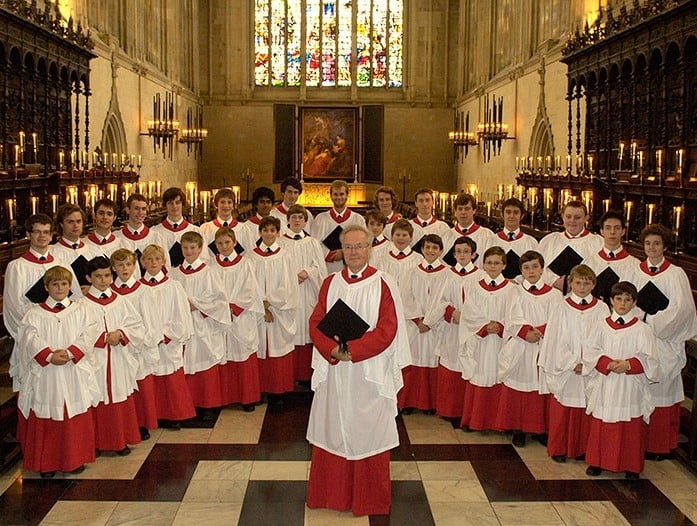
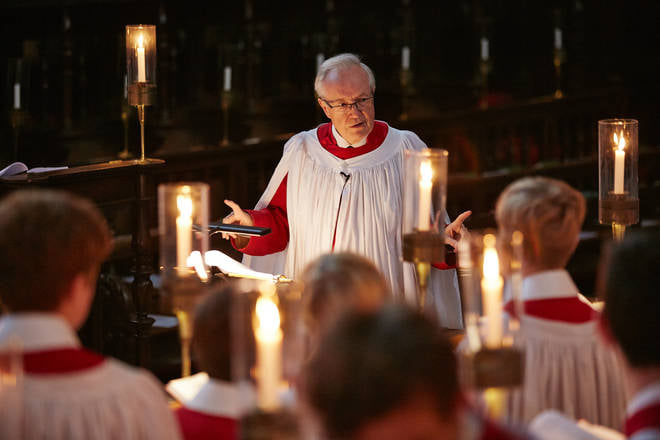
    Sir Stephen Cleobury, former director of music at King’s College, Cambridge, died on Friday at the age of 70. Cleobury has been a familiar presence for all of us here on this side of the pond, through his live Christmas Eve broadcasts of “A Festival of Nine Lessons and Carols,” for which he directed the Choir of King’s College for the past 37 years.

    I hope you’ll join me this afternoon on The Classical Network for some musical remembrances of Cleobury, whose recordings, I imagine, we’ll enjoy with increased frequency, as we once again enter the Christmas season.

    I’ll also celebrate pianist Wilhelm Kempff and composers Ilja Hurnik, Ethelbert Nevin, Tibor Serly, Sergei Taneyev, and Virgil Thomson, on this, the anniversary of their births.

    Cleobury was interviewed several times over the years on WWFM, most recently on “A Tempo” last December, in advance of the 100th anniversary of the King’s College Christmas Eve service. Cleobury’s conversation with Rachel Katz has been archived at our website. You can hear it right now by following the link.

    https://www.wwfm.org/post/tempo-festival-nine-lessons-and-carols-marks-100-years-seasonal-and-musical-inspiration?fbclid=IwAR1JSOZIIWzfrG0M2K0HGWEORRKetkuF3IbqgRXFgBjsf6PyKdXp9FUuEW4#stream/0

    Then tune in for more Cleobury and company, from 4 to 7 p.m. EST, on WWFM – The Classical Network and wwfm.org.

  • Sir Stephen Cleobury King’s College Director Dies

    Sir Stephen Cleobury King’s College Director Dies

    by 

    in
    5 responses

    The famed choral conductor Sir Stephen Cleobury has died.

    Cleobury was celebrated internationally as director of one of England’s most accomplished choirs, that of King’s College, Cambridge. In particular, he was associated with the Christmas Eve broadcasts of “A Festival of Nine Lessons and Carols,” which are heard all over the world. Cleobury presided over these for the past four decades. In that capacity, he was also responsible for commissioning new carols from many of the day’s leading composers.

    The Choir of King’s College, founded in 1441, is world-renowned for its excellence. The ensemble’s first Christmas Eve concert took place in 1918. “A Festival of Nine Lessons and Carols” has been broadcast every year since 1928.

    Cleobury was knighted earlier this year for his services to choral music. He retired as director of music at King’s College only two months ago. He died yesterday, St. Cecilia’s Day, at the age of 70.


  • Ormandy’s Lost American Music Recordings

    Ormandy’s Lost American Music Recordings

    by 

    in
    4 responses

    It’s not so much that I am out of ideas, but it is mighty convenient that I have so much material left over from last week’s show. Even now, I run my eye down the stack of CDs with the warm satisfaction of an acquisitive magpie.

    This Sunday night on “The Lost Chord,” it’s the second installment in what is shaping up to be a three-part series of Eugene Ormandy conducting the Philadelphia Orchestra in rarely-heard recordings of American music.

    Samuel Barber was born in West Chester, Pa., not far from Philly, in 1910. He attended Philadelphia’s Curtis Institute of Music and had his first orchestral work, the “School for Scandal Overture,” performed by the Philadelphia Orchestra in 1931, when he was 21 years-old.

    His “First Essay for Orchestra” was sent to Arturo Toscanini in the same mail as his “Adagio for Strings.” Toscanini performed both works with the NBC Symphony in 1938, but it was Eugene Ormandy who made the first recording of “Essay,” with the Philadelphians, in 1940.

    Vincent Persichetti was born in Philadelphia in 1915, and he died there in 1987. In between, he attended Combs College of Music, the Curtis Institute (where he studied conducting with Fritz Reiner) and the Philadelphia Conservatory. He taught at Combs and the Philly Conservatory. Then he received an invitation from William Schuman (some of whose music we heard last week) to take up a professorship at Juilliard.

    Persichetti was one of our great composers, but to this day he remains underappreciated, more respected than loved. His Symphony No 4 of 1951 must be one of his most immediately attractive works.

    Finally, John Vincent may be the most undeservedly neglected composer in Ormandy’s entire discography. Ormandy described his recording of Vincent’s Symphony in D (“A Festival Piece in One Movement”) as “one of the best we have ever done,” and the piece itself as “one of the finest compositions created by an American composer in the past decade.” The 1954 work sounds at times like Sibelius gone to the rodeo, but my, is it good stuff!

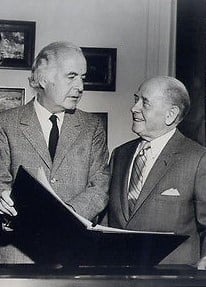
    I hope you’ll join me for “All-American Ormandy II.” Ormandy recommends a visit to the Barber (pictured), then convinces with the Vincents, this Sunday night at 10:00 EST, on WWFM – The Classical Network and wwfm.org.


  • WWFM Gratitude Gala: A Haunting & Future Support

    WWFM Gratitude Gala: A Haunting & Future Support

    by 

    in
    4 responses

    For anyone who missed it, here I am, haunting the bar at last night’s WWFM Gratitude Gala – to my knowledge, the only documented proof of my attendance. (That’s coffee in the cup, by the way.)

    If you are a supporter of the station, thank you. I met some very nice people and made a few contacts that may allow me to produce further installments of “Picture Perfect.”

    If you think it’s not in your budget to contribute enough to make a difference as an underwriter, we are now offering the option of supporting our specialty shows as part of a consortium. That means the station will act as matchmaker, pooling donations from multiple sources in order to fund individual programs.

    If that sounds like something you would like to do, to spruce up and ensure the future of your favorite shows, contact the station at 609-587-8989, during business hours – be sure to specify “Picture Perfect” or “The Lost Chord,” if that is your intention – or private message me here.

    It was great fun to jawbone with George Marriner Maull, of the Discovery Orchestra and “Inside Music,” and Joseph Horowitz and Angel-Gil Ordóñez, of the PostClassical Ensemble. It was also good to reconnect with some of the other hosts I myself seldom see.

    Of course, nothing eclipses a nice compliment, of which I gratefully received several. I am always deeply appreciative, humbled even, by sincere praise from obviously engaged listeners. Last night, one of them even sang the theme from John Williams’ “Dracula” for me. That’s NOT one of his better-known scores. Thanks to all those who attended.


    PHOTO: Classic Ross Amico, all blurred-out like Sasquatch


Tag Cloud

Aaron Copland (93) Beethoven (95) Composer (114) Film Music (145) Film Score (143) Film Scores (255) Halloween (94) John Williams (195) KWAX (229) Leonard Bernstein (104) Marlboro Music Festival (125) Movie Music (160) Mozart (91) Opera (213) Philadelphia Orchestra (89) Picture Perfect (174) Princeton Symphony Orchestra (109) Radio (88) Ross Amico (244) Roy's Tie-Dye Sci-Fi Corner (290) The Classical Network (101) The Lost Chord (269) Vaughan Williams (105) WPRB (397) WWFM (881)

DON’T MISS A BEAT

Receive a weekly digest every Sunday at noon by signing up here


RECENT POSTS