• Stephen Gunzenhauser Steps Down After 40 Years

    Stephen Gunzenhauser Steps Down After 40 Years

    by 

    in
    4 responses

    After 40 years, Stephen Gunzenhauser is stepping down as music director of the Lancaster Symphony Orchestra. The conductor has announced that the 2019-2020 season will be his last.

    Gunzenhauser’s name may be a familiar one far beyond his stomping grounds of Pennsylvania and Delaware, thanks to his tireless work on behalf of the Marco Polo and Naxos labels. With over a hundred releases in the current catalogue, Gunzenhauser has recorded works by Ernest Bloch, Antonin Dvořák, Reinhold Gliere, Karl Goldmark, Anton Rubinstein, and many others, carving out a niche for himself by documenting lesser-known repertoire and offering low-cost options to the bigger-named competition, especially at a time when there weren’t many budget alternatives to the “majors.”

    Gunzenhauser worked as an assistant to Igor Markevitch in Monte Carlo and Leopold Stokowski in New York before becoming executive and artistic director of the Wilmington Music School in 1974. Five years later, he was appointed music director of both the Delaware Symphony Orchestra and the Lancaster Symphony. Gunzenhauser led the Delaware Symphony through the end of the 2001-2002 season. He was named principal conductor of the Bogota Philharmonic in 2004.

    Naxos and Marco Polo have sold more than two million copies of his recordings, lending credence to his assertion that he is the fifth most recorded American conductor.

    Gunzenhauser raised the level of the Lancaster Symphony Orchestra from community to professional status. Following his retirement, he plans to focus on the Endless Mountain Music Festival, with which he has been closely involved since its inception in 2006.

    The Lancaster Symphony was founded in 1947. Gunzenhauser is only the second music director in the orchestra’s 72 year history.

    More information about the Lancaster Symphony at lancastersymphony.org.


    Gunzenhauser conducts Anton Rubinstein’s “Ocean” Symphony:


  • WWFM Classical Radio Needs You

    WWFM Classical Radio Needs You

    by 

    in
    4 responses

    Classical radio is as delicate as a glass slipper. We at WWFM – The Classical Network have been bringing great music to your community for 37 years, because of engaged listeners just like you.

    Thank you to all of you who participated in The Classical Network’s end-of-the-fiscal-year fundraiser. Unfortunately, we are still a little short of our goal.

    REMEMBER, YOU CAN MAKE YOUR CONTRIBUTION ONLINE AT WWFM.ORG UNTIL 11:59 TONIGHT and still have it count toward this year’s budget.

    Make this a fairy tale ending, won’t you? Work your magic with your donation at wwfm.org.

    The ball ends at midnight. Don’t let us start out 2019-2020 in a pumpkin!


  • Ellis Island History & Lessons for Today

    Ellis Island History & Lessons for Today

    by 

    in
    4 responses

    At a time when immigration remains a divisive issue, it’s instructive to look back to political cartoons of the 19th and early 20th centuries, when bomb-toting Bolsheviks seemed poised to take down our democracy, the Chinese were inscrutable back-stabbers, the Jews were bearers of poverty and disease, and the Irish were simian-faced hooligans and drunks. Anxiety about outsiders has always been with us, yet somehow we got over each successive alien group, and the country has plugged along just fine.

    This Sunday night on “The Lost Chord,” we’ll gain a little perspective, courtesy of composer Peter Boyer. From 1892 to 1954, more than 12 million immigrants passed through Ellis Island in search of a better life. More than 40 percent of the U.S. population – over 100 million Americans – can trace their roots to someone who entered this country along that route.

    Boyer’s “Ellis Island: The Dream of America” incorporates texts from testimonials archived as part of the Ellis Island Oral History Project. These are real words of real people telling their own stories. The work is performed by actors, rather than speakers or narrators, who deliver their monologues in the first person. In a powerful epilogue, each of them comes together to recite a stanza from Emma Lazarus’ poem, “The New Colossus.” It’s so effective – and affecting – I get a little choked up just thinking about it.

    You will, too, when you join me for “Spirits of Independence,” this Sunday night at 10:00 EDT, on WWFM – The Classical Network and wwfm.org.


  • Support Classical Music Radio WWFM Needs You

    Support Classical Music Radio WWFM Needs You

    by 

    in
    5 responses

    If you contributed to The Classical Network this week during our end-of-the-fiscal-year membership campaign, thank you so much for your support. We deeply appreciate your commitment to and concern for maintaining the best in classical music programming for our community and beyond, in a world where the kind of quality and variety we strive for is increasingly hard to find.

    Unfortunately, as of 6 p.m. Friday – the end of our on-air fundraising – we came up considerably short of our goal. We’ll see what comes in over the weekend, in the form of electronic contributions, but talk around the station is that cuts will have to be made. That doesn’t mean we’ll be going anywhere, but some of the shows may have to be put on hiatus. In a worst case scenario, as happened a few years ago, local hosts could be removed from the air waves until we are able to balance our budget. (I’m not saying that’s going to happen, but I speak from experience when I say that it has been done!)

    The fiscal year does not end until midnight, the morning of July 1. That means anything you contribute through the time Sunday rolls into Monday will count toward our bottom line. If you haven’t gotten around to doing so, I hope you will extend a hand to help us down from the scaffold in the form of a financial contribution at our website, wwfm.org. Click on the donate tab at the top of the page.

    We remain your friends in classical music radio. Thank you for your steadfast support of WWFM – The Classical Network.


  • Peter Westergaard Princeton Composer Dies at 88

    Peter Westergaard Princeton Composer Dies at 88

    by 

    in
    3 responses

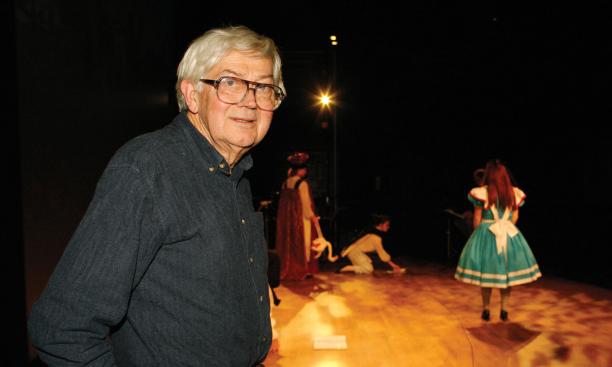
    Composer Peter Westergaard has died. Westergaard was chair of the Princeton University Music Department – twice – from 1974-1978 and from 1983-1986. He also taught at Columbia University and Amherst. Among his teachers were Milton Babbitt, Edward T. Cone, Wolfgang Fortner, Darius Milhaud, Walter Piston, and Roger Sessions. Westergaard retired from Princeton in 2001. As a composer, he wrote mainly chamber music and opera, including adaptations of the “The Tempest,” “Moby Dick,” and “Alice in Wonderland.” Westergaard was 88 years-old.

    You’ll find out more about Westergaard here:
    http://uihistories.library.illinois.edu/TAMHistory/Talbot/rh_talbot5.html

    His chamber opera, after Edward Lear, “Mr. & Mrs. Discobbolos:”

    The text of Lear’s poem:
    http://www.nonsenselit.org/Lear/ll/discobbolos.html
    http://www.nonsenselit.org/Lear/ll/discobbolos2.html


    PHOTOS: (top) Westergaard at the dress rehearsal for the premiere of “Alice in Wonderland” at Princeton in 2008; (bottom, left to right) cover design for the score and libretto of “The Tempest” by Lambertville artist Alison Carver; composer and friend enjoying some together time at the keyboard; Westergaard and his wife, Barbara, in 1994


Tag Cloud

Aaron Copland (93) Beethoven (95) Composer (114) Film Music (145) Film Score (143) Film Scores (255) Halloween (94) John Williams (195) KWAX (229) Leonard Bernstein (104) Marlboro Music Festival (125) Movie Music (160) Mozart (91) Opera (213) Philadelphia Orchestra (89) Picture Perfect (174) Princeton Symphony Orchestra (109) Radio (88) Ross Amico (244) Roy's Tie-Dye Sci-Fi Corner (290) The Classical Network (101) The Lost Chord (269) Vaughan Williams (105) WPRB (397) WWFM (881)

DON’T MISS A BEAT

Receive a weekly digest every Sunday at noon by signing up here


RECENT POSTS