• Midsummer Music Bonfires Witches and More

    Midsummer Music Bonfires Witches and More

    by 

    in
    2 responses

    Thank the Romans. They’re the ones who marked the summer solstice for June 24 – hence, the discrepancy between the longest day (June 21) and Midsummer. But the Romans liked nothing if not a good party, so why split hairs? Let the good times roll!

    The Church, though fashionably late, was quick to comprehend it would probably be best to divert the stream of paganism rather than attempt to dam(n) everything outright. To this end, June 24 was designated the Feast Day of St. John. This worked out very nicely, since St. Luke implies the birth of John the Baptist took place six months before that of Jesus.

    On the eve of this blessed anniversary, the night of June 23, good Christians celebrate as only reformed pagans can, in the understanding that everyone will be up to fulfill their religious obligations on the morrow.

    This Sunday night on “The Lost Chord,” we’ll have music for St. John’s Eve.

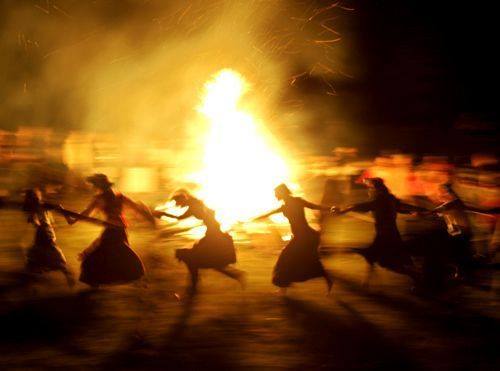
    The eve of St. John is a time for the harvesting of St. John’s Wort, with its miraculous healing powers. It’s a time to seek the fern flower, which can bring good fortune, wealth, and the ability to understand animal speech. It’s a time for the lighting of bonfires against evil spirits, and even dragons, which roam the earth, as the sun again pursues a southerly course. And it’s a time when witches are believed to rendezvous with powerful forces, such as the demon Chernobog, who emerges from the Bald Mountain on St. John’s Eve at the climax of Disney’s “Fantasia.”

    Leaping over a bonfire is seen as a surety of prosperity and good luck. Not to light a bonfire is seen as offering up one’s own house for destruction by fire. The bigger the fire, the further at bay are kept evil spirits. The further the evil spirits, the better the guarantee of a good harvest.

    We’ll have music inspired by some of these Midsummer customs, as we listen to Modest Mussorgsky’s “St. John’s Night,” an earlier, less-familiar incarnation of his popular musical picture “A Night on Bald Mountain,” as heard in his opera, “Sorochinsky Fair.”

    Also featured will be Alfred Schnittke’s impish rondo, “(K)ein Sommernachtstraum.” The root of the title is German for “A Midsummer Night’s Dream,” but the postmodern inclusion of the “K” in parentheses modifies the meaning to “NOT a Midsummer Night’s Dream.” Indeed! Schnittke sets up the listener with a soothing notturno in the style of Mozart or Schubert, but very soon the atmosphere begins to shift.

    Finally, we’ll hear selections from the ballet, “St. John’s Eve,” by the Swedish composer Gunnar de Frumerie. Not surprisingly, after a long, hard winter, the Scandinavian countries are crazy for Midsummer. The allegorical ballet features appearances by John the Baptist, Salome, the Seven Deadly Sins, Angels, and the Devil, all tied up in Swedish Midsummer traditions.

    Leap high, friends, and join me for “Midsummer Night’s Fiends,” this Sunday night at 10:00 EDT, on WWFM – The Classical Network and wwfm.org.
  • Washington Irving’s Sketch Book Rediscovered

    Washington Irving’s Sketch Book Rediscovered

    by 

    in
    3 responses

    While the big show in American letters this year has unquestionably been the Walt Whitman bicentennial, an equally worthy subject seems not to have captured the imagination of either press or internet. On June 23, 1819, the first story appeared of what was to become Washington Irving’s “The Sketch Book of Geoffrey Crayon, Gent.” – more commonly known as “The Sketch Book.”

    “The Sketch Book,” ultimately a collection of 34 stories and essays, was published serially, for a little over a year, through July 1820. Twenty years in advance of the first of James Fennimore Cooper’s “Leatherstocking Tales,” thirty years in advance of “Moby-Dick,” and a full sixty years before “The Adventures of Huckleberry Finn,” “The Sketch Book” was one of the first literary undertakings by an American to enthrall an international readership. William Makepeace Thackeray observed, “Irving was the first ambassador whom the New World of letters sent to the Old.”

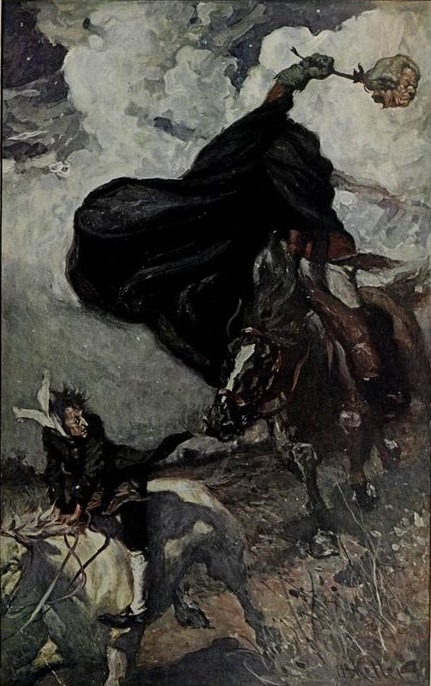
    Even those who have never encountered Irving’s work will be familiar with his creations, Rip Van Winkle, Ichabod Crane, and the Headless Horseman.

    I divined the anniversary purely by chance two weeks ago, when searching for a suitable image for my post on Antonin Dvořák’s “The Specter’s Bride.” It turns out Irving treated the same subject, an old folktale, in his “Sketch Book” story “The Spectre Bridegroom.”

    Naturally, I considered putting together a program of Irving-inspired works for “The Lost Chord.” But when I realized the material I have to work with is so thin, I was concerned it might come across a little bit like scraping the proverbial barrel.

    These are the Irving-inspired pieces that sprang immediately to mind:

    George Whitefield Chadwick: “Rip Van Winkle Overture” (1879)

    Ferde Grofé: “Hudson River Suite:” Rip Van Winkle (1955)

    Edgar Stillman Kelley: “Headless Horseman” (1891)

    Apparently George Frederick Bristow composed a “Rip Van Winkle” opera in 1855, but if it’s even been recorded, I don’t have it. (And that’s saying something.) Ah! But here’s the overture!

    Even so, that’s not a whole heck of a lot. Which means I would have had to fill out the rest of the hour with highlights from Kurt Weill’s “Knickerbocker Holiday,” which is very tangentially related indeed.

    In any case, spare a thought for Washington Irving. Maybe even re-read one of his supernatural tales. It would be especially appropriate for St. John’s Eve. More on that jolly pagan celebration tomorrow.


    CLOCKWISE FROM LEFT: “The Legend of Sleepy Hollow” (1906) by Arthur I. Keller; portrait of a dashing young Irving (1809) by John Wesley Jarvis; illustration from “Rip Van Winkle” (1921) by N.C. Wyeth


  • Zeffirelli’s Shakespeare & Film Scores

    Zeffirelli’s Shakespeare & Film Scores

    by 

    in
    5 responses

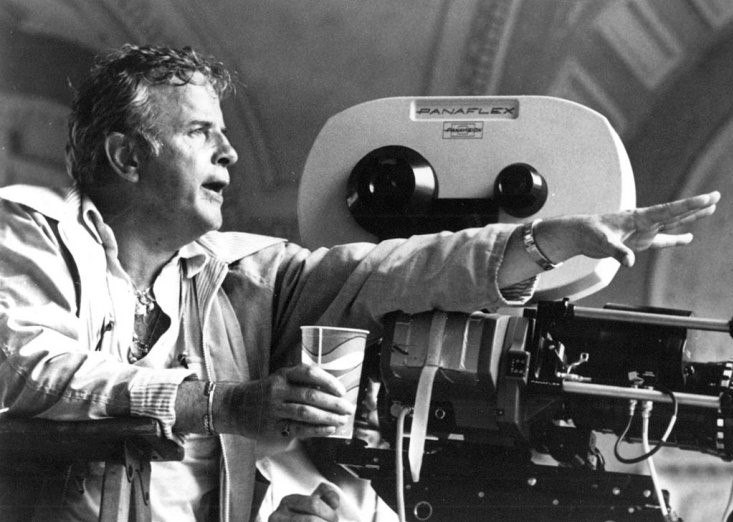
    Franco Zeffirelli died on June 15 at the age of 96. The influential director favored big emotions and grandiose subjects, making his biggest mark in Shakespeare and opera. I’ll leave the opera to other hands. However, this week on “Picture Perfect,” I’ll do what I can to honor his artistry with music from a selection of his films.

    “Romeo and Juliet” (1968) was probably the most culturally significant of these. Not only did it turn out to be a surprise hit, the film has been a staple of high school English curricula for decades. Zeffirelli’s vision proved especially appealing to teenaged audiences – in part because of the refreshing youth of its leads (Leonard Whiting and Olivia Hussey, 17 and 16 respectively).

    “Romeo and Juliet” was nominated for several Academy Awards, including those for Best Picture and Best Director. Laurence Olivier spoke the film’s prologue and epilogue, and reportedly dubbed the voice of the Italian actor who played Lord Montague. Nino Rota wrote the music, and the love theme was popularized as “A Time for Us.”

    Another enduring success for Zeffirelli, a devout Roman Catholic, was his television miniseries, “Jesus of Nazareth” (1977). This time Olivia Hussey plays Mary, mother of Jesus. The all-star cast includes eight Academy Award winners, past and future (Anne Bancroft, Ernest Borgnine, James Earl Jones, Laurence Olivier, Christopher Plummer, Anthony Quinn, Rod Steiger, and Peter Ustinov). It makes me happy to learn that the sets for the film were reused by Monty Python for “Life of Brian.”

    The music was by Maurice Jarre, David Lean’s composer-of-choice. I realize we’ve been hearing a lot of late-period Jarre recently, when he was most under the spell of electronics. “Jesus of Nazareth” sports a good old-fashioned orchestral score, with obligatory Biblical chorus.

    Zeffirelli proved again and again that he was especially adept at adapting Shakespeare for the big screen. With the unlikely casting of action hero Mel Gibson as the melancholy Dane, “Hamlet” (1990) was something of a gamble that paid off. Zeffirelli puzzlingly tampers with one of the all-time great openings in the history of drama, delaying the appearance of the ghost of Hamlet’s father in favor of some fabricated funeral that looks like a rejected scene from “Star Wars,” but Gibson brings to the title role a refreshing vitality. The reading is passionate and dangerous. The music was by Ennio Morricone.

    Art imitates life in Zeffirelli’s first feature as director, “The Taming of the Shrew” (1967), a showcase for the famously tempestuous husband-and-wife Richard Burton and Elizabeth Taylor. In addition, “Shrew” and “Romeo” provided notable supporting roles for a young Michael York. Nino Rota supplies an alternately rollicking and melancholy score in a manner that seems characteristic of Italian composers – perhaps the influence of Italian opera?

    Of course Zeffirelli made a magnificent imprint in the world of opera, with his opulent, eye-popping productions. For film, he directed adaptations of “La traviata” and “Otello,” with Placido Domingo.

    Among his other films were “Brother Sun, Sister Moon,” “The Champ,” “Endless Love,” “Jane Eyre,” and “Tea with Mussolini.” But we’ll go with the spectacle – I think Franco would have wanted it that way – this Friday evening at 6:00 EDT, on WWFM – The Classical Network and wwfm.org.

  • Jacques Offenbach 200th Birthday Celebration

    Jacques Offenbach 200th Birthday Celebration

    by 

    in
    6 responses

    Here comes the “Can Can” man!

    Today marks the 200th anniversary of the birth of Jacques Offenbach.

    Like Victor Herbert, who was born 40 years later, Jacques Offenbach was a master of operetta who gained experience as a cellist in theater orchestras. (Herbert even made it as far as the Metropolitan Opera.)

    In Offenbach’s case, he finally attained a permanent position at Paris’ Opéra-Comique. Of course, his temperament was such that he was always getting busted down in pay for playing pranks. Once, he rigged everyone’s music stands to collapse in mid-performance.

    Nevertheless, he managed to make a favorable impression on composer and conductor Fromental Halévy, who gave him private lessons in composition and orchestration. (Offenbach had left the Paris Conservatory out of boredom a year into his formal studies.)

    With the help of Friedrich von Flotow, another future luminary of the musical stage, Offenbach gained access to the salon circuit. In this way, he bolstered his reputation as a performer and a composer. He toured France and Germany, performing with musicians such as Liszt and Anton Rubinstein. In England, he met Mendelssohn and Joseph Joachim.

    Upon his return to Paris, he subtly altered his image from a cellist who happened to compose to a composer who played the cello. When the salons began to dry up, Offenbach gained employment as the musical director of the Comédie Française. There, he gained valuable experience actually writing for the stage, though his success did not transfer to the Opéra-Comique. Debussy noted that the musical establishment of the time had difficulty coping with the composer’s sense of irony.

    By the time Offenbach finally did crack the Opéra-Comique with “The Tales of Hoffmann,” he was already in the grave. Though he died before putting the finishing touches on his opera, the orchestration was completed by other hands, and the work has not been out of the repertoire since.

    Somewhere in heaven, undoubtedly, Offenbach is sawing half-way through the columns of the harps and enjoying the last laugh.

    Happy birthday, Jacques Offenbach!


    The scherzo from Offenbach’s Cello Quartet:

    His greatest hit:

    The lovely “Barcarolle:”


  • Elgar & Vaughan Williams Quintets Marlboro

    Elgar & Vaughan Williams Quintets Marlboro

    by 

    in
    9 responses

    English music is more than simply ham, lamb, and strawberry jam. On the next “Music from Marlboro,” we’ll highlight one of the most deeply personal utterances of perhaps Albion’s most respected composer.

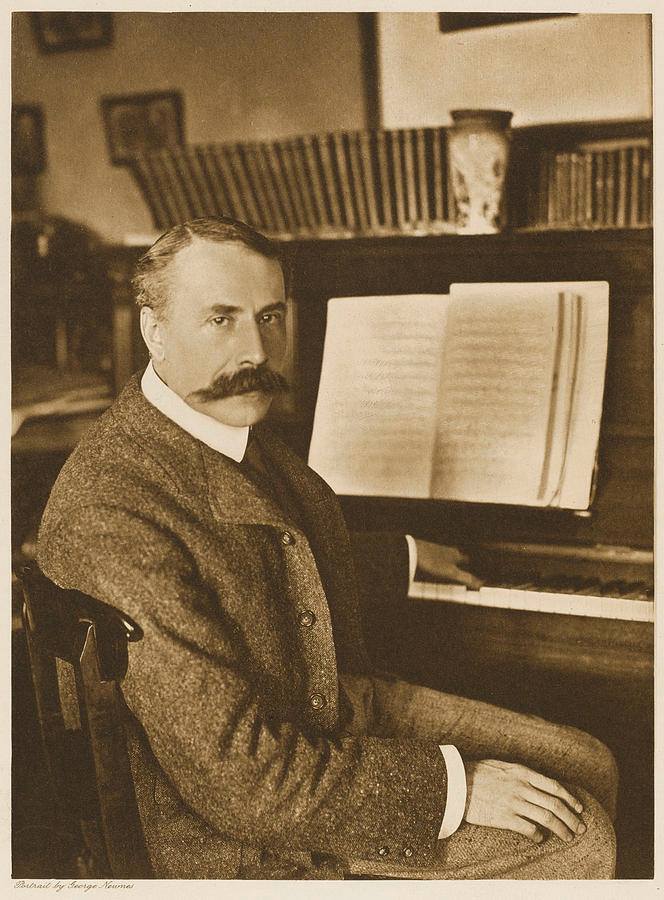
    In the spring of 1918, Sir Edward Elgar underwent an operation in London to have an infected tonsil removed. At the time, this was considered a dangerous operation for a 61 year-old man. When the composer regained consciousness, the first thing he did was ask for a piece of paper, and he jotted down the opening theme of what was to become his last major work, the Cello Concerto in E minor.

    The Elgars retired to Brinkwells, a thatched cottage that was their summer home near Fittleworth, in Sussex, so that they could have time to relax and recover from their ailments. Even in this idyllic setting, with its trees and farmland, the guns could be heard at night rumbling across the Channel. The First World War had a profound effect on Elgar, as it did on everyone, but most especially those of the older generation, who had regarded the Boer War as a yardstick against which the cost and loss of armed conflict had been measured.

    Nevertheless, by August, Elgar was composing again. In quick succession came the Violin Sonata in E minor, the Piano Quintet in A minor, and the String Quartet in E minor. All three works were given their first performances one hundred years ago, in May of 1919, at which point Elgar launched into the Cello Concerto, which was to be his final masterpiece.

    Elgar labored with great intensity, rising at 4 or 5:00 every morning. His music from this period is spare and almost confessional in nature, colored by nostalgia, introspection, and a kind of sad beauty.

    But when it came time to play through the quintet, the composer was surrounded by some of his closest confidantes, and he couldn’t have been happier. These included W.H. Reed, with whom he had worked on the Violin Concerto; Albert Sammons, who would make the concerto’s first complete recording, and Felix Salmond, who would assist him on the Cello Concerto.

    We’ll hear a performance of Elgar’s Piano Quintet from the 2002 Marlboro Music Festival, featuring pianist Jeremy Denk, violinists Erin Keefe and Bradley Creswick, violist Teng Li, and cellist Joel Noyes.

    That will be prefaced by another quintet, from 1912, by Ralph Vaughan Williams. Vaughan Williams’ “Phantasy Quintet” was one of a number of works commissioned from England’s great composers by Walter Wilson Cobbett, a businessman and amateur musician whose dual passions were chamber music and music of the Elizabethan era. (“Phantasy” was Cobbett’s preferred spelling.)

    Vaughan Williams’ quintet is full of Tudor inflections and stamped by the composer’s tell-tale love of folk music. RVW doubles his violas, and the instrument is heard to great effect throughout the piece. We’ll enjoy it in a 1975 performance from Marlboro, featuring violinists James Buswell and Sachiko Nakajima, violists Philipp Naegele and Caroline Levine, and cellist Anne Martindale.

    I hope you’ll join me for the quintessence of English quintets – and one fantastic phantasy – on the next “Music from Marlboro,” this Wednesday evening at 6:00 EDT, on WWFM – The Classical Network and wwfm.org.

    Marlboro School of Music and Festival: Official Page


Tag Cloud

Aaron Copland (93) Beethoven (95) Composer (114) Film Music (145) Film Score (143) Film Scores (255) Halloween (94) John Williams (195) KWAX (229) Leonard Bernstein (104) Marlboro Music Festival (125) Movie Music (160) Mozart (91) Opera (213) Philadelphia Orchestra (89) Picture Perfect (174) Princeton Symphony Orchestra (109) Radio (88) Ross Amico (244) Roy's Tie-Dye Sci-Fi Corner (290) The Classical Network (101) The Lost Chord (269) Vaughan Williams (105) WPRB (397) WWFM (881)

DON’T MISS A BEAT

Receive a weekly digest every Sunday at noon by signing up here


RECENT POSTS