• Shostakovich’s Misery Marlboro’s Joy

    Shostakovich’s Misery Marlboro’s Joy

    by 

    in
    4 responses

    Dmitri? DMITRI! Pull yourself together. Don’t look so miserable.

    This week on “Music from Marlboro,” we’ll be featuring your Piano Trio No. 2 in E minor. Sure, it’s dedicated to Ivan Sollertinsky, a close friend of yours who died an untimely death, and it was given its premiere in Leningrad in 1944, not the cheeriest place in the months following a years-long siege that killed probably a million and a half people, maybe two, created subhuman conditions, and instilled unfathomable desperation in the populace.

    This is the piece that lent your String Quartet No. 8 its inexorable, klezmer-influenced “danse macabre.” After all, among Sollertinsky’s many other talents and enthusiasms – as a musicologist, a critic, a linguist, a professor, and the artistic director of the Leningrad Philharmonic – he was an ardent enthusiast of the music of Gustav Mahler. Sollertinsky had been evacuated during the siege. Unfortunately, he died suddenly of a heart attack in Siberia at the age of 41.

    With Sollertinsky’s death, the barricades of misery were shattered, and you mourned as only you could. It’s not exactly uplifting music, but boy does it make an impression.

    We’ll hear it performed at the 2011 Marlboro Music Festival by pianist Bruno Canino, violinist Ying Fu, and cellist Matthew Zalkind.

    Then Alexander Glazunov – representative of an earlier generation, oblivious, and perhaps not entirely sober – will clear the air with his String Quintet in A major. Glazunov knew you well, did he not? As director of the Petrograd Conservatory, he saw to it that you were allowed to bypass preparatory theoretical courses and enter directly into the conservatory’s composition program.

    What a nice guy! Too bad you were lukewarm on his music. But you did have kind things to say about the man, and even opined that his scherzos weren’t too bad.

    Glazunov’s quintet is full of serene lyricism, generously melodic and quite beautiful. Then again, Glazunov never had to worry about Nazis and probably never had to eat anyone to survive. We’ll hear it performed at Marlboro in 1982, with violinists Sylvie Gazeau and Ernestine Schor, violist Toby Hoffman, and one-and-future cellists of the Guarneri Quartet, David Soyer and Peter Wiley.

    That’s a dazed piano trio, with a glaze of Glazunov, on the next “Music from Marlboro,” this Wednesday evening at 6:00 EDT, on WWFM – The Classical Network and wwfm.org.

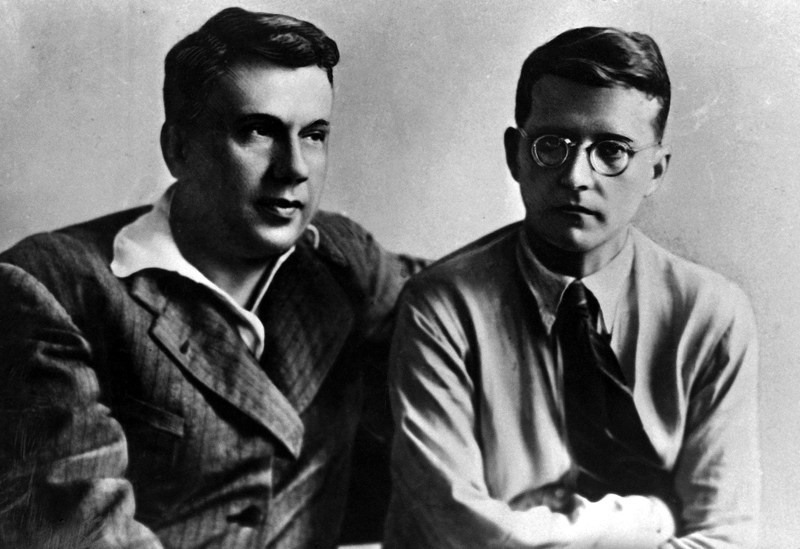
    RAINY DAY ACTIVITY: Post your most miserable photo of Shostakovich in the comments section below.

    Marlboro School of Music and Festival: Official Page


    PHOTOS: Sollertinsky (upper left) and the many moods of Shostakovich


  • 400 Facebook Likes Thank You!

    400 Facebook Likes Thank You!

    by 

    in
    3 responses

    Well, dog my cats… I’m at 400 likes! That’s one for every year I’ve been on Facebook!

    But seriously, folks… Thank you all for taking the time each day to read my musings. Your thumbs-ups, feedback, and horrifying emojis do so much to brighten my sad existence.

    Now if I can only get the other 59 people who FOLLOW the page to actually LIKE it. Maybe I’m just the classical music guy people love to hate? Quit stalking me, already, and make yourselves known!

    To celebrate this milestone, here’s the “Kiss Waltz,” Op. 400, by Johann Strauss the Younger:

    Thanks again, and here’s to the next 400!


  • Ballets Russes Treasures on The Classical Network

    Ballets Russes Treasures on The Classical Network

    by 

    in
    8 responses

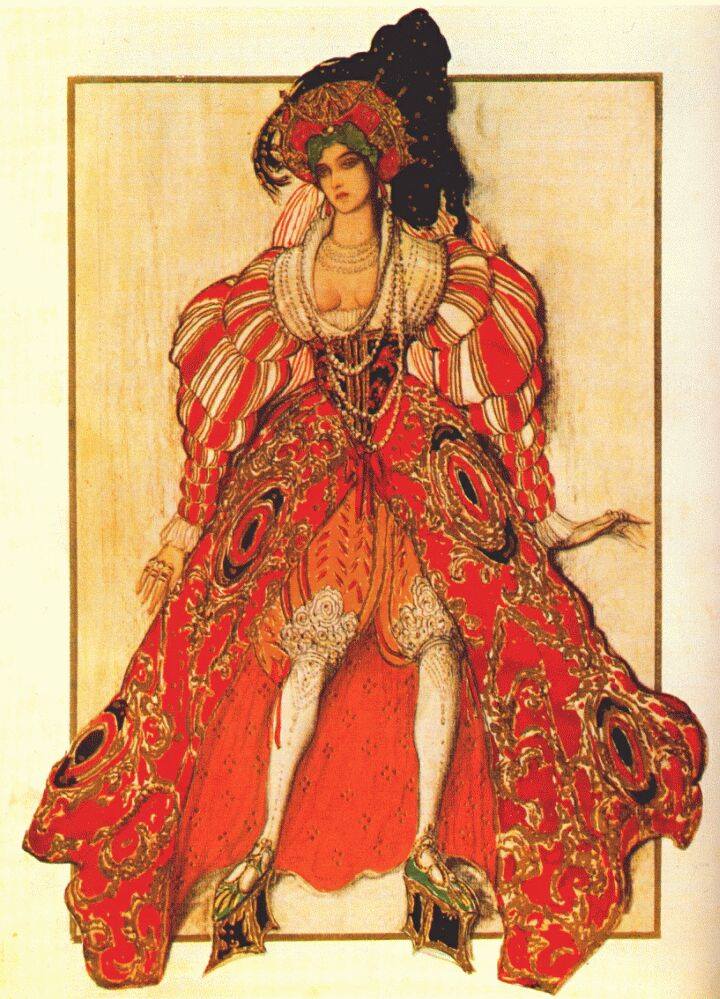
    Serge Diaghilev, impresario of the Ballets Russes, commissioned some of the most enduring ballet scores of the 20th century, from such composers as Claude Debussy (“Jeux”), Maurice Ravel (“Daphnis and Chloe”), Manuel de Falla (“The Three-Cornered Hat”), and especially Igor Stravinsky (“The Firebird,” “Petrushka” and “The Rite of Spring”).

    This afternoon on The Classical Network, we’ll have a chance to enjoy some of the lesser-known fruits of this partnership, including “Narcisse et Echo” by Nikolai Tcherepnin – written one year before “Daphnis,” though with some striking similarities – and the complete ballet “The Triumph of Neptune” – one of only two works composed for the company by an English composer, in this case Lord Berners. The suite, not exactly overplayed, was a great favorite of Sir Thomas Beecham (he recorded it several times), but the complete ballet is never done. We’ll also hear Richard Strauss’ music for the bombastic biblical spectacle “Josephslegende” (“The Legend of Joseph”) in its entirety.

    First, on today’s Noontime Concert, it’s music for voice and viol, courtesy of Gotham Early Music Scene, or GEMS. Mezzo-soprano Ashley Mulcahy and viola da gambist James Perretta of the duo Lyracle will present works for this distinctive combination from the late 16th and early 17th centuries.

    These performances were captured at GEMS’ Midtown Concerts series, held at the chapel of St. Bartholomew’s Church, 325 Park Avenue, in New York City. Free concerts take place at St. Bart’s on Thursdays at 1:15 p.m. For more information, visit GEMS’ website, gemsny.org, and click on the events calendar.

    Join me for a mix of GEMS and flawed diamonds from the Ballets Russes, from 12 to 4 p.m. EDT, on WWFM – The Classical Network and wwfm.org.


    IMAGE: Potiphar’s wife got it goin’ on!


  • Charles Lecocq Birthday & “Mam’zelle Angot”

    Charles Lecocq Birthday & “Mam’zelle Angot”

    by 

    in
    3 responses

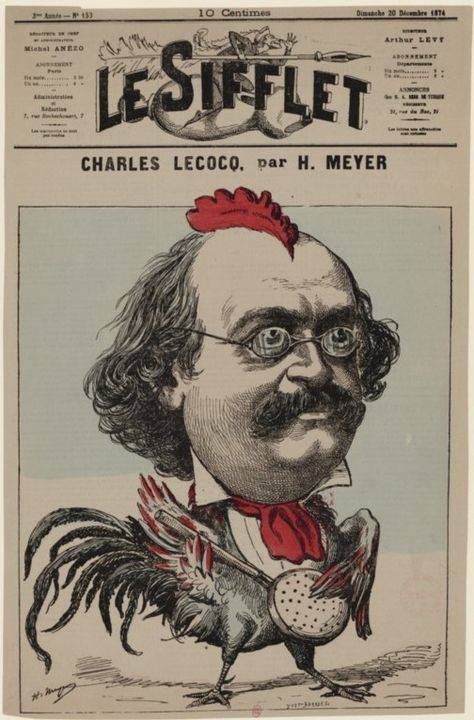
    Today is the birthday of Charles Lecocq (1832-1918). Lecocq’s affinity for light opera made him a natural successor of sorts to Jacques Offenbach. “La fille de Madame Angot” was a triumph when it opened in Brussels in 1872. Soon, it was wowing them not only in Paris, but also London and New York, and indeed all across Europe. In fact, it was the most successful French-language musical theater piece up through the turn of the century. In terms of box office, it managed even to outpace “H.M.S. Pinafore” and “Die Fledermaus.” Its momentum was such that it is now the only work of Lecocq that is ever performed.

    The opera was given a superfluous boost in the 1940s, when choreographer Léonide Massine created a new version that found its definitive form in a production by the Sadler’s Wells Ballet. Margot Fonteyn and Moira Shearer were among the principals. The adaptation, “Mam’zelle Angot,” employs arrangements by Gordon Jacob and broadly follows the opera’s original plot. Let’s just say that it is a flighty and frothy divertissement, set in a politically charged climate following the Reign of Terror. Despite the threat of looming peril, all ends happily, with mismatched lovers paired off to everyone’s general delight.

    Get an idea of what the fuss was about. It will be a boost from the roost – music from Lecocq and beyond – between 4 and 7 p.m. EDT, on WWFM – The Classical Network and wwfm.org.


  • Elgar Remastered in Accidental Stereo

    Elgar Remastered in Accidental Stereo

    by 

    in
    8 responses

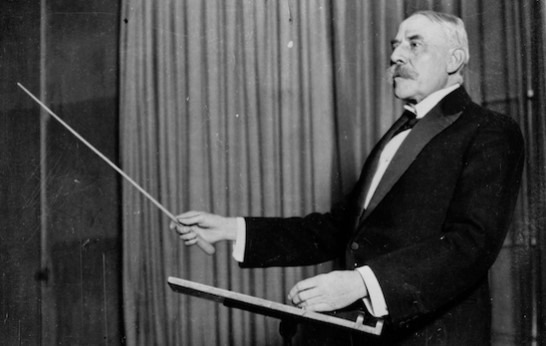
    This Sunday night on “The Lost Chord,” we’ve a present for Sir Edward Elgar, on his birthday.

    Elgar was one of the first of the great composers to endeavor to set down “definitive” interpretations of his own works on recordings. Or so it has been thought. But did Elgar really regard these performances as definitive? In fact, Elgar took great care to “grade” the various takes from his recording sessions. Some of these, he instructed, were to be destroyed outright; others were held, as the composer took the time to consider.

    What emerges, upon listening to a 4-CD set, “Elgar Remastered,” on the SOMM Recordings label, are the impressions that (1) Elgar was fairly meticulous when it came to preserving his legacy, and (2) he also understood that there’s more than one way to skin a cat. Rediscovered alternative takes make clear that the composer was amenable to looking at his own works from a variety of perspectives.

    For their parts, the conscientious engineers at EMI employed multiple machines to guard against technological failure. This was back in the late 1920s and early ‘30s. Now, for the first time, the elements have been brought together and skillfully combined to create a kind of “accidental” stereo.

    Engineer Lani Spahr has worked wonders with these recordings, from the private collection of Arthur Reynolds, chairman of the North American Branch of the Elgar Society. He also goes into considerable detail in his liner notes – in fact, to a degree that would be impractical to relate here.

    A good deal of the set is devoted to recordings and alternative takes of Elgar’s Cello Concerto. As on the composer’s authorized recording, issued on EMI, Beatrice Harrison is the soloist. These include the first complete electrical recording, from 1928 – the one which would ultimately be published, in mono – with previously unissued, alternative takes from the same sessions. There is also an earlier, truncated recording from 1920, set down using the acoustic process, and a performance of the concerto’s Adagio movement alone, with Harrison accompanied at the keyboard by Princess Victoria.

    The gem of the set is Harrison’s celebrated 1928 recording, heard here for the first time entirely in stereo, or what passes for stereo.

    Harrison was Elgar’s preferred soloist. He lavished praise on her performances, even as she took liberties with the score. At the session for this particular recording, he was overheard to say, “Give it ‘em, Beatrice, give it ‘em. Don’t mind about the notes or anything. Give ‘em the spirit.”

    Worlds away from the effusive, heart-on-the-sleeve approach of Jacqueline du Pré, Harrison’s interpretation is nonetheless riveting on its own terms. As with the other recordings in the collection, it is a kind of time capsule of period performance practice – with swooping portamenti (audible slides between notes) – and the musicians’ flexibility in regard to both tempo and phrasing.

    And Elgar can be such a volatile conductor! In addition, we’ll hear a cracking rendition of the “Cockaigne Overture” and a performance of the prelude to the oratorio “The Kingdom,” which really takes flight.

    Hear Elgar as you’ve never heard him before – in “accidental” stereo – on “Pomp and Happenstance,” this Sunday night at 10:00 EDT, on WWFM – The Classical Network and wwfm.org.


Tag Cloud

Aaron Copland (93) Beethoven (95) Composer (114) Film Music (145) Film Score (143) Film Scores (255) Halloween (94) John Williams (195) KWAX (229) Leonard Bernstein (104) Marlboro Music Festival (125) Movie Music (160) Mozart (91) Opera (213) Philadelphia Orchestra (89) Picture Perfect (174) Princeton Symphony Orchestra (109) Radio (88) Ross Amico (244) Roy's Tie-Dye Sci-Fi Corner (290) The Classical Network (101) The Lost Chord (269) Vaughan Williams (105) WPRB (397) WWFM (881)

DON’T MISS A BEAT

Receive a weekly digest every Sunday at noon by signing up here


RECENT POSTS