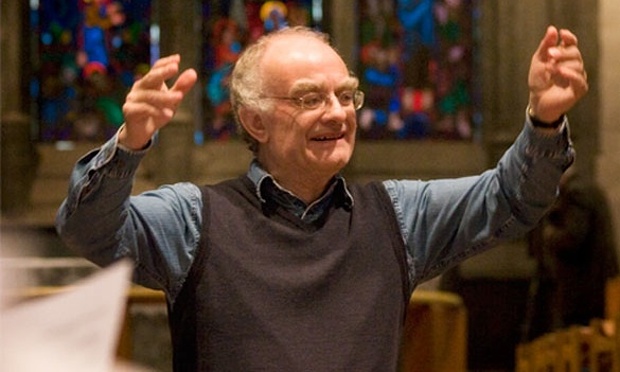
Maybe it’s too many lumps of sugar for some, but what can I say? I’ve a cotton candy soul. For me, John Rutter’s “Requiem” is the perfect music for autumn.
Rutter, of course, is one of England’s most successful choral composers and conductors. His music is everywhere at Christmastime, a natural melodic gift informing dozens of beloved carols. So it’s hardly surprising that his Requiem is full of good tunes.
The work is dedicated to the memory of his father. I find it a great comfort, especially as it’s performed here by the choir he built, the Cambridge Singers, founded in 1981. I was transported by it when I first heard it on the radio, back in the mid-‘80s, when the work was practically brand new. I am happy to say, I still am.
Rutter is 81 today. Many happy returns!
-
Rutter’s Heavenly Requiem
by
-
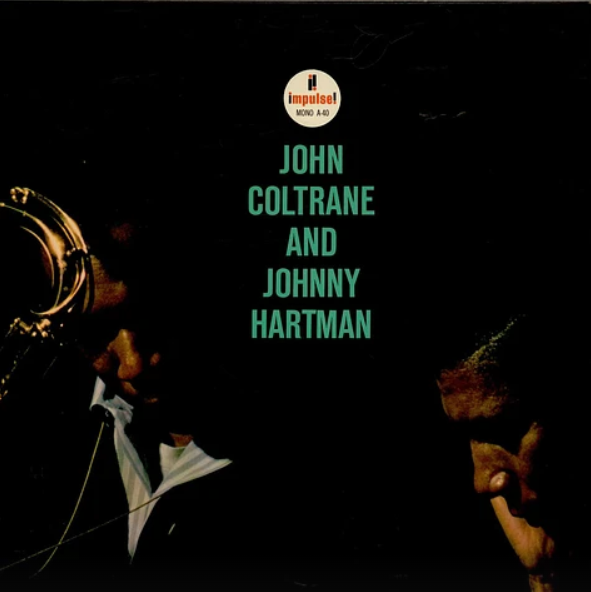
Coltrane and Hartman: Too Beautiful
by
4 responses
John Coltrane was born 100 years ago today. In 1963, he teamed with vocalist Johnny Hartman to record one of the great make-out albums of all time. According to Hartman, each of the songs was done in a single take, except “You Are Too Beautiful” – because Elvin Jones dropped a drumstick. But alternate takes have since come to light. Hey, when it comes to this album, I am willing to go with the legend. Originally, Coltrane wasn’t even on the track, allowing McCoy Tyner his moment to shine. The album was reissued with additional Coltrane obbligato on three of the songs. The enchantment is so powerful, it bends reality. I can’t listen to it without it taking me to some very wistful places.
Original versions of “My One and Only Love,” “Lush Life,” and “You Are Too Beautiful,” juxtaposed with reissues featuring more Trane
-
Welcome, Autumn!

by
3 responses
Happy first full day of autumn! It’s time to put another summer to bed.
Every September, I tell myself not to fear summer – I’m practically in the country now, with grass and fields and woods and open sky – but then the next summer rolls around, and again I am loathe to go outside, thanks to the ingrained terror of more than 30 years of blistering Philadelphia torment. I used to love summer when I was a kid. I never experienced a moment of dread anticipating the heat. I didn’t even look at the weather. If it got too hot, I played in the woods or went tubing, and at night I set up a box fan on a desk at the foot of my bed. Now, I basically hop from one air conditioned space to another – and I don’t like air conditioning either!
Ah, but next year will be different…
For now, it is the third week of September, and the most invigorating season is upon us! Autumn, soon to ripen on a vine of concerts and book sales and sweaters and hot drinks enjoyed outside, heavenly pie and black-and-white monster movies. The next two months are the high points of the year for me. Until Thanksgiving. Then it’s all downhill until January 2nd – at which point, I delude myself, things will be quiet again, and I can enjoy my solitary pursuits until spring. But there’s always something niggling in the atmosphere that tells me spring is coming, and the harbingers are invariably sooner than I anticipate. Spring announces itself early and then takes forever to get on with it. Eliot was right: April really is the cruelest month.
But enough of seasonal anxiety. For now, autumn is upon us! I think today I’ll dive right in and go for a morning walk in the woods, and then this afternoon I’ll make my first batch of vegetarian chili. I suppose, somewhere along the way, I’ll need to get some work done too. But the walk will help me think. If I’m not borne away by sprites!
-
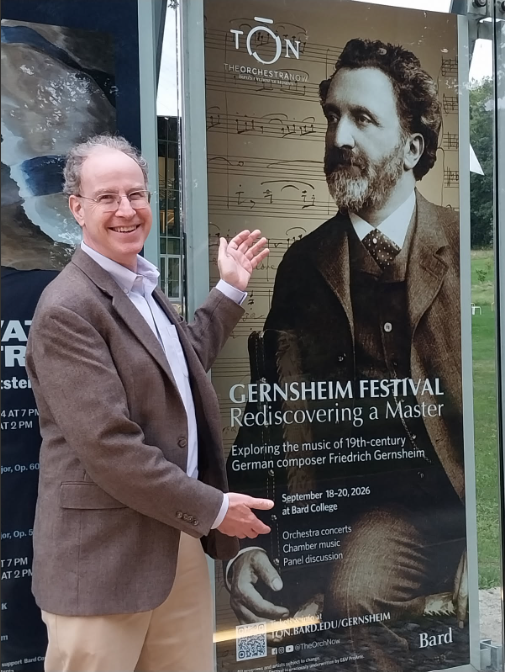
Friedrich Gernsheim, Brahms’ Brother from Another Mother
by
2 responses
If you ever wished Johannes Brahms had written more orchestral music, then Friedrich Gernsheim just might be the gift you’re looking for.
Gernsheim, who knew Brahms – the two respected one another and championed one another’s music – shared the master’s conservative, classical-Romantic outlook. Both artists favored traditional forms and structural rigor over a more subjective approach and the emotional extremes of the New German School. Yet Gernsheim remains all but unknown to most of Brahms’ admirers.
Bard College’s The Orchestra Now (TŌN) – a graduate training orchestra founded and conducted by Leon Botstein – is hoping to change all that by way of a three-year initiative to revive Gernsheim’s major works. Thanks to a grant from E&V ProArte, the first of TŌN’s Gernsheim festivals was held this past weekend. The three-day affair consisted of evening orchestral concerts at the Frank Gehry-designed Fisher Center at Bard, and afternoon chamber music concerts across campus in Olin Hall. There was also a scholarly panel held in Olin on Saturday morning.
While the festival was nowhere on the scale of its summertime flagship event, the Bard Music Festival – itself the crown jewel in the diadem of the college’s annual celebration of the arts, Bard SummerScape – it proudly extended the artistic mission of offering fine performances of worthwhile, though under-programmed, or even basically forgotten, music.
What’s more, you couldn’t beat the price: the panel and chamber concerts were presented free of charge (with the option of making a donation) and the seats for the orchestral concerts were very reasonable.
For me, it made the most sense to head up on Saturday, as the Friday night orchestral program was to be repeated. I could also take in a chamber concert and, if I could get myself moving, I might even catch the panel.
Well, I was too late to attend the 11 a.m. panel (hardly surprising, as I had a lot to do before I left, and I was coming from Princeton). I was genuinely sorry to miss it, since I always find what the scholars have to say informative, and this one included some real Gernsheim advocates. But I got there in plenty of time for the afternoon chamber program, for which there was unreserved seating. The turnout was okay, but it was by no means packed.
The program consisted of chamber music with piano. (Sunday afternoon’s concert would be devoted to chamber music for strings alone.) The Piano Quartet No. 3 in F major, Op. 47 (1883) was given its U.S. debut. The Piano Quintet No. 2 in B minor (1897) was heard for the first time in New York. Both pieces were performed with commitment and a striking level of maturity by TŌN musicians.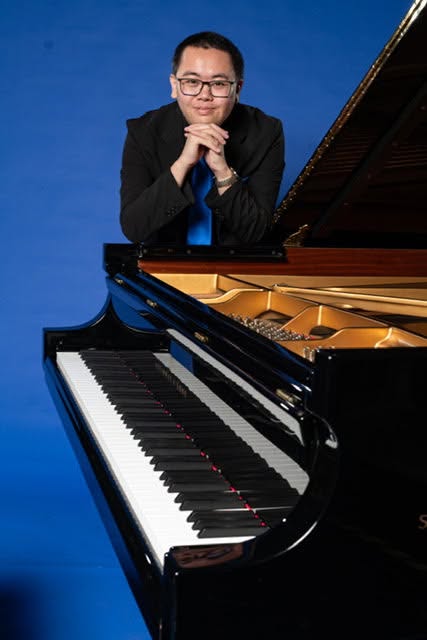
The pianist, Francis Chung-Yang Huang, deserves special mention, as he played throughout. The Quintet was almost like a reduction of a piano concerto. Altogether, the concert was a very pleasant experience. The music was well-crafted, full of long-limbed cantabile melodies, but also punched up with some energetic scherzandi. Violinists Carlos Torres and Jolin Yi-Lin Lin seemed to enjoy it too, as they exchanged smiles frequently during the Quintet.
As I say, the evening concert was a repeat of Friday. So I got to hear the U.S. premiere – or rather the second performance, since it was also done the night before – of Gernsheim’s Symphony No. 3 (1887), which bears the subtitle “Song of Miriam.” Gernsheim was inspired to write it after hearing a performance of Handel’s “Israel in Egypt.” It was a rare example of Gernsheim program music – music reflecting on extramusical matters – but the approach was definitely more Brahms than Liszt.
In fact, if there is any composer Gernsheim resembles, it’s Brahms! I would say he’s like Brahms’ more immoderate younger brother. You know, the black sheep who uses instruments like English horn, bass clarinet, and harp in his symphonies.
Because Gernsheim outlived Brahms (he died in 1916), he also tried his hand at a late Romantic tone poem, “Zu einem Drama” (“For a Drama”) – in this case, the drama unspecified – another piece of program music, which opened the concert. But again, next to Strauss, Mahler, and Schoenberg, it was pretty tame stuff. Imagine Brahms letting his hair down and using a tam-tam. Fun to listen to, but no masterwork.
In fact, for as much as his champions are no doubt hoping otherwise, I can’t imagine Gernsheim ever becoming standard repertoire. His music is well-crafted, dramatically persuasive, and often very beautiful (the second movement of the “Miriam” symphony is gorgeous), but again, he sounds too much like Brahms. That, more than any of the injustices the Nazis perpetrated against his music and reputation, is going to relegate him to, if not obscurity, then at least curiosity.
Of course, Gernsheim was long gone by the time Hitler came to power. There is nothing at all threateningly modernist about his music – like Brahms, Gernsheim is German classical-Romantic to his core – but he was Jewish and despised as such. Agenda deafened the Nazis to the evidence of their own ears.
It would have been instructive to hear Orion Weiss perform Brahms’ Piano Concerto No. 1 on the concert’s second half, but I had to slip out at intermission in order to get home at a reasonable hour. Hungry cats are angry cats, and as it was, I didn’t walk in the front door until 11:00.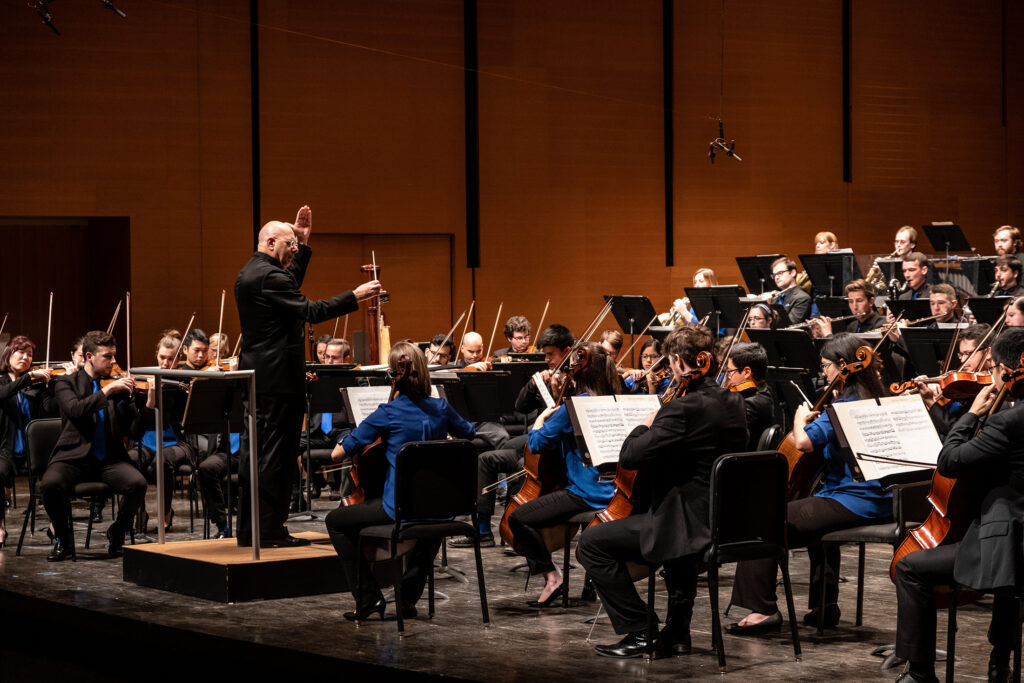
My summation of the day? In general, I found the chamber works to be more successful, in terms of not having Brahms ever before my ears. It was hardly unusual for anyone writing chamber music in the latter decades of the 19th century to have been influenced by him. But Gernsheim’s orchestrations of the symphonies are a step too far.
That’s not to say the music is bad – his symphonies easily surpass those of his nearest musical friend, Max Bruch, in terms of maintaining and rewarding interest – but there were moments in “Miriam” when I couldn’t help but smile (the hymn-like theme in the last movement, which could have been a sketch for the last movement of the Brahms’ First) and even laugh (the work’s coda, which was about as Brahms as anyone not Brahms could get).
I’m not trashing Gernsheim’s symphonies. If you’re a classical music lover and fond of the period, I definitely recommend them. They’ve been recorded, which is how I got to know them. But I can’t hear them as lost masterpieces. I would not sneer to encounter them on any orchestra program, and I look forward to whatever TŌN unearths for future festivals. But in Gernsheim’s case, I’m sorry to say, I think posterity got it right.
However, for anyone looking to add an element of surprise to their chamber music concerts, I would highly recommend checking out his piano quartet and quintet.
Thank you, TŌN, and I look forward to hearing more Gernsheim in the future!————-
The lovely second movement of Gernsheim’s Symphony No. 3, a musical response to the idea of Miriam, Moses’ sister, on the banks of the Nile on a summer night, confiding her sorrows and hopes to the stars.
The complete symphony, with more information in the write-up beneath the video.
Dave Hurwitz extols the virtues of Gernsheim
-
Ernest Cossart and a Tale of Two Holsts
by
8 responses
Composer Gustav Holst, best known for his symphonic suite “The Planets,” was not the only celebrity in the family. His younger brother, Emil, was an actor on stage and screen.
Both were born “von Holst.” Their father was of Swedish, Latvian, and German descent. Their great-grandfather had also been a composer, who taught harp at the Imperial Russian Court in St. Petersburg. Continuing in the family trade, their grandfather set up shop in England. In doing so, he added the “von,” thinking a little gravitas might help to drum up business. Sensibly, Gustav dropped the prefix with the outbreak of war with Germany in 1914. Emil took the stage name Ernest Cossart in 1896.
In Hollywood, Cossart was often typecast as butlers. Twice, he played a priest. He also played Pa Monahan in “Kings Row” (1942), with Ann Sheridan and Ronald Reagan, and Squire Brown in “Tom Brown’s School Days” (1940). You may also remember him as Ginger Rogers’ irascible father in “Kitty Foyle” (1940).
Here he is with the great character Edward Everett Horton in the Ernst Lubitsch’s “Angel” (1937).
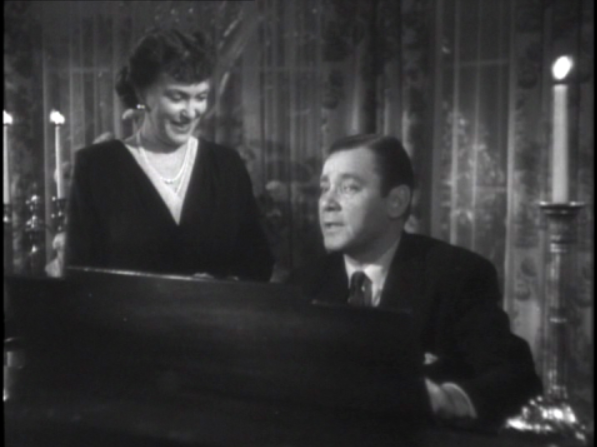
During World War II, Cossart joined Cedric Hardwicke, Basil Rathbone, and others in establishing a fund to help British artists in distress.The gentleman who hands off his hat and coat is Herbert Marshall, who starred in Lubitsch’s “Trouble in Paradise” (1932). A distant relative of Mary Shelley, Marshall lost a leg in the First World War after he was shot in the knee while serving on the Western Front. Determined to get back to the stage, he learned to walk with a prosthetic limb. This being a music page, you might be interested to know he played a blind composer in the film “The Enchanted Cottage” (1945), with Robert Young and Dorothy McGuire. His real-life handicap proved immaterial to the ladies, who were crazy about him. During the Second World War, he visited military hospitals to instill hope and give practical advise to those who were maimed during the conflict.
As a boy, Cossart (then still Emil von Holst) used to troll his brother by surreptitiously setting back the hands of the clock, prolonging Gustav’s dreaded violin practice. This did nothing to endear the instrument to the future composer. Gustav picked up the trombone at the age of 12.
Cossart died in New York City in 1951. He was 74 years old. Gustav died in 1934 at 59.
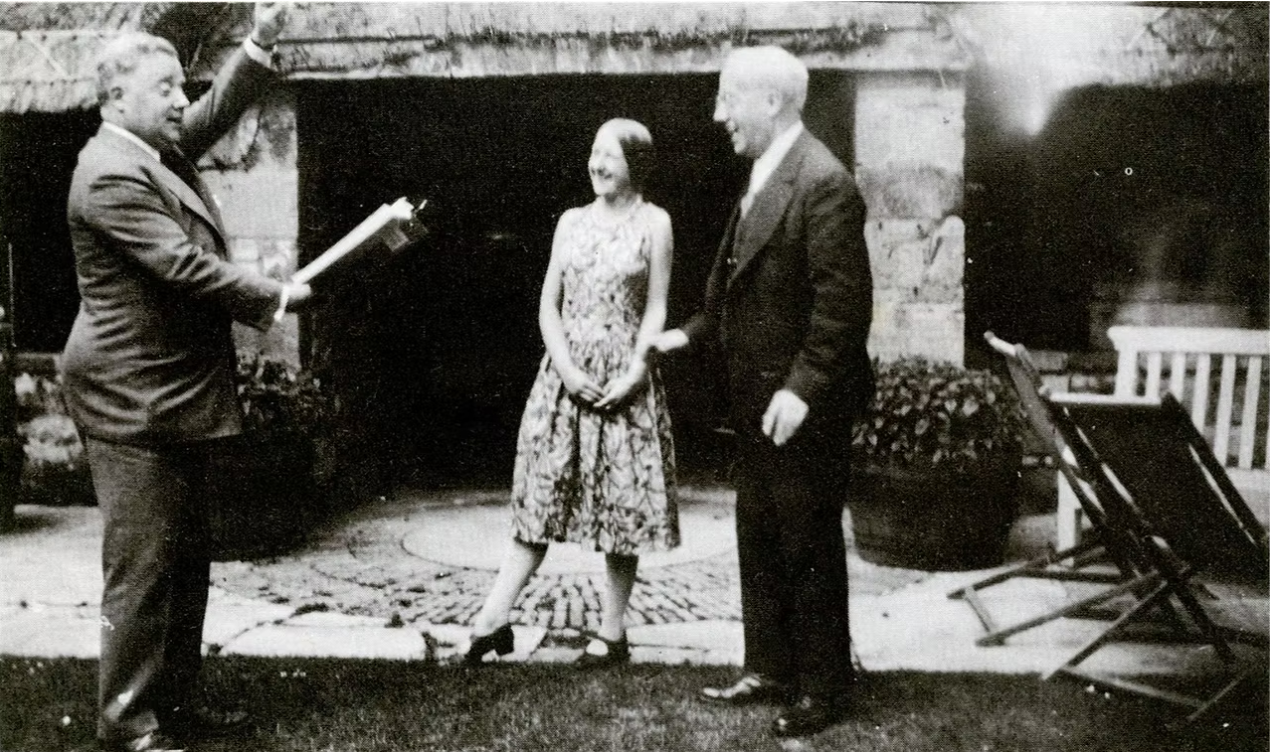
Here’s a candid photo of Cossart, left, with his niece, Imogen Holst, composer, conductor, and assistant to Benjamin Britten, and on the right, his brother, the famous composer Gustav Holst, whose birthday it is today.
Tag Cloud
Aaron Copland (94) Beethoven (95) Composer (114) Film Music (151) Film Score (143) Film Scores (255) Halloween (103) John Williams (198) KWAX (233) Leonard Bernstein (105) Marlboro Music Festival (125) Movie Music (166) Mozart (91) Opera (217) Philadelphia Orchestra (91) Picture Perfect (174) Princeton Symphony Orchestra (110) Radio (90) Ross Amico (244) Roy's Tie-Dye Sci-Fi Corner (290) The Classical Network (101) The Lost Chord (269) Vaughan Williams (107) WPRB (397) WWFM (881)
19 responses