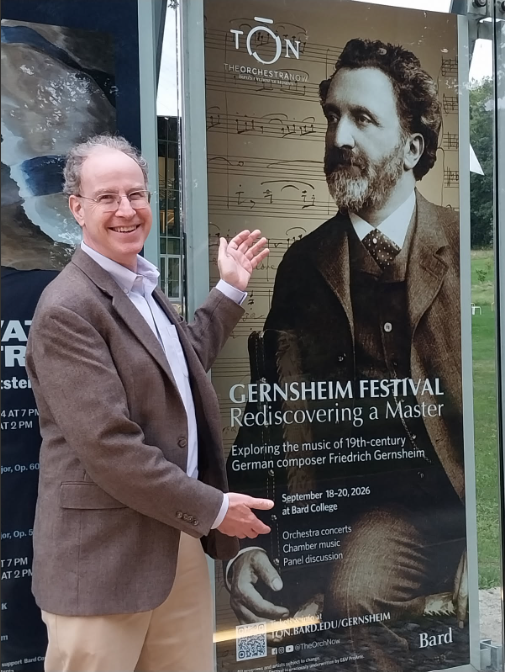
If you ever wished Johannes Brahms had written more orchestral music, then Friedrich Gernsheim just might be the gift you’re looking for.
Gernsheim, who knew Brahms – the two respected one another and championed one another’s music – shared the master’s conservative, classical-Romantic outlook. Both artists favored traditional forms and structural rigor over a more subjective approach and the emotional extremes of the New German School. Yet Gernsheim remains all but unknown to most of Brahms’ admirers.
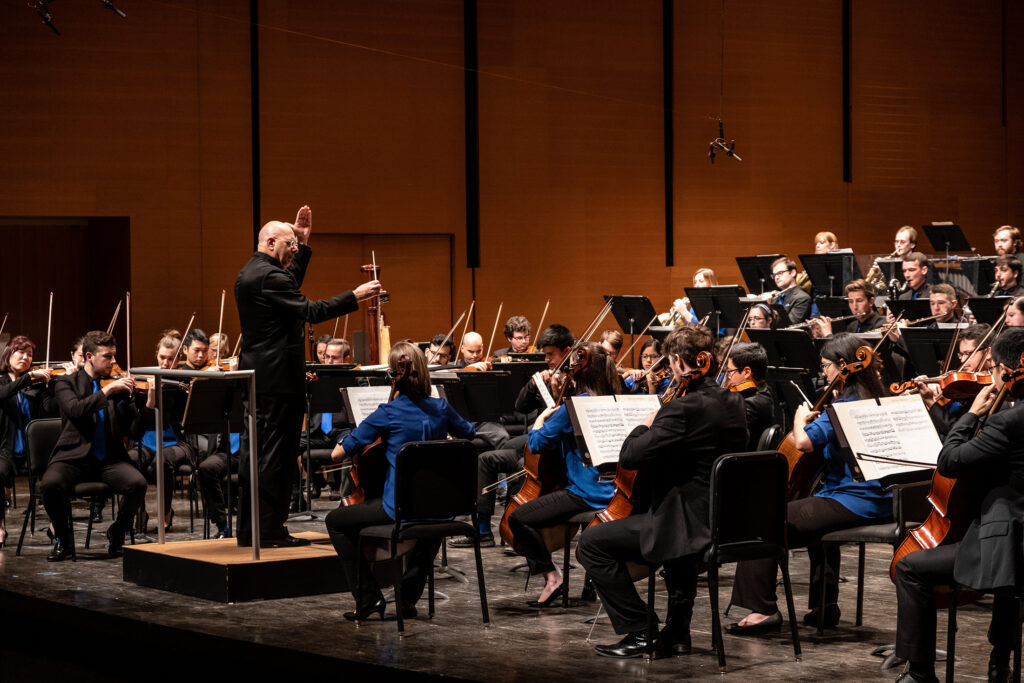
Bard College’s The Orchestra Now (TŌN) – a graduate training orchestra founded and conducted by Leon Botstein – is hoping to change all that by way of a three-year initiative to revive Gernsheim’s major works. Thanks to a grant from E&V ProArte, the first of TŌN’s Gernsheim festivals was held this past weekend. The three-day affair consisted of evening orchestral concerts at the Frank Gehry-designed Fisher Center at Bard, and afternoon chamber music concerts across campus in Olin Hall. There was also a scholarly panel held in Olin on Saturday morning.
While the festival was nowhere on the scale of its summertime flagship event, the Bard Music Festival – itself the crown jewel in the diadem of the college’s annual celebration of the arts, Bard SummerScape – it proudly extended the artistic mission of offering fine performances of worthwhile, though under-programmed, or even basically forgotten, music.
What’s more, you couldn’t beat the price: the panel and chamber concerts were presented free of charge (with the option of making a donation) and the seats for the orchestral concerts were very reasonable.
For me, it made the most sense to head up on Saturday, as the Friday night orchestral program was to be repeated. I could also take in a chamber concert and, if I could get myself moving, I might even catch the panel.
Well, I was too late to attend the 11 a.m. panel (hardly surprising, as I had a lot to do before I left, and I was coming from Princeton). I was genuinely sorry to miss it, since I always find what the scholars have to say informative, and this one included some real Gernsheim advocates. But I got there in plenty of time for the afternoon chamber program, for which there was unreserved seating. The turnout was okay, but it was by no means packed.
The program consisted of chamber music with piano. (Sunday afternoon’s concert would be devoted to chamber music for strings alone.) The Piano Quartet No. 3 in F major, Op. 47 (1883) was given its U.S. debut. The Piano Quintet No. 2 in B minor (1897) was heard for the first time in New York. Both pieces were performed with commitment and a striking level of maturity by TŌN musicians.
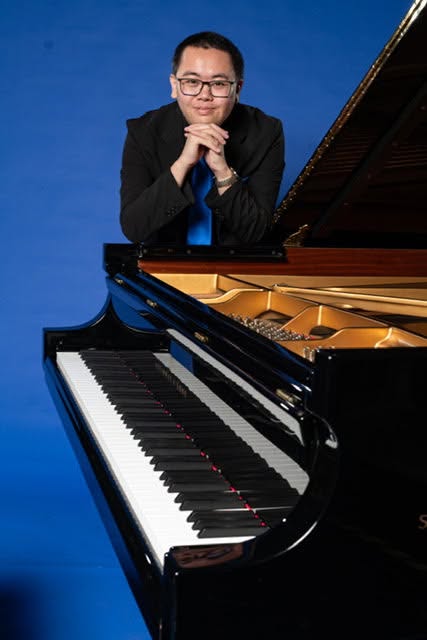
The pianist, Francis Chung-Yang Huang, deserves special mention, as he played throughout. The Quintet was almost like a reduction of a piano concerto. Altogether, the concert was a very pleasant experience. The music was well-crafted, full of long-limbed cantabile melodies, but also punched up with some energetic scherzandi. Violinists Carlos Torres and Jolin Yi-Lin Lin seemed to enjoy it too, as they exchanged smiles frequently during the Quintet.
As I say, the evening concert was a repeat of Friday. So I got to hear the U.S. premiere – or rather the second performance, since it was also done the night before – of Gernsheim’s Symphony No. 3 (1887), which bears the subtitle “Song of Miriam.” Gernsheim was inspired to write it after hearing a performance of Handel’s “Israel in Egypt.” It was a rare example of Gernsheim program music – music reflecting on extramusical matters – but the approach was definitely more Brahms than Liszt.
In fact, if there is any composer Gernsheim resembles, it’s Brahms! I would say he’s like Brahms’ more immoderate younger brother. You know, the black sheep who uses instruments like English horn, bass clarinet, and harp in his symphonies.
Because Gernsheim outlived Brahms (he died in 1916), he also tried his hand at a late Romantic tone poem, “Zu einem Drama” (“For a Drama”) – in this case, the drama unspecified – another piece of program music, which opened the concert. But again, next to Strauss, Mahler, and Schoenberg, it was pretty tame stuff. Imagine Brahms letting his hair down and using a tam-tam. Fun to listen to, but no masterwork.
In fact, for as much as his champions are no doubt hoping otherwise, I can’t imagine Gernsheim ever becoming standard repertoire. His music is well-crafted, dramatically persuasive, and often very beautiful (the second movement of the “Miriam” symphony is gorgeous), but again, he sounds too much like Brahms. That, more than any of the injustices the Nazis perpetrated against his music and reputation, is going to relegate him to, if not obscurity, then at least curiosity.
Of course, Gernsheim was long gone by the time Hitler came to power. There is nothing at all threateningly modernist about his music – like Brahms, Gernsheim is German classical-Romantic to his core – but he was Jewish and despised as such. Agenda deafened the Nazis to the evidence of their own ears.
It would have been instructive to hear Orion Weiss perform Brahms’ Piano Concerto No. 1 on the concert’s second half, but I had to slip out at intermission in order to get home at a reasonable hour. Hungry cats are angry cats, and as it was, I didn’t walk in the front door until 11:00.
My summation of the day? In general, I found the chamber works to be more successful, in terms of not having Brahms ever before my ears. It was hardly unusual for anyone writing chamber music in the latter decades of the 19th century to have been influenced by him. But Gernsheim’s orchestrations of the symphonies are a step too far.
That’s not to say the music is bad – his symphonies easily surpass those of his nearest musical friend, Max Bruch, in terms of maintaining and rewarding interest – but there were moments in “Miriam” when I couldn’t help but smile (the hymn-like theme in the last movement, which could have been a sketch for the last movement of the Brahms’ First) and even laugh (the work’s coda, which was about as Brahms as anyone not Brahms could get).
I’m not trashing Gernsheim’s symphonies. If you’re a classical music lover and fond of the period, I definitely recommend them. They’ve been recorded, which is how I got to know them. But I can’t hear them as lost masterpieces. I would not sneer to encounter them on any orchestra program, and I look forward to whatever TŌN unearths for future festivals. But in Gernsheim’s case, I’m sorry to say, I think posterity got it right.
However, for anyone looking to add an element of surprise to their chamber music concerts, I would highly recommend checking out his piano quartet and quintet.
Thank you, TŌN, and I look forward to hearing more Gernsheim in the future!
————-
The lovely second movement of Gernsheim’s Symphony No. 3, a musical response to the idea of Miriam, Moses’ sister, on the banks of the Nile on a summer night, confiding her sorrows and hopes to the stars.
The complete symphony, with more information in the write-up beneath the video.
Dave Hurwitz extols the virtues of Gernsheim
Leave a Reply