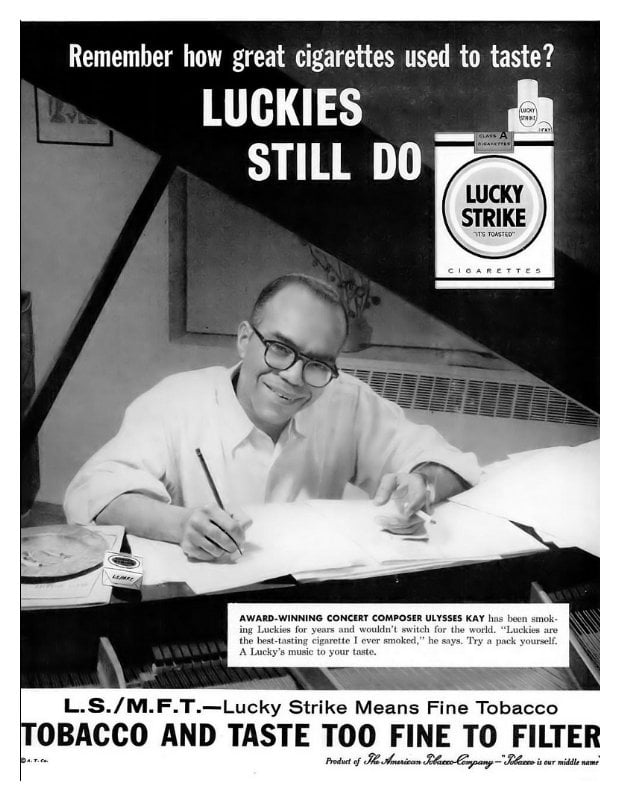
The time is ripe for the return of Ulysses.
In determining his life’s course, Ulysses Kay (1917-1995), received encouragement from his uncle, King Oliver, and William Grant Still. Among his teachers were Howard Hanson, Paul Hindemith, and Otto Luening. He also attended the American Academy in Rome.
A longtime resident of Teaneck, NJ, he composed music in all genres. This week on “The Lost Chord,” we’ll sample “Tromba” for trumpet and piano, his Concerto for Orchestra, a suite from the semi-documentary “The Quiet One,” and “Six Dances for String Orchestra.”
I hope you’ll join me for “Giving Kay His Say.” Ulysses strings his bow, on “The Lost Chord,” now in syndication on KWAX Classical Oregon!
———-
An interview with Kay conducted by Bruce Duffie:
http://www.bruceduffie.com/kay.html
———-
PHOTO: Kay gets Lucky!
Tag: American Music
-

Aaron Copland, on the 35th Anniversary of His Death
Aaron Copland died on this date in 1990. By that time, the grand old man of American music was deep in my heart. I can’t believe there was ever a time that I didn’t care for his cowboy ballets, but I didn’t like them when I first encountered them. Where was my soul?
Yeah, I liked “Appalachian Spring” and of course “Fanfare for the Common Man,” but it wasn’t until I left my small town for college in the big city that listening to Copland tore my heart out. In a good way. The man was the voice of an idealized America. 35 years later, I wonder if he still is?
Unquestionably, he was the most prominent and influential American classical music composer of his generation. He helped distill and elevate the variety and dynamism of our distinctly American idioms and for the first time place them on a competitive footing with most of what Europe had to offer.
He himself was quintessentially American. Born in Brooklyn in 1900 to hard-working Jewish immigrants, he lived through Tin Pan Alley and the Jazz Age, the Great Depression, and two world wars. In between, he studied in France, where he was exposed to and assimilated influences from the best of Europe. He experimented with modernist techniques, immersed himself in jazz and American folk song, and internalized the brave new world of serialism. Despite this restless curiosity, he never lost his own, distinctive voice.
I always marvel, when viewing documentaries about prominent figures who emerged from that era, at just how much people of Copland’s generation lived through. We see black and white photos of kids dressed like sailors or rolling hoops with sticks for entertainment – and then, decades later, here they were, in suit and tie, still walking among us. At least, that’s the way it was back then. In the 1980s, we were maybe 40 years from their most important achievements. Now we’re 40 years from the 1980s. Do younger people, in the field or otherwise, care anymore? Do they even remember?
1990 was a rough year for American music. Leonard Bernstein, who smoked too much, died in October at the age of 72. We had a good thing going here, in terms of building on what seemed to be a solid foundation for a domestic art music. Certainly artists continue to compose, but there doesn’t appear to be any centralized school of composition anymore. It’s a diverse country, so I suppose it was inevitable that our music would return to the eclecticism from which it emerged. Historical “lines” are often constructs anyway, as there is always significant activity going on outside the mainstream, beyond that which is endorsed by the establishment.
I love Copland, and he could be a generous man, but I can’t help but feel bad about his public humiliation of Alan Hovhaness. Hovhaness had received a scholarship to study at Tanglewood. It was in Bohuslav Martinů’s composition class that a record of Hovhaness’ “Exile Symphony” was played. The work, like much of Hovhaness’ music, is steeped in Eastern influences. The whole while, Copland was transparently disinterested, carrying on conversations in Spanish with his Latin American students. Afterward Bernstein mocked it at the piano, characterizing it as “ghetto music.” The comment, which was met with derisive laughter, was especially insensitive, as the work was Hovhaness’ response to the Armenian genocide. But none of us is perfect, and this was a rare lapse for Copland, who did so much to help so many.
Americans are still underrepresented on the podiums of this country’s major orchestras, and American music comprises the merest fraction of what is performed in our concert halls. Things are better for the living than for those of the “Greatest Generation.” It’s not uncommon for a new work to open a concert. But you’re not going to encounter too many full-length American symphonies on the second half of a program.
Contrast that with the American composers who came up during the Depression and were active at mid-century. Copland has certainly been luckier than most. We still encounter a number of the major works on concert programs, but these are selected largely from a narrow span of some 20 years, give or take, out of his overall output. And that’s probably about as good as it gets. But it’s not all that different from what we hear of most of the European masters. The same handful of works, played over and over. It’s a big deal if somebody programs a Haydn symphony that doesn’t bear a nickname.
On October 2, 1990, I remember listening to WFLN, Philadelphia’s (now-defunct) classical music station, which had been in existence since 1949 – the year Copland composed his Academy Award winning film score for “The Heiress.” My future WWFM colleague Bill Shedden came on that evening to share the sad news that Aaron Copland had died. It’s difficult to describe the emotions I felt, as Shedden broadcast, by way of memorial, Copland’s second set of “Old American Songs.” It was the classic recording with baritone William Warfield and the composer conducting. It was a beautiful choice. I remember regretting that I never wrote him – an actual letter, in those pre-internet days – to tell him just how much his music meant to me.
Anyway, it’s always been a part of me, and I am looking forward to the listening to the quixotic, 5-day, 41-hour marathon of his music coming up on Harvard’s radio station, WHRB, beginning at 1:00 this afternoon, EST. If you’d like to know more about it, I wrote about it yesterday. Here’s a link to the post.
https://rossamico.com/2025/12/01/fanfare-for-an-uncommon-copland-broadcast
Stream the signal at https://www.whrb.org/
And spread the word among your music-loving friends!
———-
PHOTO: Copland and Bernstein with the score to “El Salón México”
-

Turkey Day Thomson
It’s breakfast in bed for Virgil Thomson on his birthday.
Thomson was not only a composer, he was a writer on music, who wielded power of a kind unimaginable, in this day of eroded standards, as a critic at the New York Herald-Tribune.
Perhaps his brand of “faux-naïf” Americana is not for everyone. Still, it earned him a wide and enduring audience. His music for Robert Flaherty’s “Louisiana Story” (1948) remains the only film score ever to be awarded a Pulitzer Prize.
For Thomson’s birthday, here’s some music to get you in the mood for Thanksgiving.
His “Symphony on a Hymn Tune” was composed during his Paris years. Thomson, like Aaron Copland and so many others, studied in France with Nadia Boulanger. The symphony was inspired by the composer’s memories of his Kansas City boyhood. The “Sunday best” of the church hymns occasionally gets tangled up in a few modernistic burrs – the exchanges between the violin, cello, trombone, and piccolo at the end of the first movement, for instance – but in 1928, it was a landmark in terms of helping to establish a distinctly American idiom.More austere, perhaps, is Thomson’s symphonic poem “Pilgrims and Pioneers” – but just stick around for the fiddle tunes.
Finally, a seasonal work: the Concertino for Harp, Strings and Percussion, “Autumn” – according to Thomson, actually more of a “portrait of an artist ageing.”
Happy birthday, Virgil Thomson (1896-1989) – and Happy Thanksgiving!
———
PBS documentary on Thomson from 1986, for his 90th birthday – opening with “Symphony on a Hymn Tune”Thomson, sharp as a tack and full of personality, in this transcript of an interview from 1985 with radio host Bruce Duffie
https://www.bruceduffie.com/vt.html
———
PHOTO: Virgil Thomson, enjoying all his pleasures at once -
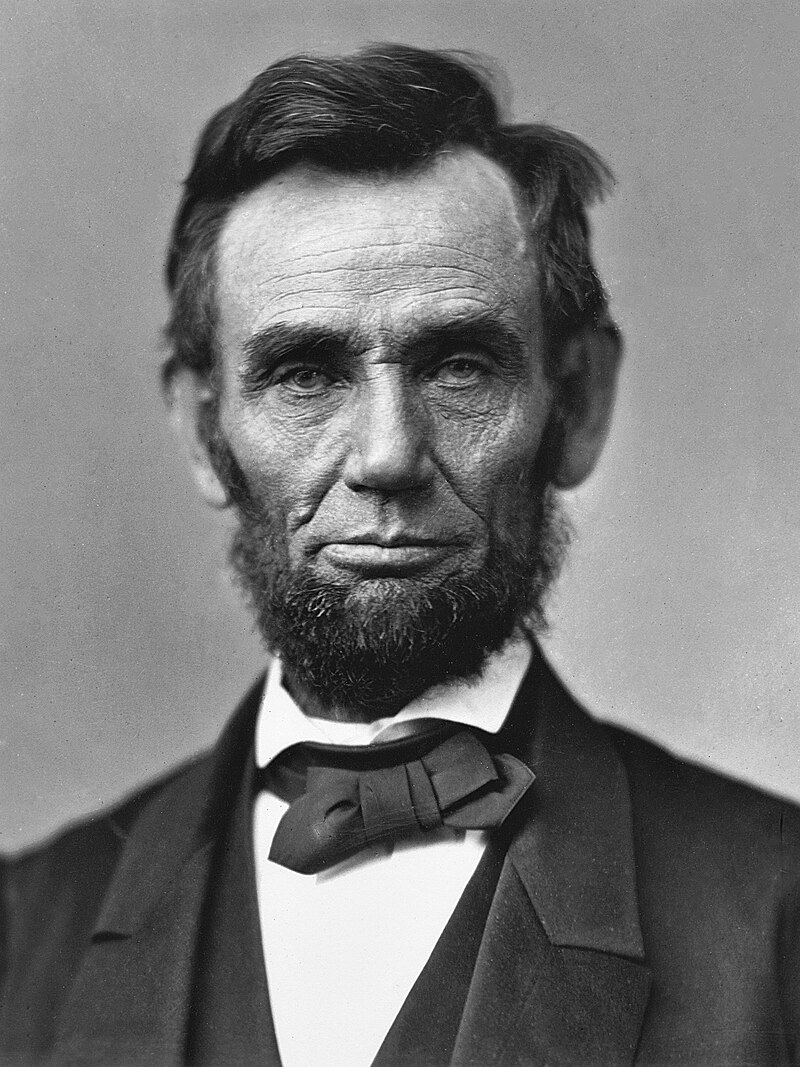
Lincoln’s Birthday Music and Legacy
Abraham Lincoln was born on this date in 1809. They sure don’t make ‘em like they used to.
James Earl Jones in Aaron Copland’s “Lincoln Portrait”
Roy Harris (born on this date in 1898), Symphony No. 6 “Gettysburg”
Paul Turok, “Variations on an American Song: Aspects of Lincoln and Liberty”
-

Labor Day Road Trip American Music
Labor Day weekend. Road trip!
This week on “The Lost Chord,” I hope you’ll join me for summer’s last hurrah, as we burn rubber with an hour of quintessentially American music about travel by car.
Frederick Shepherd Converse’s “Flivver Ten Million” celebrates the Ford Motor Company’s affordable assembly line automobile, from its creation in a Detroit factory to the manifest destiny of America’s roadways.
John Adams’ “Road Movies” has nothing to do with Bob Hope and Bing Crosby, alas; what it is, however, is a violin sonata written firmly within the American tradition, with a special affinity at its core with Copland’s Violin Sonata.
Virgil Thomson’s “Filling Station,” written for Leon Kirstein’s Ballet Caravan, may have the distinction of being the only ballet set at a gas station. The work’s success gave Copland the confidence to follow through on a Caravan commission which resulted in “Billy the Kid.”
Finally, we’ll hear one of Michael Daughtery’s most performed works, the exuberant “Route 66,” inspired by the storied “Main Street of America.”
Put the pedal to the metal. American composers hit the road for Labor Day, on “The Last Roads of Summer,” on “The Lost Chord, now in syndication on KWAX, the radio station of the University of Oregon!
Clip and save the start times for all three of my recorded shows:
PICTURE PERFECT, the movie music show – Friday at 8:00 PM EDT/5:00 PM PDT
SWEETNESS AND LIGHT, the light music program – ALL NEW! – Saturday at 11:00 AM EDT/8:00 AM PDT
THE LOST CHORD, unusual and neglected rep – Saturday at 7:00 PM EDT/4:00 PM PDT
Stream them, wherever you are, at the link!
Tag Cloud
Aaron Copland (94) Beethoven (95) Composer (114) Film Music (150) Film Score (143) Film Scores (255) Halloween (102) John Williams (198) KWAX (233) Leonard Bernstein (105) Marlboro Music Festival (125) Movie Music (165) Mozart (91) Opera (215) Philadelphia Orchestra (90) Picture Perfect (174) Princeton Symphony Orchestra (110) Radio (90) Ross Amico (244) Roy's Tie-Dye Sci-Fi Corner (290) The Classical Network (101) The Lost Chord (269) Vaughan Williams (107) WPRB (397) WWFM (881)