Even if we were to restrict ourselves to his achievements as a conductor, he was one of the very top interpreters of American music, Haydn, Schumann, Mahler, Nielsen, Shostakovich – on the evidence of his recordings, too many others to catalogue.
Here’s just an example of his artistry: in London, from 1966, Lenny captured in his prime, conducting Stravinsky’s primal “Le Sacre du printemps” (“The Rite of Spring”) – without a score.
At the end of the performance, the musicians refuse to rise, but only continue to applaud him from their seats.
An appropriately orgiastic salute to Leonard Bernstein on his birthday!
PHOTO: Bernstein’s magic elevator only goes in one direction: up!
Friday was the 150th anniversary of Serge Koussevitzky’s birth, but I had just finished recording one of my radio shows, and I couldn’t muster the energy and focus to post about it. Even a photo with a link to one of his recordings would have been something, albeit inadequate in proportion to his significance as one of the great champions of modern music and, more specifically, American music.
It’s been calculated that, between 1924 and 1944, Koussevitzky presented 162 American works, 66 of which were world premieres. On his Concerts Koussevitzky, conducted in Paris in the 1920s, he also introduced Ravel’s enduring orchestration of Mussorgsky’s “Pictures at an Exhibition” and Honegger’s “Pacific 231.” As music director of the Boston Symphony Orchestra, he gave first performances of Bartók’s Concerto for Orchestra and Copland’s “Appalachian Spring” suite.
“Kouss” was in on the ground floor at Tanglewood. He mentored Leonard Bernstein and others. When his wife, Nadia, died, he set up the Koussevitzky Music Foundation in her memory, to support and promote living composers. Early Foundation commissions yielded Britten’s “Peter Grimes” and Messiaen’s “Turangalîla-Symphonie.”
Kouss began his career as a double-bassist and blossomed into one of the most important conductors of the 20th century. I was remiss in not acknowledging him on his birthday anniversary. Mea culpa, and happy 150, Serge Koussevitzky!
First recording of “Pictures at an Exhibition”
Broadcast premiere of Bartók’s Concerto for Orchestra (with the original wet-noodle ending, soon to be revised by the composer)
Live performance of Sibelius’ Symphony No. 7
Roy Harris’ Symphony No. 3
Tchaikovsky’s Symphony No. 5
Rehearsing the BSO in Rimsky-Korsakov’s “Scheherazade”
Filmed performance of Randall Thompson’s “The Last Words of David”
Playing the slow movement of his Double-Bass Concerto, with piano
10-minute documentary, “The Story of Tanglewood” (1949)
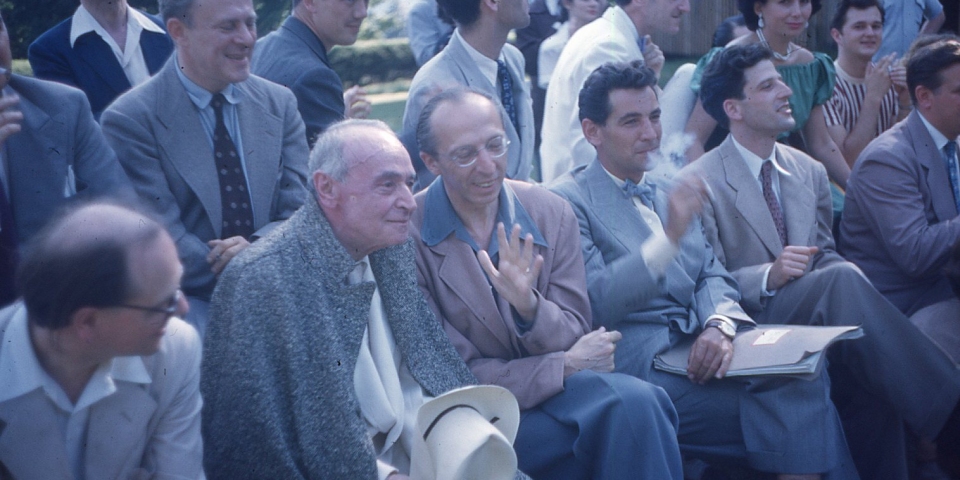
Serge Koussevitzky, holding hat, with (left to right) Olivier Messiaen, Aaron Copland, Leonard Bernstein (lighting up), and Lukas Foss at Tanglewood in 1949 (photo by Ruth Orkin)
Victor Herbert died 100 years ago today. Although perhaps we don’t hear very much of his music now, unless you’re a nostalgia buff with a sweet-tooth like mine, audiences of our grandmothers’ and great-grandmother’s generations were crazy for him. My grandmother was always singing his stuff. He was simply part of the cultural consciousness, as were the operettas of Gilbert & Sullivan. You didn’t have to love them (in the case of G&S, I did and I do), but everyone knew them.
And of course there were film adaptations of Herbert’s musicals, which, as they slipped further out of fashion, were ripe for parody. Haha, look at Nelson Eddy, singing this fruity song…!
But guess what? There’s a reason this stuff resonated the way it did. Herbert was a master of his craft and finely attuned to the tastes of his public. Even on those occasions when he displayed more ambition, he never did come across as “putting on airs.”
Born on the island of Guernsey in 1859, Herbert was told by his mother that he was born in Dublin – no doubt because of complications surrounding his parentage (apparently he was conceived out of wedlock) – and Herbert believed it for the rest of his life. He spent his early years in the home of his grandfather, Irish novelist and poet Samuel Lover. This ensured his continued affinity for Irish lore and culture.
When his mother remarried, Herbert followed her to Germany. His stepfather was a physician, and Herbert himself seemed destined for a medical career. But medical studies were expensive, so, possibly recollecting the colorful visitors of his grandfather’s circle, he decided to take up music instead.
The cello was his instrument. He performed in a number of orchestras, including that of Eduard Strauss, and he was selected by Johannes Brahms to play in a chamber orchestra for a concert celebrating the life and career of Franz Liszt. In meantime, he had begun to compose.
He married the soprano Therese Förster, and when she was invited to join the Metropolitan Opera in New York City, Herbert followed her to the United States. Förster, singing in German, became the Met’s first “Aida.” Anton Seidl conducted. Seidl would become an important mentor, fostering Herbert’s interest in conducting. In 1888, Herbert was installed as Seidl’s assistant conductor with the New York Philharmonic for its summer season at Brighton Beach. In 1898, he became principal conductor of the Pittsburgh Symphony Orchestra.
In the meantime, he continued to compose concertos, works for chorus and orchestra, symphonic poems, and lighter music. He was acutely aware of the importance of being properly compensated for his work. He became an activist for composers’ rights, testifying before Congress and influencing the development of the Copyright Act of 1909. This allowed composers to collect royalties for sound recordings. As a founding member of ASCAP (in 1914), and its director until his death in 1924, he also brought a landmark lawsuit before the U.S. Supreme Court, securing the right for composers to charge fees for public performance of their music.
Herbert composed two grand operas. One of them, “Natoma” (set in Santa Barbara, California, in 1820), allowed him to fabricate both Native American and Spanish motifs. The work was given its first performance in Philadelphia (by the Chicago Grand Opera Company) in 1911, with Mary Garden (Debussy’s Melisande) and John McCormack as the leads.
Here, the great Risë Stevens sings some of it.
The other opera, a one-acter called “Madeleine,” received its premiere at the Met in 1914.
But it was with his operettas that he struck gold. He would write 43 in all, beginning in the 1890s. By World War I, detecting Americans’ shifting tastes, he shrewdly transitioned to musical comedies. Composers like Irving Berlin and Jerome Kern would ask him to write ballet music for their shows, and he was a regular contributor to the Ziegfeld Follies.
After his death, the tiniest selection of his concert works may have lingered in a dusty corner of the repertoire, but beginning with the compact disc era, a few of these began to experience a resurgence. While Herbert was enormously successful as a musical theater composer, his most enduring contribution to the concert hall has proved to be his Cello Concerto No. 2.
Herbert was serving on the faculty of the National Conservatory of Music in New York at the time that Antonin Dvořák was its director. It’s said that Dvořák was not overly-fond of the cello as an instrument. It was a performance of Herbert’s dramatic piece that caused the scales to drop from his eyes, and Dvořák was spurred to compose his own masterful Cello Concerto in B minor, which remains the benchmark for all performers on the instrument and for any composer with the hubris to attempt their own.
Dvořák, of course, was the spiritual godfather of American music, advising our native artists to look no further than their own soil for inspiration, specifically to the music of Black and Native Americans. He led by example in writing works like his own “New World” Symphony. Victor Herbert was principal cello in the New York Philharmonic for the work’s world premiere at Carnegie Hall in 1893.
Rest well, Victor Herbert. Your music may have inspired snickers of derision from those of us who found fun in the treasures of our forebears, but in the end, you have the last laugh on us all.
Victor Herbert, Cello Concerto No. 2
For this holiday weekend, here’s Herbert wrapping himself in the flag as proudly as any American native-born. Be sure to read the comments under the video, as they offer some interesting insights into the recording.
Undeniably, Herbert had his vulgar streak, but I must too, because I can’t help but love his “Irish Rhapsody.”
Jeanette MacDonald sings “Ah! Sweet Mystery of Life” from “Naughty Marietta” (ruined forever by “Young Frankenstein”)
Madeline Kahn sings it, without the assistance of “the Monster”
Given the Ernie Kovacs treatment
Beverly Sills and Sherill Milnes sing “Thine Alone” from “Eileen”
Mario!
“March of the Toys” from “Babes in Toyland,” given the Laurel and Hardy treatment
The most widely-recognized of American classics? Perhaps. Next to “Fanfare for the Common Man” and “The Stars and Stripes Forever,” I can think of few others. George Gershwin’s “Rhapsody in Blue” is 100 today.
I once heard it performed on a New Year’s Day concert in Milan. As late as the mid ‘90s, it seemed European musicians still hadn’t acquired that innate ability to swing. But the world’s a lot smaller place now, and they seem to have gotten it.
Here’s the first recording, with Gershwin at the piano and Paul Whiteman conducting. The work is abridged and played a little faster than we’re accustomed to hearing today, in large part to be able to fit it onto two sides of a 12-inch 78 rpm record.
The first recording I acquired, on LP, was with Leonard Bernstein as conductor and pianist with the New York Philharmonic, made for Columbia Records in 1964. The performance really is more expansive than most. As the years went by, I enjoyed hearing different takes on the piece, some of them attempting to recreate its original jazz band debut.
The work has been dismissed by cognoscenti as corny. In 1934, composer Constant Lambert derided it as “neither good jazz nor good Liszt.” As recently as two weeks ago, the New York Times ran an article under the title “The Worst Masterpiece,” with pianist Ethan Iverson making a straw man argument that Duke Ellington was a more important composer. Of course the “Rhapsody” is not true jazz, any more than Brahms’ Hungarian riffs could be construed as authentic Hungarian music. But it is 100 percent American.
“Rhapsody in Blue” is one of those rare pieces of classical music whose appeal transcends genre. I have an uncle, who is by no means a classical music person, who is obsessed with the work. It’s a crowd-pleaser, and deservedly so. If anything, its winning combination of optimism, energy, and naiveté reminds us of America’s “better angels” (a phrase I borrow from Lincoln on his birthday). The work is as refreshing now as it ever was, even if, one hundred years on, it seems more and more like a distant dream. It’s still a dream to be celebrated.
Bernstein, 1964
Bernstein live, 1976
Michael Tilson Thomas’ quite different conception
Incorporating Gershwin’s 1925 piano roll
Peter Nero and the Philly Pops at Independence Hall
In Woody Allen’s “Manhattan”
Paul Whiteman, who conducted the premiere of “Rhapsody in Blue,” introduces and leads it here, beginning at the 51-minute mark (with interlude for “voodoo drums???”) in the insane, pre-Code curio, “King of Jazz” (1930). Just don’t watch it too close to bed!
Live footage of Gershwin playing “I Got Rhythm” in 1931
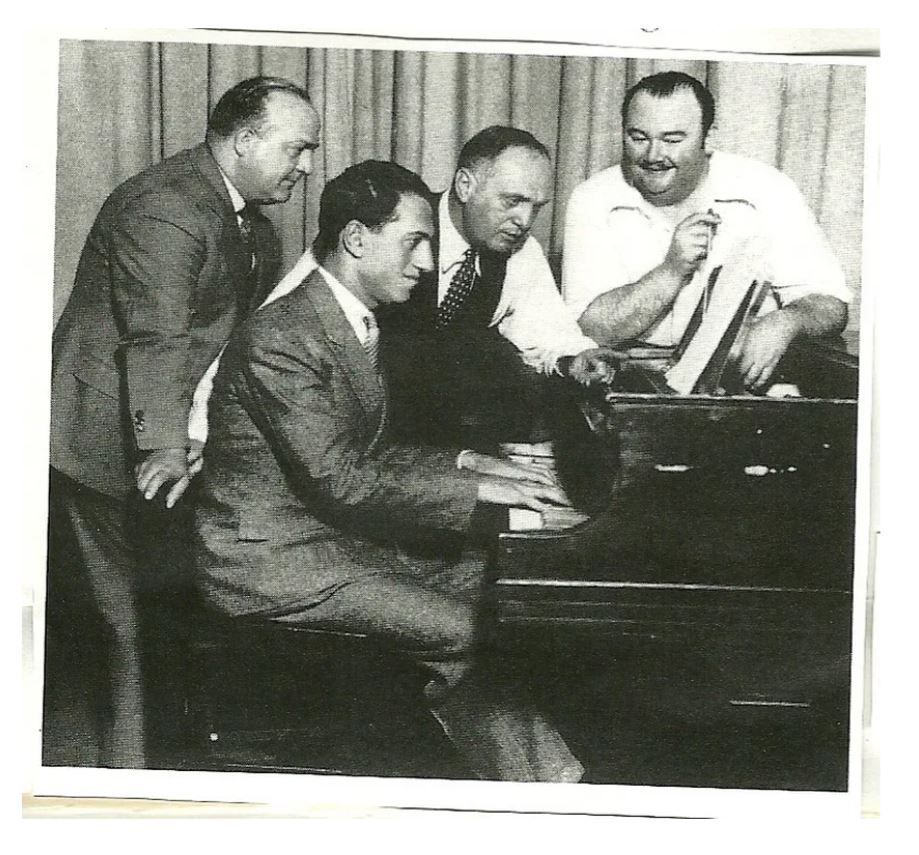
PHOTO: (left to right) Ferde Grofé, Whiteman’s orchestrator and later composer of the “Grand Canyon Suite;” Gershwin at the piano; theatrical impresario Samuel “Roxy” Rothafel; and Whiteman, with his baton
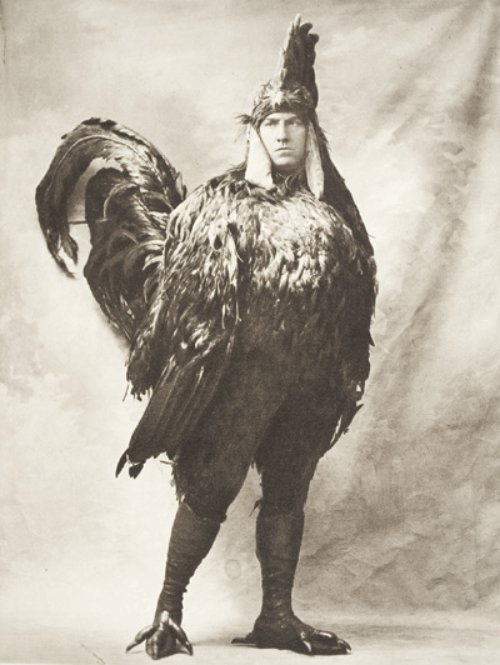
“I do not propose to write an ode to dejection, but to brag as lustily as Chanticleer in the morning, standing on his roost, if only to wake my neighbors up.” So wrote Henry David Thoreau in his preface to “Walden” (now on my bedstand, just in time for the season of consumerism run amuck).
The quote serves as a superscription for Daniel Gregory Mason’s “Chanticleer Festival Overture.” Mason was born in Brookline, MA, on this date 150 years ago. His father was Henry Mason, cofounder of the Mason & Hamlin piano company, and his grandfather was Lowell Mason, composer of some 1600 hymn tunes, including “Nearer, My God, to Thee.”
Daniel studied theory and composition at Harvard under John Knowles Paine, continuing his lessons with George Whitefield Chadwick and others. He became a writer on music and a lecturer at Columbia University. After 1907, his compositional output increased. He acquired further polish in Paris, studying with Vincent d’Indy, in 1913.
Of course, 1913 was the year that Stravinsky’s “The Rite of Spring” shook the musical world, but Mason remained resistant to its charms. Instead, he continued to create cocooned in a Romantic sensibility, and a rather conservative one.
In his way, he sought to increase respect for American music, incorporating indigenous and popular themes into a number of his works, urging native composers to stop imitating European models (though he himself evidently admired the Austro-German canon), and criticizing European conductors working in the U.S. for not including American works on their programs. On the other hand, he wasn’t overly happy with George Gershwin or Aaron Copland, nor was he thrilled by jazz or the influence of Stravinsky.
In common with many of his time, Mason held some complicated views. He publicly condemned anti-Semitism and embraced what were then described as Negro spirituals. However, he was pretty firm in his belief that American culture should be “Anglo-Saxon,” and went a little overboard in expressing his xenophobia, to the extent that he felt compelled to write an apology in the New York Times in 1933, stating that he had been misinterpreted and clarifying that he was opposed to “jingoism and Hitlerian nationalism.”
Mason was a man of contradictions, to be sure. Among his writings are 18 books on music, so there is certainly plenty to sift through. One can only imagine what he made of American music at the time of his death in 1953.
Mason’s “Chanticleer Festival Overture” dates from 1926. Gershwin’s “Rhapsody in Blue” was composed in 1924, and Copland’s jazz-inflected “Music for the Theater” appeared in 1925.
“All climates agree with brave Chanticleer. He is more indigenous even than the natives. His health is ever good, his lungs are sound, his spirits never flag.”
Mason’s own music is now virtually forgotten. But it is not without its charms. His Thoreau-derived rooster portrait is still something to crow about. A tip of the cockscomb to Daniel Gregory Mason on his sesquicentennial.
Symphony No. 3 “Lincoln,” conducted by Sir John Barbirolli
String Quartet in G minor on Negro Themes
“Variations on Yankee Doodle in the Styles of Various Composers”