
Tag: Beethoven

  • Beethoven at Marlboro Music Festival

    Beethoven at Marlboro Music Festival

    On this week’s “Music from Marlboro, we’ll hear Beethoven, early and late (maybe), performed by Marlboro artistic directors, past and present.

    It is clear from the Quintet for Piano and Winds, Op. 16, that Beethoven was an admirer of Mozart. The work, written when the composer was in his mid-20s, is evidently modeled on Mozart’s K. 452, scored for the same instrumental combination. It’s even written in the same key (E-flat).

    Beethoven’s Quintet will be performed at the 2012 Marlboro Music Festival by pianist Jonathan Biss, oboist Mary Lynch, clarinetist Tibi Cziger, hornist Wei-Ping Chou, and bassoonist Natalya Rose Vrbsky. Biss was appointed co-artistic director of the school and festival, joining Mitsuko Uchida, in 2018.

    When exactly did Beethoven composer his “Kakadu Variations?” The last of his piano trios was published in 1824. However, the first full manuscript dates from 1816. It’s possible its genesis lay even a good deal earlier than that. Was it a slip when Beethoven wrote to his brother and described the piece as having been composed in 1803? Or on another occasion, when he described it as “among my early works?”

    In any case, it’s thought that the piece underwent substantial revisions. In 1824, Beethoven was churning out masterpiece after masterpiece, including the “Diabelli Variations,” the “Missa solemnis,” and the Ninth Symphony.

    It is curious that the trio opens with such protracted air of solemnity, given its source material. The work’s Papageno-like theme is borrowed from the song “Ich bin der Schneider Kakadu” (“I am Kakadu the tailor”), from Wenzel Müller’s 1794 singspiel “Die Schwestern von Prag” (“The Sisters from Prague”). Müller’s opera had been revived in Vienna in 1814.

    The trunk of Beethoven’s trio is full of whimsy, a series of variations on Müller’s theme. Toward the end, however, the work slips back into a minor key and begins to take on renewed gravitas. The final variation exhibits on an unexpected depth, rigor and maturity, as Müller’s ditty is subjected to an incongruous display of chromatic and contrapuntal complexity.

    We’ll hear the “Kakadu Variations” performed by pianist Rudolf Serkin, violinist Yuzuko Horigome, and cellist Peter Wiley, who played the work at Marlboro in 1983. Serkin, of course, was Marlboro’s founding artistic director, from 1951.

    You can’t beat Beethoven. The composer takes wing, on the next “Music from Marlboro,” this Wednesday evening at 6:00 EST, on WWFM – The Classical Network and wwfm.org.

    Marlboro School of Music and Festival: Official Page
  • Leppard Remembered Rorem Celebrated on WWFM

    Leppard Remembered Rorem Celebrated on WWFM

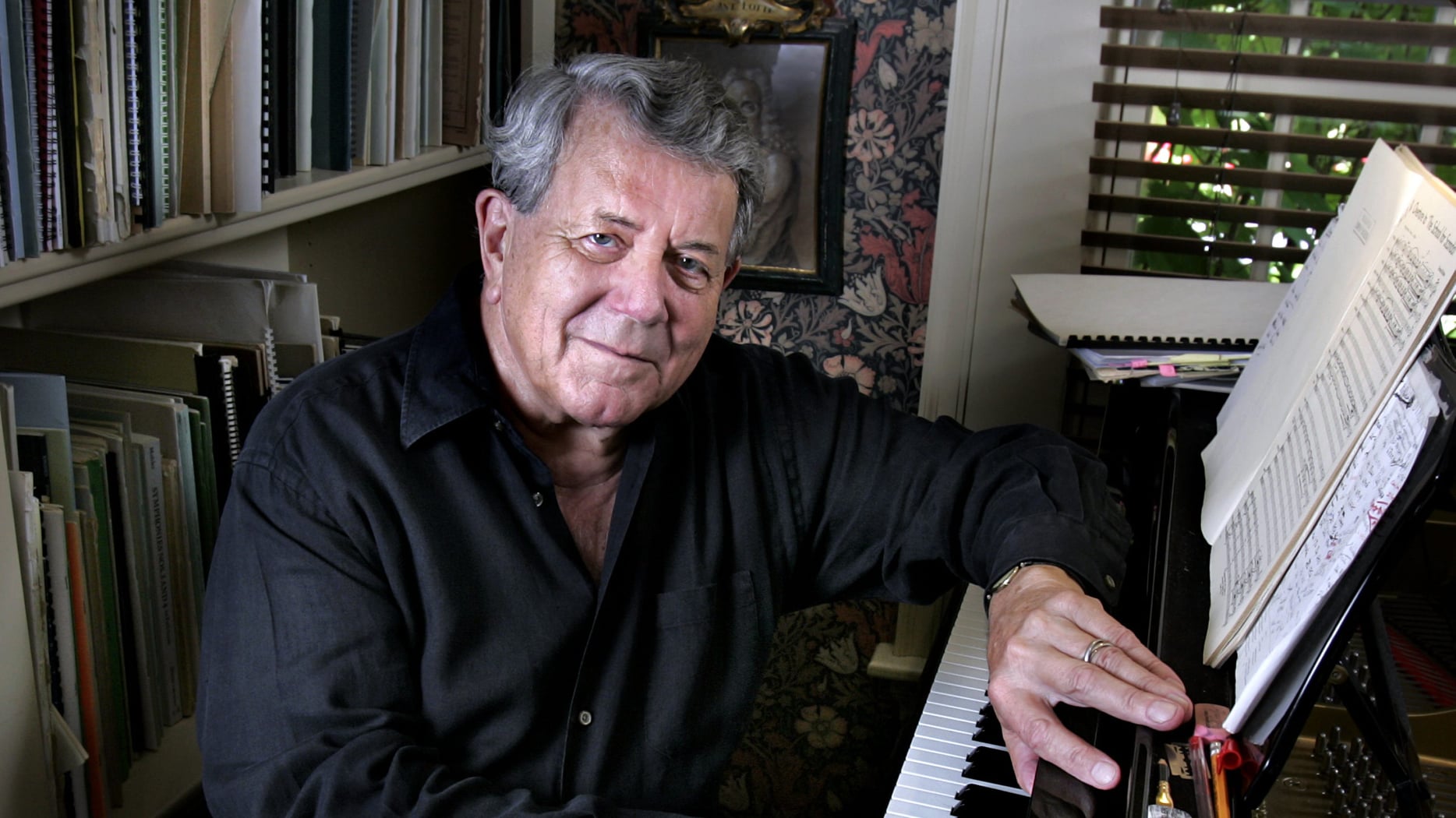
    Coming up, between 4 and 6 p.m., we remember conductor Raymond Leppard (top), who died yesterday at the age of 92, and celebrate composer Ned Rorem, who is 96 years-old today.

    At 6:00, it’s “haunting” music Beethoven and Henri Dutilleux (including Beethoven’s “Ghost” Trio), on “Music from Marlboro.”

    Plenty to raise your spirits, from 4 to 7 p.m. EDT, on WWFM – The Classical Network.

  • Halloween Music Beethoven’s Ghost Trio & Dutilleux

    Halloween Music Beethoven’s Ghost Trio & Dutilleux

    Halloween is only eight days away. On this week’s “Music from Marlboro” we’ll get into the spirit with some ghostly utterances by Beethoven and Henri Dutilleux.

    Beethoven had already been dead for fifteen years at the time his star pupil, Carl Czerny, remarked that the slow movement of one of the piano trios reminded him of Banquo’s ghost. It turns out, Czerny may not have been all that far off the mark.

    In 1808, while Beethoven was at work on his Piano Trio in D major, Op. 70, No.1, he was actually contemplating writing an opera on the subject of Macbeth. The words “Macbett” and “Ende” were scrawled near sketches for the Largo in one of his notebooks. Some scholars speculate that the composer may have been working out ideas for a projected scene with the three witches.

    The mood is certainly ominous, heightened by eerie and mournful passages, sudden pauses and outbursts, and a kind of ghostly tremolo. Beethoven would abandon the opera, when his librettist, Heinrich Joseph von Collin (to whom he had dedicated the “Coriolan Overture”), begged off the project, thinking it too dark.

    Allegedly, the “Ghost Trio” contains the slowest of all slow movements in Beethoven’s output. By some standards, it might also be said to be the most impressionistic. All the more appropriate, then, that we hear it coupled with Dutilleux’s “Ainsi la nuit” (“Thus the Night”).

    Dutilleux’s seven-movement string quartet, meticulously crafted between 1973 and 1976, has often been described as Impressionist. However, subjectively speaking, it must be Impressionism by way of Guillermo del Toro. Let’s face it, folks, masterpiece or no, this “Night” can be a little creepy.

    Dutilleux claimed he wrote the work after coming off intensive studies of the scores of Bartók, Webern, and yes, Beethoven. I think he may have been hitting the cheese plate a little too close to bed time.

    We’ll hear a performance from the 2001 Marlboro Music Festival, with violinists Joseph Lin and Harumi Rhodes, violist Richard O’Neill, and cellist Marcy Rosen.

    Beethoven’s “Ghost Trio” was performed in 2015, by pianist Dénes Várjon, violinist Michelle Ross, and cellist Brook Speltz, on tour in Washington, DC.

    The first of this season’s Marlboro tours is already underway. Remaining performances will take place tonight, at the Perleman Theater in the Kimmel Center for the Performing Arts in Philadelphia; tomorrow, at the Freer Gallery’s Meyer Auditorium in D.C.; and Sunday, at Longy School of Music in Boston. On the program are works by Mozart, Beethoven and Brett Dean. For more information, visit marlboromusic.org.

    Then join me for an hour of weird music and uncanny performances on the next “Music from Marlboro,” this Wednesday evening at 6:00 EDT, on WWFM – The Classical Network and wwfm.org.

    Marlboro School of Music and Festival: Official Page

  • Marlboro Music Change Beethoven Tchaikovsky Sextets

    Marlboro Music Change Beethoven Tchaikovsky Sextets

    MAY I HAVE YOUR ATTENTION, PLEASE!

    Last minute programming change for this week’s “Music from Marlboro:”

    Due to circumstances beyond our control, we will not be able to bring you Brahms’ Piano Quintet in F minor, as previously announced. In its place, we’ll lose ourselves in wild abandon over Beethoven’s Sextet for Winds in E-flat major, Op. 71, and Tchaikovsky’s Sextet for Strings in D minor, “Souvenir de Florence.”

    I hope you’ll join me for the joy of sextets on the next “Music from Marlboro,” this Wednesday evening at 6:00 EDT, on WWFM – The Classical Network and wwfm.org.

    Marlboro School of Music and Festival: Official Page

  • Beethoven Birthday Bash on Music from Marlboro

    Beethoven Birthday Bash on Music from Marlboro

    I’m staring at a pile of musical birthday gifts for Claudio Monteverdi, Michael Balfe, Nikolai Tcherepnin, Lars-Erik Larsson, Arthur Berger, and John Lanchbery. That’s an awful lot of wrapping for any classical music host. I hope you’ll be on hand to reap the benefits, as I’ll be jumping out of a cake repeatedly from 4 to 6 p.m. EDT.

    Then, at the end of a long day of picking scotch tape off my fingers, there really is only one remedy. On this week’s “Music from Marlboro,” it will be an all-Beethoven affair.

    Beethoven’s Piano Trio in B-flat major, Op. 97, known as the “Archduke,” was one of 14 works the composer wrote for his friend and patron Archduke Rudolf of Austria. Rudolf, an amateur pianist, was the youngest child of Holy Roman Emperor Leopold II.

    Beethoven himself appeared at the keyboard at the work’s premiere in 1814. His encroaching deafness so diminished his former prowess as a performer that he retired from concertizing after a repeat performance a few weeks later. The violinist and composer Louis Spohr summed up the discomfiture and pity felt by those in attendance, by stating, “I am deeply saddened by so hard a fate.”

    The music remains unbowed. Today, the “Archduke” Trio is as noble and inspiring as ever.

    We’ll hear it performed at the 2006 Marlboro Music Festival by pianist and Marlboro co-artistic director Mitsuko Uchida, violinist Soovin Kim, and cellist David Soyer of the legendary Guarneri Quartet.

    Also on the program will be a performance of Beethoven’s “Three Marches for Piano Four Hands,” a remarkable collaboration between an 87 year-old Mieczyslaw Horszowski and an 18 year-old Cecile Licad.

    There are plenty of gifted composers, but it’s hard to beat Beethoven. Beethoven takes the cake, on the next “Music from Marlboro,” this Wednesday evening at 6:00 EDT, on WWFM – The Classical Network and wwfm.org.

    Marlboro School of Music and Festival: Official Page
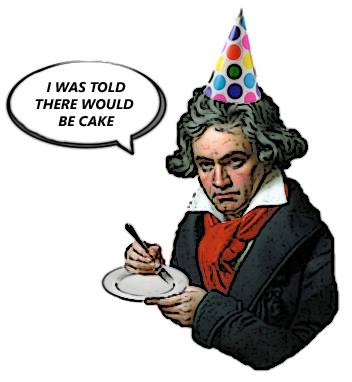

    Beethoven, ready to celebrate his unbirthday

Tag Cloud

Aaron Copland (92) Beethoven (95) Composer (114) Film Music (123) Film Score (143) Film Scores (255) Halloween (94) John Williams (187) KWAX (229) Leonard Bernstein (101) Marlboro Music Festival (125) Movie Music (138) Opera (202) Philadelphia Orchestra (89) Picture Perfect (174) Princeton Symphony Orchestra (106) Radio (87) Ralph Vaughan Williams (85) Ross Amico (244) Roy's Tie-Dye Sci-Fi Corner (290) The Classical Network (101) The Lost Chord (268) Vaughan Williams (103) WPRB (396) WWFM (881)

DON’T MISS A BEAT

Receive a weekly digest every Sunday at noon by signing up here


RECENT POSTS