Tag: Composer

  • Leo Smit Philadelphia Composer Centennial

    Leo Smit Philadelphia Composer Centennial

    Leo Smit was born in Philadelphia 100 years ago today.

    Not to be confused with the Dutch composer of the same name (born in 1900), Smit was the son of Russian immigrants. His father was a violinist who performed with Leopold Stokowski in Philadelphia, Fritz Reiner in Cincinnati, and Arturo Toscanini in New York (with the NBC Symphony).

    A child prodigy, Leo took to the piano by the age of 5. When he was about 8, his mother took him to Moscow, where he studied for a year with composer Dmitri Kabalevsky.

    Back home, he was accepted into the Curtis Institute of Music. He was taught there by Isabella Vengerova. Vengerova was a Leschetizky pupil. Her other students included Gary Graffman, Gilbert Kalish, Leonard Pennario, Menahem Pressler, and Abbey Simon.

    Smit also learned from José Iturbi, the Spanish conductor, pianist, and harpsichordist, who achieved wider recognition in Hollywood films of the 1940s. Iturbi stood in for Cornel Wilde on the soundtrack to the Chopin biopic “A Song to Remember.”

    He received further instruction in composition from Nicolas Nabokov, who was the first cousin of Vladimir Nabokov.

    At 15 or 16, Smit became a rehearsal pianist for George Balanchine. He first worked with Igor Stravinsky while preparing for the world premiere of “Jeu de Cartes.” He was a devoted champion of the music of Aaron Copland, all of whose works for the keyboard he recorded. He once had the opportunity to play privately for Béla Bartók, for whom he turned pages at Carnegie Hall. Following the Carnegie concert, Copland introduced him to Leonard Bernstein. Smit also did much to revive the reputation of boogie-woogie master Pete Johnson.

    In 1951, the Boston Symphony Orchestra performed Smit’s First Symphony. He also composed two operas, “The Alchemy of Love,” on a libretto by British astronomer Fred Hoyle (who also provided the text for an oratorio about Copernicus), and “Magic Water.” Among his other compositions was a collection of 100 songs after poems of Emily Dickinson. His works were programmed by Bernstein, Stokowski, and Serge Koussevitzky.

    For three decades, he made his home in Buffalo, where he served on the faculty of the State University of New York. Earlier, he taught at Sarah Lawrence College and the University of California. As a photographer, he captured images of some of the era’s most notable musicians. He sometimes performed recitals to curated slide shows of his work.

    Smit died in 1999 at the age of 78.

    Leo Smit, Symphony No. 1:

    Interesting interview with Bruce Duffie, including a great recollection of Stravinsky:

    http://www.bruceduffie.com/leosmit.html

    Smit speaks with David Dubal, now host of WWFM – The Classical Network’s “The Piano Mattters”:

    Smit and Copland play “Danzon Cubano,” in its original two-piano version:


    PHOTO: Smit (standing), with Copland and Bernstein, photobombed by some guy in a hair helmet
  • Celebrating 9 Decades of David Amram

    Celebrating 9 Decades of David Amram

    Celebrate nine decades of David Amram.

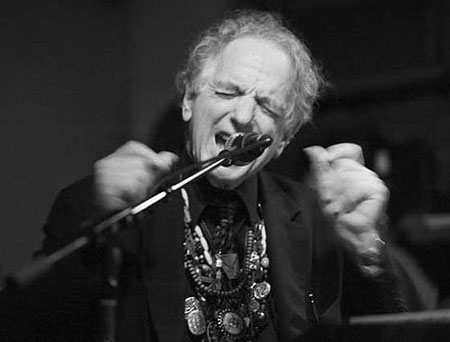
    Amram, born in Philadelphia on this date in 1930, has always been equally at home in classical music, jazz, folk, and world music. The composer of over 100 orchestral and chamber works, music for Broadway and film (including the scores for “Splendor in the Grass” and “The Manchurian Candidate”), and two operas, he’s also the author of three books: “Vibrations: The Adventures and Musical Times of David Amram” (1968), “Offbeat: Collaborating with Kerouac” (2002), and “Upbeat: Nine Lives of a Musical Cat” (2007).l;

    Amram was raised on a farm in Bucks County. There, he was introduced to classical, jazz, and cantorial music by his father and uncle. He took piano lessons and experimented with instruments of the brass family, finally settling on the French horn. Following a year at Oberlin, he lit out for George Washington University, where he studied history. While there, he performed as a freelance hornist with the National Symphony. He also studied privately with two musicians in the orchestra.

    Amram became a pioneer of the jazz French horn, as well as the New York Philharmonic’s first composer-in-residence (designated as such in 1966). He’s worked with artists ranging from Dizzy Gillespie to Bob Dylan to Leonard Bernstein, from Jack Kerouac to Arthur Miller, from Christopher Plummer to Johnny Depp. He’s a musician without boundaries, who has always been open to new experiences.

    And he’s still going strong. He was to have appeared with his quintet in Marlboro, NY, today to celebrate his 90th birthday, the first such event of 13 scheduled to take place in the U.S. and abroad. However, like everything else, the celebration has been postponed because of the virus.

    In the meantime, he is participating in a free weekly Zoom series, on which he’s been reading from his book, “Offbeat: Collaborating with Jack Kerouac.” More information is posted on his website, davidamram.com.

    A note on today’s calendar listing, about the postponed concert, suggests an alternative mode of celebration: “Write him a note, call him or best of all, he requests that you send him an ESP thought-wave-o-gram, be creative yourself and look forward to the new vaccine and new administration making us all healthier than ever in the next year!!!”

    Working on my ESP thought-wave-o-gram now. Happy birthday, David Amram!


    Trailer for “David Amram: The First 80 Years”:

    Amram Horn Concerto:

    Amram with Dizzy Gillespie:

    Amram jamming at the Philadelphia Folk Festival in 2011:

  • Sir Malcolm Arnold: Genius & Demons

    Sir Malcolm Arnold: Genius & Demons

    “…[T]hou was a skellum,
    A blethering, blustering, drunken blellum;
    That frae November till October,
    Ae market-dae thou was na sober.”

    Rabbie Burns wrote those lines of Tam O’Shanter. But they could just as well have applied to Sir Malcolm Arnold. Both men were, more or less, fond of the bottle and also driven by demons.

    Arnold was born on this date in 1921. He started out as a trumpeter with the London Philharmonic Orchestra. He became its principal in 1943.

    During World War II, Arnold registered as a conscientious objector. However, following the death of his brother, a pilot in the RAF, he decided to enlist. At least for a time. Though he never saw action beyond a military band, he quite literally shot himself in the foot in order to get back to civilian life.

    In 1948, he retired from orchestral playing to devote himself exclusively to composition. He had an attractive melodic gift, which served him well in the writing of light music and film scores. He won an Academy Award in 1957 for his work on “The Bridge on the River Kwai.”

    However, Arnold also had his dark side, as can be detected in passages of his symphonies. He was frequently cantankerous, often inebriated, and also highly promiscuous. He tried to kill himself at least twice. He was treated for depression and alcoholism, overcoming both, but then in the early 1980s he was given only a year to live. In the event, he actually lasted another 22, during which he completed his Symphony No. 9, among other works.

    Arnold died in 2006, one month shy of his 85th birthday. He was a brilliant composer, of great facility. After Malcolm Williamson was named Master of the Queen’s Music in 1975, Sir William Walton remarked that they had given the job to the “wrong Malcolm.” For a man with so many personal demons, he wrote reams of perfectly delightful music.

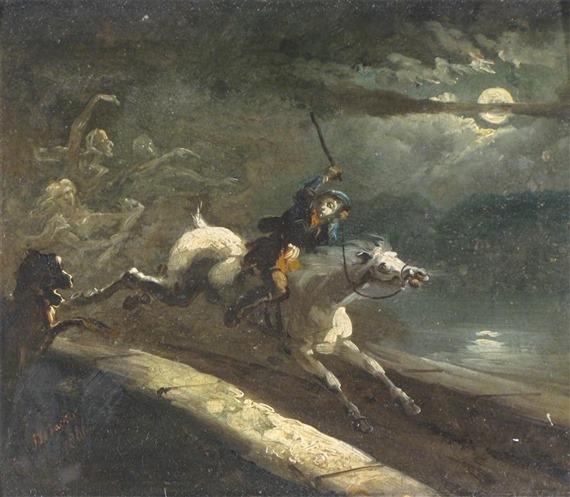
    A good example, and one of my favorite Halloween pieces, is the descriptive overture “Tam O’Shanter” (1955), in which Burns’ antihero tarries at a pub, in defiance of his wife, then staggers out into the night. Under ominous skies, he detects the sound of bagpipes emanating from the ruins of an old church. Pressing his face to chink he espies “Auld Nick,” the Devil himself, “in shape o’ beast,” presiding over a coven of high-stepping witches and warlocks. When a particularly comely witch catches Tam’s eye, he, in his drunkenness, roars, “Weel done, Cutty-sark!” (in reference to her short skirt). This brings the forces of darkness down up him, and there is a hell-for-leather sprint by horseback for a nearby river, since spirits are said not be able to cross running water.

    If you’re interested in the rest, you can read for yourself here:
    http://loki.stockton.edu/~kinsellt/litresources/ayr/tam.html

    Then listen to Arnold’s musical response:

    And for a bonus, enjoy his “Four Scottish Dances” (1957):

    Happy birthday, Sir Malcolm Arnold, you tormented genius.


    “Tam O’Shanter Fleeing the Witches” (1866), by John Joseph Barker

  • Happy Birthday Lenny Bernstein Candide Lives

    Happy Birthday Lenny Bernstein Candide Lives

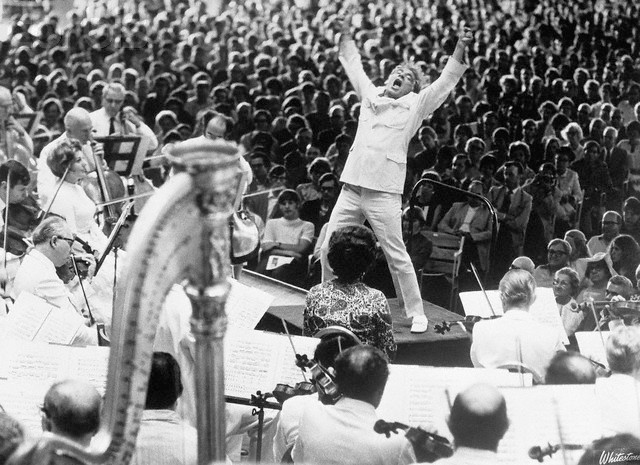
    Happy birthday, Lenny!

    Leonard Bernstein has seen the future… and it is YES.

    When Lenny and “Candide” were still young:

  • Rediscovering Glazunov’s Genius

    Rediscovering Glazunov’s Genius

    Okay, I admit it, I have a sweet tooth. And perhaps, at a time when I have no intention of getting a haircut, much less going to the dentist, that predilection could cost me. But damn it, here it is, dental health to the dogs: I do like the music of Alexander Glazunov!

    Glazunov is one of those composers I’ve always felt a little sheepish about liking. I remember sitting at a listening bar at a record shop in Philadelphia and asking to preview a recording of Glazunov ballet music. “I know I’m not supposed to like this stuff,” I offered, apologetically.

    Admittedly, at the time, other than the Violin Concerto, I didn’t really know a lot of great recordings of his music. I found the Marco Polo releases that I had heard, with the Hong Kong Philharmonic, to be underwhelming, and these prejudiced me against the composer for years. But Neeme Järvi’s performances on Chandos were revelatory. Then of course I eventually got my hands on the Melodiya issues with Gennady Rozhdestvensky and Evgeny Svetlanov. I know it’s going to make somebody cry to read this, but I currently have in my collection four complete cycles of Glazunov’s symphonies. Not even I know how that happened.

    Okay, so he isn’t Beethoven. Who is? But at his best, his music is well-crafted, attractive (to me, anyway), and marked by an abundance of memorable melodies that would make any honest composer jealous.

    As a person, he was not without his faults. He had a real problem with alcohol, which may have contributed to his disastrous performance as conductor at the premiere of Rachmaninoff’s First Symphony, a real train-wreck that elicited a savage review from Cesar Cui and plunged the younger composer into creative paralysis.

    But Glazunov was also generous, almost to a fault. As director of the Petrograd Conservatory, he was in a position to pull strings so that a young Dmitri Shostakovich didn’t have to deal with preparatory theory and instead could plunge right into the business of composition.

    Also, after the death of Alexander Borodin, Glazunov stepped up (with Rimsky-Korsakov) to help complete Borodin’s unfinished masterpiece, the opera “Prince Igor.” Legend has it that he wrote out the overture from memory, having heard Borodin play through it a couple of times on the piano.

    So maybe you don’t want this guy on the podium during a performance of your music, but put him on a piano bench with a bottle of vodka, and you’re in good hands.

    Glazunov’s own music can be full of serene lyricism, generously melodic, and, yes, often quite beautiful.

    Happy birthday, Alexander Glazunov! You won’t catch me going to a custard stand during COVID, but surely this is the next best thing.


    Symphony No. 4

    String Quintet in A major

    Violin Concerto

    The symphonic poem “Stenka Razin”

    “Raymonda” (selections)
    https://www.youtube.com/watch?v=nAs9mcGhtgg

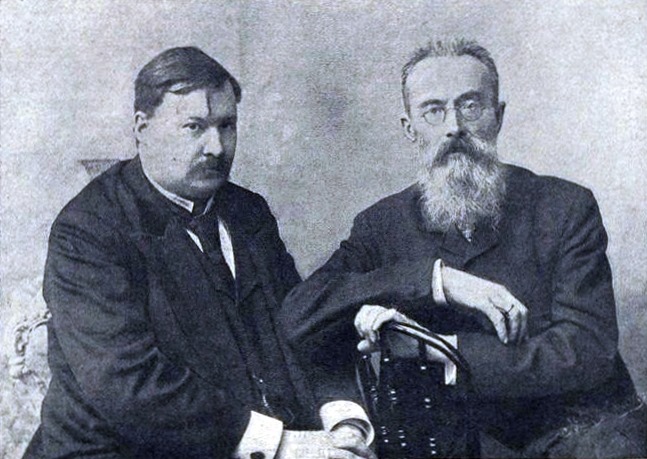
    PHOTO: Glazunov (left), hanging out with Rimsky-Korsakov

Tag Cloud

Aaron Copland (92) Beethoven (95) Composer (114) Film Music (123) Film Score (143) Film Scores (255) Halloween (94) John Williams (187) KWAX (229) Leonard Bernstein (101) Marlboro Music Festival (125) Movie Music (138) Opera (202) Philadelphia Orchestra (89) Picture Perfect (174) Princeton Symphony Orchestra (106) Radio (87) Ralph Vaughan Williams (85) Ross Amico (244) Roy's Tie-Dye Sci-Fi Corner (290) The Classical Network (101) The Lost Chord (268) Vaughan Williams (103) WPRB (396) WWFM (881)

DON’T MISS A BEAT

Receive a weekly digest every Sunday at noon by signing up here


RECENT POSTS