Composer Nancy Bloomer Deussen has died at the age of 88, and for the second time in two years, there are murmurs about an illegitimate child of George Gershwin. Deussen’s mother, Julia Van Norman, was exceptionally close with Gershwin, perhaps closer than the Gershwin estate would have liked.
For her part, Deussen never wished to exploit her possible kinship to promote her own music, so perhaps it’s a disservice to her memory to even mention it. I only do so, because still fresh in the memory is the death last year of Alan Gershwin, who always insisted he was George’s son.
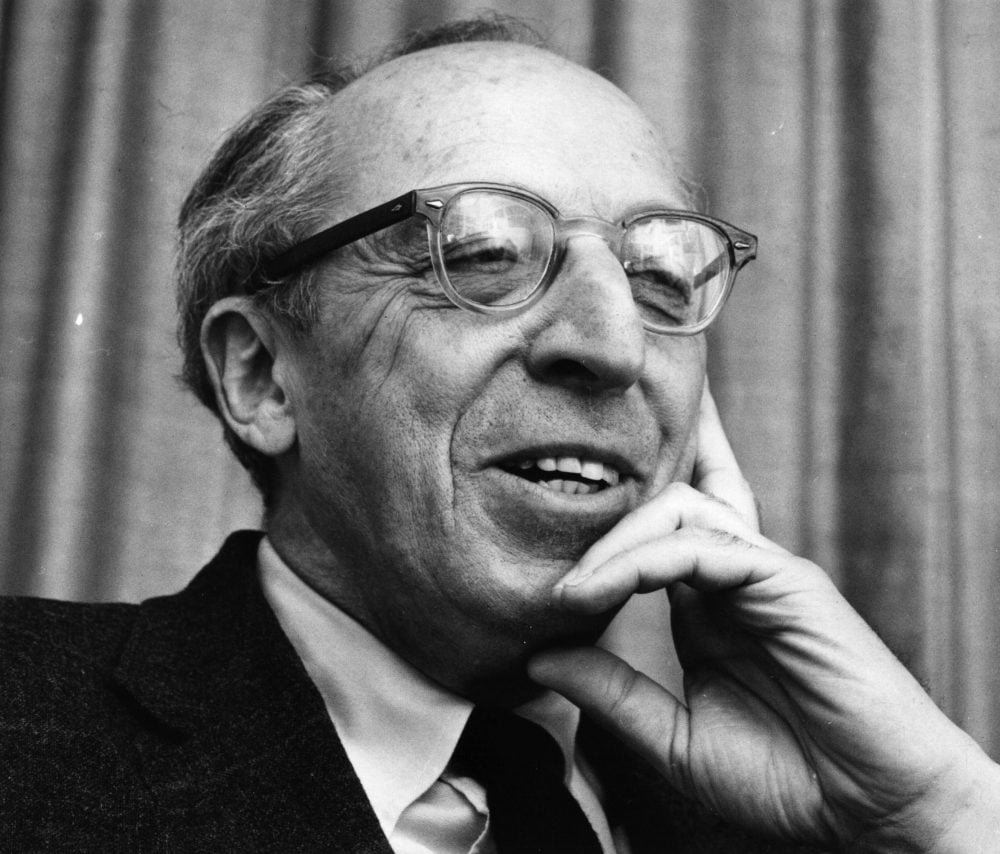
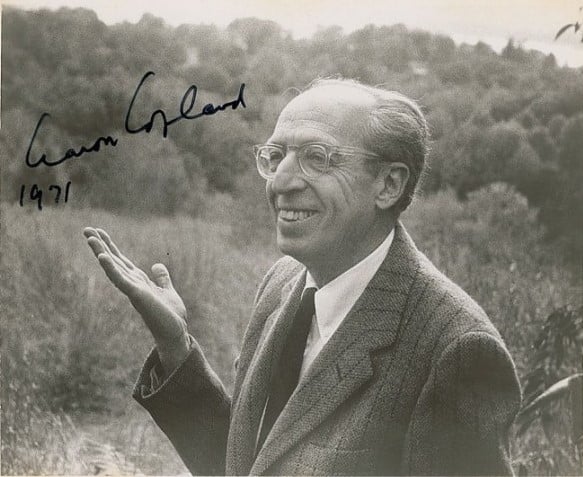
I am so happy to rediscover this 30-minute documentary on Aaron Copland. I remember watching it years ago. What an exciting time for American music – and for America – to say nothing of the arts in general. Not that American music does not remain vital. But Copland seems to be the last man standing, in terms of the active repertoire, of that great generation. To catch a Roy Harris or a William Schuman symphony in concert is very rare indeed.
It is the fate of even the greatest composers to be remembered through but a handful of pieces, usually from a particular phase of his or her career. In Copland’s case, it’s pretty much the cowboy music. Some people love it; some are put off by it. Cowboys aren’t exactly “in” right now, and when someone hears “I Ride an Old Paint,” they may not trouble themselves to look beyond the trappings.
But nearly everything Copland wrote is worth hearing – and I’ve heard most of it – even the misfires. Once you get to know him, his sound is immediately identifiable in anything he touched. He had vision, he had craft, and he had integrity.
I love this man, and I love his music, and I love what he did for music. Would that we had someone of his caliber today. Happy birthday, Aaron Copland.
Whose name is more fun to say, Unico Wilhelm van Wassenaer or Carl Ditters von Dittersdorf?
Wassenaer (1692-1766), the Dutch nobleman who composed his six “Concerti Armonici” on a whim, refused to have them published, until a couple of his friends twisted his arm. Wassenaer would condone it, barely, but only if his name was in no way connected with the material. Instead, the concertos would be attributed to violinist Carlo Ricciotti, who played in their first private performance, and dedicated to Wassenaer’s friend, Count Willem Bentick. A rumor circulate that the collection was actually the work of Giovanni Pergolesi, which is why, in 1920, a movement of the Concerto Armonico No. 2 wound up being used in Stravinsky’s ballet “Pulcinella” (allegedly on Pergolesi themes).
Here’s how it sounds in the original:
“…[T]hese concertos were published against my wishes,” Wassenaer wrote. “Some of them are tolerable, some middling, others wretched. Had they not been published, I would perhaps have corrected the mistakes in them, but other business has left me no leisure to amuse myself with them, and I would have caused their editor offence.”
Dittersdorf (1739-1799) was one of the closest friends of Franz Joseph Haydn.
He played first violin in a superstar string quartet that also included Haydn (second violin), Mozart (viola) and Dittersdorf pupil Jan Křtitel Vaňhal – a.k.a. Johann Baptist Wanhal (cello). Imagine being a fly on a wall at those performances, or even rehearsals! (Though wet blanket Michael Kelly, the Irish tenor who created Don Basilio and Don Curzio in Mozart’s “The Marriage of Figaro,” claimed the ensemble played well enough, but was nothing exceptional.)
Among Dittersdorf’s enormous output, which includes some 120 numbered symphonies (it’s possible he may have composed 90 more), are twelve programmatic works inspired by Ovid’s “Metamorphoses.”
Personally, I find more enjoyment in his chamber music. Here is his String Quartet No. 3 in G major.
I’d never actually juxtaposed them before today, but of the two composers’ names, I’d have to say, it just tickles me to say “Carl Ditters von Dittersdorf.” How’s about you?
Happy birthday, boys!
PICTURED: Supercilious Wassenaer (left) and super-silly Dittersdorf