
WOWZERS! If you can wrangle a ticket – and hit a restroom beforehand (since the performance runs 90 minutes without break) – do not miss the Verdi Requiem with The Philadelphia Orchestra this weekend. Last night’s performance was nothing short of sublime. Chorus and orchestra were impeccable and the execution riveting. Riccardo Muti, Philadelphia’s former music director (from 1980 to 1992), returned after many years to remind everyone just how thrilling he could be in the right repertoire. Muti brought an authority to the podium that, for good or bad, seems to be notably lacking in these days of chummy, everyman conductors. The audience welcomed him with a standing ovation and was unusually attentive throughout. Cell phones remained silent, perhaps for the fear of God (both literally and metaphorically). The last time Muti conducted in Philadelphia was in 2005. Speaking as someone who’s already cleared the bar on monumental, bladder-challenging concerts of both Bruckner and Mahler in Philadelphia this season, I have to say that this one was on another level entirely. An absorbing, at times overwhelming experience.
Tag: Concert Review
-

Trenton & Princeton’s Fall Concerts
It’s autumn, the market is full of apples, and once again the music is bounteous in the Trenton-Princeton area, as I was privileged to enjoy a fruitful weekend of concerts, performed by the Capital Philharmonic of New Jersey, on Saturday night, and the Princeton Symphony Orchestra, on Sunday afternoon.
The Capital Phil program, which was presented at the Trenton War Memorial under the title “American Stories,” was, for me, just too interesting to pass up. As you know, I’m a sucker for unusual and neglected repertoire, and the first half of Saturday’s concert was like Classic Ross Amico catnip. Guest conductor Ruth Ochs selected works by two American women whose reputations surpass the comparative infrequency of live performances of their music. Ochs, conductor of the Princeton University Sinfonia, took the podium for Joan Tower’s “Made in America” and Florence Price’s “Ethiopia’s Shadow in America.”
Tower, now 86, lived with her family in Bolivia from ages nine to 18. (Her father was a mining engineer who oversaw the daily operations of the country’s tin mines.) When she came to compose “Made in America” in 2005, nearly half a century after her return to the United States, from a country blighted by poverty and, for much of its history, political instability, she recollected her early comprehension of our many blessings, including freedom of choice, potential for upward mobility, and basic luxuries we, as American citizens, too often take for granted. The patriotic song “America the Beautiful” is woven throughout the fabric of the piece, not in a jingoist fashion, but often wistfully or even challenged, suggesting perhaps the American promise is too often not only underappreciated, but also unfulfilled. The dream is nevertheless a resilient one. Personally, I nominate this work as the composer’s most attractive since “Petroushskates,” which playfully combines her admiration for Stravinsky with her love of figure skating. And the orchestra played it very well.
Following an ovation, Ochs returned to the stage to introduce Price’s “Ethiopia’s Shadow in America,” which she’s conducted before in Princeton and says is very close to her heart. Her brief comment echoed her program note, in which she shared her perception of an open-ended quality to the work, that perhaps Price was suggesting that there was still much to be achieved in this country, as far as social justice is concerned. Hey, Price couldn’t have been more dignified, for the period in which she worked and lived. “Ethiopia’s Shadow” was composed sometime before 1933 and was among the many unpublished manuscripts recovered from her dilapidated Illinois home in 2009. (Price died in 1953.) It was given what is believed to be its first performance only in 2015. The challenging thread of the work follows “The Arrival of the Negro in America when first brought here as a slave,” “His Resignation and Faith,” and “His Adaptation – A fusion of his native and acquired impulses.” The lingering spirit of its conclusion leaves a similar sensation to that of the Joan Tower piece, actually. This really was a thoughtfully-constructed program!
The second half of the concert, a more extroverted affair, was devoted to highlights from George Gershwin’s “Porgy and Bess,” an American classic, which nevertheless has had a mixed reception in the Black community. For sure, the work has its stereotypes, and I can only imagine how awkward it must be to be subjected to supposed Black dialect rendered by White librettists from 1934 (note, roughly the same period as when Price was at work on “Ethiopia’s Shadow”). But really, Gershwin was flirting with verismo, an Italian operatic genre that strove for a new realism, in setting its dramatic scenarios among everyday people, especially the poor. Gershwin’s inspired music is full of humanity and, I hope, transcends any whiff of minstrelsy, not least in “Bess, You Is My Woman Now,” which musically and in performance, may have served as the highlight of the concert’s second half.
Heather Hill had a pleasing soprano voice, but it was hard to properly assess baritone Keith Spencer, as it was difficult at times to make out words or even voices from my seat in the balcony. I understand that opera singers are supposed to be able to project, but Robert Russell Bennett’s brash orchestrations did the soloists no favors, especially when played by musicians out of the opera pit and sharing the actual stage. I’m not generally one in favor of miking voices in opera, but this is one case where it might have been effective, excusable, and even appreciated. Spencer was faced with a further challenge in having to sing arias by characters in different vocal ranges, as Porgy was conceived for bass-baritone and Sportin’ Life for tenor. (You can’t have a “Porgy and Bess” sampler without “It Ain’t Necessarily So.”) At least the characters of Clara, who opens the opera with the indelible “Summertime,” and Bess are both sopranos. Nevertheless, there were moments of real electricity generated by the performance.
Westminster Choir College’s Vinroy D. Brown oversaw the orchestra and amalgamation of four choruses with which he has a history: Westminster Symphonic Choir, Westminster Jubilee Singers, Capital Singers of Trenton, and Elmwood Concert Singers. Several of the singers stepped out (figuratively speaking) to provide brief solos.
This was the first Capital Phil concert since Daniel Spalding stepped down at the end of last season, after ten years as the organization’s (founding) music director. I have to say, over all, the orchestra acquitted itself quite well. For the complete Capital Phil 2024-25 schedule, visit http://www.capitalphilharmonic.org.
I am also happy to report that Spalding remains active, and he will be bringing his Philadelphia Virtuosi Chamber Orchestra to the Trenton State Museum for another hard-to-pass-up program, which will include a suite from Bohuslav Martinu’s witty ballet, “La revue de cuisine,” which examines romantic entanglements among the kitchen utensils, and Lee Hoiby’s one-act opera “Bon Appétit!,” with Christine Meadows as Julia Child, on the evening of November 23. To learn more, check out http://www.pvco.org/event-list.
The Capital Philharmonic concert turned out to be a bit of a radio host reunion, as I ran into not only Marjorie and Buzz Herman, near my roost in the balcony, but also, downstairs, Andrew Rudin.
Then it was off to Princeton University’s Richardson Auditorium on Sunday afternoon for the second performance of the Princeton Symphony Orchestra’s season-opener, featuring Michael Abel’s “More Seasons,” Sergei Prokofiev’s “Classical Symphony,” and Ludwig van Beethoven’s “Triple Concerto.”
I’ll begin with the second half. It’s rare to encounter the “Triple Concerto” in concert. For one thing, it requires cutting checks for three soloists, as opposed to one, so if it’s done at all, it’s common for orchestras to bypass big names in favor of its principal musicians, who I assume are less likely to break the bank. This does not necessarily connote any loss in quality. This is not a star soloist vehicle, but rather a concerto for piano trio, an ensemble of well-balanced chamber musicians. The Princeton performances featured PSO concertmaster Basia Danilow (violin) and principal cellist Alistair MacRae, alongside visiting pianist Steven Beck. Danilow played with an attractive tone, and Beck rendered his part with aristocratic poise.
Beethoven was already experiencing difficulties with hearing loss at the time of the work’s composition (in 1804-08), and I’m wondering if this explains in part the questionable balance between the featured cellist and orchestra. Unless one is a career soloist with a big tone, on the level of a Leonard Rose or a Mstislav Rostropovich, it’s easy for the instrument to get swallowed up. MacRae could be heard best in the concerto’s reflective second movement. And he was a standout in that wonderful anticipatory passage that leads into the work’s uplifting finale. In the outer movements, he was done no favors by a performance that seemed to lack dynamic shading. Make no mistake, everything was played very well, as it invariably is by this ensemble. But the poor cello, in its low register, while it could certainly be heard, lacked the advantages of the violin and of course the piano. (By the way, Beethoven worked at the “Triple Concerto” concurrently with his Piano Concerto No. 4.) Perhaps everyone was simply caught up in the excitement of the moment. As I say, the composer’s great innovation in the piece is the marriage of the piano trio with the classical concerto form. The only problem is, the piano trio is all about chamber music.
Much more nuanced was Milanov’s characterful performance, on the concert’s first half, of Prokofiev’s “Classical Symphony.” This was a textbook example of a conductor really “conducting,” with Milanov, in his element, punctuating the piece with little accents and teasing out certain details in a way that revealed its careful preparation. The courtly second movement at its core opened up into a true pastoral interlude. Timpanist Jeremy Levine, who is always one of the great pleasures of attending these Princeton concerts perhaps lacked a little classical restraint at times, but when it lent such a sense of propulsion to the last movement, who cares? It was also enjoyable to be able to pick up on some of the counterpoint that too often slips by when listening to a recording, such as the bassoon part played so compellingly on Sunday by Brad Balliett.
The concert opened with Pulitzer Prize winner Michael Abels’ “More Seasons,” a quasi-minimalist riff on Vivaldi’s “The Four Seasons.” The insistent basso continuo (with Hanbyeol Lee on the harpsichord) anchored the work’s inexorable progress, with the gradual introduction of later musical developments betraying that this is not indeed a genuine Baroque composition. It is, however, quite an effective piece! I must say, Abels mastered some very idiomatic Vivaldiesque string solos (much more convincing than Fritz Kreisler’s once-notorious forgeries). Guest concertmaster Claire Bourg got to show her mettle, as she played many of them.
Another fine concert, then, by perhaps the state’s best-prepared and often most exciting regional orchestra. For a complete schedule, visit http://www.princetonsymphony.org.
PHOTOS: (top) Princeton Symphony Orchestra principal cellist Alistair MacRae, concertmaster Basia Danilow, and pianist Steven Beck, with Rossen Milanov on the podium for Beethoven’s “Triple Concerto;” (bottom left) the Capital Philharmonic of New Jersey and friends, following their performance of highlights from “Porgy and Bess;” and (bottom right) yours truly, in the balcony of Patriots Theater at the Trenton War Memorial, with Marjorie and Buzz Herman
-

Salonen’s Bad Hair Day: Earthbound, Incoherent, Uninspiring Sibelius
It was a dreary day last Thursday, but a great pleasure to finally meet up with sportswriter Brad Wilson for the first time at Philadelphia’s Kimmel Center for the Performing Arts. Brad’s beat is my old stomping grounds of the Lehigh Valley and across the river in Warren and Hunterdon Counties.
I wish I could say I derived as much pleasure from Esa-Pekka Salonen’s performance of Sibelius’ Symphony No. 5 with the Philadelphia Orchestra.
Sadly, as someone who loves this symphony very much and who has heard it performed many times, I thought Salonen really missed the ball on this one (I promise, my only sports analogy in this write-up). At no point did I feel moved or inspired, nor did I get any sense of the conductor’s understanding of the tectonic movement or spatial relationships in the piece. I didn’t think it possible not to be cheered by the opening “sunrise” of French horns and flutes, nor do I think I have ever heard the plangent woodwinds in the third movement (if we regard it as a four-movement symphony), like forlorn waterfowl, without them tugging at my heartstrings.
There should be a sense of mounting suspense, dread even, as the ground begins to shift into the inexorable accelerando between the first two movements (which are connected). Ideally, it should carry all the thrill and terror of the sublime, but here I did not sense that it was undertaken with any great care. Rather, like most of the performance, it was simply tossed off, blithely and unconvincingly.
Even in the magnificent last movement, it was like stuff just happened. In more satisfying performances (which is to say, probably just about every other performance I’ve ever heard), everything comes together in its rough-hewn way and conductors succeed in making it sound as if every component belongs, relates, and makes some kind of coherent sense. Despite his vast experience with this composer, Salonen did not – at least for me. Maybe it was just I who was having an off-night, but I did not like it, and nothing is as depressing as having a piece of music you love and know very well not take flight.
I hasten to add, I realize the performance may not have impressed everyone the same way. At the end of the six monolithic chords that bring the symphony to a close, people around me burst into wild applause and the guy in front of me actually whooped, even as it took everything in my power to conjure a golf-clap. I didn’t want it to come across as if I don’t love the composer or don’t appreciate the orchestra’s efforts. But Salonen. Oy vey. I don’t know what people want from their Sibelius, but I expect more.
I searched for some online reviews, to make sure I wasn’t taking crazy pills, and I came across this one in which every one of the reviewer’s impressions run counter to my own. The stuff he dismisses about the concert, I enjoyed, and the stuff I disliked, he lauded to Pohjola and back. Believe me, I would have settled for “majestic stateliness.”
https://bachtrack.com/review-esa-pekka-salonen-philadelphia-orchestra-sibelius-stucky-may-2024
If there was a Philadelphia Inquirer review, I could not find it and wouldn’t be able to read it anyway, unless forwarded to me, because it would be paywalled (and in any case probably mostly worthless).
It’s unusual for Philadelphia to program the same piece two years in a row, but they did so with the Sibelius 5th. Frankly, I thought Dalia Stasevska’s performance last year was head and shoulders over what I heard Thursday night – nimble, thrilling, and intelligently judged. Even Don Liuzzi was more electrifying on the timpani. This is not a reflection on his playing on Thursday, but a musician has to work within the overall design of a conductor’s interpretation, such that it is. Salonen’s brass had some good moments with the big tune (Sibelius’ “swan theme”) in the last movement, but nothing seemed to fit together or flow organically – unusual for a conductor of his experience with this most organic of composers – or, at the very least, generate some tension and release.
Salonen is often characterized as “a modernist.” I don’t care about that. The mature Sibelius is not exactly the most sentimental composer. I would be perfectly satisfied if he had allowed the architecture of the music to simply speak for itself. But it was as if he had no idea of its magnificent layout. Rather, it was like he was flipping through a magazine (Architectural Digest?) in the waiting room at the doctor’s office. The performance, to me, just felt uninvolved, and by extension uninvolving. Maybe he’s just conducted it too many times.
Steven Stucky’s “Radical Light,” which opened the program, was also just kind of there. Salonen commissioned the work, back during his days as music director of the Los Angeles Philharmonic, to be included on a program between Sibelius’ 4th and 7th Symphonies. On Thursday, it just came off as a time-killer. Sure, it paid tribute to Sibelius by aping some of his mannerisms and textures, but I couldn’t help but think how much more satisfying it would have been had the concert just opened with the 7th Symphony or “Tapiola.”
The highlight of the evening was Salonen’s own “kínēma” (all lower case) for clarinet and orchestra, which even at 30 minutes I found engaging and wonderfully played. Ricardo Morales, the orchestra’s charismatic principal clarinet, was the soloist. I confess I was pleasantly surprised, as I own a few recordings of Salonen’s own music, and while I find it agreeable enough to just go with it if I’m in the right mood, this piece was by far the most immediately ingratiating of anything of his I have ever heard.
I want to make it clear that I don’t dislike Salonen, and I wish him all the best in conducting “Daphnis and Chloe” in Philadelphia this week. Even Pierre Boulez knew how to pull off a good performance of Ravel.
Likewise, none of this is intended as a reflection on Brad, who was kind enough to secure our tickets. He and I have enjoyed a kind of radio and Facebook messaging friendship for a good number of years now. His musical knowledge is vast and his tastes are diverse (ranging from Bach to Elliot Carter), and his observations and recommendations are always valued. From his comments that night, I gather he liked the Sibelius. I don’t have the gift of diplomacy, so I was hesitant to start in, knowing that whatever I had to say would likely blossom into a rant.
And what do I know? Salonen is Finnish (like the composer) and he has decades of experience interpreting this music. Me? I’m just a grouch. Maybe I should have eaten something closer to the start of the concert. But I love Sibelius and I love this symphony, and I have a pretty good idea of when somebody gets it right. Even Simon Rattle, with his bewildering obsession with whispered pianissimos, got it when he conducted it in Philly in 1999. Salonen was like Väinämöinen, the star-crossed wizard of the Kalevala, on one of his terrible, horrible, no good, very bad days.
And dammit, the program notes were weak too!
This amused me: Dave Hurwitz’s recollection of three terrible concerts. Hurwitz can be an acquired taste, but once you acquire it, he’s like an amusing, outspoken friend. I agree with him that live music concerts, even at their worst, can be wonderful. Also that there can be a certain satisfaction to be found in tearing the bad ones apart.
I would have had this posted days ago, but I was interrupted by a phone call, like the poet Coleridge, distracted by a knock at the door in the middle of setting down the lines for “Kubla Khan,” which had come to him in a dream; and then when he returned, he found he couldn’t pick up the thread. However, unlike Coleridge, this humble review is unlikely to be included in anthologies of English literature in 200 years, even as society inevitably continues to deteriorate.
-
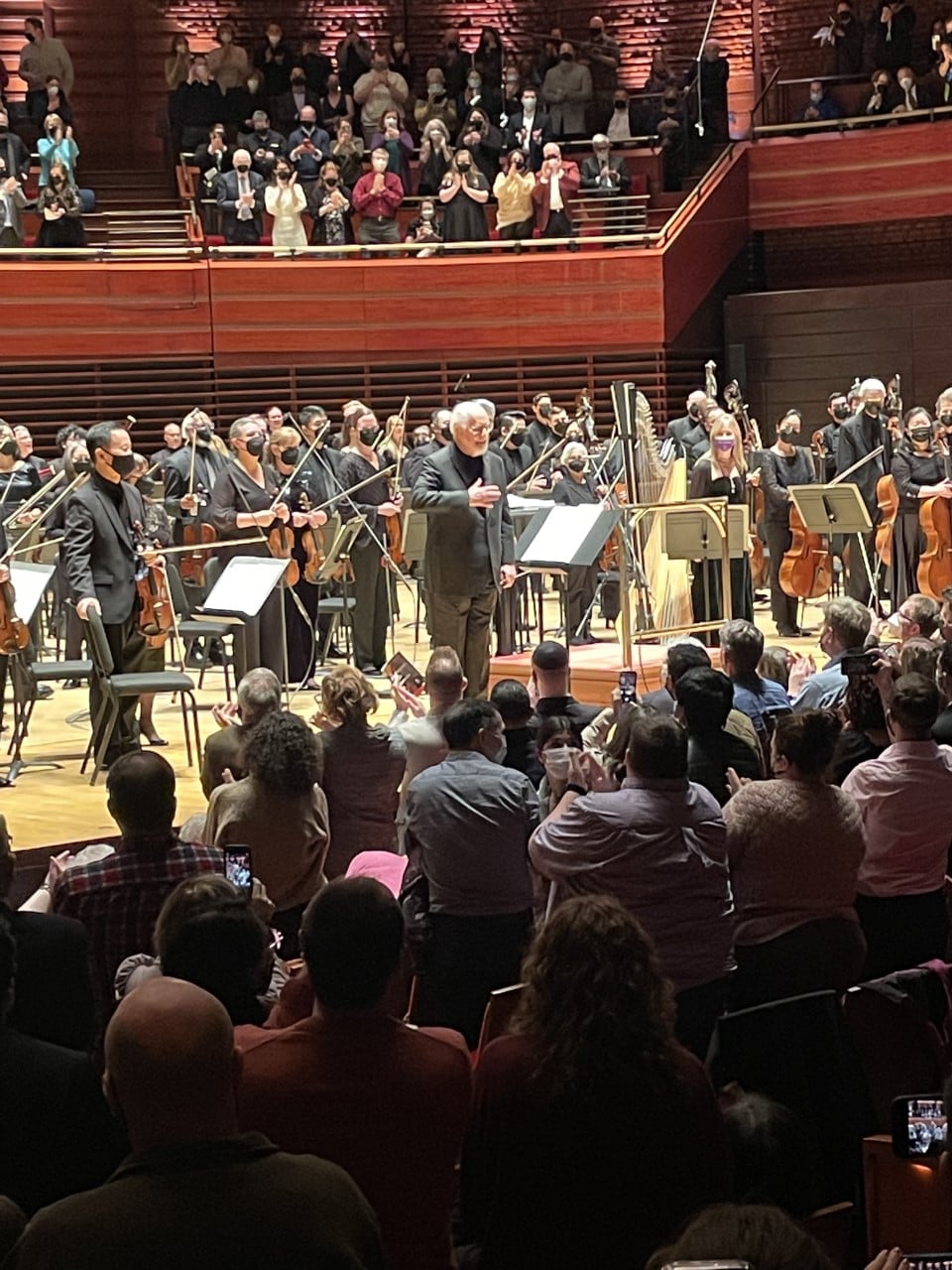
John Williams Live in Philadelphia
Yesterday, I made a last-minute decision to catch John Williams in Philadelphia. Having seen him three times before (four, actually, as once he came out to acknowledge an ovation, following a performance of one of his concertos, the night after he conducted a program of his own music), I had resigned myself to sitting this one out. When the concert was announced, I went to the Philadelphia Orchestra website, and instead of being able to buy tickets, there were instructions to email for information. Forget that. But when I went back yesterday, after many months, there were a handful of seats posted, so I got out my credit card and jumped through the usual hoops to reserve one.
I have been reluctant to attend concerts since Covid-19, and with Williams, I knew the hall would be packed, but I lucked into a box seat with three other people, so we were elevated slightly, above the main floor, and the chairs were positioned in such a way that there was little chance of us breathing on one another. Everyone was masked, of course, and proof of vaccination was required. My seat was the equivalent of twelve rows from the stage, maybe 35 or 40 feet from the podium, with a great sightline.
The emotional high point of the evening came at the very beginning, when Williams emerged to a rafter-rattling standing ovation. At 90 years-old, he is a marvel. If not for his evident care when walking back and forth to the podium (I did see him fall once in Baltimore a number of years ago), I’d say he hasn’t changed a bit in the last 20 years. He did not conduct from a chair, as many superannuated maestros do, but led the entire two-hours-plus standing. He did lean on concertmaster David Kim’s shoulder a few times when getting on and off the podium.
Anne-Sophie Mutter joined him as soloist in his brand new Violin Concerto No. 2 (given its premiere at Tanglewood in July), which they have been touring, with another performance scheduled for Carnegie Hall tomorrow night. This is probably the third time I’ve heard the piece – having seen the debut on PBS and listened to a bootleg on YouTube – and I hear more in it every time. Like most of Williams’ concertos, it has little in common with his film work, beyond a shared expertise in the handling of the instrumental colors. Everyone remembers the big moments in his film scores, but there’s real magic in the connective material. When required, Williams does delicacy as well as any frontal assault. Although I imagine Mutter knows the concerto pretty well by now (it was written for her), she played it from the score.
Audiences at these kinds of events are not necessarily classical music people – the guy next to me commented that he had never attended the Philadelphia Orchestra before – but everyone listened attentively, or at any rate patiently, knowing the programming on the second half of the concert was calculated to please. I do hope, after all these performances of the work, that one of the major labels (Deutsche Grammophon?) will allow Mutter and Williams to record it. Record companies don’t exactly stumble over themselves to finance recordings of Williams’ concert music.
The first half of the concert opened with a brief occasional piece, “Sound the Bells,” written to celebrate the royal wedding of Crown Prince (now Emperor) Naruhito and Masko Owada of Japan. Following the concerto, Mutter played an encore, “Across the Stars,” in an arrangement for violin and orchestra, from “Attack of the Clones.” Addressing the audience, Williams played coy, stating it was from one of the nine “Star Wars” scores, but he didn’t remember which one; he hadn’t had a chance to look it up. I find that doubtful, since he made the same quip at the Tanglewood concert, when it was also played as an encore to the concerto.
This was not the last we would hear from Mutter. Following intermission, there were selections from “Hook” and “Close Encounters of the Third Kind.” Then Mutter returned to play some new arrangements, also written for her, of selections from “Harry Potter,” “Cinderella Liberty,” and “The Adventures of Tintin.” These were played very well, of course – Mutter is one the world’s great violinists – but, while I don’t begrudge other’s enjoyment of this sort of “easy listening” approach to film music, personally I always find it to be a little kitschy.
Williams did give a nice shout-out to André Previn, whom he described as a lifelong friend. The two met in Hollywood, when Previn was a prolific, and Academy Award-decorated, film composer. Mutter was married to Previn from 2002 to 2006. Williams told how he asked Previn whether or not he thought Mutter, who is used to playing Mozart, Beethoven, and Tchaikovsky, would be able to grasp the jazzy idiom of “Cinderella Liberty.” Previn assured him, Williams said, that Anne-Sophie could play anything.
Williams also observed that he and Previn were probably the only two who remembered seeing “Cinderella Liberty,” which was released 50 years ago. It was one of several remarks on Williams’ part to stir melancholy reflections of my own, that time is passing at an alarming rate, and that Williams, at 90, is a toehold on a vanishing world. He even made an aside about Errol Flynn, “for those of you who remember who he is.” There may have been those in the audience who didn’t.
During intermission, the guy next to me had asked about Mutter. When I mentioned her marriage to Previn, I got the impression he had never heard of him. He certainly didn’t know “Bad Day at Black Rock,” “Elmer Gantry,” or “My Fair Lady.” He turned to me then, when Williams mentioned him, in acknowledgement. Time is passing very quickly indeed. When the orchestra launched into the Throne Room and End Title music from “Star Wars,” it seemed “a long time ago, in a galaxy far, far away,” and not just for the reasons originally intended.
Standing ovations punctuated the evening. The audience recalled Williams and Mutter again and again. I attended a Williams concert a few years ago, and the encores lengthened the program by nearly a third. Last night, we got “Schindler’s List” (with Mutter) and the flying theme from “E.T.” The audience was ruthless in its adoration. Williams was recalled multiple times, but after a lovely evening, the point had come when he should be allowed to go. He’s 90 years-old, people! At last, he put two hands together and held them to his cheek, as he always does, to signify that he was tired and it was time to get some sleep. And everyone laughed, as they always do.
I was happy to see the musicians so evidently gratified to be playing the music, and many of them were obviously star-struck in Williams’ presence. You could see it on their faces, especially of those whose hands he was able to shake. The personnel are now mostly of an age when they would have been reared, as I was, on Williams’ music. I was 10 at the time “Star Wars” was released. There was a lot of love in the room.
New to Williams’ repertoire was the fist-bump, of which he exchanged several with people in the front row of the audience. He also reacted to cries and whistles from the balconies. He’s an exceptionally gracious presence. I can’t believe for a moment that he doesn’t recognize how much his music has meant to so many, but he always conveys a modest, appreciative disposition. What a charmed career he’s had. There’s been plenty of hard work, to be sure, supported by an innate musicianship and a masterful command of technique. But the whole Lucas-Spielberg connection gave him an unprecedented opportunity to dream big and to reach the broadest possible audience. How many other composers, living or dead, have been so fortunate?
I don’t have a smart phone (Verizon keeps threatening to cancel my flip), so the image on this post was kindly shared with me by the gentleman next to me, with whom I had conversed a couple of times during the evening. So thank you to him!
By coincidence, I also wrote about Williams for my article in the current edition of the Princeton weekly newspaper U.S. 1, in connection with an all-Williams concert to be given by the Capital Philharmonic of New Jersey in Trenton in this Saturday. I’ll write a little more about that in a separate post later today.
Tag Cloud
Aaron Copland (94) Beethoven (95) Composer (114) Film Music (148) Film Score (143) Film Scores (255) Halloween (97) John Williams (196) KWAX (232) Leonard Bernstein (105) Marlboro Music Festival (125) Movie Music (163) Mozart (91) Opera (215) Philadelphia Orchestra (90) Picture Perfect (174) Princeton Symphony Orchestra (110) Radio (90) Ross Amico (244) Roy's Tie-Dye Sci-Fi Corner (290) The Classical Network (101) The Lost Chord (269) Vaughan Williams (107) WPRB (397) WWFM (881)