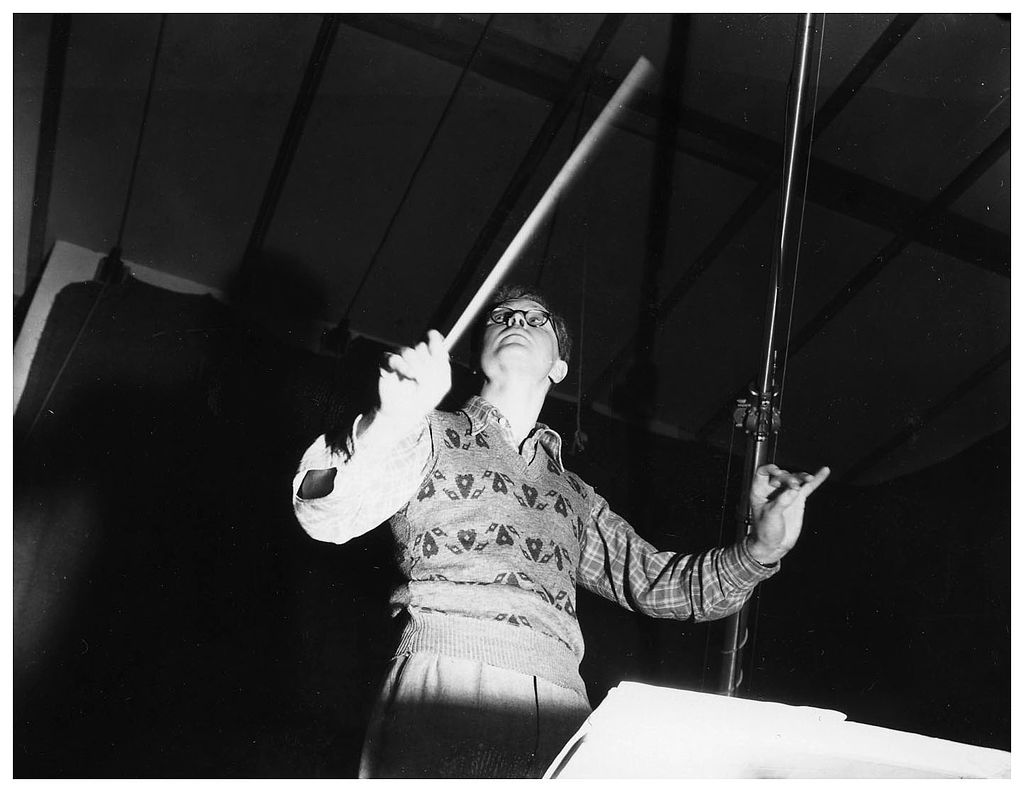
Being such a huge Sibelius fan, I remember being positively charmed on my discovery of the music of Douglas Lilburn. Lilburn is probably New Zealand’s most celebrated composer.
Lilburn studied journalism and music at Canterbury University College, then part of the University of New Zealand, before embarking for London’s Royal College of Music. There he was tutored by Ralph Vaughan Williams. The two remained good friends, with Lilburn sending his former teacher gifts of New Zealand honey.
Lilburn made his mark at home not only as a composer, but as a conductor and a noted teacher. For decades, he was associated with Victoria University in Wellington, beginning in 1947.
Astonishingly, for one whose own music was so rooted in tradition, Lilburn founded the first electronic music studio in Australasia. This followed visits to electronic facilities at Darmstadt and the University of Toronto.
Actually, his comparatively thorny Third Symphony signaled something of a turning point. Soon after its completion, in 1961, he shifted his attention exclusively to electronics, a field in which he spent the remainder of his career. Many of his works in the medium evoke the New Zealand landscape and the natural sounds he loved so well.
Lilburn died in 2001. He was 85 years old. He has been described as “the elder statesman” and “grandfather” of New Zealand music.
Happy birthday to this eminent antipodean!
“A Song of Islands” (1946)
The composer in the electronic music studio he founded
The headline read “Who Cares if You Listen?” And the notoriety was instant and long-lasting.
All at once, Milton Babbitt was a musical monster.
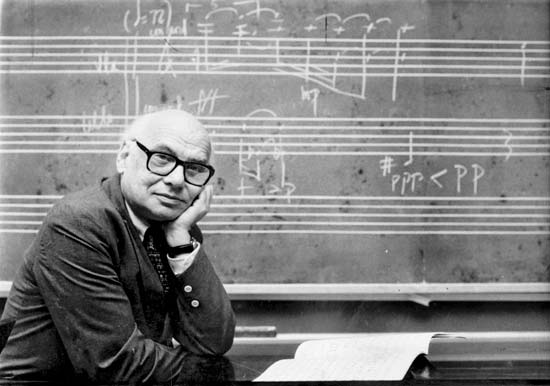
Babbitt, a staple at Princeton University for many years, was born in Philadelphia on this date in 1916. He received lasting blowback from angry villagers wielding torches and pitchforks for an essay he wrote for High Fidelity magazine, which bore the title stated above.
Unfortunately, the headline wasn’t Babbitt’s. It was actually an editorial decision. Babbitt’s original title had been “The Composer as Specialist” – not nearly as eye-catching or provocative. Today, we might describe it as clickbait. But it stuck like Karloff’s neck-bolts, as both a source of animation and a signal of abnormality, branding him in the eyes of the superstitious rabble as an outcast to be feared.
Also, it is kind of arrogant.
While it’s true that Babbitt frequently composed in a serial style, which might be off-putting to some coming to it for the first time, his music is often fairly lucid, without undo congestion and with a minimum of soul-crushing dissonances. On the contrary, he often achieved a paradoxical simplicity under the guise of complexity.
In the 1960s, Babbitt became interested in electronic music, apparently for its rhythmic precision, as opposed to any unusual timbral considerations. I find it endearing that he was also fond of jazz and musical theater and that late in life he enjoyed a friendship of sorts with film composer John Williams. (They bonded over Bernard Herrmann.) His one-time student, Stephen Sondheim, characterized him as “a frustrated show composer.”
Babbitt himself was a saxophonist. In 1946, he penned a musical, “Fabulous Voyage,” a retelling of Homer’s “The Odyssey.”
Yes, we all have our off-days, but the lasting impression Babbitt left on his students and colleagues seems to be that he was largely a warm and personable human being. He loved Broadway, beer, and football. Simple pleasures for someone portrayed as so lofty, he didn’t give a hang if you listened.
Babbitt was the recipient of an honorary Pulitzer Prize in 1982. He died in Princeton in 2011, at the age of 94.
Listen to “Penelope’s Night Song” from “Fabulous Voyage” and tell me if it seems to you like the product of a rampaging monster.
“Composition for Twelve Instruments” (1948):
“Reflections” (1974) for piano and synthesized tape:
If you’re interested in learning more about Princeton’s important role in the history of computer music and haven’t done so yet, do check out this podcast, produced by the Princeton University Engineering Department.
Regional madness aside, “Aniara” carries a universal message. It’s not a happy opera, but it is a compelling one. Somber, inevitable, and unafraid to confront the grim truth, “Aniara” pushes beyond our solar system into the spiritual void.
With its polyglot embrace of serialism, electronic music, and jazz, the work is rarely-heard, but worth checking out. The recording is long out of print and quite pricey on the collectors’ market. I broke into a cold sweat when I found my copy at @[100064570938690:2048:Princeton Record Exchange]. There’s also a Swedish film, based on the original poem (not the opera), from 2018.
Listen and despair this afternoon at 3:00 EDT. In terms of Scandinavian art, “Aniara” does Edvard Munch one better – in space, no one can hear you scream.
Milton Babbitt, a staple at Princeton University for many years, was born in Philadelphia on this date in 1916. Babbitt gained widespread notoriety for an essay he wrote for High Fidelity magazine, titled “Who Cares If You Listen?” It turns out the provocative stance was actually the result of an editorial decision, and that Babbitt’s original title had been “The Composer as Specialist” – not likely to generate nearly as much controversy.
While he frequently composed in a serial style, Babbitt’s music is often fairly lucid, without undo congestion and with a minimum of soul-crushing dissonances. On the contrary, he often achieved a paradoxical simplicity under the guise of complexity.
In the 1960s, Babbitt became interested in electronic music, apparently for its rhythmic precision, as opposed to any unusual timbral considerations. I find it endearing that he was also fond of jazz and musical theater and that late in life he enjoyed a friendship of sorts with film composer John Williams. (They bonded over Bernard Herrmann.) His one-time student, Stephen Sondheim characterized him as “a frustrated show composer.”
Babbitt himself was a saxophonist. In 1946, he penned a musical, “Fabulous Voyage,” a retelling of Homer’s “The Odyssey.”
He was the recipient of an honorary Pulitzer Prize in 1982. Babbitt died in Princeton in 2011, at the age of 94.
Listen here for “Penelope’s Night Song” from “Fabulous Voyage”:
If you’re interested in learning more about Princeton’s important role in the history of computer music and haven’t done so yet, do check out this podcast, produced by the Princeton University Engineering Department.
If you need to get away from the candles and clove of Windham Hill, there’s always Godfrey Winham.
When Winham takes on a Christmas classic, it’s like a great, big, satisfying ice ball in the face of George Winston. He’s as bracing as a ride in a one-horse open sleigh.
Winham is probably best-known for his role right here in Princeton as an electronic music pioneer. As might be expected, this didn’t lead to a lot of toe-tappers. One day, after listening to some of Windham’s music, his son asked him if he could write something a bit simpler. This was the impetus for a 26-minute set of keyboard meditations on a familiar Christmas tune, titled “Variations on a Theme by James Pierpont” – otherwise known as “The Jingle Bells Variations.”
This is music a grown-up Schroeder would be proud to own. You can listen to it here, starting about 26 minutes into the program
If you are at all interested in Princeton and the history of computer music, and you haven’t checked out this podcast yet, you owe it to yourself to do so:
This is my favorite version of “Jingle Bells” – presented by the Robert DeCormier Singers as it was originally published in 1857.
BONUS! Leopold Mozart’s “A Musical Sleigh Ride,” complete with neighing horses, excitable hounds, and whip cracks. As a radio host, I made it a point to share this fun recording with the Eduard Melkus Ensemble every year on my last shift before Christmas. At home, it drove the dogs crazy.
With extreme winter weather expected to disrupt travel and last-minute Christmas shopping across much of the country, there’s plenty of music about winter recreation to fuel your imagination as you cozy-in around the hearth.