Tag: Electronic Music

  • Percy Grainger Free Music Pioneer

    Percy Grainger Free Music Pioneer

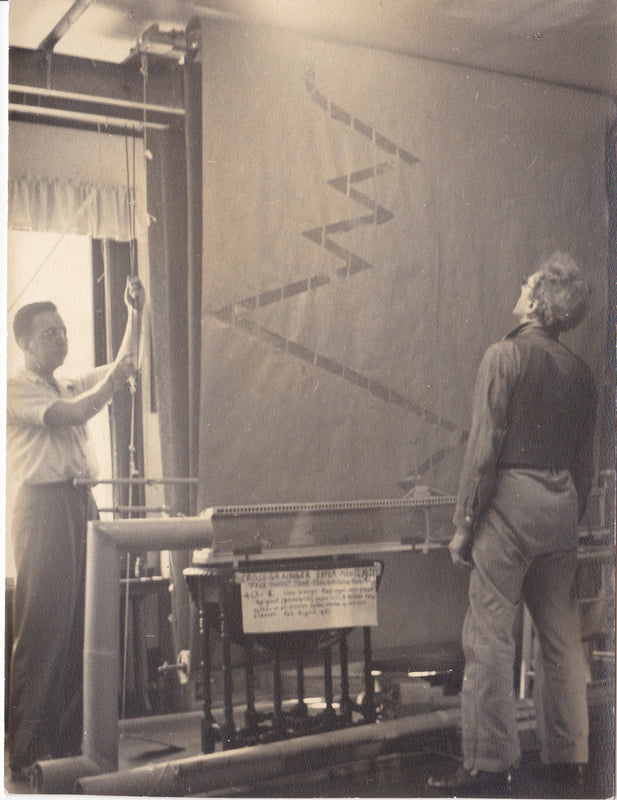
    Percy Grainger, composer of beloved, albeit quirky arrangements of familiar English folk songs and Morris dance tunes, was also a pioneer of “free music.” Here’s a fascinating look at the experimental machines he worked on at his home in White Plains, NY. The sounds they generate anticipated the electronic sound synthesizer.

    “In 1938, Grainger wrote that he first heard ‘free music’ in his head when, as a boy in Melbourne [Australia], he watched the sea at Brighton and Albert Park. He could never see why, in a scientific age, music shouldn’t be as free and as infinitely variable as the waves.”

    Percy Grainger’s Synthesizers

    The first programmable electronic sound synthesizer, the RCA Mark II (nicknamed Victor), an instrument of heroic dimensions, was developed by American acoustical engineers Harry Olson and Herbert Belar in 1955, at the Radio Corporation of America (RCA) laboratories in Princeton, NJ. It was installed at the legendary Columbia-Princeton Electronic Music Center at Columbia University in 1957. Controlled by punch cards and employing hundreds of vacuum tubes, the interconnected components filled an entire room.

    Gain a greater appreciation for the amount of sweat that went into synthesized composition prior to the invention of the Moog!


    PHOTO: Grainger (right) with Burnett Cross, standing before one of his “free music” machines, in 1951

  • Milton Babbitt a surprising composer

    Milton Babbitt a surprising composer

    In reading an interview with John Williams in The New Yorker only a few months back, I was amused to discover that he and Milton Babbitt enjoyed a friendship of sorts. I guess Babbitt was a Bernard Herrmann fan. Who knew?

    https://www.newyorker.com/culture/persons-of-interest/the-force-is-still-strong-with-john-williams

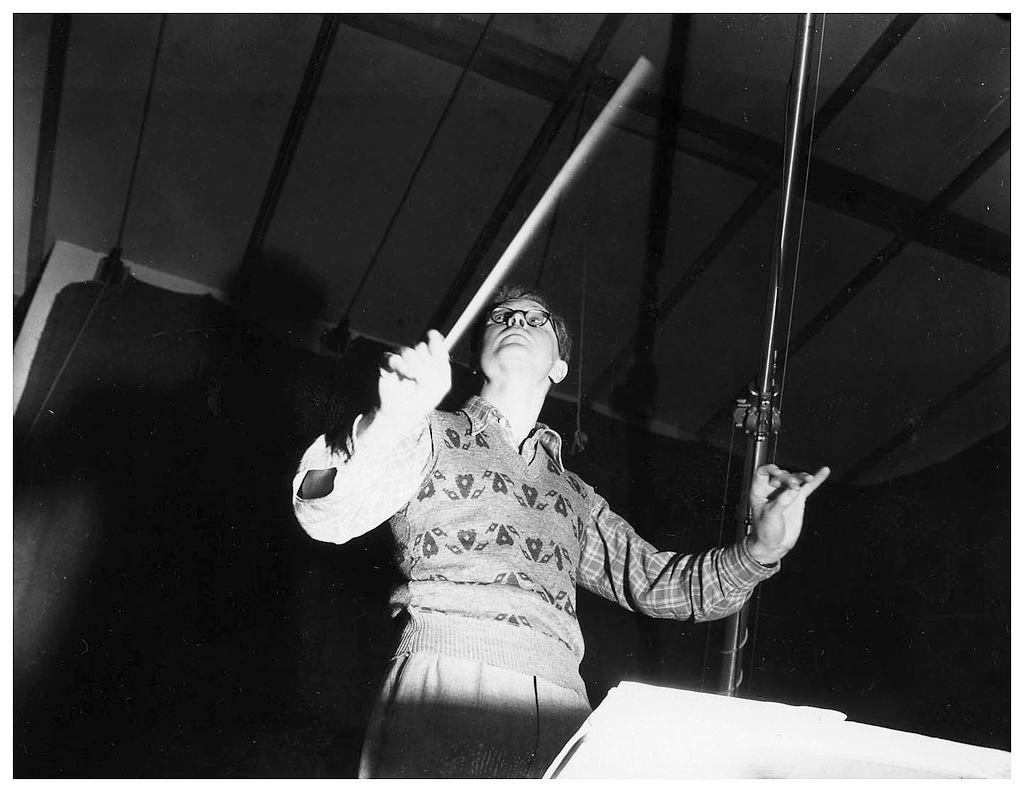
    Babbitt, who was born in Philadelphia on this date in 1916, was a fixture at Princeton University for many years. It’s telling that he joined both the music and mathematics faculties there. Later, he also served on the faculty of the Juilliard School.

    He gained widespread notoriety for his essay published under the title “Who Cares If You Listen?” The provocative slant was actually the result of an editorial decision. Babbitt’s original title had been “The Composer as Specialist” – not likely to generate nearly as much controversy.

    Broadly speaking, while he frequently composed in a serial style, his music is fairly lucid, without undo congestion, and with a minimum of soul-crushing dissonances. On the contrary, he often achieved a paradoxical simplicity under the guise of complexity.

    In the 1960s, Babbitt became interested in electronic music, apparently more for its rhythmic precision than for any unusual timbral considerations. I find it endearing to learn that he was also fond of jazz and musical theater. He himself was a saxophonist. In 1946, he penned a musical, “Fabulous Voyage,” a retelling of Homer’s “The Odyssey.”

    Babbitt was the recipient of an honorary Pulitzer Prize in 1982. He died in Princeton in 2011, at the age of 94.


    Listen here for “Penelope’s Night Song” from “Fabulous Voyage”:

    “Composition for Twelve Instruments” (1948):

    “Reflections” (1974) for piano and synthesized tape:

    Milton Babbitt on electronic music:

  • Douglas Lilburn New Zealand’s Celebrated Composer

    Douglas Lilburn New Zealand’s Celebrated Composer

    Being such a huge Sibelius fan, I remember being positively charmed on my discovery of the music of Douglas Lilburn. Lilburn is probably New Zealand’s most celebrated composer.

    Lilburn studied journalism and music at Canterbury University College (then part of the University of New Zealand), before embarking for London’s Royal College of Music. There he was tutored by Ralph Vaughan Williams. The two remained good friends, with Lilburn sending his former teacher gifts of New Zealand honey.

    Lilburn made his mark at home not only as a composer, but also as a conductor and a noted teacher. For decades, beginning in 1947, he was associated with Victoria University in Wellington.

    Astonishingly, for one whose own music was so rooted in tradition, Lilburn founded the first electronic music studio in Australasia. This followed visits to electronic facilities at Darmstadt and the University of Toronto.

    Actually, his comparatively thorny Third Symphony signaled something of a turning point. Soon after its completion, in 1961, he shifted his attention exclusively to electronics, a field in which he spent the remainder of his career. Many of his works in the medium evoke the New Zealand landscape and the natural sounds he loved so well.

    Lilburn died in 2001. He was 85 years old. He has been described as the “elder statesman” and “grandfather” of New Zealand music.

    Happy birthday to this Sibelius of the Southern Cross!


    Liliburn’s “A Song of Islands” (1946):

    The composer in the electronic music studio he founded:

    PHOTO: Ant’s-eye Antipodean

  • Hot Dog Music Independence Day Social Distance

    Hot Dog Music Independence Day Social Distance

    Happy Independence Day! Concerned about social distancing? Alienate everyone by making electronic music with hot dogs.

    https://www.foodandwine.com/news/hot-dog-music-electricity

  • Subotnick’s Silver Apples electronic music pioneer

    Subotnick’s Silver Apples electronic music pioneer

    I remember hearing this for the first time in the middle of the night, broadcast by Henry Varlack on WFLN in Philadelphia. As you can imagine, I never forgot it. It’s the first piece of electronic music specifically commissioned by a record label (Nonesuch Records). This is from back in the day when Nonesuch was Nonesuch, and synthesizers were synthesizers!

    https://www.youtube.com/watch?v=3G1hRNLlYpg

    Happy birthday, Morton Subotnick, pioneering composer of the cult classic “Silver Apples of the Moon.”


    Morton Subotnick: The Mad Scientist in the Laboratory of the Ecstatic Moment:

Tag Cloud

Aaron Copland (92) Beethoven (95) Composer (114) Film Music (123) Film Score (143) Film Scores (255) Halloween (94) John Williams (187) KWAX (229) Leonard Bernstein (101) Marlboro Music Festival (125) Movie Music (138) Opera (202) Philadelphia Orchestra (89) Picture Perfect (174) Princeton Symphony Orchestra (106) Radio (87) Ralph Vaughan Williams (85) Ross Amico (244) Roy's Tie-Dye Sci-Fi Corner (290) The Classical Network (101) The Lost Chord (268) Vaughan Williams (103) WPRB (396) WWFM (881)

DON’T MISS A BEAT

Receive a weekly digest every Sunday at noon by signing up here


RECENT POSTS