Tag: Electronic Music

  • Princeton’s Lost Music: A Digital History

    Princeton’s Lost Music: A Digital History

    60 years ago, Princeton University engineers noticed members of the music department, staring agog at a recently-installed computer. It wasn’t long before a not-so-unlikely alliance was formed that helped to change history. New Jersey’s role in the creation of digital music is the subject of a new podcast, “Composers & Computers.”

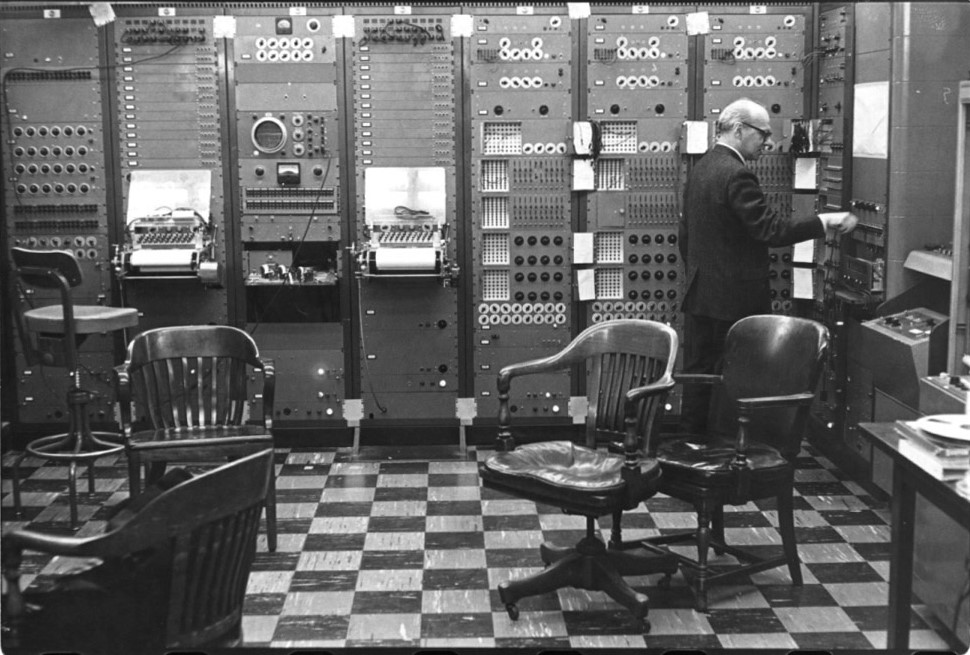
    The accessible, absorbing presentation illuminates the work of engineers at RCA Laboratories in Princeton in the 1950s, Princeton music faculty at the Columbia-Princeton Electronic Music Center in New York, and musicians who first entered the computer center in the Princeton University EQuad in 1962, with the intention of harnessing a new IBM 7090 to synthesize music.

    No less than 20 subjects were interviewed for the series, to create an oral history spanning six decades. Commentary, anecdotes, and insights are punctuated and underscored by samples of electronic music, from Milton Babbitt and Charles Wuorinen (his Pulitzer Prize-winning “Time’s Encomium”) to Stevie Wonder and The Beach Boys.

    Aaron Nathans, Digital Media Editor at Princeton’s School of Engineering and Applied Science, is the mastermind behind the podcast. He too is an interesting, multifaceted individual, who became the unexpected co-subject of an article I wrote for this week’s U.S. 1 Newspaper – PrincetonInfo.

    Learn more about electronic music pioneers Milton Babbitt, Godfrey Winham, Paul Lansky, Ken Steiglitz, and their colleagues and students, and the continued vitality of the Princeton computer scene as exemplified by the Princeton Laptop Orchestra and the multidisciplinary experimentation of Naomi Leonard and her “Rhythm Bots.”

    Look for the story in print in area vending machines and local businesses, or find immediate gratification here:

    https://www.communitynews.org/princetoninfo/artsandentertainment/a-good-ear-for-stories-and-electronic-music-inspires-a-princeton-podcast/article_93780110-3384-11ed-93a9-1ba8b9106ed7.html

    The “Composers & Computers” podcast, sponsored by Princeton University’s School of Engineering and Applied Science, can be heard on iTunes, Spotify, Google Podcasts, Stitcher, and other platforms. Show notes, including playlists, sources, rare photos, and podcast audio, are also available at https://engineering.princeton.edu/series/composers-computers-podcast


    ONCE UPON A TIME IN NEW YORK: Princeton composer Milton Babbitt at the Columbia-Princeton Electronic Music Center

  • Oskar Sala Google Doodle Celebrates Electronic Music Pioneer

    Oskar Sala Google Doodle Celebrates Electronic Music Pioneer

    Oh my! This is a surprise. Oskar Sala gets a Google Doodle for his 112th birthday!

    Sala was a physicist and electronic music pioneer, who promoted and developed an instrument called the Trautonium (later the Mixtur-Trautonium), a precursor to the synthesizer. He also worked with composer Bernard Herrmann to create the unsettling sound design for Alfred Hitchcock’s “The Birds,” a film without a musical score. Note the inclusion of two birds (ravens?) in the doodle.

    Sala died in 2002 at the age of 91. Keep an eye out for him, should you wind up doing a Google search today!


    Sala plays his Mixtur-Trautonium

    https://www.youtube.com/watch?v=-tQQEChMq1A

    As soloist in Harald Genzmer’s Trautonium Concerto

    More about this unusual instrument

    https://120years.net/wordpress/the-mixturtrautonium-oskar-sala-germany-1936/

    Sala’s sound design enhances “The Birds”

  • Iannis Xenakis Revolutionary Music Visionary

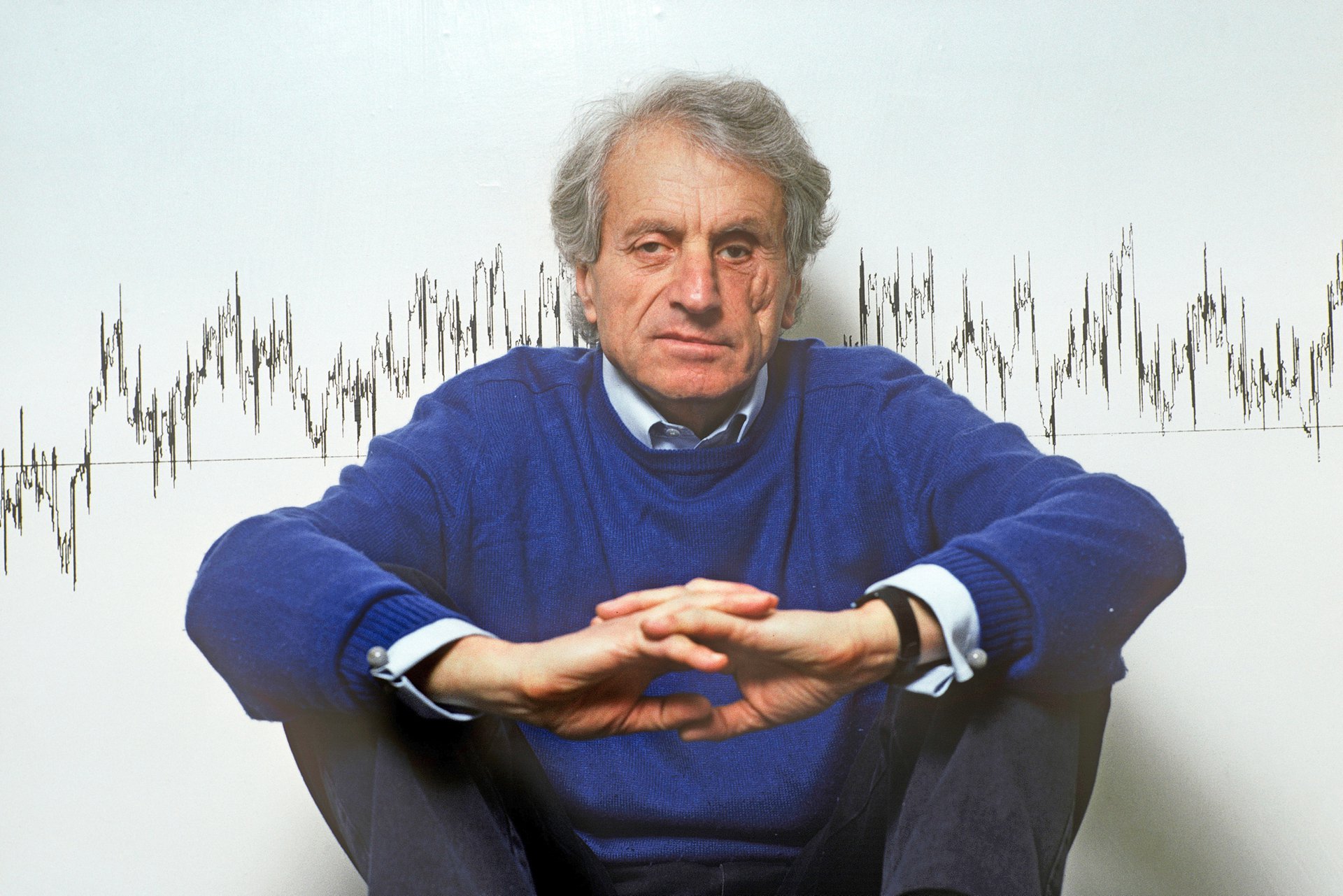
    Iannis Xenakis Revolutionary Music Visionary

    He was a literal revolutionary who altered our perception of music.

    Iannis Xenakis was a Communist who came from wealth, an intellectual who was half-blinded, disfigured, and broken-jawed by shrapnel from a tank blast while rioting in the streets of Athens. He helped to drive the Axis out of Greece, opposed the restoration of the monarchy by the British, and was sentenced to death in absentia by a conservative regime. He fled the country using forged papers. He settled in Paris, illegally, where was hired by the architect Le Corbusier.

    There, he applied himself seriously to composition. He was refused as a student by Nadia Boulanger and Arthur Honegger. His lessons with Darius Milhaud went nowhere. It was Olivier Messiaen who at last recognized and acknowledged his unique genius. But understanding his special gifts, even Messiaen refused to spoil him with the humdrummery of drills in harmony and counterpoint. Instead, he gave him his benediction.

    “I understood straight away that he was not someone like the others…. He is of superior intelligence…. [T]his was a man so much out of the ordinary that I said… ‘No, you are almost 30, you have the good fortune of being Greek, of being an architect and having studied special mathematics. Take advantage of these things. Do them in your music.’”

    Xenakis took that freedom and ran with it. He explored music from the perspective of architecture, mathematics, and physics, yet his creations could be searingly visceral. He experimented with spatial effects, pushed the boundaries of electroacoustics, and devised computer systems that could translate graphical images into sound.

    Xenakis may have been a towering intellectual, but he was also a force of nature. His death sentence, which had been commuted to a ten-year prison term, was finally lifted in 1974. Finally, he was able to return home, where he was received as the avant-garde Odysseus and intellectual Colossus he was.

    His music has been described as wild, terrifying, raw, primal, primordial, and elemental. He made the serialists of mid-century seem hidebound, which in a sense they were, and positively tame by comparison.

    Is Xenakis a man for all seasons? It depends on how you like your Sunday mornings. Any Xenakis worth playing is worth playing loudly.

    Happy birthday, Iannis Xenakis, on what would have been your 100th birthday.


    “Pléiades” (1979)

    “Metastasis” (1953-54), with graphical score

    “Pithoprakta” (1955-56), with graphical score

    “Serment-Orkos” (1981)

  • Hans Zimmer Oscar Win Controversy

    Hans Zimmer Oscar Win Controversy

    Hans Zimmer wins this year’s Oscar for electronic gibberish.

    Thanks, The Academy, for the disrespectful pre-ceremony announcement!

  • Mario Lavista 1943-2023 Mexican Composer

    Mario Lavista 1943-2023 Mexican Composer

    Hasta la vista.

    Mario Lavista, the much-decorated Mexican composer, died yesterday at the age of 78.

    Lavista was born in Mexico City in 1943. He studied with Carlos Chávez and Jean-Étienne Marie, receiving additional instruction from Rodolfo Halffter, Nadia Boulanger, and Karlheinz Stockhausen, among others. He experimented with improvisation and electronic music, and applied that same curiosity in his quest for unusual timbres employing acoustic instruments and extended techniques. He founded and edited Pauta, one of the most significant music journals in Latin America. His sacred music was influenced by Medieval and Renaissance procedures. He also composed for theater and film.

    Lavista’s music is imaginative, beautiful and transporting. Gracias, Maestro, y que descanse en paz.


    “Cuaderno de viaje” for solo violin

    “Clepsidra” for orchestra

    “Danza Isorritmica” for percussion ensemble

    “Reflejos de la Noche” for string quartet

    “Maithuna” for voice and percussion

    “Responsorio In Memoriam Rodolfo Halffter” for bassoon, bass drums, and tubular bells

    Lavista plays “Jaula” on a prepared piano. Music begins at 1:36.

Tag Cloud

Aaron Copland (92) Beethoven (95) Composer (114) Film Music (123) Film Score (143) Film Scores (255) Halloween (94) John Williams (187) KWAX (229) Leonard Bernstein (101) Marlboro Music Festival (125) Movie Music (138) Opera (202) Philadelphia Orchestra (89) Picture Perfect (174) Princeton Symphony Orchestra (106) Radio (87) Ralph Vaughan Williams (85) Ross Amico (244) Roy's Tie-Dye Sci-Fi Corner (290) The Classical Network (101) The Lost Chord (268) Vaughan Williams (103) WPRB (396) WWFM (881)

DON’T MISS A BEAT

Receive a weekly digest every Sunday at noon by signing up here


RECENT POSTS