If you’ll allow a labored pun, Bax is a composer I can really get behind.
Sir Arnold Bax blazed his own trail in English music, for the most part forgoing both the pomp and circumstance of Sir Edward Elgar and the rustic folk song of Ralph Vaughan Williams. (Bax once quipped, “You should make a point of trying every experience once, excepting incest and folk dancing.”) Like Elgar, he found much to admire in the German Romantics, especially Wagner and Strauss, but he also made a careful study of Debussy.
Sadly, he lacked the French master’s refinement when it came to some of his own queasy chromatic harmonies. Even after decades, I can’t say I’m entirely fond of the symphonies, which come off more like extended rhapsodies, clunkily strung together. As if Frederick Delius met Percy Grainger on a bad day. It is in his tone poems, his love of all things Celtic, and his colorful orchestrations that he is at his most gratifying.
Bax wrote most of his piano music for Harriet Cohen, the magnetic virtuoso who captivated seemingly every English composer of her time. She and Bax engaged in a tempestuous affair that spanned some 40 years. His most famous work, the symphonic poem “Tintagel” (1917, orchestrated in 1919), was ostensibly inspired by the ruins of an Arthurian castle overlooking the turbulent Cornish seascape. But it’s widely understood that there’s a subtext to the piece: the erotic intensity of illicit lovers, who passed an especially ardent six weeks on vacation there.
Also ravishing, for entirely different reasons, is the season-appropriate tone poem “November Woods” (1917)
Bax’s “Elegiac Trio” (1916), for flute, viola and harp, appeared the year after Debussy’s trio for the same instrumental combination (which Bax may or may not have known). Its alluring melancholy emerged from a world at war. Bax was especially affected by escalating tensions between England and Ireland, which had just boiled over into violence with the Easter Rising.
“Three Pieces for Small Orchestra” (1913; revised 1928), including “Evening Piece,” “Irish Landscape,” and “Dance in the Sunlight”
A Bax rarity: The “Russian Suite” (1919), originally for piano. A delightful pastiche. This could be a great pops favorite, if anyone would actually program it. Quite unexpected, I’m sure, for anybody accustomed to Bax the dreamy impressionist. Its three movements are posted separately, so allow them to play through! You can thank me later.
Bax was knighted in 1937. In 1942, he was appointed Master of the King’s Music (retitled, with the death of George VI in 1952, Master of the Queen’s Music). The appointment surprised many, since Bax was by no means an establishment figure.
Happy birthday, Sir Arnold Bax!
PHOTO: Bax and Cohen in Cornwall. Evidently there was time for reading, too.
Integrity never guarantees popularity. But it may get you a mention on Classic Ross Amico on your centenary.
Today is the 100th anniversary of the birth of English composer Robert Simpson. A conscientious objector during World War II, Simpson served in a mobile surgical unit during the London Blitz. On the side, he studied composition with Herbert Howells. Eventually music got the upper hand, and Simpson abandoned medicine. He did, however, become a doctor – a Doctor of Music – on graduation from Durham University.
In 1951, he joined the staff of the British Broadcasting Corporation. There, he became one of the organization’s most-respected producers. He would remain with the BBC for the better part of three decades. When corporate meddling began to erode the quality of broadcast in the late ‘70s, Simpson was among those who protested the loudest. He clashed with management, went to the press, and ultimately resigned, only months before he would have been eligible to retire with full pension. (Ah, the world of radio. I know it well.)
That kind of integrity is also reflected in his music, which includes 11 expertly-crafted symphonies and 15 string quartets. Simpson’s music has always had his admirers. Unusually for a living composer, a Robert Simpson Society was formed in 1980, with the aim of promoting his work.
Simpson himself greatly respected Beethoven, Bruckner, Nielsen, and Sibelius. He gave insightful talks on their music and added to their scholarship. As a producer, he was an active champion of the works of Havergal Brian, the eccentric autodidact who wrote 32 symphonies – 20 of them after the age of 80. In particular, Simpson supervised the historic Proms broadcast of Brian’s Symphony No. 1, the “Gothic,” frequently cited as the largest symphony ever composed.
In 1956, Simpson was awarded a Carl Nielsen Gold Medal. In 1963, he received a Medal of Honor from the Bruckner Society of America. Unusual for an amateur, he was also made a Fellow of the British Astronomical Association. (Astronomy was another one of Simpson’s great passions.) He refused an appointment as Commander of the Order of the British Empire in 1980.
In 1986, he moved to Ireland. There, he lived on Tralee Bay in Kerry. Five years later, while on a lecture tour, he suffered a severe stroke which left him in debilitating pain for the remaining six years of his life. He died in 1997.
Most of his major works have been documented on the Hyperion label, the symphonies conducted by Vernon Handley. His music has also been recorded by Sir Adrian Boult, Jascha Horenstein, William Boughton, and Rafael Wallfisch.
The Fourth Symphony is as good an introduction as any, with a scherzo transparently modeled after its counterpart in Beethoven’s 9th. Further, the overall tone of the work strikes me as buoyant and optimistic. I hope you enjoy it. It’s not background music, but it is rewarding.
A lifetime of integrity counts for something. But it certainly doesn’t hurt to have the compositional chops to back it up. Happy birthday, Robert Simpson.
As composer, conductor, critic, brilliant conversationalist, and connoisseur of European culture, Constant Lambert proved himself to be one of the most versatile figures in English music.
This Sunday night on “The Lost Chord,” we’ll benefit from but one facet of this multitalented individual.
Lambert, born in 1905, emerged from an introverted childhood, marred by illness, and blossomed into a preternaturally-gifted musician. At 13, he was writing orchestral works. At 20, he composed a ballet, “Romeo and Juliet,” for Serge Diaghilev and the Ballets Russes.
He gained further notoriety as a reciter of Edith Sitwell’s patter verses for William Walton’s “Façade” (which was dedicated to him). His piano concerto with voice and orchestra, “The Rio Grande,” unashamedly incorporated jazz elements, at a time when it could still provoke scandal. He also directed the first recording of Peter Warlock’s “The Curlew.”
His book, “Music, Ho!,” written at the age of 28, offers concise and witty commentary on the “decline” of modern music. In it, he favors jazz and popular idioms, praises the music Liszt and Sibelius, savages Stravinsky and Les Six, lauds the Marx Brothers, and pokes holes in what he perceives as an artificial “symphonic folk” tradition.
In 1931, he was appointed music director of the Vic-Wells Ballet, soon to become the Sadler’s Wells. While he achieved great acclaim in this capacity, his responsibilities cut into his activities as a composer. Instead, he became largely occupied with the arranging of others’ music. An exception, his gloomy and sardonic choral work, “Summer’s Last Will and Testament,” was coolly received, following as it did so closely on the death of George V. Lambert took the failure to heart, and began to have serious doubts about his talent.
Further, the outbreak of war, alcoholism, and undiagnosed diabetes all took their toll on his vitality and creativity. A long-held fear of doctors, stemming from his childhood experiences, only hastened his decline. Lambert died on August 21, 1951, two days shy of his 46th birthday.
At Sadler’s Wells, he was integral to the planning of each new production, in many cases providing arrangements of lesser-known works by worthy composers. He also became something of an artistic mentor to dancers Margot Fonteyn and Robert Helpmann. In the case of Fonteyn, their relationship developed beyond teacher-pupil. In defiance of his personal demons and deteriorating health, Lambert’s conducting – like his celebrated conversation – remained buoyant and inspired.
We’ll sample vintage recordings of ballet music after Tchaikovsky, Meyerbeer, Boyce, and Rossini. Lambert is the only constant, on “Lambent Lambert,” this Sunday night at 10:00 EST, on WWFM – The Classical Network and wwfm.org.
A rainy day in Princeton – perfect weather in which to celebrate Ralph Vaughan Williams. Vaughan Williams was born on this date in 1872. Don’t let that easygoing demeanor — the untrimmed eyebrows, the rumpled hat, the unkempt tie – fool you. Aside from being one of England’s greatest composers, “Uncle Ralph” possessed the drive and determination to render several other, far less glamorous services to music, each of which were of incalculable value.
First, he performed the actual legwork of roaming the English countryside and documenting the remnants of authentic folk song, the origins of which reached back deep into the nation’s past. He preserved these at a time when centuries-old traditions were in imminent peril of being swept away by encroaching modernization.
Equally, he worked with tireless enthusiasm in reviving and celebrating English church music. In selecting and arranging numbers for “The English Hymnal,” he produced one of the finest and most influential compilations of its kind. He had a passion for music of the Tudor Era. This is reflected in one of his greatest hits, the “Fantasia on a Theme by Thomas Tallis.” His Mass in G minor is a modern milestone in the revival of English polyphony. His magnum opus, which occupied him for decades, is a spiritual allegory after Bunyan, the opera “The Pilgrim’s Progress.” While not a conventionally religious man, Vaughan Williams wrote music that exudes a generosity of spirit and is often characterized by a kind of otherworldly luminosity, so that it seems at times to transcend any earthly concerns.
At the same time, he understood and confronted the horrors of the 20th century, as can be heard in the turbulent Symphony No. 4 or the desolate Symphony No. 6. Even in “A Pastoral Symphony” (the Symphony No. 3) – despite its title a reflection of the composer’s experiences as an ambulance driver during the First World War – all is not as it seems. But the cumulative effect of his music is one of hope, overriding any loss or melancholy, in pieces like the Symphony No. 5, which more than any other expresses an unshakeable faith in time of darkness.
Vaughan Williams also had faith in the value of amateur singing. In addition to his folk song settings and hymn tune arrangements, he composed innumerable Christmas carols. He loved Christmas, and he loved the communal aspect of musicmaking. To his way of thinking, music was not only for the professionals; it was a birthright. Anyone who draws breath should be entitled to partake in its joys. From 1905 to 1953, he returned every year to lead the amateur choirs of the Leith Hill Music Festival in performance of Bach’s “St. Matthew Passion.” He also wrote works, such as his “Concerto Grosso,” that include parts for amateur players, and “Household Music,” designed to be played on whatever instruments happen to be at hand.
Broadly speaking, Vaughan Williams was not enamored of German music – he was intentionally mischievous in his numerous digs against Beethoven, though clearly he recognized Beethoven’s genius – but in Bach he found a kindred spirit. It could be said that Vaughan Williams’ own greatest sin was in not being German himself, since it hindered his broader acceptance in a world that had grown accustomed to regarding Germany as center of the musical universe. Vaughan Williams did more than any other English composer to shatter that hegemony.
So his intent was not merely to promote a conservative agenda, of preserving the status quo. He was also quietly progressive. Every one of his symphonies, while hewing to tonality, is different from every other, always pressing into new territories and exploring fresh sonorities – the stark soundscapes of the “Sinfonia Antartica” (sic), the exotic percussion and sectional division of his Symphony No. 8, the strange saxophones and emotional ambiguity of his Symphony No. 9. When the Symphony No. 5 was given its premiere in 1943, Vaughan Williams was already 70 years-old. Many already began to regard each new work as valedictory. But the old man clearly had plenty of juice left. On top of everything else, he had only just begun to embrace new challenges in writing music for the movies.
As has been the fate of most composers, time and habit have worked against a broader appreciation of Vaughan Williams’ overall output, distilling his life’s work to just a few “hits.” Mostly we hear the “Tallis Fantasia,” the “Fantasia on Greensleeves,” and “The Lark Ascending.” Vaughan Williams’ music is still underrated in many circles, pigeon-holed as the modal ramblings of a cow-pat provincialist. His work on behalf of folk song has forever colored him in some people’s eyes. Certainly, his prominence in the field ensured legions of imitators, and the sins of the sons have been visited upon the father.
But Vaughan Williams was so much more than the musical soul of England, as if that were not enough. He acquired continental polish from his studies with Ravel, and he possessed a largeness of vision and character that place him on a par with any of the great composers. He was a 20th century master. That his music has traveled so poorly is everyone’s loss.
Incidental music to “The Wasps”
“Fantasia on a Theme by Thomas Tallis”
Mass in G minor
Symphony No. 4, conducted by the composer
Phantasy Quintet
Selections from the opera “The Poisoned Kiss,” virtually unknown, but full of good tunes
Adrian Boult conducts a selection from “Job: A Masque for Dancing”
Symphony No. 8, conducted by Charles Munch
Serenade to Music
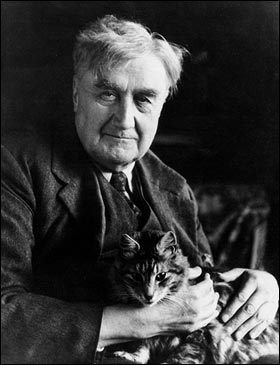
My oft-posted but favorite photo of Vaughan Williams and Foxy
As a classical music radio host of many years, it’s easy to fall back on the same biographical details whenever I come to announce a given composer’s works. This is especially true when the composer’s life contains some particularly lurid or poignant detail.
But is it really fair to define someone by the manner of his or her death? After all, composers lived rounded lives like the rest of us, full of joys and sorrows. There must be some laughter even in a life weighted with misery, and tears in the make-up of any clown.
So it was with George Butterworth. If we hear anything at all in the minute or two it takes to set up the broadcast of one of his works, it’s that Butterworth was cut down by a sniper during the Battle of the Somme at the age of 31. Of course, it doesn’t help that his compositions make one’s heart ache from their exquisite beauty.
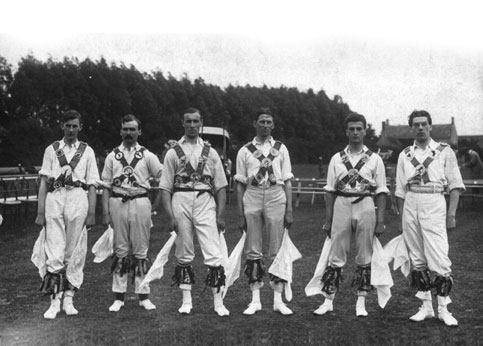
In reading up on Butterworth in advance of celebrating the anniversary of his birth yesterday, I stumbled across this page and sat transfixed, as I viewed for the first time rare footage of him folk dancing with Cecil Sharp. It put a human face on this composer every bit as poignant as the idea of him being cut down in his prime. It’s especially amusing to see the two men get tangled up in their choreography and then continue on their merry way.