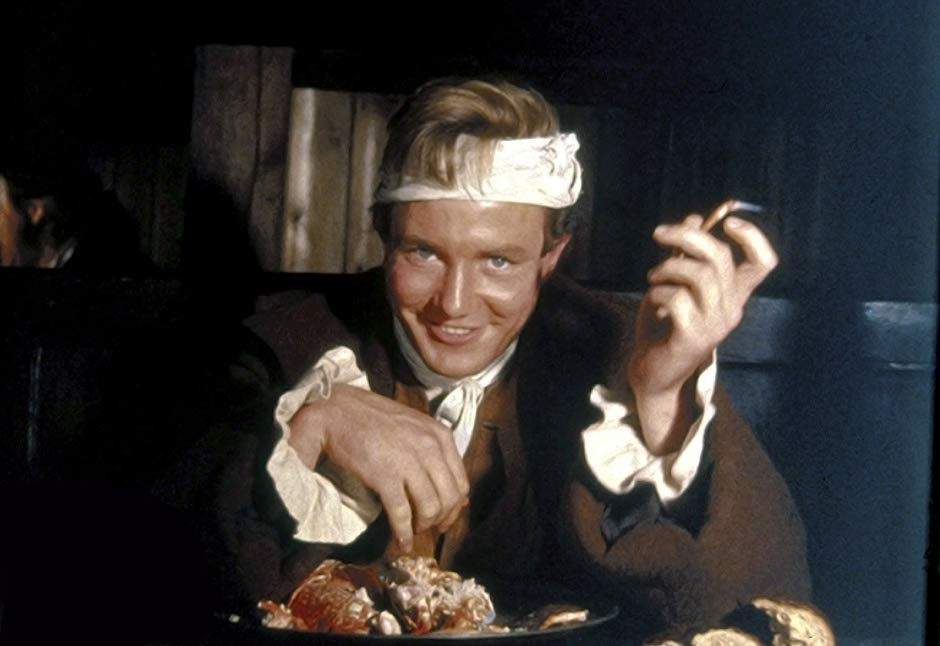
Calling all rapscallions and scapegraces! This week on “Picture Perfect,” get ready to revel in some freewheeling lack of judgment, with an hour of films based on picaresque novels.
For those of you who weren’t English majors, the picaresque novel is a literary genre often characterized by the presence of rogues or anti-heroes as protagonists, episodic, wayward structures, and, not infrequently, low humor.
We’ll hear music from “The Reivers,” after William Faulkner’s Pulitzer Prize-winning novel, a coming-of-age story about a boy swept into automobile theft and illicit horseracing in the American South. Mark Rydell directed the 1969 film, which stars Steve McQueen as the rakish Boon Hogganbeck and features narration by Burgess Meredith. John Williams wrote the breezy Americana score.
Mark Twain’s “The Adventures of Huckleberry Finn” is frequently categorized as an American picaresque. It’s certainly one of the funniest of “serious” books. A middling film adaptation was made in 1960, directed by Michael Curtiz, with Tony Randall given top billing, shifting the focus of the story to the con artistry of the King and the Duke. It features an evocative score by Jerome Moross.
If Hervey Allen’s “Anthony Adverse” had any humor to begin with, it was definitely lost in translation. (Too bad the novel was written in English.) However, the 1936 screen adaptation certainly does sprawl. One could say it’s picaresque in the worst way. It just doesn’t go anywhere. It does, however, feature a top-notch cast (Frederic March, Olivia De Havilland, Claude Rains, etc.) and an Academy Award-winning score by Erich Wolfgang Korngold.
While the modern picaresque novel has its roots in the Renaissance, the genre really seemed to hit its stride in the 18th century, with comic novelists such as Henry Fielding. Fielding’s “Tom Jones,” perhaps the quintessential picaresque, was made into a film in 1963. It went on to win Academy Awards for Best Picture, Best Director (Tony Richardson), Best Adapted Screenplay (John Osborne), and Best Original Score (John Addison). Addison’s music suits Richardson’s quirky virtuosity like an off-kilter powdered wig.
We’re up to no good, with an hour of picaresque adventures, on “Picture Perfect,” music for the movies, now in syndication on KWAX Classical Oregon!
———
Clip and save the start times for all three of my recorded shows:
PICTURE PERFECT, the movie music show – Friday at 8:00 PM EDT/5:00 PM PDT
SWEETNESS AND LIGHT, the light music program – Saturday at 11:00 AM EDT/8:00 AM PDT
THE LOST CHORD, unusual and neglected rep – Saturday at 7:00 PM EDT/4:00 PM PDT
Stream them, wherever you are, at the link!
https://kwax.uoregon.edu
Tag: Erich Wolfgang Korngold
-
Picaresque Adventures on “Picture Perfect”
-
Erich Wolfgang Korngold on “Picture Perfect”
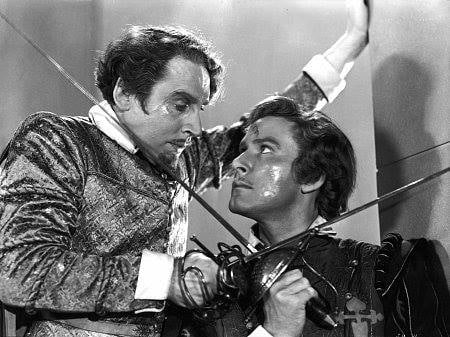
May 29 marks the birthday of one of my favorite composers: Erich Wolfgang Korngold (1897-1957). Thanks to a steady diet of Errol Flynn films, Korngold will forever be a part of the soundtrack to my life.
Korngold went from being one of Europe’s most astounding musical prodigies – his works admired by Mahler, Strauss and Puccini, and championed by Schnabel, Weingartner and Klemperer – to becoming one of Hollywood’s transformative film composers. He is a link from Old World opulence to New World fantasy, his music gracing a number of Warner Brothers’ classic historical adventures.
The best ones starred Flynn, and this week on “Picture Perfect,” we’ll hear music from “The Sea Hawk” (1940) and “The Adventures of Robin Hood” (1938), as well as the mostly forgotten “Another Dawn” (1937). Flynn stars alongside Kay Francis and Ian Hunter (who would go on to play Richard the Lionheart in “Robin Hood”) in this love triangle involving pilots in a British desert colony.
The film may be an obscurity to all save classic movie buffs, but Korngold thought enough of his music that he salvaged the main title as the opening theme of his Violin Concerto, premiered by Heifetz in 1947.
It was an invitation from theatrical impresario Max Reinhardt that brought Korngold to Hollywood in the first place, for a cinematic adaptation of “A Midsummer Night’s Dream” (1935). The film stars James Cagney, Dick Powell and Olivia de Havilland, in her big screen debut, with Mickey Rooney an irrepressible Puck.
For the project, Korngold adapted the famous incidental music of Felix Mendelssohn, interweaving material from Mendelssohn’s symphonies and orchestrating some of the “Songs without Words.” Even so, the music bears the composer’s unmistakable stamp, as you’ll hear in the opening number, lifted from the “Scottish Symphony,” but infused with plenty of Korngoldian swagger.
I hope you’ll join me, as the playlist is all-Korngold this week on “Picture Perfect,” music for the movies, now in syndication on KWAX Classical Oregon!
Happy birthday, EWK!
——-
Clip and save the start times for all three of my recorded shows:
PICTURE PERFECT, the movie music show – Friday at 8:00 PM EDT/5:00 PM PDT
SWEETNESS AND LIGHT, the light music program – Saturday at 11:00 AM EDT/8:00 AM PDT
THE LOST CHORD, unusual and neglected rep – Saturday at 7:00 PM EDT/4:00 PM PDT
Stream them, wherever you are, at the link!
https://kwax.uoregon.edu -
All the World’s a Rager, as We Celebrate Shakespeare on “Sweetness and Light”
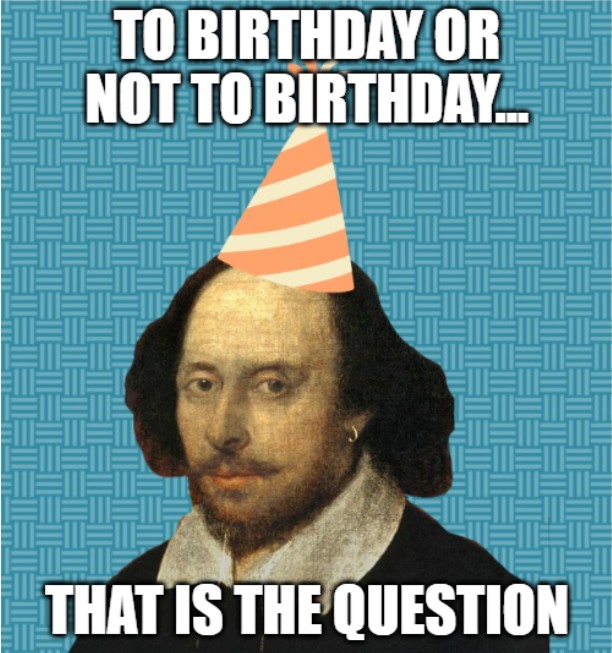
We don’t know exactly when Shakespeare was born. We do know that he was baptized on April 26, 1564. Since he died on April 23, 1616, the urge to keep it tidy has been too difficult to resist: traditionally the Bard’s birthday has been observed on the same date as that of his death. At any rate, we hardly need an excuse to celebrate his plays, which have inspired lots of colorful music.
I hope you’ll join me this morning on “Sweetness and Light” for our annual Shakespeare celebration. We’ll hear a comedy overture inspired by “Hamlet,” of all things, by Geoffrey Bush; a suite compiled from incidental music for “The Winter’s Tale,” “As You Like It,” and “The Tempest,” by Engelbert Humperdinck (composer of “Hansel and Gretel”); a prelude from one of Sir William Walton’s majestic film scores; further works for the stage by Charles Gounod and Erich Wolfgang Korngold; and one of Ralph Vaughan Williams’ loveliest creations, the “Serenade to Music,” inspired by a passage from “The Merchant of Venice.” This is a piece of such aching beauty, it’s said to have brought the notoriously dour Sergei Rachmaninoff, present at the work’s first performance, to tears.
Laughing at “Hamlet” and crying at beauty? Partying is such sweet sorrow! I hope you’ll join me for an hour of great Shakes on “Sweetness and Light,” this Saturday morning at 11:00 EDT/8:00 PDT, exclusively on KWAX Classical Oregon!
Stream it, wherever you are, at the link!
https://kwax.uoregon.edu/ -
Korngold’s “The Silent Serenade” to Find a Voice at Mannes
I’ve been a fan of Erich Wolfgang Korngold ever since the quarterstaff music got stuck in my head while watching “The Adventures of Robin Hood” on TV when I was a kid and my best friend and I took down the curtain rods and started dueling all over the house. A few years later, I discovered the Classic Flim Scores series conducted by Charles Gerhardt, and I loved the Korngold albums best.
But before the mass-exposure he enjoyed as one of the great composers of Hollywood’s golden age, and in fact one of the progenitors of the Hollywood sound, he was enormously successful in Europe. Whenever you listen to music in an old movie and think that it sounds like Richard Strauss, there’s a reason for that, as Korngold and Max Steiner and many of their colleagues had their origins in that world, driven from their homes and across the Atlantic by fascism, the Holocaust, and World War II.
As a wunderkind in Vienna, Korngold was declared a genius by Gustav Mahler. In his teens, he shared a box with Strauss for the premiere of his own “Schauspiel Overture.” Afterwards, Strauss confessed he found such talent in one so young terrifying. Korngold composed a ballet-pantomime, “Der Schneemann” (“The Snowman”), when he was 12. He wrote his first opera, “Der Ring des Polykrates” (“The Ring of Polykrates”), when he was 17. His greatest hit was the opera “Die tote Stadt” (“The Dead City”), given a double premiere (with Otto Klemperer conducting at one of the venues) when he was 23. By then, he was one of the most famous composers in the world.
The great tragedy of Korngold’s life was that by the time the war ended, the world had changed so much, it was impossible for him to regain his former prominence. His style, rooted in fin-de-siècle post-Romanticism, seemed hopelessly old fashioned after Hitler and Hiroshima. He died in 1957, at the age of 60, believing himself basically forgotten.
That would all change in the early 1970s, as a few well-received albums, especially the Gerhardt series, sparked a renewed interest in the composer. There was also a strongly-argued performance of the post-war Symphony in F-sharp, conducted by Rudolf Kempe, and the world premiere recording of “Die tote Stadt,” what might still be the work’s best, with Erich Leinsdorf at the helm.
As it occurred in real time, progress seemed very slow. In the 1980s, it was still difficult to hear any of the concert pieces. They were seldom programmed and recordings were few. But I acquired what I could, and with the advent of compact disc, I rode the Korngold wave, as record companies looked beyond the standard repertoire to stake out new, hopefully lucrative territory, with attractive, slightly off-the-beaten path, opulently-scored music that would exploit the fidelity and dynamic range of the new technology. I literally bought every single Korngold recording that appeared on CD until the duplications became so frequent I just couldn’t do it anymore.
And what a difference the last 40 years have made. I remember making big plans to hear the Korngold Violin Concerto live back in 1990. Now it’s part of the active repertoire of virtually every major violinist. I can’t even tell you how many times I’ve heard it now. But things were very different then.
Recorded explorations of the composer’s output have been so successful it had seemed there was very little left to revive. Surely the major works have been exhausted? Not so!
It was but a few years ago that I was bouncing around the internet and I stumbled across some music I had never heard. It was a Korngold operetta called “Die stumme Serenade” (“The Silent Serenade”). Again, it was written after the war, at a time when “serious” composers like Marc Blitzstein, Gian Carlo Menotti, and Leonard Bernstein were gaining a toehold on Broadway with accessible operas.
Korngold composed a romantic farce with elements of Viennese operetta, a tradition he knew well, as the arranger of several such works by Johann Strauss II for successful revivals in the 1920s and from having completed Leo Fall’s “Roses from Florida” after Fall’s death toward the end of the decade. In the intervening years, he had assimilated a few Americanisms he surely hoped would endear him to producers and audiences on the Great White Way.He also must have realized the practicality of smaller forces. The work was conceived for eight singers, eight actors, and a chamber orchestra consisting of two pianos, the first doubling on celesta, two violins, cello, flute, clarinet or saxophone, trumpet, and percussion.
Korngold tried it out in Europe in the early ‘50s, only to have it tank badly. There are two recordings of the piece, one taken from a Viennese radio broadcast in 1951 and more recently a 2009 recording, with a lot of German dialogue, released in 2011 on the CPO label.
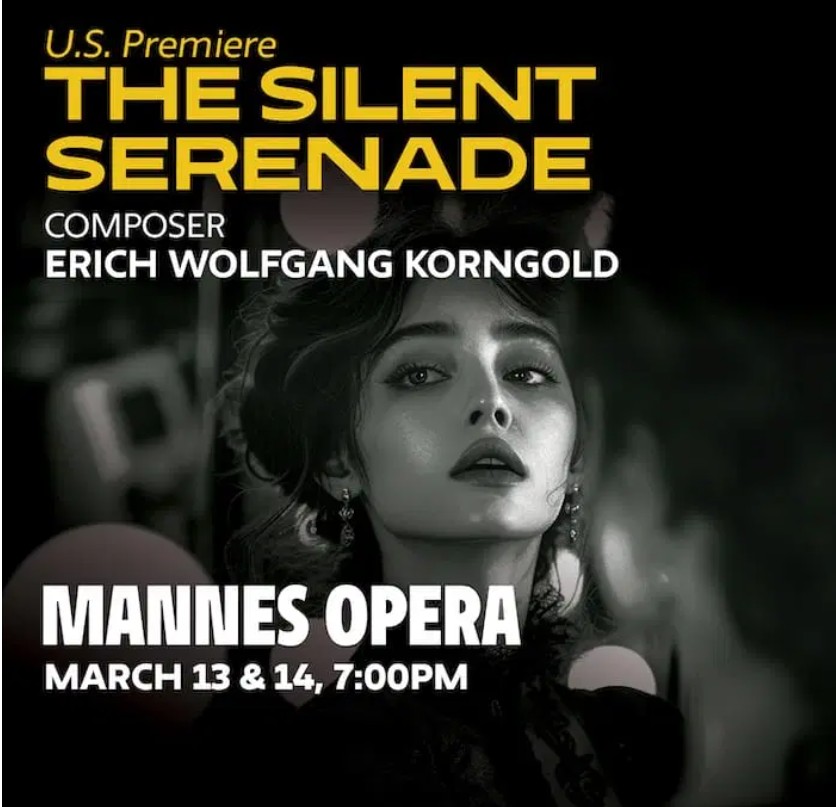
“The Silent Serenade” has never been performed in the United States. But that’s about to change, as Mannes Opera of the Mannes School of Music will host two performances, this Friday and Saturday at 7 p.m., at the Gerald W. Lynch Theater at John Jay College, 524 West 59th Street (between 10th & 11th Avenues), in New York City.
I am sorry to say, for anyone who didn’t hop on it, tickets – which were free – are no longer available. However, the production will be streamed later this month, from what I understand, on March 23 at 4 p.m. If I were you, I would monitor Mannes’ website and social media. Good luck!
https://event.newschool.edu/mannesoperadiestummeserenadeth
Here’s the CPO recording of the piece, shorn of most of the spoken dialogue. The Mannes performances will be in English. -
Double Your Pleasure on “Picture Perfect”
This week on “Picture Perfect,” we’re seeing double.
James Stewart plays Scottie Ferguson, a traumatized police detective who becomes obsessed with the woman he loves – and loses – in Alfred Hitchcock’s “Vertigo” (1958). Kim Novak portrays both the enigmatic beauty and her spitting image, who Ferguson, rather creepily, attempts to mold. Bernard Herrmann wrote the hypnotic score.
Krzysztof Kieślowski’s “La double vie de Véronique”/“The Double Life of Véronique” (1991) depicts parallel characters living in Poland and France who are mysteriously linked, both of them played by Irène Jacob. The performance(s) earned Jacob an award for Best Actress at the Cannes Film Festival. The music, which plays a significant role in the actual plot, is by Zbigniew Preisner.
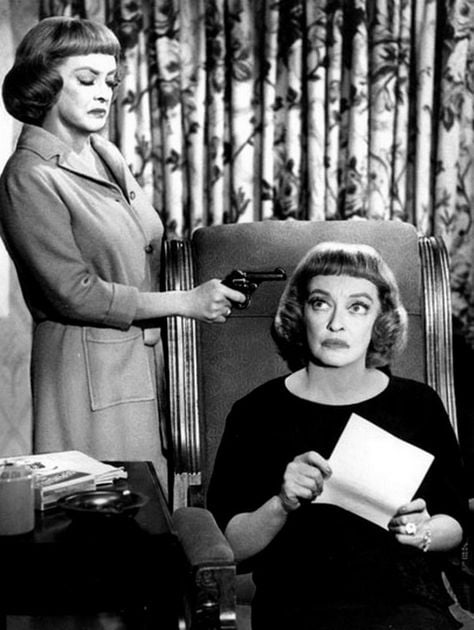
For the second time in her career, Bette Davis gets a chance to play an evil twin in “Dead Ringer” (1964). The first was in the 1946 good twin-bad twin melodrama, “A Stolen Life.” When asked what the difference was between the two performances, Davis quipped, “About 20 years.” “Dead Ringer” was directed by her longtime friend and “Now, Voyager” co-star Paul Henreid. The music is by André Previn, whose score employs a stock-in-trade sinister harpsichord, yet when he comes to write the love theme, he manages to whip up one hell of a tribute to Erich Wolfgang Korngold.
Korngold scored a number of Davis’ films in the 1940s, though he is principally remembered for his work on the swashbucklers of Errol Flynn. To capitalize on Flynn’s star-making performance in “Captain Blood,” Warner Brothers produced a big screen adaptation of Mark Twain’s Tudor switcheroo, “The Prince and the Pauper” (1937). Flynn steals the show as Miles Hendon, the devil-may-care guardian of Prince Edward and Tom Canty, Edward’s mirror image, played by real-life twins Bobby and Billy Mauch. If you’re a Korngold fan, or an enthusiast of violin concertos, you may recognize some of the music. Korngold recycled the theme for use in the last movement of his Violin Concerto, championed by Heifetz and others.
Double your pleasure with an hour of doppelgangers, twins, and dual identities, on “Picture Perfect,” music for the movies, now in syndication on KWAX Classical Oregon!
——–
Clip and save the start times for all three of my recorded shows:
PICTURE PERFECT, the movie music show – Friday at 8:00 PM EST/5:00 PM PST
SWEETNESS AND LIGHT, the light music program – Saturday at 11:00 AM EST/8:00 AM PST
THE LOST CHORD, unusual and neglected rep – Saturday at 7:00 PM EST/4:00 PM PST
Stream them, wherever you are, at the link!
https://kwax.uoregon.edu
Tag Cloud
Aaron Copland (94) Beethoven (95) Composer (114) Film Music (148) Film Score (143) Film Scores (255) Halloween (97) John Williams (196) KWAX (232) Leonard Bernstein (105) Marlboro Music Festival (125) Movie Music (163) Mozart (91) Opera (215) Philadelphia Orchestra (90) Picture Perfect (174) Princeton Symphony Orchestra (110) Radio (90) Ross Amico (244) Roy's Tie-Dye Sci-Fi Corner (290) The Classical Network (101) The Lost Chord (269) Vaughan Williams (107) WPRB (397) WWFM (881)