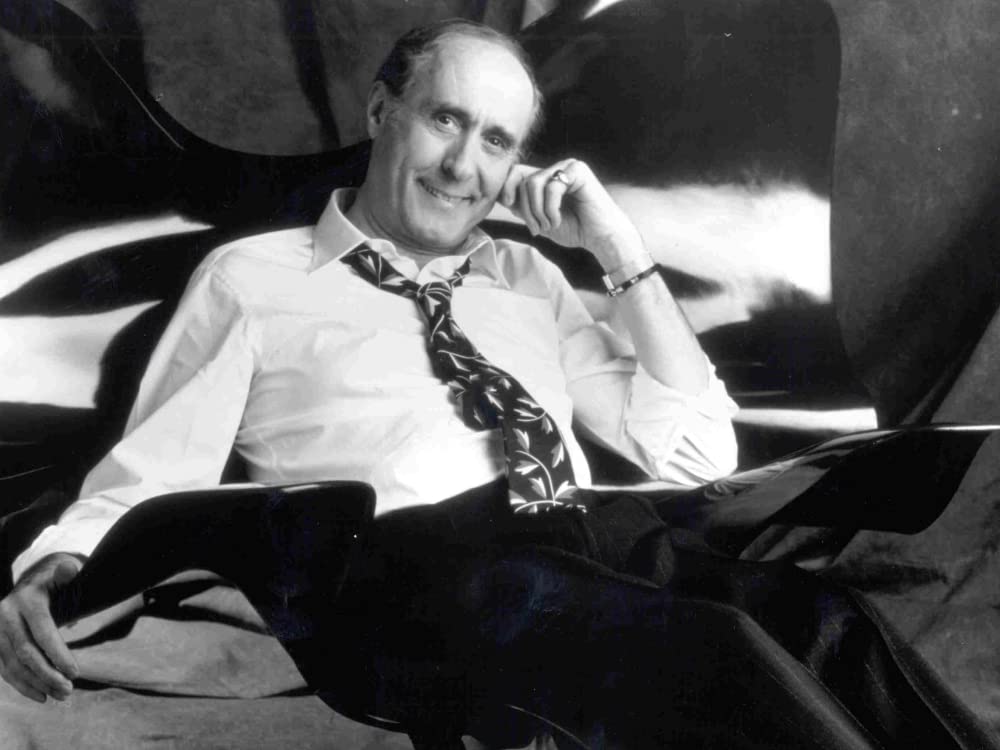
The recipient of 4 Academy Awards, 20 Grammy Awards, 1 Golden Globe, and a posthumous Grammy for Lifetime Achievement. His arrangement of Nino Rota’s love theme from “Romeo and Juliet” spent two weeks at the top of the rock-dominated Billboard charts in 1969.
One of the most important composers of the second half of the 20th century has died.
In 1960, Polish master Krzysztof Penderecki rode an atomic blast that leveled Soviet-sanctioned socialist realism in music and propelled him into the forefront of the avant-garde. “Threnody for the Victims of Hiroshima” became an international sensation.
A follow-up, “Polymorphia,” for 48 violins, was creepy enough that it was selected by director William Friedkin for inclusion in the soundtrack to “The Exorcist.” For both works, Penderecki abandoned traditional notation and invented his own system of graphic notation inspired by electroencephalograms. Dense clusters, microtones and glissandi prevail.
Over the decades, filmmakers have been drawn to Penderecki’s early concert works to enhance their own eerie, anxious, and otherworldly visions. His music was used in “The Shining,” “Wild at Heart,” “Twin Peaks,” and “Shutter Island.” He provided an original score for the cult classic “The Saragasso Manuscript” (1965), based on a trippy 1815 picaresque, in itself way ahead of its time, by Jan Potocki. It’s said that “The Saragasso Manuscript” was Jerry Garcia’s favorite movie.
In the 1970s, Penderecki, while still employing avant-garde techniques, began to explore more recognizable harmonic relations, and by 1980, he leveled off into a more widely approachable style. He felt the avant-garde had tumbled too far down the formalistic rabbit hole. The pendulum had swung too wide; the solution had become the problem. It had served its purpose as a big “eff you” to Soviet authoritarianism, but now he was ready to settle down and write music.
He abandoned the undeniably striking stunt compositional style of his youth – on which his fame principally rests – and in the works of his maturity everything is laid bare. There is not much in his later music to frighten the horses, but prolonged exposure might make them a little gloomy.
Critics began to offer comparisons to the works of Dmitri Shostakovich. Penderecki was seldom ingratiating – I am hard-pressed to think of a sunny Penderecki piece – but he was always a master of his craft.
He composed four operas, eight symphonies, concertos, chamber and solo instrumental music, and choral settings of mainly religious texts. His “St. Luke Passion” made a big impression in Rome, though he himself attended a minority Armenian church.
Penderecki was 86 years-old.
The first time I encountered “Threnody for the Victims of Hiroshima” (1960), it was like nothing I had ever heard before. This is not comforting music, but it is unforgettable.
“Polymorphia” (1961), with score in graphic notation:
“St. Luke Passion” (1966):
Symphony No. 3 (1988-95), Penderecki embraces the Romantic tradition:
“Resurrection” Concerto (2002), written in response to the terrorist attacks of 9/11:
Though he was born in the Dutch East Indies, to Dutch parents, Schurmann was raised in England. Following service in the RAF during WWII, he combined a career as a concert pianist with work as acting Cultural Attaché at the Netherlands Embassy in London. It was Eduard van Beinem, music director of the Concertgebouw Orchestra, who helped him attain a position as conductor at the Dutch Radio. Later, Schurmann returned to England to devote himself to composition.
In 1980, he was invited by the State Department to tour orchestras and universities in the United States. He moved here the following year, when he settled in Hollywood Hills. His concert music was championed by Lorin Maazel and Edo de Waart, among others. He also composed his share of music for film, including that for a personal favorite from my childhood, Walt Disney’s “Dr. Syn, Alias the Scarecrow” (a.k.a. “The Scarecrow of Romney Marsh”), starring Patrick McGoohan.
Schurmann provided orchestrations for the Academy Award winning scores to “Lawrence of Arabia” and “Exodus.” He was 96 years-old.
“Leotaurus” (Variations for Piano):
“Dr. Syn”:
“Romancing the Strings,” including a pre-concert chat with the composer:
Today is the 100th birthday of Academy Award winning composer John Addison.
Addison was awarded his statuette for “Tom Jones” in 1964. The score is a brilliant admixture of unusual instrumentation (harpsichord, well-worn upright, banjo, accordion) and music hall brio.
Addison also provided the memorable music for “Sleuth.”
And, for television, “Murder She Wrote.”
Addison was the composer to whom Alfred Hitchcock turned, notoriously, after his falling out with Bernard Herrmann over the scoring of “Torn Curtain.” The studio was pressuring Hitch for a more “popular” sound. Ironically, Addison just wound up trying to conjure Herrmann – as did every one of Hitch’s collaborators thereafter.
Addison also provided music for “The Entertainer,” “A Taste of Honey,” “The Loneliness of a Long Distance Runner,” “Start the Revolution Without Me,” “Luther,” “The Seven-Per-Cent Solution,” “A Bridge Too Far,” and the television miniseries “Centennial.”
A student of Gordon Jacob at the Royal College of Music in London, he wrote a number of concert works, though he remarked, “If you find you’re good at something, as I was as a film composer, it’s stupid to do anything else.”
Here is Addison’s Trumpet Concerto:
Over a half century before Warren Beauty and Faye Dunaway got caught up in the infamous “La La Land” snafu, Sammy Davis Jr. was bitten by “Tom Jones”: