Tag: Film Score

  • Ernest Gold: Exodus Oscar Winner

    Ernest Gold: Exodus Oscar Winner

    While Ernest Gold embarked on his career as a composer of symphonies, his heart was always in the world of Max Steiner. Gold was born Ernst Sigmund Goldner, in Vienna, 100 years ago today.

    If you missed my tribute to Gold Sunday night on “The Lost Chord,” on WWFM – The Classical Network, the show is now posted as a webcast. On the program is his String Quartet No. 1, his song cycle “Songs of Love and Parting,” and two of his most famous film themes – those for “Exodus” and “It’s a Mad, Mad, Mad, Mad World.” The songs are performed by Gold’s wife of 19 years, Marni Nixon, the soprano who “ghost voiced” for a number of the musicals’ leading ladies, in films like “The King and I,” “My Fair Lady,” and “West Side Story.”

    https://www.wwfm.org/post/lost-chord-july-11-unalloyed-gold

    As an addendum, it’s only within the last year or so that I discovered Gold’s Piano Concerto, written when he was 17 years-old. The recording appeared on a CD with George Antheil’s music for the film “Dementia.” Gold worked as an orchestrator on a number of Antheil’s films. When Antheil fell ill and was unable to follow through on a commitment to score “On the Beach,” Gold stepped up. The music earned Gold an Academy Award nomination and a Golden Globe.

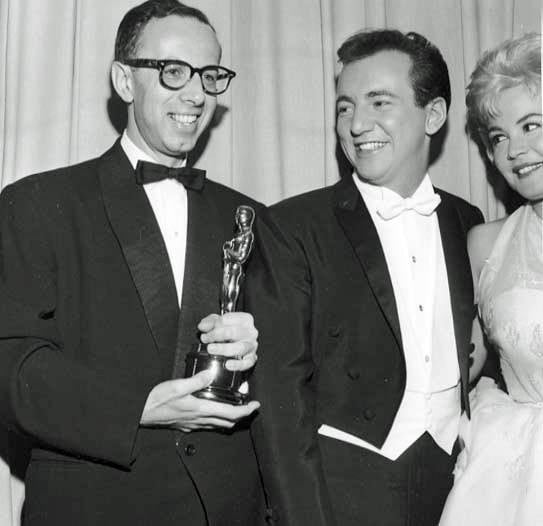
    In all, Gold would be nominated by the Academy four times. He was recognized with an Oscar for his powerful contribution to “Exodus” in 1960. Here’s another nice Gold tribute:

    Eddie Harris riffs on “Exodus”:

    Not really my cup of tea, but “Fight for Survival” from “Exodus” was sampled (a string passage, reversed) by Moby, great-great-great nephew of Herman Melville (!), for his song “Porcelain.”

    All that glitters is Gold. Happy birthday, Ernest Gold!


    PHOTO: With Bobby Darin, Sandra Dee, and his “Exodus” Oscar
  • Miklós Rózsa Centennial Celebration

    Miklós Rózsa Centennial Celebration

    Today is the birthday of the great Miklós Rózsa (1907-1995).

    Rózsa receives his third Academy Award, from the hand of Gene Kelly. (BONUS: André Previn wins for his work on “Porgy and Bess.”)

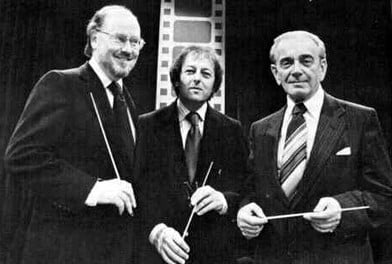
    Later, Rózsa conducted a suite from his most celebrated film score on the PBS series “Previn & the Pittsburgh.”

    Previn interviews Rózsa, in the presence of John Williams. (Fun anecdote about Bernard Herrmann and slight regard for Herbert Stothart.)

    Happy birthday, Miklós Rózsa!


    PHOTO (right to left): Rózsa, Previn, and Williams in 1979

  • Remembering Ennio Morricone Maestro Forever

    Remembering Ennio Morricone Maestro Forever

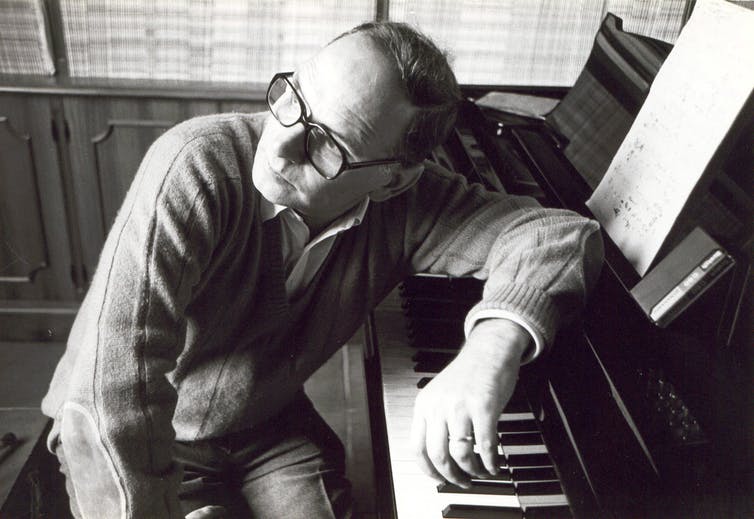
    This is the first Ennio Morricone birthday we celebrate without the Maestro. Morricone died in July at the age of 91. The untouchable who touched us all. Mi manchi, Morricone.

  • Sir Malcolm Arnold: Genius & Demons

    Sir Malcolm Arnold: Genius & Demons

    “…[T]hou was a skellum,
    A blethering, blustering, drunken blellum;
    That frae November till October,
    Ae market-dae thou was na sober.”

    Rabbie Burns wrote those lines of Tam O’Shanter. But they could just as well have applied to Sir Malcolm Arnold. Both men were, more or less, fond of the bottle and also driven by demons.

    Arnold was born on this date in 1921. He started out as a trumpeter with the London Philharmonic Orchestra. He became its principal in 1943.

    During World War II, Arnold registered as a conscientious objector. However, following the death of his brother, a pilot in the RAF, he decided to enlist. At least for a time. Though he never saw action beyond a military band, he quite literally shot himself in the foot in order to get back to civilian life.

    In 1948, he retired from orchestral playing to devote himself exclusively to composition. He had an attractive melodic gift, which served him well in the writing of light music and film scores. He won an Academy Award in 1957 for his work on “The Bridge on the River Kwai.”

    However, Arnold also had his dark side, as can be detected in passages of his symphonies. He was frequently cantankerous, often inebriated, and also highly promiscuous. He tried to kill himself at least twice. He was treated for depression and alcoholism, overcoming both, but then in the early 1980s he was given only a year to live. In the event, he actually lasted another 22, during which he completed his Symphony No. 9, among other works.

    Arnold died in 2006, one month shy of his 85th birthday. He was a brilliant composer, of great facility. After Malcolm Williamson was named Master of the Queen’s Music in 1975, Sir William Walton remarked that they had given the job to the “wrong Malcolm.” For a man with so many personal demons, he wrote reams of perfectly delightful music.

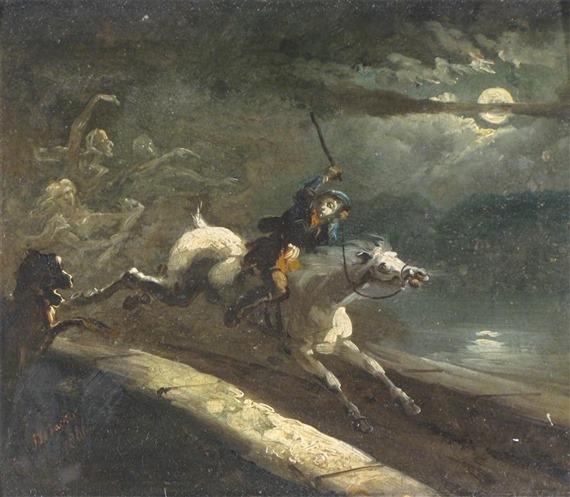
    A good example, and one of my favorite Halloween pieces, is the descriptive overture “Tam O’Shanter” (1955), in which Burns’ antihero tarries at a pub, in defiance of his wife, then staggers out into the night. Under ominous skies, he detects the sound of bagpipes emanating from the ruins of an old church. Pressing his face to chink he espies “Auld Nick,” the Devil himself, “in shape o’ beast,” presiding over a coven of high-stepping witches and warlocks. When a particularly comely witch catches Tam’s eye, he, in his drunkenness, roars, “Weel done, Cutty-sark!” (in reference to her short skirt). This brings the forces of darkness down up him, and there is a hell-for-leather sprint by horseback for a nearby river, since spirits are said not be able to cross running water.

    If you’re interested in the rest, you can read for yourself here:
    http://loki.stockton.edu/~kinsellt/litresources/ayr/tam.html

    Then listen to Arnold’s musical response:

    And for a bonus, enjoy his “Four Scottish Dances” (1957):

    Happy birthday, Sir Malcolm Arnold, you tormented genius.


    “Tam O’Shanter Fleeing the Witches” (1866), by John Joseph Barker

  • English Documentary Music Vaughan Williams Britten

    English Documentary Music Vaughan Williams Britten

    What has often been regarded in the United States as “hack work,” in England has been accepted as just another aspect of what it means to be a working artist. There is no disgrace in a composer earning a living, and some of the nation’s greatest musicians – including those in the employ of the Royal Family – have contributed finely-crafted scores to its body of cinema.

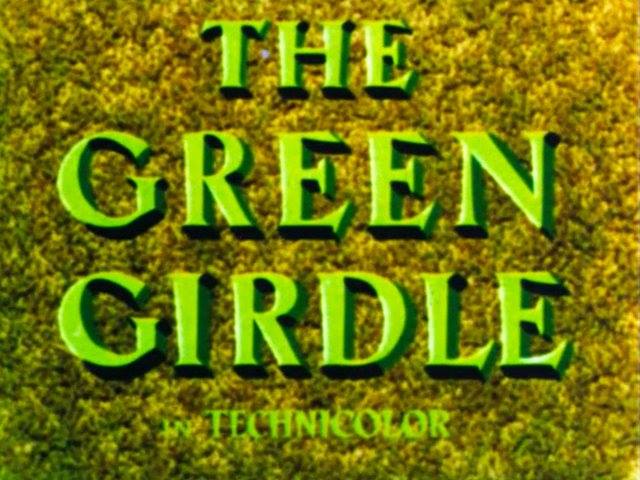
    This week on “Picture Perfect,” it’s an hour of English documentary music. We’ll hear selections by Ralph Vaughan Williams, from “The People’s Land” (1941), Benjamin Britten, from “The King’s Stamp” (1935), William Alwyn, from “The Green Girdle” (1941), and Sir Arthur Bliss, from “The Royal Palaces of Britain” (1966). All four films are patriotic utterances on distinctly English themes.

    You may not have seen any of these shorts, but the music is beautiful. I hope you’ll join me for music from English documentaries, this Saturday evening at 6:00 EDT, on WWFM – The Classical Network and wwfm.org.


    In the meantime, if you’re having a slow afternoon, why not get a taste of the films themselves?

    “The People’s Land,” score by Vaughan Williams:

    https://film.britishcouncil.org/resources/film-archive/the-peoples-land

    “The King’s Stamp,” score by Benjamin Britten:

    “The Green Girdle,” score by William Alwyn:


    PHOTO: It’s not about what you think

Tag Cloud

Aaron Copland (92) Beethoven (95) Composer (114) Film Music (123) Film Score (143) Film Scores (255) Halloween (94) John Williams (187) KWAX (229) Leonard Bernstein (101) Marlboro Music Festival (125) Movie Music (138) Opera (202) Philadelphia Orchestra (89) Picture Perfect (174) Princeton Symphony Orchestra (106) Radio (87) Ralph Vaughan Williams (85) Ross Amico (244) Roy's Tie-Dye Sci-Fi Corner (290) The Classical Network (101) The Lost Chord (268) Vaughan Williams (103) WPRB (396) WWFM (881)

DON’T MISS A BEAT

Receive a weekly digest every Sunday at noon by signing up here


RECENT POSTS