Today is the 120th anniversary of the birth of Sir William Walton. Walton is perhaps best remembered for his coronation marches and film scores, but he also wrote operas, symphonies, concertos, chamber music, and choral works.
Sadly, these days, we don’t seem to encounter these much in concert anymore, at least in the U.S., which is a great pity, since Walton was an impeccable craftsman and his music often quite inspirational.
Be that as it may, his influence has been felt by just about anyone who’s ever gone to the movies since 1977. That’s the year John Williams married Walton’s heroic sound to George Lucas’ vision of a long time ago, in a galaxy far, far away.
Walton’s concert music may have fallen out of fashion, but Williams would have never become the household name he has without having assimilated his marches, harmonies, and orchestrations. When André Previn first heard Williams conduct his music to “Star Wars,” he could hardly contain his glee, exclaiming, “Why, it’s Willie Walton!”
Hear for yourself…
“Star Wars” throne room – from the one-minute mark, pure Walton:
What Walton cooked up for the Queen in 1953 – there’s a proto-“Star Wars” moment about two minutes in, but do listen to the whole thing:
This is what he composed for her dad in 1937:
For Olivier’s film of “Richard III”
“Belshazzar’s Feast”: “Praise Ye!”
“Belshazzar’s Feast”: “Alleluia”
In 1966, Previn himself laid down what is considered the benchmark recording of Walton’s Symphony No. 1. It’s possible he managed to surpass it with this explosive performance with the London Symphony Orchestra in 1970:
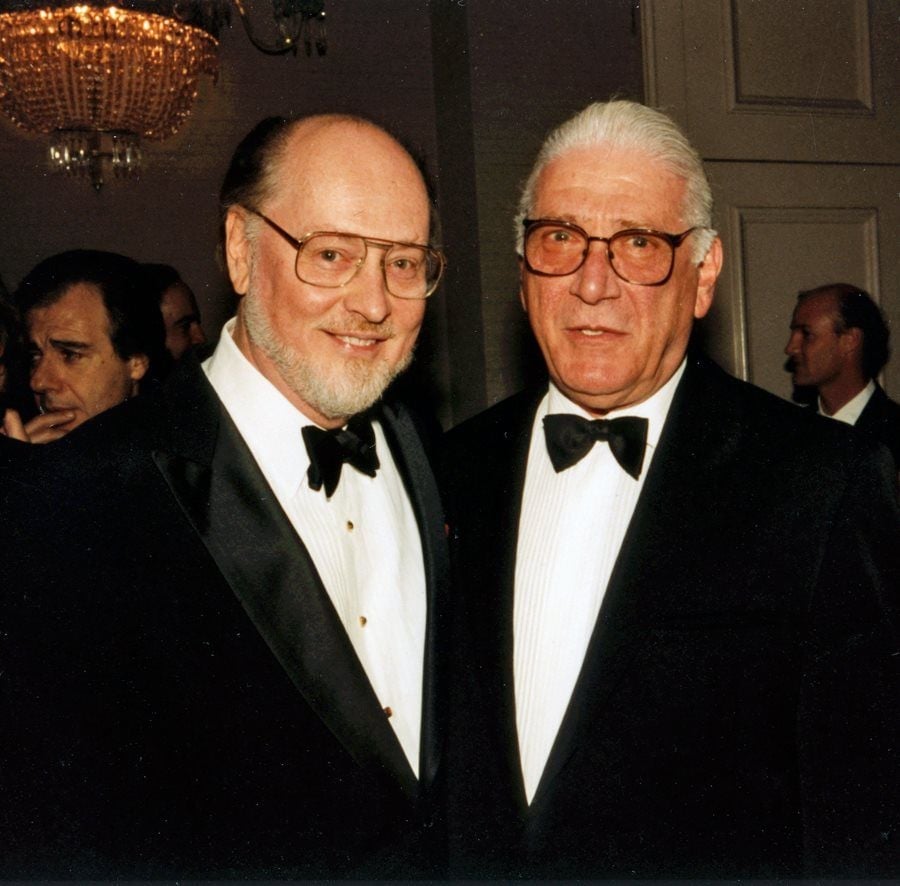
If you are a fan of either John Williams or Jerry Goldsmith, you will be transfixed by this virtual conversation, documented in 2021, but reposted this week by The Legacy of John Williams. It’s one of those rare instances where I thought I’d sample some of it with the idea of watching the rest later, and before I knew it, I wound up watching the whole blessed two hours!
Participants include names familiar to film score fanatics – writer Jeff Bond, producer Mike Matessino, and engineer Bruce Botnick, composer David Newman (who played violin on a number of Williams and Goldsmith scores of the late ‘70s and early ‘80s), studio pianist Mike Lang (who worked with Williams, Goldsmith, and Henry Mancini), and conductor Leonard Slatkin (who grew up in Hollywood and later conducted Williams’ film and concert works, as well as Goldsmith’s “Music for Orchestra”).
The geekier you are about film music, the more you will love this. Lots of behind-the-scenes reminiscences and entertaining anecdotes about the artists and the industry. Enjoy!
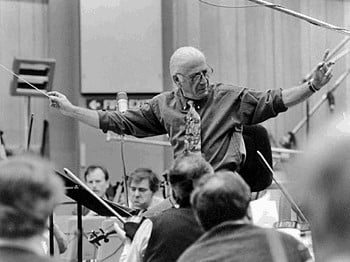
After “Jaws” and “Star Wars,” John Williams became everyone’s first choice. Too often, Jerry Goldsmith was left with the dregs.
But the man was a professional, a true work horse, who also had a rare talent for speed. He wrote the replacement score for “Chinatown” in ten days. When Randy Newman was dropped from “Air Force One,” again he saved the day, writing and recording the music in less than two weeks.
Unfortunately, not every film was “Chinatown.” For every “Planet of the Apes,” “Patton,” and “Papillon,” there was “The Mummy” (with Brendan Fraser), “The Haunting” (remake), and “Looney Tunes: Back in Action.”
Williams got “Superman.” Goldsmith got “Supergirl.” Williams got “Raiders of the Lost Ark.” Goldsmith got “King Solomon’s Mines” (with Richard Chamberlain). Williams got “E.T. The Extra-Terrestrial.” Goldsmith got “Baby: The Secret of the Lost Legend.”
But even when the movies were terrible, Goldsmith’s music was like a consolation prize. And nothing can take away the classics. He was one of the last of the greats, and he lived through a great era, so we certainly have enough to cherish. He just had the bad fortune to have more stamina than the movies themselves, which got weaker and weaker and weaker.
The composer himself expressed frustration at his music being drowned out by ever more-elaborate sound effects, which is why his scores tended to become more streamlined – and less memorable – in the ‘90s. He would have lost his mind in these days of laptop editing, when movies can be trimmed and shuffled within an inch of their lives, right up until the day of distribution.
For television, he wrote music for “Dr. Kildare,” “The Twilight Zone,” “Gunsmoke,” “The Man from U.N.C.L.E.,” “The Waltons,” and “Barnaby Jones.” He was the recipient of five Emmy Awards.
Incredibly, despite EIGHTEEN nominations, he was honored with but a single Oscar, for his influential score to “The Omen” (1976). Goldsmith died in 2004, at the age of 75. If he were to come back today, he would mop the joint with all the Hans Zimmer knockoffs.
To honor Goldsmith, and as kind of a belated tribute to special effects artist Douglas Trumbull, who died earlier this week, let’s take a look at the show-stopping drydock sequence from “Star Trek: The Motion Picture” (1979).
In a tight spot in post-production when the effects work was proving to be lackluster, director Robert Wise reached out to and implored Trumbull to work his magic. Trumbull was already a legend in the field, having worked on “2001: A Space Odyssey,” “Silent Running,” and “Close Encounters of the Third Kind.”
“Star Trek” would require more composites than “Star Wars” and “Close Encounters” combined. Paramount Pictures was over a barrel, with an impending deadline that would result in a mega-lawsuit from exhibitors if it didn’t deliver.
Trumbull accepted the challenge, but he drove a hard bargain. In exchange for his services, he leveraged a considerable fee, release from his Paramount contract, and ownership of the technology he developed for “Brainstorm,” his dream project, long languishing in development hell, so that he could shop it around to other studios. Without flinching, Paramount blurted “Yes!” Trumbull assembled his crew, divided them into three teams, and they worked seven days a week, 24 hours a day, for the next seven months, to bring the picture in on time.
Say what you want about the movie, but the effects and the music are unimpeachable – especially this sequence, which Trumbull directed himself – a perfect marriage of music and visuals of a kind you will not find in movies today. This is how it’s done, kids.
As a post-script, we’ll be celebrating the legacy of Douglas Trumbull on the next Roy’s Tie-Dye Sci-Fi Corner. Because Roy will be participating in a live theater event with Country Gate Players this Saturday (“Radio Noir Murders” at 6 pm at Belvidere Manor in Belvidere, NJ), we’ll be taking the week off from our movie-fueled digressions. But we’ll be back at the base of Devil’s Tower, watching for your Kodály hand signals in the comments section, when we livestream on Facebook, NEXT Friday evening, February 18, at 7:30 EDT!
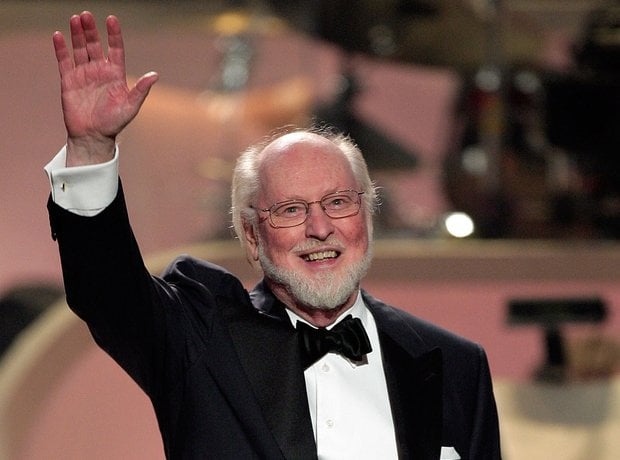
His music introduced me to the glories of the symphony orchestra and changed my life forever. The world’s greatest living film composer is 90. Happy birthday, John Williams!
One need only listen to this fan compilation of Williams’ contrapuntal writing, including some unexpected choices, to understand that there really is no one else in the field today who can touch him. You certainly won’t hear anything like it from the Zimmer school.
This one still gives me chills 43+ years later!
Williams and Steven Spielberg discuss music from the piano bench:
Good exchange with Tavis Smiley (especially toward the end):
Perhaps Williams’ best interview, an unusually candid conversation with André Previn:
Williams is the recipient of five Academy Awards, 25 Grammy Awards, and four Golden Globe Awards. He’s been nominated for an Oscar 52 times, more than any other living person, and second only to Walt Disney.
So what’s he up to now? Although he suggested he would be retiring with “Star Wars: The Rise of Skywalker,” he’s been conducting concerts all over place, with Anne-Sophie Mutter the soloist in his new Violin Concerto. He’s also scoring Spielberg’s “The Fabelmans” – their 29th collaboration – and prepping for the fifth Indiana Jones adventure, out next year.
Over the coming month or so, I’ll be including some Williams selections in my “Picture Perfect” programming. Tune in this week to enjoy a suite from “Jane Eyre” (1970), as part of hour of Gothic romances for Valentine’s Day, and next week for music from “JFK” (1991), “Nixon” (1995), “Amistad” (1997), and “Lincoln” (2012) for Presidents Day Weekend. More to come. “Picture Perfect” can be heard Saturday evenings at 6:00 EST on WWFM – The Classical Network and wwfm.org.
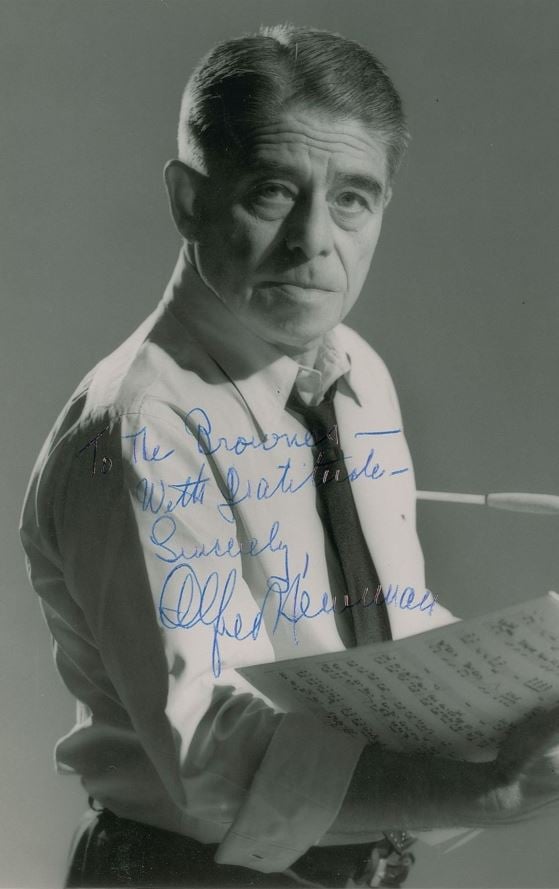
This week on “Picture Perfect,” experience the Power of Alfred Newman – TYRONE Power, that is. It’s all music from Power swashbucklers made at 20th Century Fox, where Newman served as music director for 20 years.
“Captain from Castile” (1947) was one of Power’s most opulent vehicles. Based on the novel by Samuel Shellabarger, the film relates Pedro de Vargas’ escape from persecution at the hands of the Inquisition and his accompaniment of Hernán Cortéz in the conquest of Mexico. Also starring Jean Peters and Cesar Romero (as Cortéz), the film capitalizes on the happenstance of a real-life erupting volcano. The climactic march, known as “Conquest,” went on to become one of Newman’s greatest hits. It’s entered the marching band repertoire and has been recorded many times.
“The Black Swan” (1942) costars Maureen O’Hara and Laird Cregar (as Henry Morgan). Also, if you ever wanted to see George Sanders in a red beard, then this is the movie for you. This time the source material is a novel by Rafael Sabatini, who also created “Captain Blood,” “The Sea Hawk,” and “Scaramouche.”
Of course, it was “The Mark of Zorro” (1940) that solidified Power’s reputation as 20th Century Fox’s resident swashbuckler. In its own way, the remake manages to match the delights of Douglas Fairbanks’ 1920 original, which was one of the silent era’s most thrilling adventures.
Finally, it’s back to Shellabarger for “Prince of Foxes” (1949). This time, the setting is the Italian Renaissance. Orson Welles is Cesare Borgia, with an oddly cast Everett Sloane playing an assassin. Sloane was a veteran of Welles’ Mercury Theatre. You may remember him as Mr. Bernstein from “Citizen Kane,” or perhaps from the famous funhouse finale from “The Lady from Shanghai.”
It’s interesting that all of the films represented this week were inspired by books. (Zorro was introduced in “The Curse of Capistrano” by Johnston McCully.) It was another day, as they say.
I hope you’ll join me for music by Alfred Newman, written for the swashbucklers of Tyrone Power, on “Picture Perfect,” music for the movies, this Saturday evening at 6:00 EST, on WWFM – The Classical Network and wwfm.org.
A fun reminiscence of Newman (“the best conductor who ever picked up a baton in Hollywood”) by composer David Raksin: